Brazil Ballast Water Treatment Market Size, Share & Growth Rate
The Brazil Ballast Water Treatment Market was estimated at USD 435 Million in 2025 and is projected to reach USD 522 Million by 2032, growing at a CAGR of 2.6% from 2026 to 2032. This growth trajectory is supported by increasing maritime transportation activities, stringent environmental regulations aimed at protecting Brazil's rich biodiversity, and heightened awareness of the ecological impact associated with ballast water discharge. The demand for effective ballast water treatment systems continues to rise, driven by the need to comply with international standards and preserve marine ecosystems.
Brazil Ballast Water Treatment Market Year-wise Growth Rate and Key Drivers
This graph highlights how the Brazil Ballast Water Treatment Market has steadily grown over the years, supported by major growth factors.
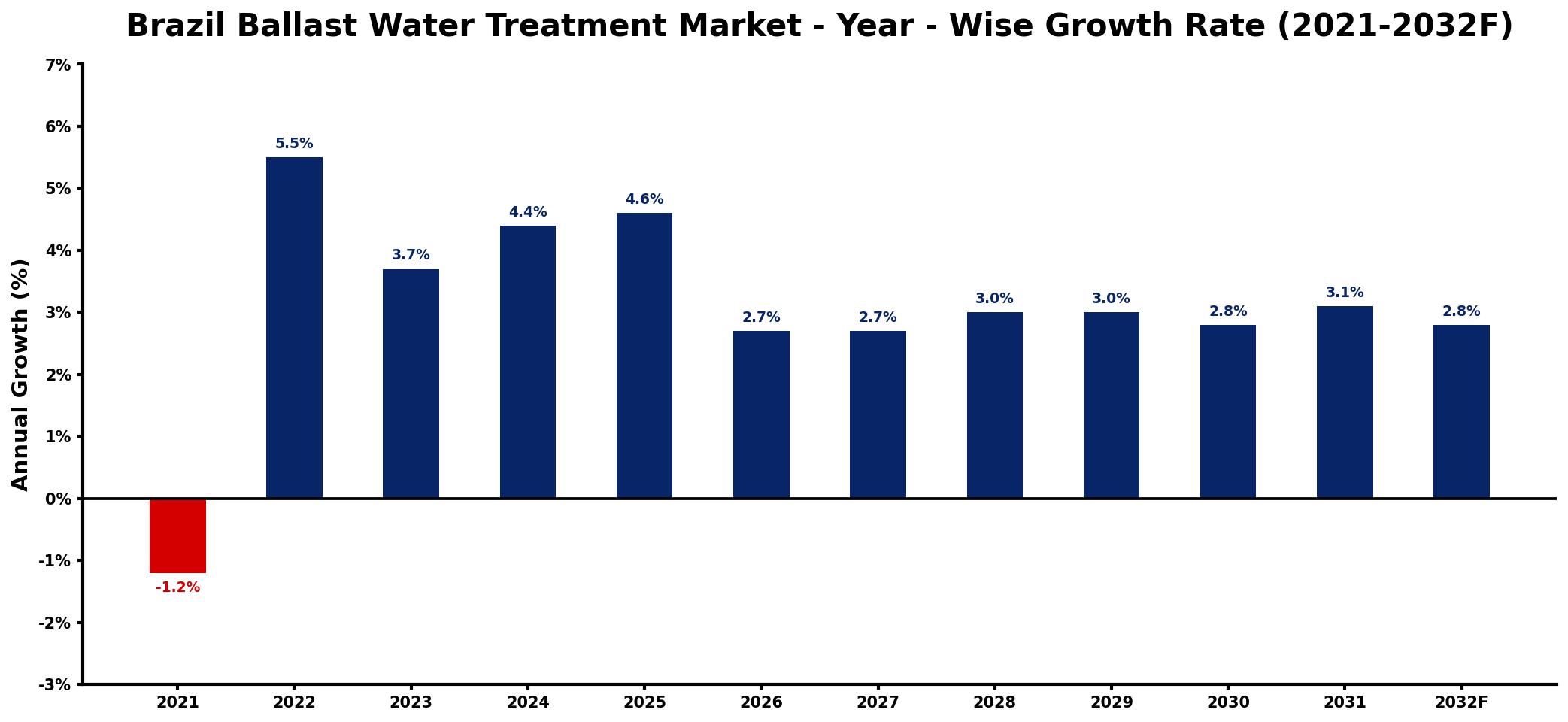
The table below presents the year‑wise growth rates along with the key drivers influencing the market
| Year | Growth Rate | Major Drivers |
| 2021 | -1.2% | Decreased maritime regulations enforcement |
| 2022 | 5.5% | Rising environmental compliance requirements |
| 2023 | 3.7% | Increased shipping industry investments |
| 2024 | 4.4% | Expansion of global trade networks |
| 2025 | 4.6% | Technological advancements in compliance |
| 2026 | 2.7% | Growing demand for eco-friendly solutions |
| 2027 | 2.7% | Enhanced focus on sustainability initiatives |
| 2028 | 3.0% | Increased awareness of pollution impacts |
| 2029 | 3.0% | Strengthened international regulatory frameworks |
| 2030 | 2.8% | Rising consumer demand for sustainability |
| 2031 | 3.1% | Growth in marine biodiversity projects |
| 2032 | 2.8% | Emerging markets adopting compliance standards |
Note: Market size estimations and growth projections presented in this report are based on 6Wresearch's proprietary forecasting methodology, utilizing the latest available industry data, government publications, and primary research inputs.
Brazil Ballast Water Treatment Market Synopsis
The Brazil Ballast Water Treatment Market is witnessing a pivotal moment characterized by a growing emphasis on environmental sustainability. With Brazil's vast coastline and numerous ports, the urgency to manage ballast water effectively has intensified, pushing ship operators to seek compliant treatment solutions. Technological advancements are paving the way for more efficient systems that not only meet regulatory standards but also minimize operational costs.
Recent trends indicate a shift towards integrated systems that combine multiple treatment technologies, enhancing the effectiveness of ballast water management. As the industry faces scrutiny over environmental impacts, the adoption of innovative solutions is essential for protecting Brazil's unique aquatic ecosystems while supporting the maritime sector's growth.
Brazil Ballast Water Treatment Market Key Takeaways
- The market is projected to grow from USD 435 Million in 2025 to USD 522 Million by 2032, at a CAGR of 2.6%.
- Increased maritime activities are driving demand for efficient ballast water treatment systems in Brazil.
- Technological innovations are leading to more effective and cost-efficient treatment solutions.
- Regulatory compliance remains a key motivator for investment in ballast water management technologies.
- The focus on environmental protection is leading to collaborative efforts among maritime organizations to promote best practices.
Evaluation of Restraints in Brazil Ballast Water Treatment Market
Despite its growth potential, the Brazil Ballast Water Treatment Market encounters several obstacles that could hinder progress. The regulatory landscape, while aiming to protect marine ecosystems, can pose challenges for shipowners who must navigate complex compliance requirements. Additionally, the technological complexity of some treatment systems may deter adoption, particularly among smaller operators. Cost constraints further complicate the situation, especially in the context of economic uncertainty within the shipping industry. Companies aiming to thrive must prioritize developing cost-effective solutions that align with stringent regulations and ensure broad industry acceptance.
Brazil Ballast Water Treatment Market Trends
The market is increasingly influenced by trends that emphasize innovation and sustainability. A notable trend is the integration of advanced digital technologies, such as IoT and AI, into ballast water treatment systems, enhancing monitoring and operational efficiency. Furthermore, the demand for modular systems that allow flexible installations is on the rise, enabling shipowners to customize solutions according to specific needs. The industry is also seeing a shift towards collaborative approaches, with stakeholders working together to share insights and resources for best practices in ballast water management.
Brazil Ballast Water Treatment Market Opportunities
Opportunities abound in the Brazil Ballast Water Treatment Market, particularly in the realm of technological advancements. The emergence of new treatment methodologies presents an avenue for innovation, while the push for compliance with global standards provides a fertile ground for investment. Companies that focus on developing affordable, efficient, and certified treatment solutions are well-positioned to capture market share. Moreover, partnerships with local maritime organizations can enhance credibility and accelerate the adoption of new technologies.
Government Initiatives in the Brazil Ballast Water Treatment Market
The Brazilian government plays a critical role in shaping the ballast water treatment landscape through regulations and initiatives aimed at promoting sustainable maritime practices. Environmental protection policies are designed to mitigate the ecological impact of shipping activities, leading to stricter compliance mandates for ballast water management. Investments in research and development for innovative treatment technologies are encouraged through various governmental programs. Additionally, public awareness campaigns underscore the importance of preserving Brazil's marine biodiversity, further driving support for effective ballast water treatment systems.
Future Insights of the Brazil Ballast Water Treatment Market
Looking ahead to 2026-2032, the Brazil Ballast Water Treatment Market is poised for steady growth, propelled by increasing regulatory pressures and technological advancements. The transition towards more sophisticated treatment solutions that ensure compliance while optimizing operational efficiency will likely gain momentum. As awareness of environmental issues continues to rise, so too will the demand for innovative practices that protect Brazil's unique aquatic ecosystems. Stakeholders who invest in sustainable technologies and forge strategic partnerships will be best positioned to navigate this evolving landscape successfully.
Brazil Ballast Water Treatment Market Latest Developments (2025 - 2026)
The Brazil Ballast Water Treatment Market is experiencing a wave of recent developments characterized by increased collaboration between government entities and private stakeholders. Initiatives aimed at enhancing regulatory compliance are taking shape, prompting ship operators to invest in advanced treatment solutions. Additionally, pilot projects for new technologies are underway, with preliminary results indicating promising efficacy in managing ballast water. The industry is also witnessing growing interest from international organizations in supporting Brazil's efforts to achieve sustainable shipping practices.
Brazil Ballast Water Treatment Market - Key Attractiveness of the Report
- 10 Years of Market Numbers
- Historical Data Starting from 2022 to 2025
- Base Year: 2025
- Forecast Data until 2032
- Key Performance Indicators Impacting the Market
- Major Upcoming Developments and Projects
Key Highlights of the Report:
- Brazil Ballast Water Treatment Market Outlook
- Market Size of Brazil Ballast Water Treatment Market, 2025
- Forecast of Brazil Ballast Water Treatment Market, 2032
- Historical Data and Forecast of Brazil Ballast Water Treatment Revenues & Volume for the Period 2022-2032F
- Brazil Ballast Water Treatment Market Trend Evolution
- Brazil Ballast Water Treatment Market Drivers and Challenges
- Brazil Ballast Water Treatment Price Trends
- Brazil Ballast Water Treatment Porter's Five Forces
- Brazil Ballast Water Treatment Industry Life Cycle
- Historical Data and Forecast of Brazil Ballast Water Treatment Market Revenues & Volume By Technology for the Period 2022-2032F
- Historical Data and Forecast of Brazil Ballast Water Treatment Market Revenues & Volume By Physical Disinfection for the Period 2022-2032F
- Historical Data and Forecast of Brazil Ballast Water Treatment Market Revenues & Volume By Mechanical Method for the Period 2022-2032F
- Historical Data and Forecast of Brazil Ballast Water Treatment Market Revenues & Volume By Chemical Method for the Period 2022-2032F
- Historical Data and Forecast of Brazil Ballast Water Treatment Market Revenues & Volume By Service for the Period 2022-2032F
- Historical Data and Forecast of Brazil Ballast Water Treatment Market Revenues & Volume By Installation & Calibration for the Period 2022-2032F
- Historical Data and Forecast of Brazil Ballast Water Treatment Market Revenues & Volume By Performance Measurement for the Period 2022-2032F
- Historical Data and Forecast of Brazil Ballast Water Treatment Market Revenues & Volume By Recommissioning for the Period 2022-2032F
- Brazil Ballast Water Treatment Import Export Trade Statistics
- Market Opportunity Assessment By Technology
- Market Opportunity Assessment By Service
- Brazil Ballast Water Treatment Top Companies Market Share
- Brazil Ballast Water Treatment Competitive Benchmarking By Technical and Operational Parameters
- Brazil Ballast Water Treatment Company Profiles
- Brazil Ballast Water Treatment Key Strategic Recommendations






































