Peru Ballast Water Treatment Market Size, Share & Growth Rate
The Peru Ballast Water Treatment Market was estimated at USD 1292 Million in 2025 and is projected to reach USD 1860 Million by 2032, growing at a CAGR of 5.3% from 2026 to 2032. This robust growth trajectory can be attributed to increasing compliance pressures from international regulations, particularly the International Maritime Organization's guidelines, and heightened awareness among shipping companies regarding environmental protection.
Peru Ballast Water Treatment Market Year-wise Growth Rate and Key Drivers
This graph highlights how the Peru Ballast Water Treatment Market has steadily grown over the years, supported by major growth factors.
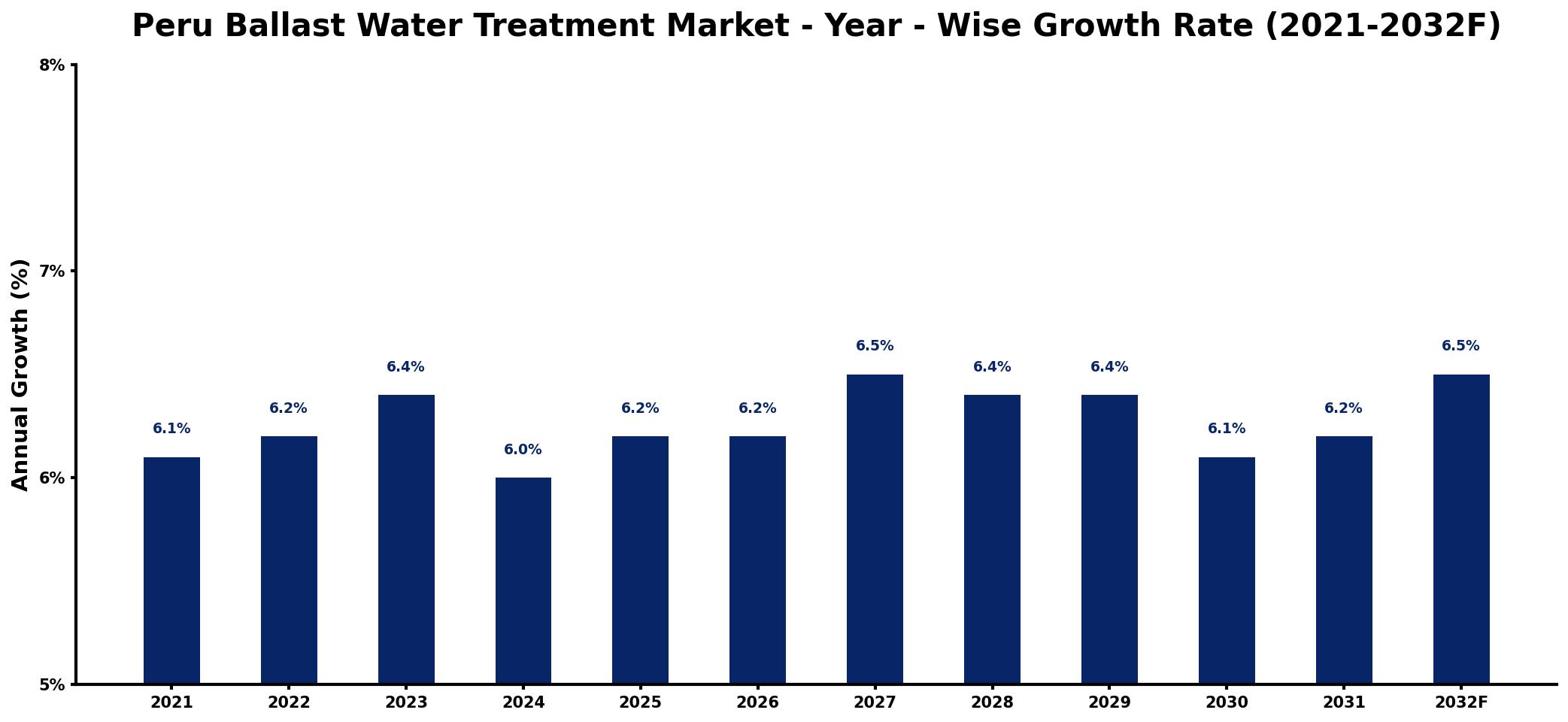
The table below presents the year‑wise growth rates along with the key drivers influencing the market
| Year | Growth Rate | Major Drivers |
| 2021 | 6.1% | Rising environmental regulations driving adoption |
| 2022 | 6.2% | Increased shipping industry compliance requirements |
| 2023 | 6.4% | Growing focus on sustainability practices |
| 2024 | 6.0% | Expansion of international shipping routes |
| 2025 | 6.2% | Investments in marine technology innovation |
| 2026 | 6.2% | Enhanced government incentives for compliance |
| 2027 | 6.5% | growing automotive sector requirements |
| 2028 | 6.4% | Strengthened partnerships between stakeholders |
| 2029 | 6.4% | Emergence of new compliance standards |
| 2030 | 6.1% | Heightened consumer awareness on sustainability |
| 2031 | 6.2% | Technological advancements in marine solutions |
| 2032 | 6.5% | Increased funding for environmental initiatives |
Note: Market size estimations and growth projections presented in this report are based on 6Wresearch's proprietary forecasting methodology, utilizing the latest available industry data, government publications, and primary research inputs.
Peru Ballast Water Treatment Market Synopsis
The strongest force currently shaping the Peru Ballast Water Treatment Market is the stringent regulatory environment aimed at curbing the spread of invasive species through ballast water discharge. As Peru continues to integrate international standards into its maritime practices, the demand for efficient and compliant treatment systems is rapidly increasing.
This market is further influenced by the rising operational costs of non-compliance and an urgent need for innovative solutions. As various industries, including shipping and fisheries, prioritize sustainability, there is an upward trend in investments towards advanced treatment technologies that not only meet regulatory standards but also enhance operational efficiency.
Peru Ballast Water Treatment Market Key Takeaways
- The market is propelled by increased regulatory compliance and environmental awareness.
- Technological advancements are leading to the development of cost-effective and efficient treatment systems.
- Compact and easy-to-install solutions are in high demand to cater to diverse vessel types.
- Collaboration between government bodies and industry players is crucial for effective implementation.
- Investment opportunities abound in R&D for tailored treatment solutions addressing local needs.
Evaluation of Restraints in Peru Ballast Water Treatment Market
Despite its promising outlook, the Peru Ballast Water Treatment Market faces several limitations. One significant restraint is the ambiguity surrounding regulatory frameworks, which can lead to confusion for shipowners and operators about compliance requirements. Moreover, the financial burden associated with procuring and installing sophisticated treatment systems poses challenges, especially for smaller vessels. The scarcity of skilled technicians to maintain these systems further complicates operational compliance, necessitating a coordinated effort among stakeholders to overcome these hurdles.
Peru Ballast Water Treatment Market Trends
The Peru Ballast Water Treatment Market is currently witnessing a trend toward the adoption of eco-friendly and efficient technologies. Innovations like UV disinfection, electrochlorination, and advanced filtration systems are gaining traction, driven by the urgent need for compliance with international standards. Moreover, the focus is shifting toward compact solutions that are easier to install and operate, catering to the varying needs of vessels traversing Peruvian waters. This trend reflects a broader commitment to sustainability within the maritime industry.
Peru Ballast Water Treatment Market Opportunities
Given the regulatory landscape and the growing concern over invasive species, the Peru Ballast Water Treatment Market is ripe for investment opportunities. Companies can explore avenues in developing affordable, state-of-the-art treatment technologies that comply with international standards. Additionally, partnerships with local shipping firms and government agencies can facilitate compliance efforts, providing a lucrative path forward. Investors can also benefit by focusing on R&D efforts that create sustainable solutions, aligning technological advancements with the specific requirements of the Peruvian market.
Government Initiatives in the Peru Ballast Water Treatment Market
The Peruvian government has taken significant steps to regulate ballast water treatment, aiming to protect its marine ecosystems from invasive species. The implementation of the International Maritime Organization's Ballast Water Management Convention is a key policy in this regard. The National Water Authority plays a crucial role in enforcing these regulations, conducting inspections and ensuring compliance through mandatory ballast water management plans and records for vessels. This regulatory framework highlights the government's commitment to safeguarding Perus marine environment.
Future Insights of the Peru Ballast Water Treatment Market
Looking ahead, the Peru Ballast Water Treatment Market is expected to experience steady growth fueled by increased maritime trade and a heightened focus on environmental sustainability. Anticipated advancements in ballast water treatment technologies will enhance system efficiency and compliance, further driving market expansion. As both governmental and industry stakeholders prioritize sustainable practices, the demand for innovative solutions tailored to the unique challenges of Peru's marine environment is poised to increase significantly between 2026 and 2032.
Peru Ballast Water Treatment Market Latest Developments (2025 - 2026)
Recent developments in the Peru Ballast Water Treatment Market indicate a growing trend toward collaboration between technology providers and local shipping companies. Initiatives aimed at fostering knowledge-sharing and capacity-building are underway, helping to address the skills gap in maintaining advanced treatment systems. Moreover, several pilot projects for innovative ballast water treatment technologies are being explored, demonstrating the industrys commitment to compliance and environmental sustainability.
Peru Ballast Water Treatment Market - Key Attractiveness of the Report
- 10 Years of Market Numbers
- Historical Data Starting from 2022 to 2025
- Base Year: 2025
- Forecast Data until 2032
- Key Performance Indicators Impacting the Market
- Major Upcoming Developments and Projects
Key Highlights of the Report:
- Peru Ballast Water Treatment Market Outlook
- Market Size of Peru Ballast Water Treatment Market, 2025
- Forecast of Peru Ballast Water Treatment Market, 2032
- Historical Data and Forecast of Peru Ballast Water Treatment Revenues & Volume for the Period 2022-2032F
- Peru Ballast Water Treatment Market Trend Evolution
- Peru Ballast Water Treatment Market Drivers and Challenges
- Peru Ballast Water Treatment Price Trends
- Peru Ballast Water Treatment Porter's Five Forces
- Peru Ballast Water Treatment Industry Life Cycle
- Historical Data and Forecast of Peru Ballast Water Treatment Market Revenues & Volume By Technology for the Period 2022-2032F
- Historical Data and Forecast of Peru Ballast Water Treatment Market Revenues & Volume By Physical Disinfection for the Period 2022-2032F
- Historical Data and Forecast of Peru Ballast Water Treatment Market Revenues & Volume By Mechanical Method for the Period 2022-2032F
- Historical Data and Forecast of Peru Ballast Water Treatment Market Revenues & Volume By Chemical Method for the Period 2022-2032F
- Historical Data and Forecast of Peru Ballast Water Treatment Market Revenues & Volume By Service for the Period 2022-2032F
- Historical Data and Forecast of Peru Ballast Water Treatment Market Revenues & Volume By Installation & Calibration for the Period 2022-2032F
- Historical Data and Forecast of Peru Ballast Water Treatment Market Revenues & Volume By Performance Measurement for the Period 2022-2032F
- Historical Data and Forecast of Peru Ballast Water Treatment Market Revenues & Volume By Recommissioning for the Period 2022-2032F
- Peru Ballast Water Treatment Import Export Trade Statistics
- Market Opportunity Assessment By Technology
- Market Opportunity Assessment By Service
- Peru Ballast Water Treatment Top Companies Market Share
- Peru Ballast Water Treatment Competitive Benchmarking By Technical and Operational Parameters
- Peru Ballast Water Treatment Company Profiles
- Peru Ballast Water Treatment Key Strategic Recommendations






































