Brazil Barrier Systems Market Size, Share & Growth Rate
The Brazil Barrier Systems Market was estimated at USD 184 Million in 2025 and is projected to reach USD 217 Million by 2032, growing at a CAGR of 2.4% from 2026 to 2032. This growth trajectory is significantly influenced by Brazil's rapid urbanization and extensive road infrastructure projects aimed at enhancing public safety. The increasing focus on efficient traffic management solutions further propels demand for advanced barrier systems tailored for diverse applications across the country.
Brazil Barrier Systems Market Year-wise Growth Rate and Key Drivers
This graph highlights how the Brazil Barrier Systems Market has steadily grown over the years, supported by major growth factors.
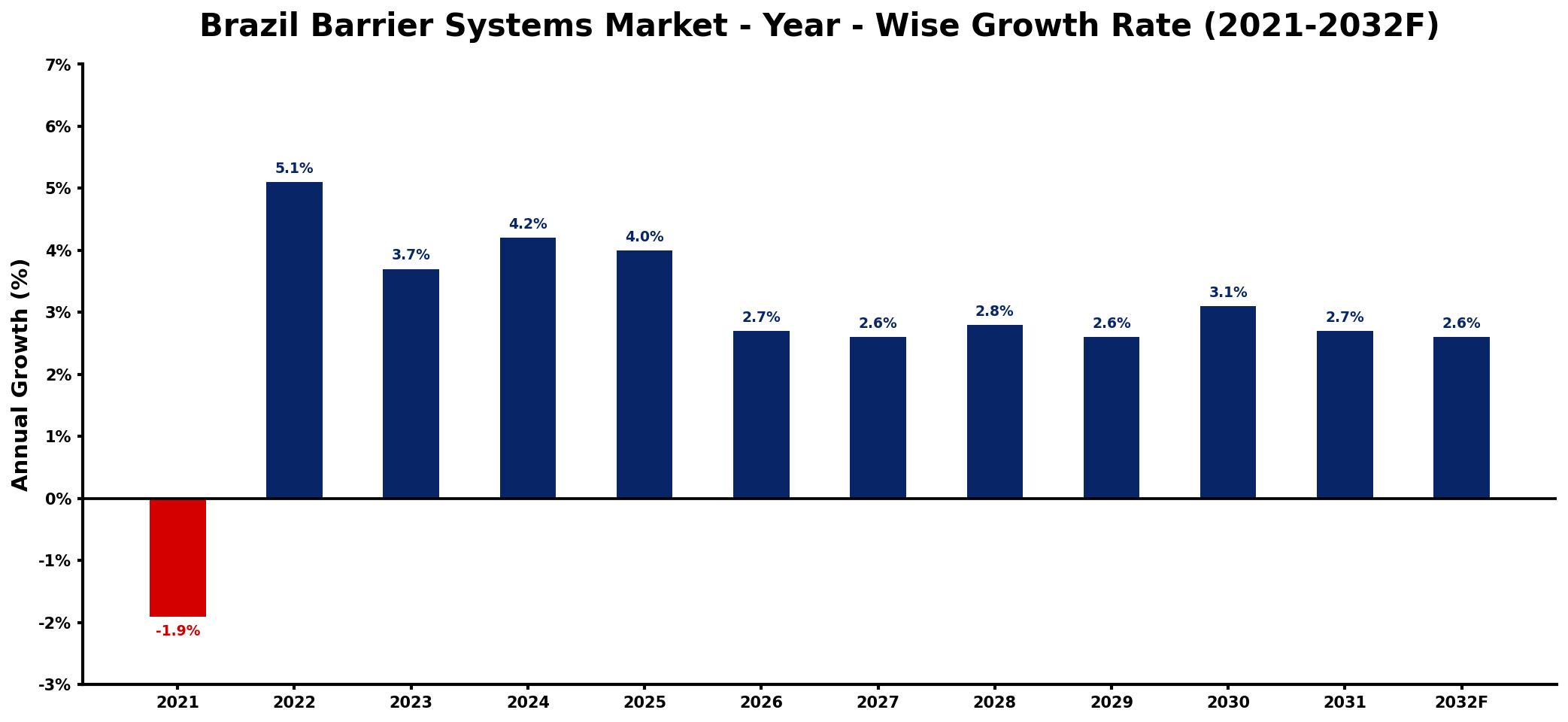
The table below presents the year‑wise growth rates along with the key drivers influencing the market
| Year | Growth Rate | Major Drivers |
| 2021 | -1.9% | Construction sector facing downturn |
| 2022 | 5.1% | Infrastructure investments gaining momentum |
| 2023 | 3.7% | Rising urban development projects |
| 2024 | 4.2% | Government funding for transportation |
| 2025 | 4.0% | Increased focus on safety regulations |
| 2026 | 2.7% | Growing demand for public transport |
| 2027 | 2.6% | Expansion of renewable energy initiatives |
| 2028 | 2.8% | Urbanization driving infrastructure needs |
| 2029 | 2.6% | Technological advancements in construction |
| 2030 | 3.1% | Sustainability trends influencing investments |
| 2031 | 2.7% | growing automotive sector requirements |
| 2032 | 2.6% | Increased urban planning efforts |
Note: Market size estimations and growth projections presented in this report are based on 6Wresearch's proprietary forecasting methodology, utilizing the latest available industry data, government publications, and primary research inputs.
Brazil Barrier Systems Market Synopsis
In recent years, the Brazil Barrier Systems Market has seen a surge in interest, driven by heightened awareness of road safety and the necessity for effective traffic control solutions. However, as the market evolves, stakeholders are recognizing the importance of sustainable materials and innovative designs to meet the dynamic needs of urban environments.
Looking ahead, the market is poised for a transformative phase, with regulatory changes and public-private partnerships shaping its landscape. As compliance with updated safety standards becomes more stringent, the sector must adapt swiftly to ensure continued growth and resilience.
Brazil Barrier Systems Market Key Takeaways
- The market is fueled by increasing urbanization and infrastructural development across Brazil.
- There is a growing emphasis on sustainable and durable materials to address environmental concerns.
- Regulatory compliance will drive innovation and adaptation in barrier designs.
- Public-private collaboration is essential for overcoming funding and maintenance challenges.
- Emerging traffic patterns necessitate more sophisticated traffic management solutions.
Evaluation of Restraints in Brazil Barrier Systems Market
Despite the positive growth outlook, the Brazil Barrier Systems Market faces several notable restraints. Funding limitations continue to restrict the scope of infrastructure projects, often delaying the implementation of necessary safety measures. Furthermore, the ongoing need for regular maintenance of existing systems can strain budgets, leading to further challenges in compliance with safety standards. Additionally, as traffic patterns evolve, adapting barrier systems to meet the changing demands of road design can prove complex, requiring careful planning and innovative solutions to ensure safety and efficiency.
Brazil Barrier Systems Market Trends
Current trends in the Brazil Barrier Systems Market highlight a shift towards smarter technology integration. Advanced traffic management systems and smart barrier solutions are gaining traction as municipalities seek to enhance road safety. Innovations in design and materials are also emerging, with a focus on lightweight, sustainable products that meet rigorous safety standards while minimizing environmental impact.
Brazil Barrier Systems Market Opportunities
Opportunities within the Brazil Barrier Systems Market are abundant, particularly in sectors such as public infrastructure and urban development. Investments in research and development can pave the way for cutting-edge solutions that address contemporary safety challenges. Furthermore, as cities expand and traffic volumes increase, there is a critical need for adaptive barrier systems that can respond to evolving road conditions and safety requirements.
Government Initiatives in the Brazil Barrier Systems Market
Government initiatives play a pivotal role in shaping the Brazil Barrier Systems Market. Policies aimed at enhancing road safety are continuously being revised to improve standards for barrier design, installation, and maintenance. Public spending is increasingly focused on collaborative projects that involve both governmental and private entities, striving to strike a balance between cost-effectiveness and high safety standards while minimizing road accidents.
Future Insights of the Brazil Barrier Systems Market
Looking forward to the years 2026-2032, the Brazil Barrier Systems Market is set to witness significant advancements driven by technological innovation and regulatory demands. The push for safer roads and efficient traffic management will require ongoing investments in infrastructure. As environmental considerations become more pressing, the adoption of sustainable practices and materials will likely become a standard within the industry, shaping the future landscape of barrier systems in Brazil.
Brazil Barrier Systems Market Latest Developments (2025 - 2026)
During this period, there has been a noticeable shift in industry direction as manufacturers focus on integrating technology with traditional barrier systems. Efforts are being made to enhance the functionality of barriers through the incorporation of sensors and smart traffic management systems. Additionally, several public-private partnerships are being initiated to facilitate the development of innovative solutions that meet the stringent regulatory requirements while addressing the growing safety concerns of urban traffic.
Brazil Barrier Systems Market - Key Attractiveness of the Report
- 10 Years of Market Numbers
- Historical Data Starting from 2022 to 2025
- Base Year: 2025
- Forecast Data until 2032
- Key Performance Indicators Impacting the Market
- Major Upcoming Developments and Projects
Key Highlights of the Report:
- Brazil Barrier Systems Market Outlook
- Market Size of Brazil Barrier Systems Market, 2025
- Forecast of Brazil Barrier Systems Market, 2032
- Historical Data and Forecast of Brazil Barrier Systems Revenues & Volume for the Period 2022-2032F
- Brazil Barrier Systems Market Trend Evolution
- Brazil Barrier Systems Market Drivers and Challenges
- Brazil Barrier Systems Price Trends
- Brazil Barrier Systems Porter's Five Forces
- Brazil Barrier Systems Industry Life Cycle
- Historical Data and Forecast of Brazil Barrier Systems Market Revenues & Volume By Device Type for the Period 2022-2032F
- Historical Data and Forecast of Brazil Barrier Systems Market Revenues & Volume By Fences for the Period 2022-2032F
- Historical Data and Forecast of Brazil Barrier Systems Market Revenues & Volume By Bollards for the Period 2022-2032F
- Historical Data and Forecast of Brazil Barrier Systems Market Revenues & Volume By Gate for the Period 2022-2032F
- Historical Data and Forecast of Brazil Barrier Systems Market Revenues & Volume By Crash Barrier Systems for the Period 2022-2032F
- Historical Data and Forecast of Brazil Barrier Systems Market Revenues & Volume By Crash Cushions for the Period 2022-2032F
- Historical Data and Forecast of Brazil Barrier Systems Market Revenues & Volume By End Treatments for the Period 2022-2032F
- Historical Data and Forecast of Brazil Barrier Systems Market Revenues & Volume By Sand and Water Filled Barriers for the Period 2022-2032F
- Historical Data and Forecast of Brazil Fences Barrier Systems Market Revenues & Volume By Guardrail Energy Absorbent Terminal for the Period 2022-2032F
- Historical Data and Forecast of Brazil Barrier Systems Market Revenues & Volume By Technology for the Period 2022-2032F
- Historical Data and Forecast of Brazil Barrier Systems Market Revenues & Volume By Rigid for the Period 2022-2032F
- Historical Data and Forecast of Brazil Barrier Systems Market Revenues & Volume By Semirigid for the Period 2022-2032F
- Historical Data and Forecast of Brazil Barrier Systems Market Revenues & Volume By Flexible for the Period 2022-2032F
- Historical Data and Forecast of Brazil Barrier Systems Market Revenues & Volume By Material Type for the Period 2022-2032F
- Historical Data and Forecast of Brazil Barrier Systems Market Revenues & Volume By Metal for the Period 2022-2032F
- Historical Data and Forecast of Brazil Barrier Systems Market Revenues & Volume By Steel for the Period 2022-2032F
- Historical Data and Forecast of Brazil Barrier Systems Market Revenues & Volume By Aluminum for the Period 2022-2032F
- Historical Data and Forecast of Brazil Barrier Systems Market Revenues & Volume By Tungsten for the Period 2022-2032F
- Historical Data and Forecast of Brazil Barrier Systems Market Revenues & Volume By Non-Metal for the Period 2022-2032F
- Historical Data and Forecast of Brazil Barrier Systems Market Revenues & Volume By Plastics for the Period 2022-2032F
- Historical Data and Forecast of Brazil Barrier Systems Market Revenues & Volume By Wood for the Period 2022-2032F
- Historical Data and Forecast of Brazil Barrier Systems Market Revenues & Volume By Concrete for the Period 2022-2032F
- Historical Data and Forecast of Brazil Barrier Systems Market Revenues & Volume By Application for the Period 2022-2032F
- Historical Data and Forecast of Brazil Barrier Systems Market Revenues & Volume By Roadways for the Period 2022-2032F
- Historical Data and Forecast of Brazil Barrier Systems Market Revenues & Volume By Airports for the Period 2022-2032F
- Historical Data and Forecast of Brazil Barrier Systems Market Revenues & Volume By Railways for the Period 2022-2032F
- Historical Data and Forecast of Brazil Barrier Systems Market Revenues & Volume By Others for the Period 2022-2032F
- Brazil Barrier Systems Import Export Trade Statistics
- Market Opportunity Assessment By Device Type
- Market Opportunity Assessment By Technology
- Market Opportunity Assessment By Material Type
- Market Opportunity Assessment By Application
- Brazil Barrier Systems Top Companies Market Share
- Brazil Barrier Systems Competitive Benchmarking By Technical and Operational Parameters
- Brazil Barrier Systems Company Profiles
- Brazil Barrier Systems Key Strategic Recommendations






































