Brazil Bicycle Accessories Market (2026-2032) Outlook | Share, Industry, Analysis, Size, Companies, Forecast, Revenue, Growth, Value & Trends
Market Forecast By Product (Helmets, Gloves & Warmers, Jerseys/Tees, LED Lights, Mirrors, Bottle Cages, Pumps (Hand & Foot), Bar Ends/Grips), By Bicycle Type (Mountain Bikes, Hybrid/Cross, Road, Comfort, Youth, Cruisers, Electric, Others), By Type (OEM, Aftermarket), By Sales Channel (Online, Offline) And Competitive Landscape
| Product Code: ETC431818 | Publication Date: Oct 2022 | Updated Date: Jul 2026 | Product Type: Market Research Report | |
| Publisher: 6Wresearch | Author: Shubham Padhi | No. of Pages: 75 | No. of Figures: 35 | No. of Tables: 20 |
Brazil Bicycle Accessories Market Size, Share & Growth Rate
The Brazil Bicycle Accessories Market was estimated at USD 411 Million in 2025 and is projected to reach USD 492 Million by 2032, growing at a CAGR of 2.6% from 2026 to 2032. This growth trajectory is fueled by an increasing awareness of health and environmental issues, prompting more individuals to view cycling as a viable option for both recreation and daily commuting. Furthermore, government initiatives promoting active lifestyles and sustainable transport are playing a crucial role in amplifying the demand for various bicycle accessories.
Brazil Bicycle Accessories Market Year-wise Growth Rate and Key Drivers
This graph highlights how the Brazil Bicycle Accessories Market has steadily grown over the years, supported by major growth factors.
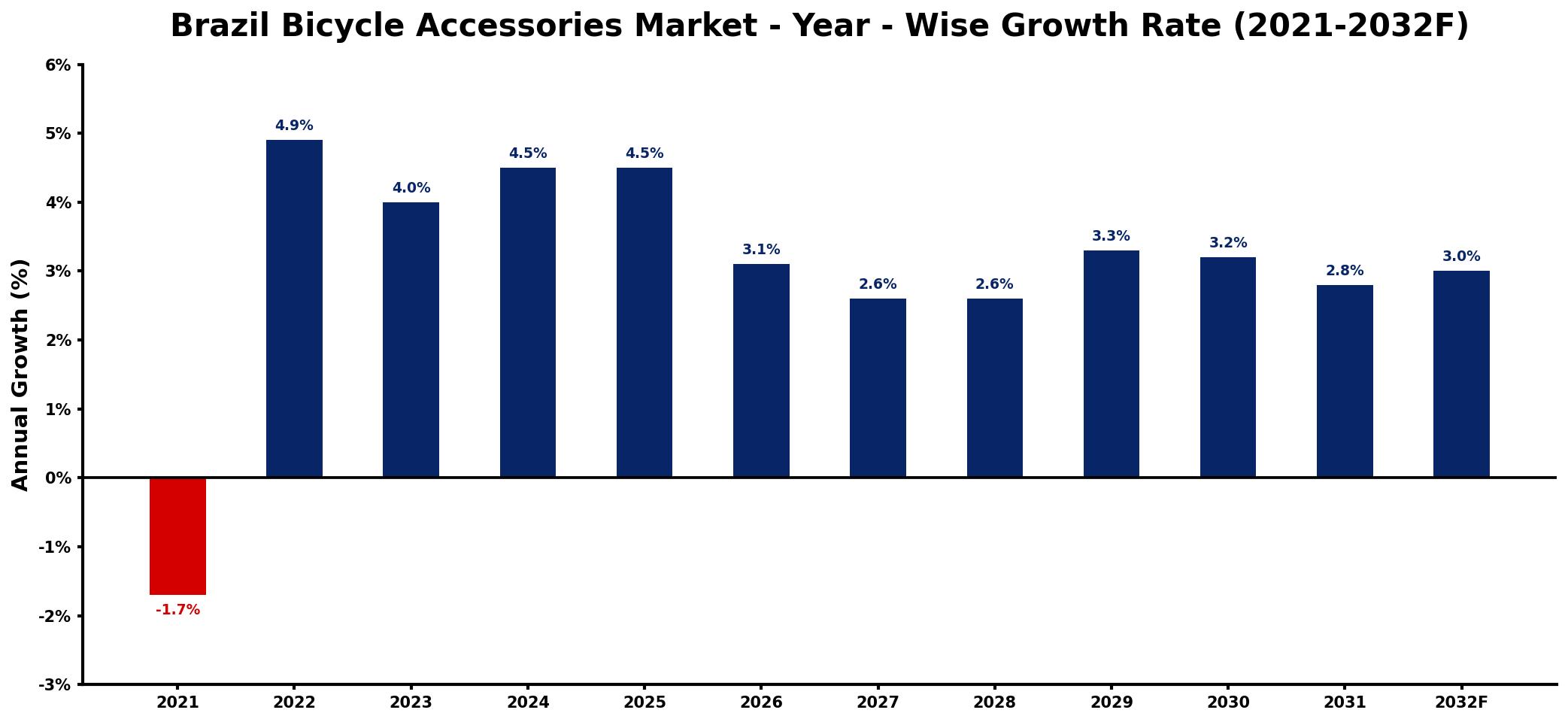
The table below presents the year‑wise growth rates along with the key drivers influencing the market
| Year | Growth Rate | Major Drivers |
| 2021 | -1.7% | decrease in consumer spending |
| 2022 | 4.9% | growing popularity of cycling |
| 2023 | 4.0% | increase in health awareness |
| 2024 | 4.5% | rise in urban commuting trends |
| 2025 | 4.5% | expansion of eco-friendly initiatives |
| 2026 | 3.1% | boost in recreational activities |
| 2027 | 2.6% | enhanced government infrastructure investments |
| 2028 | 2.6% | growth in outdoor lifestyle adoption |
| 2029 | 3.3% | increased social media influence |
| 2030 | 3.2% | development of new technologies |
| 2031 | 2.8% | surge in fitness trends |
| 2032 | 3.0% | growing demand for sustainability |
Note: Market size estimations and growth projections presented in this report are based on 6Wresearch's proprietary forecasting methodology, utilizing the latest available industry data, government publications, and primary research inputs.
Brazil Bicycle Accessories Market Synopsis
The strongest force currently shaping the Brazil Bicycle Accessories Market is the rising popularity of cycling among diverse demographics. More people are recognizing the dual benefits of cycling, not only for physical health but also as an eco-friendly mode of transportation, thus creating a robust demand for a wide array of accessories.
As cycling becomes increasingly integrated into urban mobility plans, the market is responding to the evolving needs of cyclists. This shift is encouraging innovation in product design, focusing on safety features, durability, and multifunctionality, as consumers seek gear that enhances their riding experience.
Brazil Bicycle Accessories Market Key Takeaways
- Rising health consciousness and environmental awareness are driving growth in the market.
- The market is characterized by a diverse range of products, including safety gear, racks, and specialized components.
- Government initiatives are actively promoting cycling, contributing to a more favorable market landscape.
- Challenges such as fluctuating consumer demand and competition from alternative transport modes must be navigated for sustained growth.
- Innovation and effective marketing strategies are critical for meeting the diverse needs of cyclists.
Evaluation of Restraints in Brazil Bicycle Accessories Market
Despite the promising growth, the Brazil Bicycle Accessories Market faces several restraints. Economic downturns can influence consumer spending, leading to fluctuating demand for accessories. Additionally, the competition from alternative modes of transportation can detract from cycling's appeal. Moreover, the lack of adequate distribution channels can hinder market reach. To overcome these limitations, a focus on market diversification, innovative marketing strategies, and infrastructure development is essential for long-term success.
Brazil Bicycle Accessories Market Trends
Emerging trends in the Brazil Bicycle Accessories Market include a growing emphasis on safety and high-performance gear. Consumers are increasingly looking for accessories that not only enhance their cycling experience but also ensure their safety, such as advanced helmets and reflective gear. Additionally, the rise of smart technology in accessories, such as GPS trackers and app-integrated devices, is reshaping consumer expectations and driving demand for more innovative solutions.
Brazil Bicycle Accessories Market Opportunities
Opportunities for growth in the Brazil Bicycle Accessories Market lie in the expansion of product offerings that cater to specific cycling styles, such as mountain biking or urban commuting. The demand for eco-friendly and sustainable materials in accessories is also on the rise, creating avenues for brands focused on sustainability. Moreover, enhancing distribution channels through e-commerce platforms can significantly broaden market access, tapping into the tech-savvy consumer segment.
Government Initiatives in the Brazil Bicycle Accessories Market
The Brazilian government has been actively promoting cycling as a sustainable transport option through various policies and initiatives. Investments in cycling infrastructure, including bike lanes and secure parking facilities, are crucial for fostering a cycling culture. Furthermore, public health campaigns that advocate for active living are also contributing to a favorable environment for the growth of the bicycle accessories market.
Future Insights of the Brazil Bicycle Accessories Market
Looking ahead to 2026-2032, the Brazil Bicycle Accessories Market is poised for continued growth. As cycling becomes more entrenched in urban planning and lifestyle choices, accessory manufacturers will need to innovate in response to changing consumer preferences. Sustainability and safety will be key focal points, driving the development of products that appeal to both recreational and commuting cyclists.
Brazil Bicycle Accessories Market Latest Developments (2025 - 2026)
In recent months, the Brazil Bicycle Accessories Market has seen a surge in product launches featuring smart technology. Manufacturers are increasingly focusing on developing connected devices that integrate seamlessly with smartphones, offering cyclists enhanced safety and tracking features. Additionally, companies are exploring collaborations with local governments to promote cycling through community events, further solidifying the connection between cycling and urban lifestyle.
Brazil Bicycle Accessories Market - Key Attractiveness of the Report
- 10 Years of Market Numbers
- Historical Data Starting from 2022 to 2025
- Base Year: 2025
- Forecast Data until 2032
- Key Performance Indicators Impacting the Market
- Major Upcoming Developments and Projects
Key Highlights of the Report:
- Brazil Bicycle Accessories Market Outlook
- Market Size of Brazil Bicycle Accessories Market, 2025
- Forecast of Brazil Bicycle Accessories Market, 2032
- Historical Data and Forecast of Brazil Bicycle Accessories Revenues & Volume for the Period 2022-2032F
- Brazil Bicycle Accessories Market Trend Evolution
- Brazil Bicycle Accessories Market Drivers and Challenges
- Brazil Bicycle Accessories Price Trends
- Brazil Bicycle Accessories Porter's Five Forces
- Brazil Bicycle Accessories Industry Life Cycle
- Historical Data and Forecast of Brazil Bicycle Accessories Market Revenues & Volume By Product for the Period 2022-2032F
- Historical Data and Forecast of Brazil Bicycle Accessories Market Revenues & Volume By Helmets for the Period 2022-2032F
- Historical Data and Forecast of Brazil Bicycle Accessories Market Revenues & Volume By Gloves & Warmers for the Period 2022-2032F
- Historical Data and Forecast of Brazil Bicycle Accessories Market Revenues & Volume By Jerseys/Tees for the Period 2022-2032F
- Historical Data and Forecast of Brazil Bicycle Accessories Market Revenues & Volume By LED Lights for the Period 2022-2032F
- Historical Data and Forecast of Brazil Bicycle Accessories Market Revenues & Volume By Mirrors for the Period 2022-2032F
- Historical Data and Forecast of Brazil Bicycle Accessories Market Revenues & Volume By Bottle Cages for the Period 2022-2032F
- Historical Data and Forecast of Brazil Bicycle Accessories Market Revenues & Volume By Pumps (Hand & Foot) for the Period 2022-2032F
- Historical Data and Forecast of Brazil Helmets Bicycle Accessories Market Revenues & Volume By Bar Ends/Grips for the Period 2022-2032F
- Historical Data and Forecast of Brazil Bicycle Accessories Market Revenues & Volume By Bicycle Type for the Period 2022-2032F
- Historical Data and Forecast of Brazil Bicycle Accessories Market Revenues & Volume By Mountain Bikes for the Period 2022-2032F
- Historical Data and Forecast of Brazil Bicycle Accessories Market Revenues & Volume By Hybrid/Cross for the Period 2022-2032F
- Historical Data and Forecast of Brazil Bicycle Accessories Market Revenues & Volume By Road for the Period 2022-2032F
- Historical Data and Forecast of Brazil Bicycle Accessories Market Revenues & Volume By Comfort for the Period 2022-2032F
- Historical Data and Forecast of Brazil Bicycle Accessories Market Revenues & Volume By Youth for the Period 2022-2032F
- Historical Data and Forecast of Brazil Bicycle Accessories Market Revenues & Volume By Cruisers for the Period 2022-2032F
- Historical Data and Forecast of Brazil Bicycle Accessories Market Revenues & Volume By Electric for the Period 2022-2032F
- Historical Data and Forecast of Brazil Bicycle Accessories Market Revenues & Volume By Others for the Period 2022-2032F
- Historical Data and Forecast of Brazil Bicycle Accessories Market Revenues & Volume By Type for the Period 2022-2032F
- Historical Data and Forecast of Brazil Bicycle Accessories Market Revenues & Volume By OEM for the Period 2022-2032F
- Historical Data and Forecast of Brazil Bicycle Accessories Market Revenues & Volume By Aftermarket for the Period 2022-2032F
- Historical Data and Forecast of Brazil Bicycle Accessories Market Revenues & Volume By Sales Channel for the Period 2022-2032F
- Historical Data and Forecast of Brazil Bicycle Accessories Market Revenues & Volume By Online for the Period 2022-2032F
- Historical Data and Forecast of Brazil Bicycle Accessories Market Revenues & Volume By Offline for the Period 2022-2032F
- Brazil Bicycle Accessories Import Export Trade Statistics
- Market Opportunity Assessment By Product
- Market Opportunity Assessment By Bicycle Type
- Market Opportunity Assessment By Type
- Market Opportunity Assessment By Sales Channel
- Brazil Bicycle Accessories Top Companies Market Share
- Brazil Bicycle Accessories Competitive Benchmarking By Technical and Operational Parameters
- Brazil Bicycle Accessories Company Profiles
- Brazil Bicycle Accessories Key Strategic Recommendations
Frequently Asked Questions About the Market Study (FAQs):
The Brazil Bicycle Accessories Market is estimated to be USD 411 Million in 2025 and is projected to reach USD 492 Million by 2032, growing at a CAGR of 2.6% from 2026 to 2032.
Government initiatives aimed at promoting healthier lifestyles and sustainable transport are creating a supportive environment for cycling. Investments in infrastructure, such as bike lanes, are particularly impactful.
Increased health and environmental consciousness among consumers, combined with the rising popularity of cycling as both a recreational activity and a means of transport, are the key drivers fueling market growth.
Challenges include fluctuating consumer demand, the need for improved distribution channels, and competition from alternative modes of transportation that could affect the growth trajectory of the market.
There is a notable shift towards prioritizing safety, durability, and sustainability in accessory purchases. Consumers are increasingly seeking products that enhance their cycling experience while addressing environmental concerns.
6Wresearch actively monitors the Brazil Bicycle Accessories Market and publishes its comprehensive annual report, highlighting emerging trends, growth drivers, revenue analysis, and forecast outlook. Our insights help businesses to make data-backed strategic decisions with ongoing market dynamics. Our analysts track relevent industries related to the Brazil Bicycle Accessories Market, allowing our clients with actionable intelligence and reliable forecasts tailored to emerging regional needs.
Yes, we provide customisation as per your requirements. To learn more, feel free to contact us on sales@6wresearch.com
Global Go To Market Strategy - 2030
Export potential enables firms to identify high-growth global markets with greater confidence by combining advanced trade intelligence with a structured quantitative methodology. The framework analyzes emerging demand trends and country-level import patterns while integrating macroeconomic and trade datasets such as GDP and population forecasts, bilateral import–export flows, tariff structures, elasticity differentials between developed and developing economies, geographic distance, and import demand projections. Using weighted trade values from 2020–2024 as the base period to project country-to-country export potential for 2030, these inputs are operationalized through calculated drivers such as gravity model parameters, tariff impact factors, and projected GDP per-capita growth. Through an analysis of hidden potentials, demand hotspots, and market conditions that are most favorable to success, this method enables firms to focus on target countries, maximize returns, and global expansion with data, backed by accuracy.
By factoring in the projected importer demand gap that is currently unmet and could be potential opportunity, it identifies the potential for the Exporter (Country) among 190 countries, against the general trade analysis, which identifies the biggest importer or exporter.
To discover high-growth global markets and optimize your business strategy:
Click Here
Pricing
- Single User License$ 1,995
- Department License$ 2,400
- Site License$ 3,120
- Global License$ 3,795

Leadership Perspectives from Industry Events
Search
Thought Leadership and Analyst Meet





Our Clients








6WResearch In News
- India Air Conditioner Market Set for Strong Rebound in 2026 After Weather-Led Correction and GST-Driven Recovery: 6Wresearch
- ADAS in India: How Automatic Emergency Braking, Blind Spot Detection & Driver Monitoring are Transforming Road Safety
- Doha a strategic location for EV manufacturing hub: IPA Qatar
- Demand for luxury TVs surging in the GCC, says Samsung
- Empowering Growth: The Thriving Journey of Bangladesh’s Cable Industry
- Demand for luxury TVs surging in the GCC, says Samsung
Latest Reports
- Nicaragua RPG Gaming Market (2026-2032)
- New Zealand RPG Gaming Market (2026-2032)
- Netherlands RPG Gaming Market (2026-2032)
- Nauru RPG Gaming Market (2026-2032)
- Namibia RPG Gaming Market (2026-2032)
- Mozambique RPG Gaming Market (2026-2032)
- Montenegro RPG Gaming Market (2026-2032)
- Mongolia RPG Gaming Market (2026-2032)
- Monaco RPG Gaming Market (2026-2032)
- Micronesia RPG Gaming Market (2026-2032)
Industry Events and Analyst Meet

EV India Expo 2026

HIMTEX 2026

India Refining Summit 2026

India EV Show 2026

EV tech India Expo 2026
Whitepaper
- Middle East & Africa Commercial Security Market Click here to view more.
- Middle East & Africa Fire Safety Systems & Equipment Market Click here to view more.
- GCC Drone Market Click here to view more.
- Middle East Lighting Fixture Market Click here to view more.
- GCC Physical & Perimeter Security Market Click here to view more.


