Brazil Bicycle Market (2025-2031) | Outlook, Industry, Forecast, Value, Share, Revenue, Companies, Size, Analysis, Trends & Growth
Market Forecast By Product (Mountain Bikes, Hybrid Bikes, Road Bikes, Cargo Bikes, Others), By Technology (Electric, Conventional), By End-user (Men, Women, Kids), By Distribution Channel (Online, Offline) And Competitive Landscape
| Product Code: ETC362102 | Publication Date: Aug 2022 | Updated Date: Oct 2025 | Product Type: Market Research Report | |
| Publisher: 6Wresearch | Author: Shubham Padhi | No. of Pages: 75 | No. of Figures: 35 | No. of Tables: 20 |
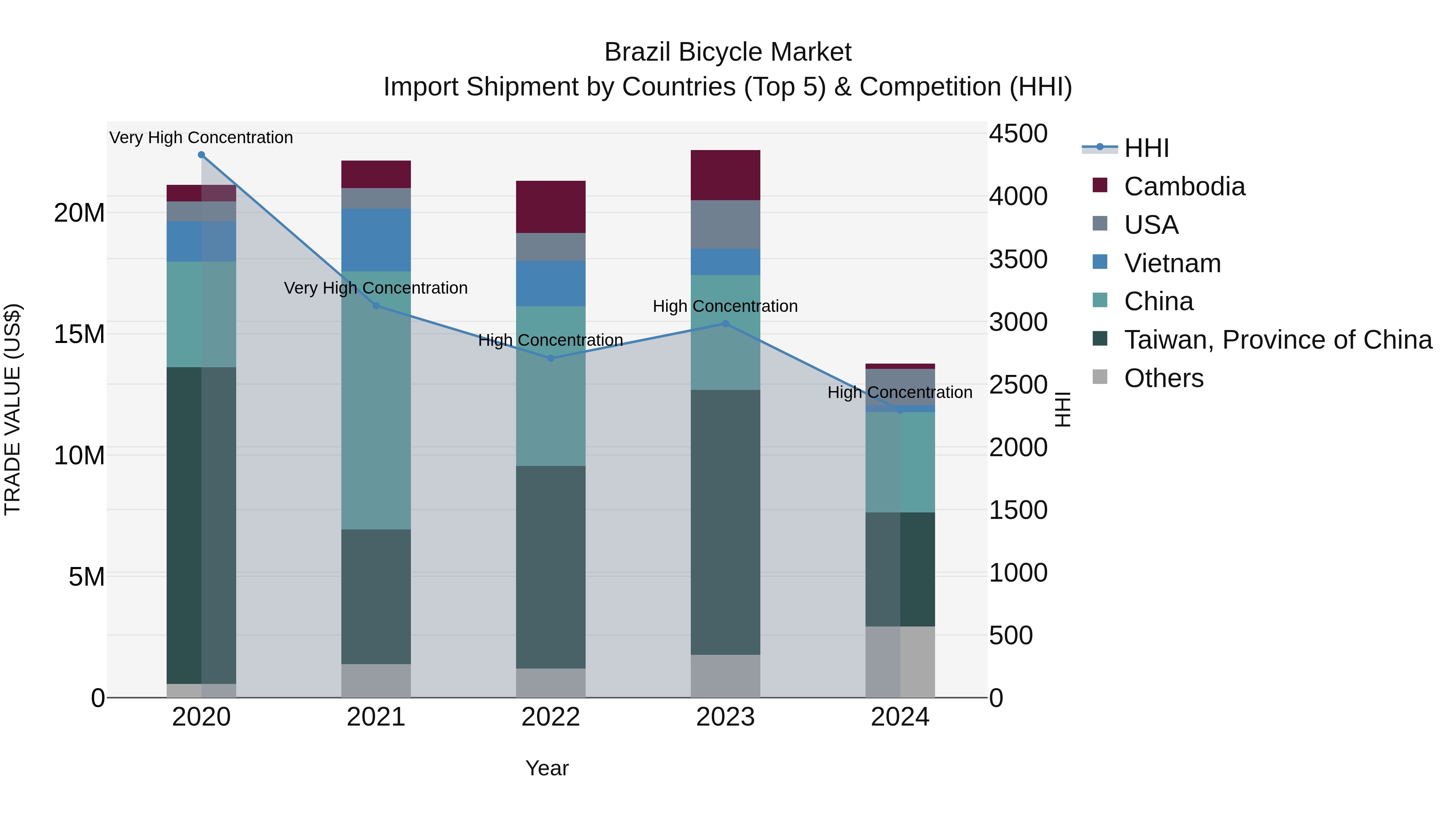
Brazil Bicycle Market Top 5 Importing Countries and Market Competition (HHI) Analysis
Despite a decline in the growth rate in 2024, Brazil continues to be a key market for bicycle imports. The top countries exporting to Brazil, including Taiwan, China, and the USA, highlight the global interest in the Brazilian market. The high concentration of the Herfindahl-Hirschman Index (HHI) indicates a competitive market landscape. The negative Compound Annual Growth Rate (CAGR) from 2020 to 2024 suggests some challenges in the industry, but there may be opportunities for growth and development in the future.
Brazil Bicycle Market Growth Rate
According to 6Wresearch internal database and industry insights,
Brazil Bicycle Market Highlights
| Report Name | Brazil Bicycle Market |
| Forecast period | 2025-2031 |
| CAGR | 7.4% |
| Growing Sector | Urban Mobility & Recreation |
Topics Covered in the Brazil Bicycle Market Report
The Brazil Bicycle Market report thoroughly covers the market by product, technology, end-user, and distribution channel. The market report provides an unbiased and detailed analysis of ongoing market trends, opportunities/high growth areas, and market drivers, which would help stakeholders to devise and align their market strategies according to the current and future market dynamics.
Brazil Bicycle Market Synopsis
Brazil Bicycle Market is anticipated to attain rapid advancement due to surging adoption of bicycles for daily commuting, fitness, and last-mile delivery. Extending cycle-lane chains in major cities, corporate wellness programs, and expanding recreational cycling communities are proliferating requirement across mountain, hybrid, road, and cargo platforms. A bicycle is a human-powered vehicle with two wheels attached to a frame, propelled by pedalling and steered with handlebars. Increasing obtainability of locally assembled models, specialization in components, and advancing retail finance options are further broadening attainment for distinctive consumer sections.
Evaluation of Growth Drivers in the Brazil Bicycle Market
Below mentioned are some prominent drivers and their influence on the market dynamics:
| Drivers | Primary Segments Affected | Why it Matters (Evidence) |
| Urban Mobility Investments | Hybrid Bikes; Electric; Men, Women; Online & Offline | City-led bike-lane expansion, bike-sharing, and intermodal hubs increase the practicality of cycling commutes and stimulate replacement and upgrade cycles. |
| Health & Fitness Awareness | Mountain & Road; Conventional; Men, Women | Rising focus on active lifestyles increases recreational and performance cycling purchases, accessories, and service revenues. |
| E-Commerce Penetration | All products; Online; Men, Women, Kids | Broader model availability, transparent pricing, and doorstep delivery helps hasten adoption beyond Tier-1 cities. |
| Logistics & Micro-mobility | Cargo Bikes; Electric; Offline Fleets | Last-mile delivery platforms adopt cargo and utility e-bikes to lower operating prices and develop urban access. |
| Local Manufacturing & Financing | Conventional & Entry E-bikes; Offline | Dealer credit, BNPL, and domestic assembly develop budget-friendliness and condense lead times for mass-market models. |
The Brazil Bicycle Market size is expected to grow at the CAGR of 7.4% during the forecast period of 2025-2031. Demand is underpinned by multimodal urban mobility plans, extending recreational events, and the professionalization of retail and aftersales networks. Increasing fuel prices and parking constraints in dense corridors also encourage modal shift from short car trips to bikes and e-bikes. Additionally, the rising focus on sustainable and eco-friendly transportation ids focussing both individuals and corporate fleets to utilize bicycles as a primary mobility solution.
Evaluation of Restraints in the Brazil Bicycle Market
Below mentioned are some major restraints and their influence on the market dynamics:
| Restraints | Primary Segments Affected | What this Means (Evidence) |
| Import Cost Volatility | Mid/High-end Road & Mountain; Electric | Exchange-rate swings and duties affect premium bikes and e-drive components, elevating retail costs. |
| Fragmented Service Infrastructure | Electric; Cargo; Men, Women | Insufficient certified e-drive technicians and spare parts availability can slow e-bike fleet uptime and consumer confidence. |
| Safety & Theft Concerns | Urban Users; Online Purchase Intent | Recognised road safety gaps and theft risks minimize adoption without secure parking and enforcement. |
| Supply Chain Lead Times | Performance Segments; Offline | Popular sizes/specs face seasonal stockouts, delaying costs and upgrades. |
| Affordability Gap | Kids & Entry Adults; Conventional | Buying power disparities constrain penetration without financing and subsidy support. |
Brazil Bicycle Market Challenges
The Brazil Bicycle Industry struggles with jagged cycling infrastructure quality between cities, insufficient standardization in e-bike regulations across municipalities, and the need for expert technicians for mid-drive systems and battery diagnostics. Independent retailers encounter working-capital burden to hold broad assortments, while luxurious import dependence challenges steady provision of operational components and carbon frames.
Moreover, the increase in mid-rise mid-drive systems and advanced lithium batteries has overtaken the need for the presence of proficient technicians who has the ability of diagnostics, safe handling, and effective repairs, driving up service costs and undermining consumer faith in after-sales support.
Brazil Bicycle Market Trends
Several prominent trends reshaping the market arena include:
Electric Drivetrain Uptake: Increased development of commuter and utility e-bikes with integrated batteries, torque sensors, and connected displays. These are being done to develop ride quality and range.
Omni-Channel Retailing: Integration of digital model discovery, click-and-collect, and in-store fitting/services. This assists in minimising buying friction.
Gravel & Adventure Cycling: Increasing interest in mixed-terrain bikes bridging road and MTB, rising accessory categories like bike - packing gear.
Fleet & Subscription Models: Corporate mobility and delivery fleets taking in subscription/lease for predictable costs and maintenance coverage.
Safety & Smart Accessories: Advancement in MIPS/rotational helmets, daytime running lights, GPS tracking, and app-linked locks developing rider confidence.
Investment Opportunities in the Brazil Bicycle Industry
Some of the transformative investment opportunities in the market consist of:
Urban E-Commuter Platforms – Local assembly of step-through, mid-drive e-commuters with fenders, racks, and lights personalised for city use.
Cargo & Utility Ecosystems – Develop long-tail/box cargo bikes, swappable battery systems, and fleet telematics for delivery operators.
Aftermarket & Service Networks – Build certified e-drive service hubs, mobile workshops, and technician training academies to raise uptime.
Domestic Components & Accessories – Allocating money in alloy wheels, tires, drivetrains, helmets, and safety tech to minimise import exposure and advance the margins.
Top 5 Leading Players in the Brazil Bicycle Market
Some leading players operating in the market include:
Caloi (Dorel Industries – Brazil)
Established Year: 1898
Headquarters: São Paulo, Brazil
Official Website: https://www.caloi.com
Caloi is a heritage Brazilian brand providing broad portfolios across MTB, urban, kids, and e-bikes, encouraged by nationwide distribution and localized assembly.
Sense Bike
Established Year: 2009
Headquarters: Belo Horizonte, Brazil
Official Website: https://www.sensebike.com.br
Sense Bike designs and assembles mountain, gravel, urban, and electric models are concentrating on Brazilian terrain and value-for-money performance.
Oggi Bikes
Established Year: 2014
Headquarters: São Paulo, Brazil
Official Website: https://www.oggibikes.com.br
Oggi produces MTB, road, and urban lines with strong dealer chains and financing choices, focussing on durable frames for local riding conditions.
Trek Bicycle (Brazil)
Established Year: 1976
Headquarters: Waterloo, Wisconsin, USA (Brazil operations in major metros)
Official Website: https://www.trekbikes.com
Trek provides premium road, MTB, and e-bike platforms, retail concepts, and professional fitting services serving performance and enthusiast cyclists.
Specialized (Brazil)
Established Year: 1974
Headquarters: Morgan Hill, California, USA (presence in Brazil)
Official Website: https://www.specialized.com
Specialized gives high-performance road/MTB/e-bike ranges and integrated components, complemented by dealer training and aftersales support for proficient riders.
Government Regulations Introduced in the Brazil Bicycle Market
According to Brazilian government data, various initiatives have been introduced that have the objective of enhancing the Brazil Bicycle Market by the Brazilian Government. Municipal mobility plans under the National Urban Mobility Policy encourage interconnected bike lanes and parking near transit stations. These plans helps in the encouragement of cycling as an established means of urban transport rathe rather than just a leisure activity.
It assists in focussing the need for continuous, good-condition roads which connects residential areas to employment hubs, schools, and commercial centres. City programs such as public bike-sharing, school cycling education, and traffic-calming zones support first- and last-mile use. In select states, tax and fee relief on bicycle parts and safety equipment, together with public procurement of cargo bikes for municipal services, provide direct demand signals for the industry.
Future Insights of the Brazil Bicycle Market
The Brazil Bicycle Market Growth is anticipated to increase in the upcoming years. Advancement will be underpinned by maturing urban cycling chains, increasing acceptance of e-bikes for commuting and logistics, and the formalization of service ecosystems. Brand strategies that localize assembly, extend credit access, and partner with cities and employers are predicted to capture outsized profits, particularly in utility and fitness sectors.
Market Segmentation Analysis
The report offers a comprehensive study of the subsequent market segments and their leading categories.
Mountain Bikes to Dominate the Market– By Product
According to Shubhamdeep, Senior Research Analyst at 6Wresearch, the Mountain Bikes category holds the largest Brazil Bicycle Market Share. Trail diversity around urban borders and recreational appeal make MTBs the first bought item for many riders. Durable frames, suspension choices, and broader tire availability at accessible cost points strengthen MTB dominance over hybrid, road, cargo, and others.
Conventional to Dominate the Market– By Technology
Conventional bicycles currently lead given cost sensitivity and expansive aftermarket/service familiarity. While electric models are quickening, conventional bikes persist to be the main choice for fitness and leisure. This is due to the reason that it has simpler maintenance and lower upfront prices sustaining high volumes across regions.
Men to Dominate the Market– By End-user
Men account for the largest user base, accelerated by increasing participation in recreational mountain and road cycling, event participation, and premium upgrade cycles. Women and kids segments are lengthening via urban commuting programs, school initiatives, and growing availability of geometry-specific designs.
Offline to Dominate the Market– By Distribution Channel
Offline retail leads due to the prominence of test rides, bike fitting, and immediate service/assembly. Dealer chains provide finance options, maintenance plans, and warranty handling that creates trust for first-time and performance buyers, while online channels complement discovery and obtainability.
Key Attractiveness of the Report
- 10 Years of Market Numbers.
- Historical Data Starting from 2021 to 2024.
- Base Year: 2024.
- Forecast Data until 2031.
- Key Performance Indicators Impacting the Market.
- Major Upcoming Developments and Projects
Key Highlights of the Report:
- Brazil Bicycle Market Overview
- Brazil Bicycle Market Outlook
- Brazil Bicycle Market Forecast
- Market Size of Brazil Bicycle Market, 2024
- Forecast of Brazil Bicycle Market, 2031
- Historical Data and Forecast of Brazil Bicycle Revenues & Volume for the Period 2021-2031
- Brazil Bicycle Market Trend Evolution
- Brazil Bicycle Market Drivers and Challenges
- Brazil Bicycle Price Trends
- Brazil Bicycle Porter's Five Forces
- Brazil Bicycle Industry Life Cycle
- Historical Data and Forecast of Brazil Bicycle Market Revenues & Volume By Product for the Period 2021-2031
- Historical Data and Forecast of Brazil Bicycle Market Revenues & Volume By Mountain Bikes for the Period 2021-2031
- Historical Data and Forecast of Brazil Bicycle Market Revenues & Volume By Hybrid Bikes for the Period 2021-2031
- Historical Data and Forecast of Brazil Bicycle Market Revenues & Volume By Road Bikes for the Period 2021-2031
- Historical Data and Forecast of Brazil Bicycle Market Revenues & Volume By Cargo Bikes for the Period 2021-2031
- Historical Data and Forecast of Brazil Bicycle Market Revenues & Volume By Others for the Period 2021-2031
- Historical Data and Forecast of Brazil Bicycle Market Revenues & Volume By Technology for the Period 2021-2031
- Historical Data and Forecast of Brazil Bicycle Market Revenues & Volume By Electric for the Period 2021-2031
- Historical Data and Forecast of Brazil Bicycle Market Revenues & Volume By Conventional for the Period 2021-2031
- Historical Data and Forecast of Brazil Bicycle Market Revenues & Volume By End-user for the Period 2021-2031
- Historical Data and Forecast of Brazil Bicycle Market Revenues & Volume By Men for the Period 2021-2031
- Historical Data and Forecast of Brazil Bicycle Market Revenues & Volume By Women for the Period 2021-2031
- Historical Data and Forecast of Brazil Bicycle Market Revenues & Volume By Kids for the Period 2021-2031
- Historical Data and Forecast of Brazil Bicycle Market Revenues & Volume By Distribution Channel for the Period 2021-2031
- Historical Data and Forecast of Brazil Bicycle Market Revenues & Volume By Online for the Period 2021-2031
- Historical Data and Forecast of Brazil Bicycle Market Revenues & Volume By Offline for the Period 2021-2031
- Brazil Bicycle Import Export Trade Statistics
- Market Opportunity Assessment By Product
- Market Opportunity Assessment By Technology
- Market Opportunity Assessment By End-user
- Market Opportunity Assessment, By Distribution Channel
- Brazil Bicycle Top Companies Market Share
- Brazil Bicycle Competitive Benchmarking, By Technical and Operational Parameters
- Brazil Bicycle Company Profiles
- Brazil Bicycle Key Strategic Recommendations
Market Covered
The report offers a comprehensive study of the subsequent market segments:
By Product
- Mountain Bikes
- Hybrid Bikes
- Road Bikes
- Cargo Bikes
- Others
By Technology
- Electric
- Conventional
By End-user
- Men
- Women
- Kids
By Distribution Channel
- Online
- Offline
Brazil Bicycle Market (2025-2031): FAQs
The Brazil Bicycle Market is expected to grow at a CAGR of approximately 7.4% during the forecast period.
The future of the Brazil Bicycle Market is set for potent growth, spurred by expanding urban cycling chains, increasing e-bike adoption, and formalized service ecosystems.
Local e-commuter assembly, cargo/utility ecosystems for delivery, certified e-drive service hubs, and domestic component/accessory manufacturing present strengthening opportunities.
Key drivers consist of growing adoption of bicycles for eco-friendly transportation and rising fuel costs that push commuters toward affordable alternatives.
6Wresearch actively monitors the Brazil Bicycle Market and publishes its comprehensive annual report, highlighting emerging trends, growth drivers, revenue analysis, and forecast outlook. Our insights help businesses to make data-backed strategic decisions with ongoing market dynamics. Our analysts track relevent industries related to the Brazil Bicycle Market, allowing our clients with actionable intelligence and reliable forecasts tailored to emerging regional needs.
Yes, we provide customisation as per your requirements. To learn more, feel free to contact us on sales@6wresearch.com
Export potential assessment - trade Analytics for 2030
Export potential enables firms to identify high-growth global markets with greater confidence by combining advanced trade intelligence with a structured quantitative methodology. The framework analyzes emerging demand trends and country-level import patterns while integrating macroeconomic and trade datasets such as GDP and population forecasts, bilateral import–export flows, tariff structures, elasticity differentials between developed and developing economies, geographic distance, and import demand projections. Using weighted trade values from 2020–2024 as the base period to project country-to-country export potential for 2030, these inputs are operationalized through calculated drivers such as gravity model parameters, tariff impact factors, and projected GDP per-capita growth. Through an analysis of hidden potentials, demand hotspots, and market conditions that are most favorable to success, this method enables firms to focus on target countries, maximize returns, and global expansion with data, backed by accuracy.
By factoring in the projected importer demand gap that is currently unmet and could be potential opportunity, it identifies the potential for the Exporter (Country) among 190 countries, against the general trade analysis, which identifies the biggest importer or exporter.
To discover high-growth global markets and optimize your business strategy:
Click Here
Pricing
- Single User License$ 1,995
- Department License$ 2,400
- Site License$ 3,120
- Global License$ 3,795

Search
Thought Leadership and Analyst Meet





Our Clients








Latest Reports
- United Kingdom (UK) Long-term Care Insurance Market (2026-2032) | Growth, Share, Consumer Insights, Drivers, Opportunities, Competition, Pricing Analysis, Segments, Restraints, Companies, Competitive, Value, Outlook, Size, Demand, Analysis, Challenges, Strategic Insights, Investment Trends, Revenue, Trends, Supply, Forecast
- United Kingdom (UK) Long Term Care Market (2026-2032) | Companies, Outlook, Analysis, Trends, Value, Revenue, Segmentation, Share, Forecast, Competitive Landscape, Growth, Size & Forecast
- Iraq Insulation and Waterproofing Market (2026-2032) | Outlook, Drivers, Growth, Size, Share, Industry, Revenue, Trends, Demand, Competitive, Strategic Insights, Opportunities, Segments, Companies, Challenges, Strategy, Consumer Insights, Analysis, Investment Trends, Value, Segmentation, Forecast, Restraints
- India Switchgear Market Outlook (2026 - 2032) | Size, Share, Trends, Growth, Revenue, Forecast, Analysis, Value, Outlook
- Pakistan Contraceptive Implants Market (2025-2031) | Demand, Growth, Size, Share, Industry, Pricing Analysis, Competitive, Strategic Insights, Strategy, Consumer Insights, Analysis, Investment Trends, Opportunities, Revenue, Segments, Value, Segmentation, Supply, Forecast, Restraints, Outlook, Competition, Drivers, Trends, Companies, Challenges
- Sri Lanka Packaging Market (2026-2032) | Outlook, Competition, Drivers, Trends, Demand, Pricing Analysis, Competitive, Strategic Insights, Companies, Challenges, Strategy, Consumer Insights, Analysis, Investment Trends, Opportunities, Growth, Size, Share, Industry, Revenue, Segments, Value, Segmentation, Supply, Forecast, Restraints
- India Kids Watches Market (2026-2032) | Strategy, Consumer Insights, Analysis, Investment Trends, Opportunities, Growth, Size, Share, Industry, Revenue, Segments, Value, Segmentation, Supply, Forecast, Restraints, Outlook, Competition, Drivers, Trends, Demand, Pricing Analysis, Competitive, Strategic Insights, Companies, Challenges
- Saudi Arabia Core Assurance Service Market (2025-2031) | Strategy, Consumer Insights, Analysis, Investment Trends, Opportunities, Growth, Size, Share, Industry, Revenue, Segments, Value, Segmentation, Supply, Forecast, Restraints, Outlook, Competition, Drivers, Trends, Demand, Pricing Analysis, Competitive, Strategic Insights, Companies, Challenges
- Romania Uninterruptible Power Supply (UPS) Market (2026-2032) | Industry, Analysis, Revenue, Size, Forecast, Outlook, Value, Trends, Share, Growth & Companies
- Saudi Arabia Car Window Tinting Film, Paint Protection Film (PPF), and Ceramic Coating Market (2025-2031) | Strategy, Consumer Insights, Analysis, Investment Trends, Opportunities, Growth, Size, Share, Industry, Revenue, Segments, Value, Segmentation, Supply, Forecast, Restraints, Outlook, Competition, Drivers, Trends, Demand, Pricing Analysis, Competitive, Strategic Insights, Companies, Challenges
Industry Events and Analyst Meet

India EV Show 2026

EV tech India Expo 2026

Auto Tech Asia 2026
Battery Tech India 2026

Smart Production Solutions Guangzhou 2026
Whitepaper
- Middle East & Africa Commercial Security Market Click here to view more.
- Middle East & Africa Fire Safety Systems & Equipment Market Click here to view more.
- GCC Drone Market Click here to view more.
- Middle East Lighting Fixture Market Click here to view more.
- GCC Physical & Perimeter Security Market Click here to view more.
6WResearch In News
- Doha a strategic location for EV manufacturing hub: IPA Qatar
- Demand for luxury TVs surging in the GCC, says Samsung
- Empowering Growth: The Thriving Journey of Bangladesh’s Cable Industry
- Demand for luxury TVs surging in the GCC, says Samsung
- Video call with a traditional healer? Once unthinkable, it’s now common in South Africa
- Intelligent Buildings To Smooth GCC’s Path To Net Zero


