Brazil Blenders Market Summary
The brazil blenders market was estimated at USD 295 Million in 2025 and is projected to reach USD 353 Million by 2032, growing at a CAGR of 2.7% from 2026 to 2032.
Brazil Blenders Market Year-wise Growth Rate and Key Drivers
This graph highlights how the Brazil Blenders Market has steadily grown over the past five years, supported by major growth factors.
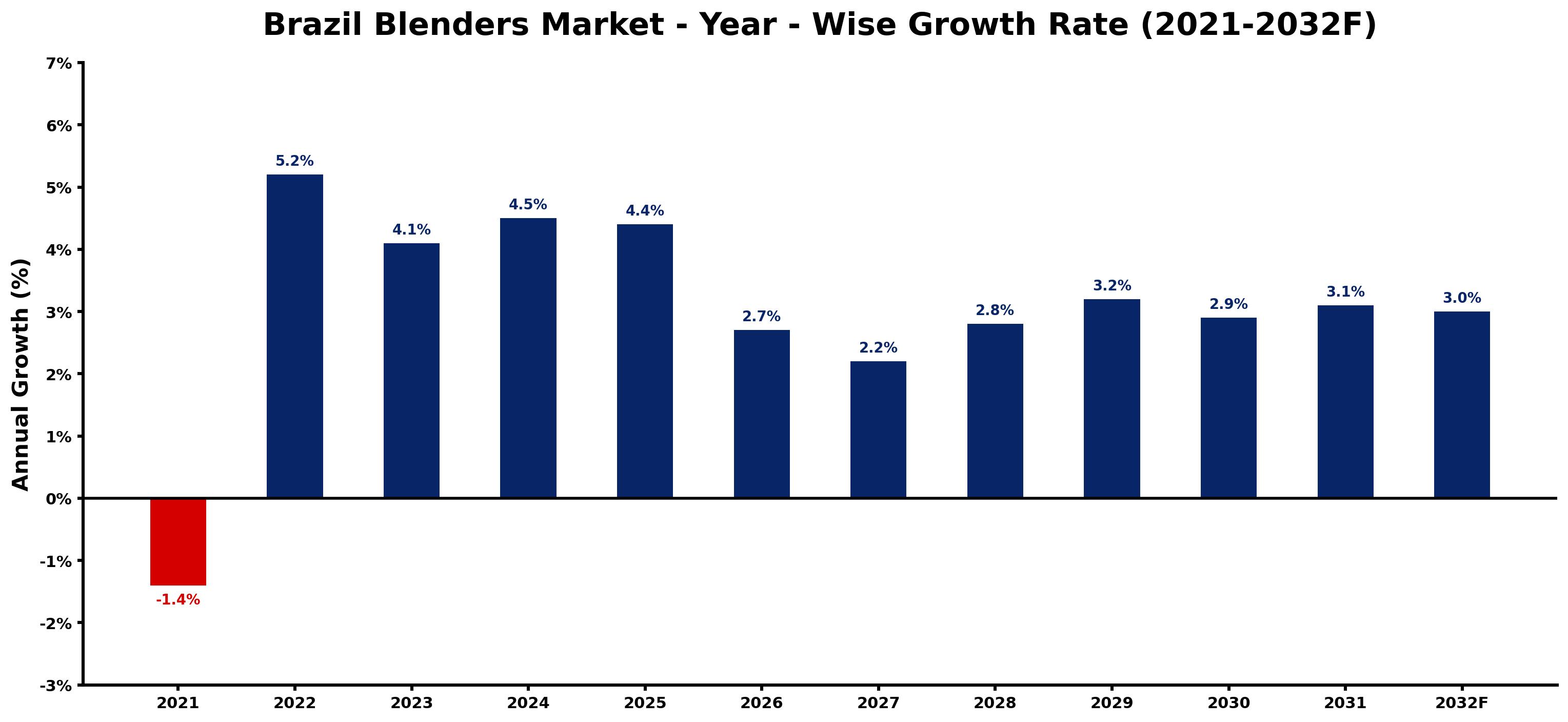
The table below presents the year wise growth rates along with the key drivers influencing the market
| Year | Growth Rate | Major Drivers |
| 2021 | -1.4% | Increased competition from lowcost imported alternatives pressured domestic brands, diminishing market share and consumer loyalty. |
| 2022 | 5.2% | Emerging kitchen trends see innovative designs enhancing user experiences with blenders. |
| 2023 | 4.1% | Online retail channels gain traction, expanding consumer access to premium blender brands. |
| 2024 | 4.5% | Local manufacturers introduce affordable, high-quality blenders tailored for Brazilian households. |
| 2025 | 4.4% | Sustainability trends influence consumers seeking eco-friendly materials in kitchen appliances. |
| 2026 | 2.7% | Culinary shows and social media influencers elevate blender usage among home chefs. |
| 2027 | 2.2% | Urbanization leads to smaller living spaces, increasing demand for multifunctional kitchen appliances. |
| 2028 | 2.8% | Health and wellness initiatives encourage blender use for nutrient-rich meal preparation. |
| 2029 | 3.2% | Technological integration in appliances attracts tech-savvy consumers to advanced blender features. |
| 2030 | 2.9% | Collaborations with fitness brands promote specific blender models for smoothies and protein shakes. |
| 2031 | 3.1% | Rising disposable income allows households to invest in premium kitchen gadgets like blenders. |
| 2032 | 3.0% | Growing interest in gastronomy fuels the trend of innovative blender recipes and uses. |
Note - Market size estimations and growth projections presented in this report are based on 6Wresearch's advanced forecasting approach, validated with industry datasets as of June 2026.
Brazil Blenders Market Synopsis
The Brazil Blenders Market is projected to reach 2.7% and witness significant growth during the forecast period (2026-2032). This sector is increasingly pivotal as Brazilian households invest in high-quality kitchen appliances, particularly blenders that offer both functionality and design. The surge in sales of premium blender models can be attributed to their multifunctionality, ease of use, and the growing trend of home cooking and healthy living among consumers. Brazil's economic growth, alongside rising disposable incomes, is fostering a favorable environment for the expansion of the blender market.
Brazil Blenders Market Growth Drivers
Several key factors are contributing to the growth of the Brazil Blenders Market. Firstly, the increasing emphasis on health and wellness is driving consumers towards blenders that support nutritious lifestyles, such as smoothie and juice preparations. Secondly, advancements in technology have made modern blenders more appealing, with features such as touchscreens and multiple speed settings enhancing user experience. Thirdly, consumer preference is shifting towards premium appliances, which are perceived to offer better performance and durability. Additionally, Brazil's expanding middle class is leading to higher disposable incomes, thus allowing for more investments in quality kitchen appliances. Finally, promotional campaigns from retailers and manufacturers are also boosting consumer awareness and encouraging purchases.
Brazil Blenders Market Trends and Opportunities
The Brazil Blenders Market is witnessing several emerging trends that create valuable opportunities for growth. An increasing number of consumers are gravitating towards multifunctional blenders that not only blend but also chop, purée, and even heat ingredients. The popularity of online shopping platforms has further altered buying behaviors, making it easier for consumers to compare and purchase products. Moreover, the rise of eco-conscious consumers is catalyzing demand for energy-efficient and sustainable blender options. Additionally, manufacturers are focusing on innovation by launching models equipped with smart features that can connect to mobile applications for enhanced usability. The adoption of attractive and modern designs is also gaining traction, catering to the aesthetic preferences of consumers.
Brazil Blenders Market Challenges and Restraints
Despite its positive prospects, the Brazil Blenders Market faces certain challenges. Economic fluctuations can impact consumer spending habits, leading to restrained growth in specific segments. Price sensitivity among lower-income households poses a challenge for premium brands, which may struggle to capture market share in this demographic. Additionally, the vast array of choices in the market can overwhelm consumers, making decision-making difficult. Supply chain disruptions, whether due to geopolitical factors or natural events, may also hinder the availability of products. Finally, the increasing prevalence of counterfeit products poses a challenge to brand reputation and consumer trust in the market.
Brazil Blenders Market Investment Opportunities
Investors looking at the Brazil Blenders Market can find substantial opportunities in several areas. The growing trend towards home cooking presents a ripe avenue for investment in innovative blender technologies. Furthermore, there is potential for growth in e-commerce platforms that specialize in kitchen appliances, leveraging the shift in consumer purchasing behavior. Focusing on energy-efficient and sustainable products can attract eco-conscious consumers looking for responsible choices in their kitchen appliances. Collaborations with health and wellness influencers to promote products can also drive brand visibility and sales. Lastly, investing in local manufacturing can reduce costs and improve supply chain efficiency, creating a competitive edge in the market.
Brazil Blenders Market Government Investment and Initiatives
The Brazilian government is actively supporting the growth of the blenders market through various initiatives and policy frameworks. Investments in manufacturing infrastructure aim to enhance the production capabilities of kitchen appliances, including blenders. Public spending is being directed toward programs that promote home cooking and nutrition education, thereby increasing demand for kitchen appliances. Furthermore, incentives for sustainable practices in manufacturing are encouraging companies to adopt environmentally friendly production methods, aligning with global trends towards sustainability. Additionally, government initiatives aimed at fostering innovation in technology and design are expected to further invigorate competition and product development in the blender market.
Brazil Blenders Market Latest Developments (May 2025 - June 2026)
Recent developments in the Brazil Blenders Market highlight a continued shift towards technological integration and consumer-centric designs. Manufacturers are launching new models equipped with advanced technology, such as Wi-Fi connectivity and mobile app compatibility, catering to the tech-savvy consumer base. There has been a notable increase in marketing efforts focusing on health and wellness, aligning product promotions with consumer aspirations for healthier lifestyles. Additionally, brands are investing in research and development to create more energy-efficient and eco-friendly appliances, reflecting the growing consumer demand for sustainability. The competitive landscape has also intensified, with local players enhancing their product offerings to compete with established global brands.
Brazil Blenders Market - Key Attractiveness of the Report
- 10 Years of Market Numbers
- Historical Data Starting from 2022 to 2025
- Base Year: 2025
- Forecast Data until 2032
- Key Performance Indicators Impacting the Market
- Major Upcoming Developments and Projects
Key Highlights of the Report:
- Brazil Blenders Market Outlook
- Market Size of Brazil Blenders Market, 2025
- Forecast of Brazil Blenders Market, 2032
- Historical Data and Forecast of Brazil Blenders Revenues & Volume for the Period 2022-2032
- Brazil Blenders Market Trend Evolution
- Brazil Blenders Market Drivers and Challenges
- Brazil Blenders Price Trends
- Brazil Blenders Porter's Five Forces
- Brazil Blenders Industry Life Cycle
- Historical Data and Forecast of Brazil Blenders Market Revenues & Volume By Types for the Period 2022-2032
- Historical Data and Forecast of Brazil Blenders Market Revenues & Volume By Hand Blenders for the Period 2022-2032
- Historical Data and Forecast of Brazil Blenders Market Revenues & Volume By Single-Serve Blenders for the Period 2022-2032
- Historical Data and Forecast of Brazil Blenders Market Revenues & Volume By Full-Size Blenders for the Period 2022-2032
- Historical Data and Forecast of Brazil Blenders Market Revenues & Volume By Applications for the Period 2022-2032
- Historical Data and Forecast of Brazil Blenders Market Revenues & Volume By Commercial for the Period 2022-2032
- Historical Data and Forecast of Brazil Blenders Market Revenues & Volume By Household for the Period 2022-2032
- Brazil Blenders Import Export Trade Statistics
- Market Opportunity Assessment By Types
- Market Opportunity Assessment By Applications
- Brazil Blenders Top Companies Market Share
- Brazil Blenders Competitive Benchmarking By Technical and Operational Parameters
- Brazil Blenders Company Profiles
- Brazil Blenders Key Strategic Recommendations






































