Mexico Blenders Market Summary
The mexico blenders market was estimated at USD 90 Million in 2025 and is projected to reach USD 103 Million by 2032, growing at a CAGR of 1.3% from 2026 to 2032.
Mexico Blenders Market Year-wise Growth Rate and Key Drivers
This graph highlights how the Mexico Blenders Market has steadily grown over the past five years, supported by major growth factors.
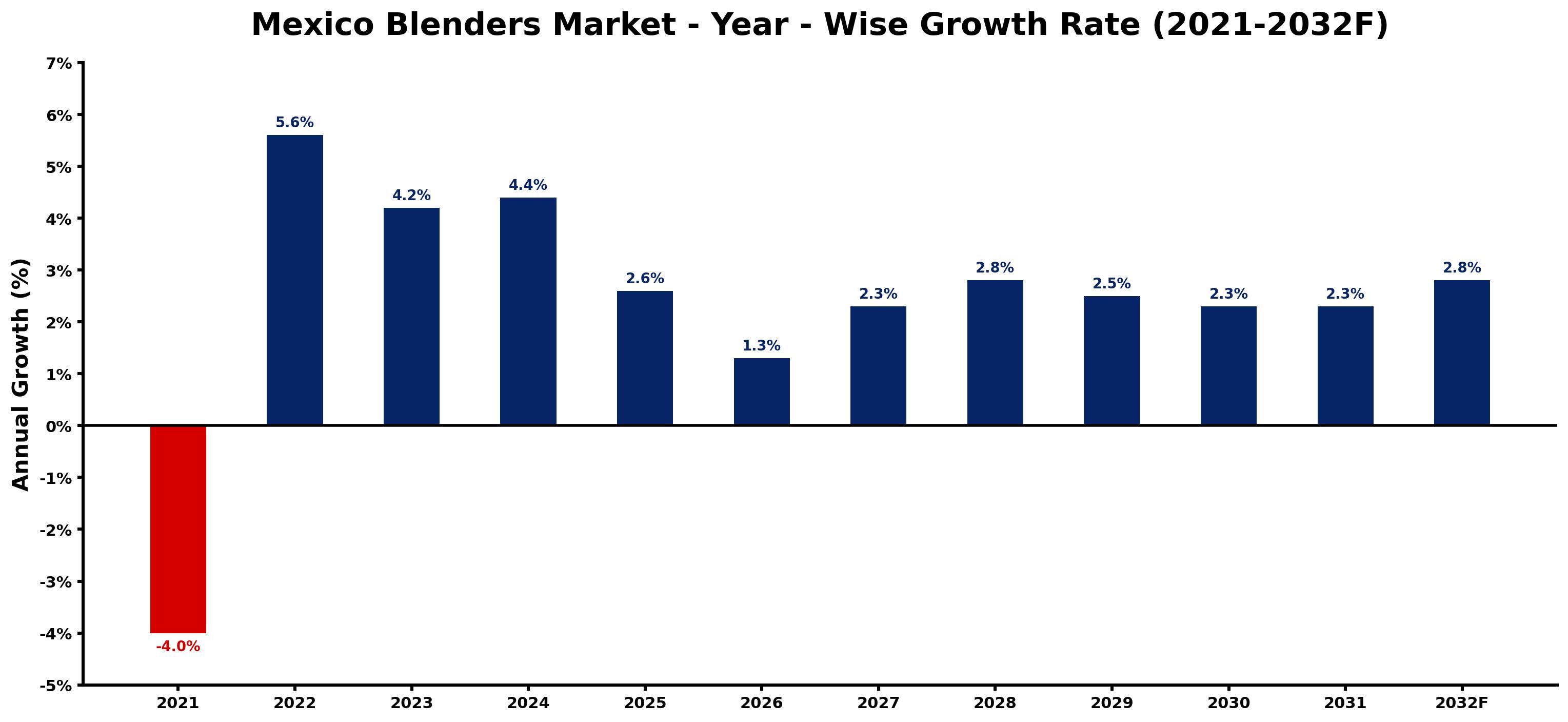
The table below presents the year wise growth rates along with the key drivers influencing the market
| Year | Growth Rate | Major Drivers |
| 2021 | -4.0% | Supply chain disruptions due to the pandemic hindered product availability and delayed retail restocking efforts. |
| 2022 | 5.6% | Health-conscious consumers increasingly favor smoothies, boosting blender sales significantly. |
| 2023 | 4.2% | E-commerce growth provides accessibility, transforming how consumers shop for kitchen appliances. |
| 2024 | 4.4% | Innovative product features attract tech-savvy millennials, shifting market dynamics considerably. |
| 2025 | 2.6% | Rise in home cooking trends encourages multi-functional appliances, including advanced blenders. |
| 2026 | 1.3% | Social media influencers promote healthy lifestyles, leading to increased blender visibility. |
| 2027 | 2.3% | Sustainable materials gain traction, appealing to environmentally conscious customers in Mexico. |
| 2028 | 2.8% | Urbanization trends shift consumer preferences towards compact, efficient kitchen appliances. |
| 2029 | 2.5% | Emerging local brands disrupt market with affordable, high-quality blender options. |
| 2030 | 2.3% | Smart home integration creates demand for connected kitchen devices, including smart blenders. |
| 2031 | 2.3% | Increased disposable income allows for premium appliance purchases, enhancing market competition. |
| 2032 | 2.8% | Continued focus on wellness and nutrition solidifies the blender's place in households. |
Note - Market size estimations and growth projections presented in this report are based on 6Wresearch's advanced forecasting approach, validated with industry datasets as of June 2026.
Mexico Blenders Market Synopsis
The Mexico Blenders Market is projected to reach 1.3% and witness significant growth during the forecast period (2026-2032). Mexico stands as the largest blender market in Latin America and ranks among the leading global markets for these kitchen appliances. The upward trajectory in household purchases of blenders is expected to continue, driven by rising disposable incomes and a burgeoning middle class. This growth is accompanied by the increasing popularity of nutritious eating habits, which has led to a demand for blenders that facilitate healthy beverage preparation.
Mexico Blenders Market Growth Drivers
Several key factors are fueling the expansion of the Mexico Blenders Market. Firstly, the increasing disposable incomes of consumers empower households to invest in kitchen gadgets that simplify meal preparation. Secondly, the expanding middle class is actively seeking quality blenders that offer functionality without compromising on affordability. Thirdly, the growing trend towards healthy lifestyles is prompting a shift in consumer preferences towards smoothies and other blended beverages. Additionally, the strong presence of both national and international brands enhances product availability and variety. Lastly, advancements in technology have led to innovative blender features, further attracting consumers.
Mexico Blenders Market Trends and Opportunities
The Mexico Blenders Market is witnessing notable trends that present various opportunities. A significant trend is the increasing consumer inclination towards mid-range blenders equipped with multi-speed controls and ice-crushing capabilities. Consumers are seeking versatile appliances that can cater to diverse culinary needs. Moreover, the rise of online retail platforms has made it easier for consumers to explore a broader range of products. Also, manufacturers are investing in research and development to introduce more efficient and environmentally friendly models, aligning with the sustainability trend. These opportunities indicate a robust pathway for future market expansion.
Mexico Blenders Market Challenges and Restraints
While the Mexico Blenders Market shows promising growth, it also faces certain challenges. One significant challenge is the presence of counterfeit products that undermine consumer trust and affect sales of reputable brands. Furthermore, fluctuating raw material prices can impact manufacturing costs, potentially leading to higher retail prices. Additionally, the economic landscape, influenced by inflation and other macroeconomic variables, can hinder consumer spending on non-essential goods like blenders. Lastly, the market's growth might be tempered by the competition from alternative kitchen appliances capable of performing similar functions.
Mexico Blenders Market Government Investment and Initiatives
The Mexican government has recognized the importance of household appliances, including blenders, and has initiated several policies to bolster the domestic market. Investments in infrastructure development and public initiatives aimed at promoting healthy lifestyles indirectly support the growth of the blender market. Moreover, various programs encourage local manufacturers to innovate and improve their products, thus enhancing competitiveness. Incentives for research and development in appliance technology are also part of the government's strategy to stimulate the market while fostering sustainability and economic growth.
Mexico Blenders Market Regional Analysis
The Mexico Blenders Market's dynamics vary across different regions, influenced by socio-economic factors and consumer behavior. Urban areas exhibit higher demand for advanced blenders due to lifestyle preferences favoring convenience and health. In contrast, rural regions may show a propensity for more affordable, basic models. This regional diversity creates opportunities for manufacturers to tailor their offerings according to local preferences. Additionally, increasing urbanization is likely to spur demand in metropolitan areas, aligning with the nationwide trend towards higher disposable incomes and modernized kitchens.
Mexico Blenders Market Latest Developments (May 2025 - June 2026)
Recent developments in the Mexico Blenders Market have highlighted a shift towards sustainability and smart technology. Manufacturers are increasingly focusing on eco-friendly materials and energy-efficient designs to meet rising consumer expectations regarding environmental responsibility. Simultaneously, the integration of smart technology in blenders, such as connectivity features and app-controlled functionalities, is gaining traction, providing consumers with enhanced convenience. Additionally, marketing strategies have evolved, with brands leveraging social media and influencer partnerships to reach a broader audience and promote healthy lifestyle choices.
Mexico Blenders Market - Key Attractiveness of the Report
- 10 Years of Market Numbers
- Historical Data Starting from 2022 to 2025
- Base Year: 2025
- Forecast Data until 2032
- Key Performance Indicators Impacting the Market
- Major Upcoming Developments and Projects
Key Highlights of the Report:
- Mexico Blenders Market Outlook
- Market Size of Mexico Blenders Market, 2025
- Forecast of Mexico Blenders Market, 2032
- Historical Data and Forecast of Mexico Blenders Revenues & Volume for the Period 2022-2032
- Mexico Blenders Market Trend Evolution
- Mexico Blenders Market Drivers and Challenges
- Mexico Blenders Price Trends
- Mexico Blenders Porter's Five Forces
- Mexico Blenders Industry Life Cycle
- Historical Data and Forecast of Mexico Blenders Market Revenues & Volume By Types for the Period 2022-2032
- Historical Data and Forecast of Mexico Blenders Market Revenues & Volume By Hand Blenders for the Period 2022-2032
- Historical Data and Forecast of Mexico Blenders Market Revenues & Volume By Single-Serve Blenders for the Period 2022-2032
- Historical Data and Forecast of Mexico Blenders Market Revenues & Volume By Full-Size Blenders for the Period 2022-2032
- Historical Data and Forecast of Mexico Blenders Market Revenues & Volume By Applications for the Period 2022-2032
- Historical Data and Forecast of Mexico Blenders Market Revenues & Volume By Commercial for the Period 2022-2032
- Historical Data and Forecast of Mexico Blenders Market Revenues & Volume By Household for the Period 2022-2032
- Mexico Blenders Import Export Trade Statistics
- Market Opportunity Assessment By Types
- Market Opportunity Assessment By Applications
- Mexico Blenders Top Companies Market Share
- Mexico Blenders Competitive Benchmarking By Technical and Operational Parameters
- Mexico Blenders Company Profiles
- Mexico Blenders Key Strategic Recommendations






































