Brazil Canned Pineapple Market Size, Share & Growth Rate
The Brazil Canned Pineapple Market was estimated at USD 203 Million in 2025 and is projected to reach USD 242 Million by 2032, growing at a CAGR of 2.5% from 2026 to 2032. This growth trajectory is largely attributed to the consistent consumer demand for convenient, ready-to-use pineapple, which transcends seasonal availability. Furthermore, the increasing inclination towards tropical flavors in diverse culinary applications continues to bolster the market's expansion, reinforcing its place in both traditional and contemporary Brazilian cuisine.
Brazil Canned Pineapple Market Year-wise Growth Rate and Key Drivers
This graph highlights how the Brazil Canned Pineapple Market has steadily grown over the years, supported by major growth factors.
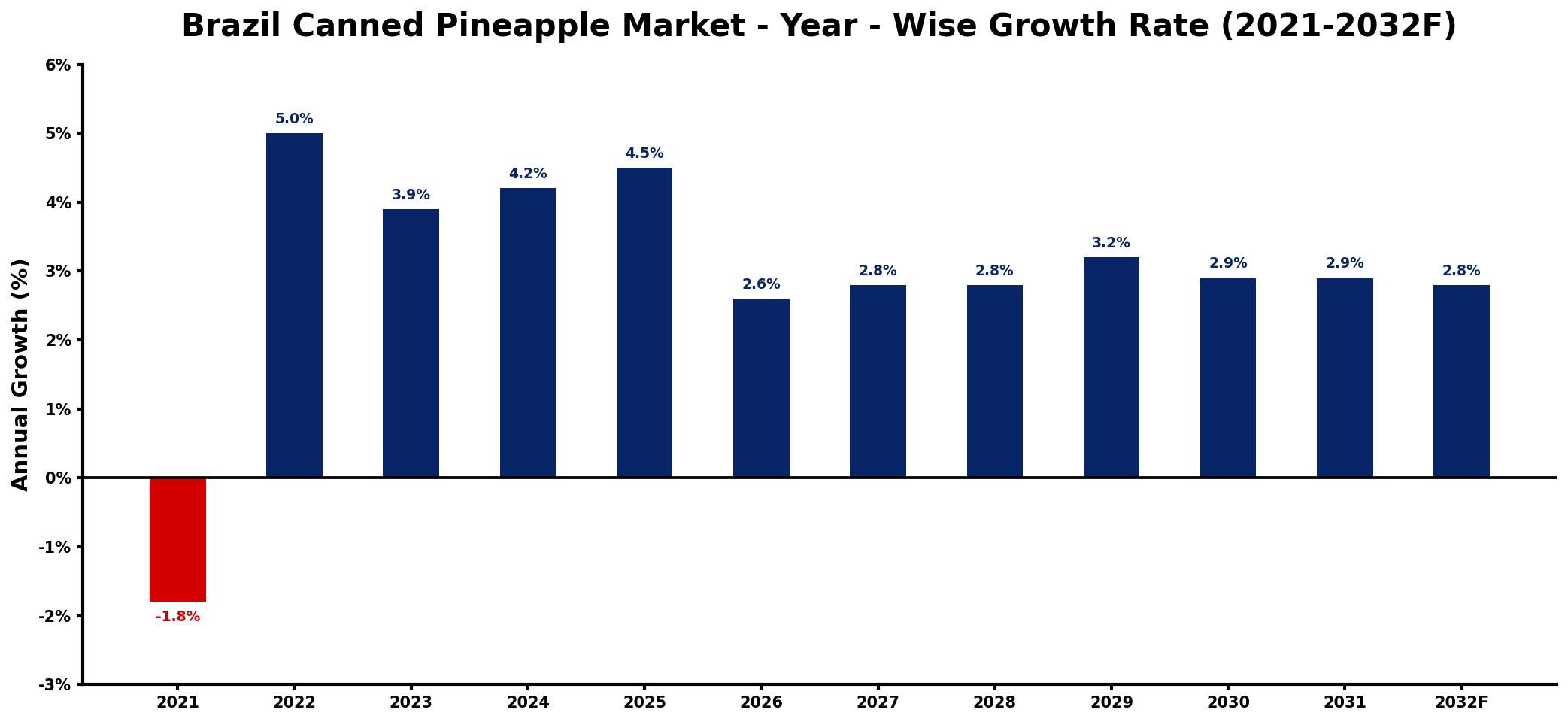
The table below presents the year‑wise growth rates along with the key drivers influencing the market
| Year | Growth Rate | Major Drivers |
| 2021 | -1.8% | Consumer preferences shifted downward |
| 2022 | 5.0% | Increased demand for healthy snacks |
| 2023 | 3.9% | Rising interest in tropical flavors |
| 2024 | 4.2% | Expansion of retail distribution channels |
| 2025 | 4.5% | Growth in export opportunities |
| 2026 | 2.6% | Innovations in packaging technology |
| 2027 | 2.8% | Growing popularity of plant-based diets |
| 2028 | 2.8% | Increased consumer awareness nutrition |
| 2029 | 3.2% | Emergence of new market players |
| 2030 | 2.9% | Strengthened supply chain efficiencies |
| 2031 | 2.9% | Rising trend of convenience foods |
| 2032 | 2.8% | Focus on sustainable sourcing practices |
Note: Market size estimations and growth projections presented in this report are based on 6Wresearch's proprietary forecasting methodology, utilizing the latest available industry data, government publications, and primary research inputs.
Brazil Canned Pineapple Market Synopsis
The driving force currently shaping the Brazil Canned Pineapple Market is the growing consumer preference for convenient, ready-to-eat products. As lifestyles become busier, the appeal of canned pineapple as a versatile ingredient in a multitude of dishes—from desserts to savory meals—has significantly enhanced its market position.
Additionally, the continuous exposure to global culinary trends has cultivated a taste for tropical flavors among Brazilian consumers. This shift in preferences aligns well with the unique offerings of canned pineapple, further solidifying its demand in both domestic markets and export opportunities.
Brazil Canned Pineapple Market Key Takeaways
- The market is driven by the year-round availability of canned pineapple.
- Consumer preferences are increasingly favoring convenience and versatility in food options.
- Tropical flavors are gaining popularity, contributing to higher demand for canned pineapple products.
- The market faces challenges related to climate variations impacting pineapple quality.
- Government policies promote food safety and encourage modernization in production facilities.
Evaluation of Restraints in Brazil Canned Pineapple Market
The Brazil Canned Pineapple Market is facing various restraints that may hinder its growth. One significant limitation is the vulnerability of pineapple crops to climatic changes, which can lead to variations in quality and yield. This uncertainty in supply can adversely affect the processing timelines and overall market stability. Furthermore, the competition from fresh and frozen pineapple alternatives, coupled with the rising consumer inclination towards natural and organic food products, poses additional challenges. Efficient supply chain management is essential to navigate these hurdles, ensuring timely product availability while maintaining quality standards.
Brazil Canned Pineapple Market Trends
Current trends in the Brazil Canned Pineapple Market indicate a growing affinity for sustainable and environmentally-friendly practices. Consumers are increasingly seeking brands that prioritize eco-friendly packaging and production methods. Additionally, the incorporation of canned pineapple into health-focused recipes is gaining traction, as it is seen as a versatile ingredient that offers a tropical twist without compromising on nutrition. Innovations in processing technologies are also emerging, enhancing the preservation of flavor and texture while extending shelf life.
Brazil Canned Pineapple Market Opportunities
There are genuine growth opportunities in the Brazil Canned Pineapple Market, particularly in expanding export initiatives. As global demand for tropical fruits rises, Brazilian canned pineapples stand poised to capture a larger share of international markets. Additionally, innovations in product offerings, such as organic canned pineapple and value-added products with unique flavor blends, could attract health-conscious consumers. Collaborations with foodservice businesses and restaurants to incorporate canned pineapple into their menus could also unlock new revenue streams.
Government Initiatives in the Brazil Canned Pineapple Market
Government initiatives in Brazil related to the canned pineapple market focus heavily on ensuring quality control and food safety standards. Regulations are in place to ensure that products not only meet domestic requirements but also adhere to international export standards. Policies encouraging the modernization of production facilities and the adoption of advanced processing technologies are vital in maintaining the competitiveness of Brazilian canned pineapples in the global market.
Future Insights of the Brazil Canned Pineapple Market
Looking ahead to 2026-2032, the Brazil Canned Pineapple Market is expected to evolve significantly. Consumer trends favoring convenience and flavor will likely drive further innovation in product development. The integration of technology in processing and distribution will enhance product quality and availability, addressing some current market restraints. Moreover, the commitment to sustainable practices will continue to shape consumer preferences, thereby influencing market dynamics and offering new opportunities for growth.
Brazil Canned Pineapple Market Latest Developments (2025 - 2026)
Recent developments in the Brazil Canned Pineapple Market have emphasized a stronger focus on sustainability and health-oriented product offerings. Companies are increasingly investing in eco-friendly packaging solutions to cater to environmentally-conscious consumers. Additionally, the introduction of innovative product lines, such as organic canned pineapple variants, reflects the industry's adaptation to changing consumer demands. Collaborative efforts within the foodservice sector have also intensified, promoting the versatility of canned pineapple in various culinary applications.
Brazil Canned Pineapple Market - Key Attractiveness of the Report
- 10 Years of Market Numbers
- Historical Data Starting from 2022 to 2025
- Base Year: 2025
- Forecast Data until 2032
- Key Performance Indicators Impacting the Market
- Major Upcoming Developments and Projects
Key Highlights of the Report:
- Brazil Canned Pineapple Market Outlook
- Market Size of Brazil Canned Pineapple Market, 2025
- Forecast of Brazil Canned Pineapple Market, 2032
- Historical Data and Forecast of Brazil Canned Pineapple Revenues & Volume for the Period 2022-2032F
- Brazil Canned Pineapple Market Trend Evolution
- Brazil Canned Pineapple Market Drivers and Challenges
- Brazil Canned Pineapple Price Trends
- Brazil Canned Pineapple Porter's Five Forces
- Brazil Canned Pineapple Industry Life Cycle
- Historical Data and Forecast of Brazil Canned Pineapple Market Revenues & Volume By Products for the Period 2022-2032F
- Historical Data and Forecast of Brazil Canned Pineapple Market Revenues & Volume By Pineapple Slices for the Period 2022-2032F
- Historical Data and Forecast of Brazil Canned Pineapple Market Revenues & Volume By Pineapple Chunks for the Period 2022-2032F
- Historical Data and Forecast of Brazil Canned Pineapple Market Revenues & Volume By Applications for the Period 2022-2032F
- Historical Data and Forecast of Brazil Canned Pineapple Market Revenues & Volume By Beverages & Drinks for the Period 2022-2032F
- Historical Data and Forecast of Brazil Canned Pineapple Market Revenues & Volume By Bakery & Snacks for the Period 2022-2032F
- Historical Data and Forecast of Brazil Canned Pineapple Market Revenues & Volume By Others for the Period 2022-2032F
- Brazil Canned Pineapple Import Export Trade Statistics
- Market Opportunity Assessment By Products
- Market Opportunity Assessment By Applications
- Brazil Canned Pineapple Top Companies Market Share
- Brazil Canned Pineapple Competitive Benchmarking By Technical and Operational Parameters
- Brazil Canned Pineapple Company Profiles
- Brazil Canned Pineapple Key Strategic Recommendations






































