Brazil Car Clock Market Size, Share & Growth Rate
The Brazil Car Clock Market was estimated at USD 220 Million in 2025 and is projected to reach USD 262 Million by 2032, growing at a CAGR of 2.5% from 2026 to 2032. This growth trajectory reflects the increasing integration of advanced technological features into automotive interiors, as consumers are more inclined towards personalized and aesthetically appealing designs. Furthermore, the evolution of car clocks from basic timekeeping devices to multifunctional, stylish components has become a focal point in the automotive accessory segment in Brazil.
Brazil Car Clock Market Year-wise Growth Rate and Key Drivers
This graph highlights how the Brazil Car Clock Market has steadily grown over the years, supported by major growth factors.
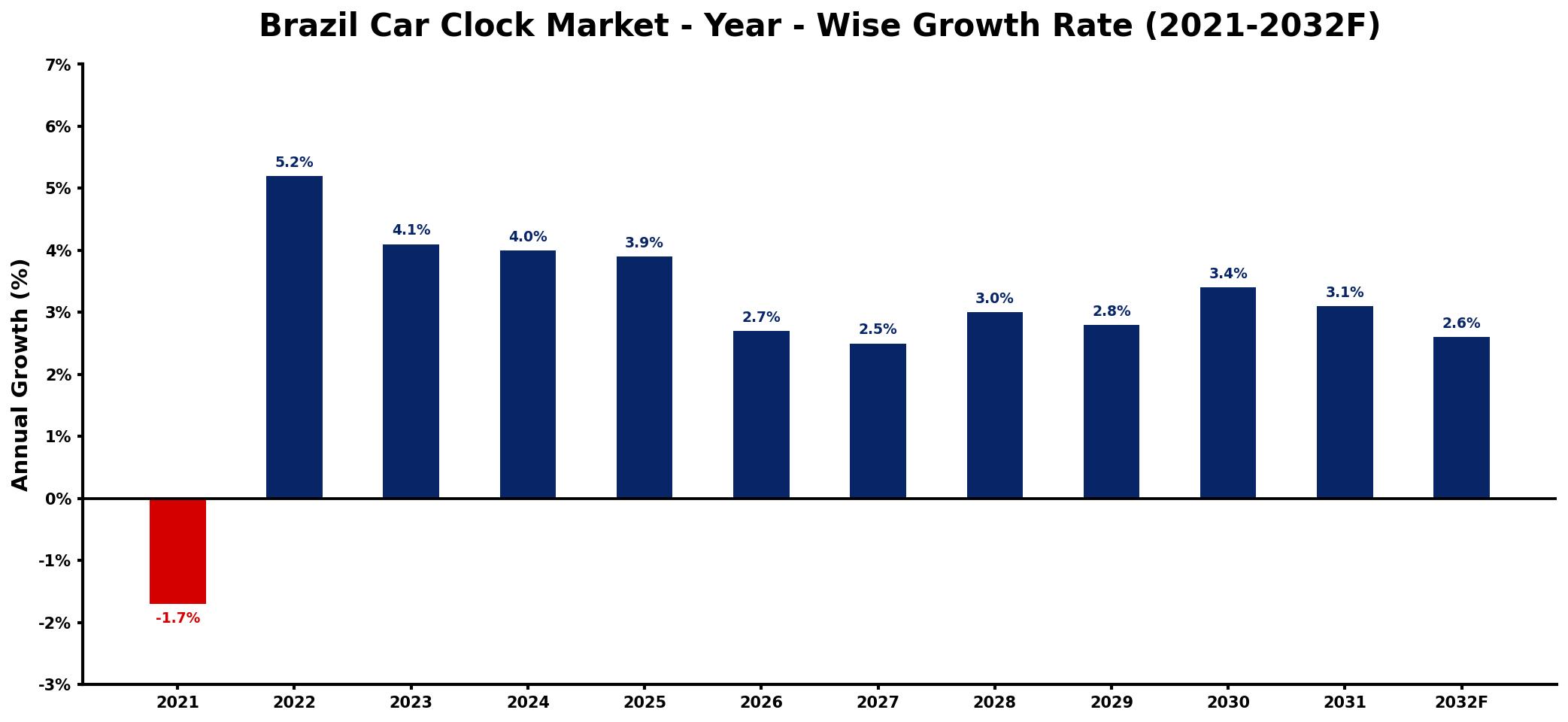
The table below presents the year‑wise growth rates along with the key drivers influencing the market
| Year | Growth Rate | Major Drivers |
| 2021 | -1.7% | Consumer spending on nonessentials declines |
| 2022 | 5.2% | Increase in automotive accessory demand |
| 2023 | 4.1% | Technological advancements in vehicle accessories |
| 2024 | 4.0% | Rising disposable income among consumers |
| 2025 | 3.9% | Expansion of online retail platforms |
| 2026 | 2.7% | Growing popularity of smart technologies |
| 2027 | 2.5% | Increased focus on vehicle customization |
| 2028 | 3.0% | Strengthening of automotive aftermarket services |
| 2029 | 2.8% | Surge in eco-friendly product offerings |
| 2030 | 3.4% | Enhanced consumer awareness of trends |
| 2031 | 3.1% | Rising interest in luxury features |
| 2032 | 2.6% | Investment in automotive innovation initiatives |
Note: Market size estimations and growth projections presented in this report are based on 6Wresearch's proprietary forecasting methodology, utilizing the latest available industry data, government publications, and primary research inputs.
Brazil Car Clock Market Synopsis
As the Brazilian automotive industry experiences continuous innovation, the demand for car clocks that harmoniously blend with digital interfaces is surging. Consumers are now favoring car clocks that not only tell time but also offer compatibility with mobile devices, navigation systems, and entertainment platforms, thereby enhancing the overall driving experience.
Moreover, the shift towards electric vehicles and smart technologies has put additional pressure on manufacturers to create car clocks that integrate seamlessly with advanced automotive systems. This pivot necessitates a fresh perspective on design, functionality, and technological compatibility to meet evolving consumer expectations.
Brazil Car Clock Market Key Takeaways
- The market is experiencing a shift towards integrating car clocks with advanced vehicle technologies.
- Consumer demand for personalized and high-tech driving experiences is a key growth driver.
- Compliance with government regulations regarding automotive safety standards is essential for manufacturers.
- Adapting to changing consumer preferences remains crucial for success in the market.
- The need for compatibility with modern vehicle systems is reshaping product development strategies.
Evaluation of Restraints in Brazil Car Clock Market
The Brazil Car Clock market faces significant restraints stemming from rapidly changing consumer preferences. Many consumers now prioritize multifunctional devices over traditional car clocks, posing challenges for manufacturers to innovate continually. Additionally, the integration of digital alternatives and smart technologies increases competition, which could dilute market share for conventional products. Moreover, rising cost pressures necessitate efficiency improvements and cost reduction strategies, compelling manufacturers to reassess their production and supply chain methodologies to remain viable.
Brazil Car Clock Market Trends
Current trends in the Brazil Car Clock market are leaning towards digitalization and the introduction of smart features. Enhanced functionality, such as integration with smartphone applications, GPS displays, and interactive user interfaces, is becoming a standard expectation. Furthermore, aesthetic appeal remains paramount, with sleek designs and customizable options attracting consumers. The burgeoning market for electric vehicles also presents a unique opportunity, as these vehicles often come equipped with more advanced technological interfaces, demanding corresponding upgrades in car clock functionalities.
Brazil Car Clock Market Opportunities
There are considerable growth opportunities in the Brazil Car Clock market, particularly for manufacturers willing to invest in innovation and design improvements. The shift towards electric and hybrid vehicles opens avenues for developing specialized car clocks that can efficiently integrate with these new systems. Moreover, tapping into the rising consumer interest in smart, connected devices can lead to the creation of multifunctional car clocks that address various needs, from navigation assistance to entertainment options.
Government Initiatives in the Brazil Car Clock Market
Government policies in Brazil significantly influence the automotive accessory market, including car clocks. Regulatory standards aimed at enhancing vehicle safety directly impact the design and functionality of car clocks. Compliance with these standards is crucial for manufacturers, necessitating continual updates to products to align with regulatory shifts. Furthermore, government incentives for electric vehicle adoption could spur growth in the car clock segment by demanding advanced integration of automotive technology.
Future Insights of the Brazil Car Clock Market
Looking ahead to the period from 2026 to 2032, the Brazil Car Clock market is poised for dynamic transformation. As consumer preferences evolve, demand for car clocks that blend technology with style will likely intensify. Manufacturers that prioritize innovation and adaptability will stand out, particularly as electric vehicle adoption increases. Anticipated advancements in automotive technology will also require seamless integration of timekeeping devices into a broader suite of vehicle functionalities, setting the stage for robust market growth.
Brazil Car Clock Market Latest Developments (2025 - 2026)
Recent developments in the Brazil Car Clock market indicate a concerted effort by manufacturers to enhance product offerings. Innovations focusing on digital interfaces and user engagement are on the rise, with many companies exploring collaborations to integrate their products into broader smart car ecosystems. Additionally, there is a noticeable uptick in consumer interest for car clocks that provide unique visual appeal and multifunctionality, aligning with the broader trends in automotive technology and design.
Brazil Car Clock Market - Key Attractiveness of the Report
- 10 Years of Market Numbers
- Historical Data Starting from 2022 to 2025
- Base Year: 2025
- Forecast Data until 2032
- Key Performance Indicators Impacting the Market
- Major Upcoming Developments and Projects
Key Highlights of the Report:
- Brazil Car Clock Market Outlook
- Market Size of Brazil Car Clock Market, 2025
- Forecast of Brazil Car Clock Market, 2032
- Historical Data and Forecast of Brazil Car Clock Revenues & Volume for the Period 2022-2032F
- Brazil Car Clock Market Trend Evolution
- Brazil Car Clock Market Drivers and Challenges
- Brazil Car Clock Price Trends
- Brazil Car Clock Porter's Five Forces
- Brazil Car Clock Industry Life Cycle
- Historical Data and Forecast of Brazil Car Clock Market Revenues & Volume By Type for the Period 2022-2032F
- Historical Data and Forecast of Brazil Car Clock Market Revenues & Volume By Analog Type for the Period 2022-2032F
- Historical Data and Forecast of Brazil Car Clock Market Revenues & Volume By Digital Type for the Period 2022-2032F
- Historical Data and Forecast of Brazil Car Clock Market Revenues & Volume By Application for the Period 2022-2032F
- Historical Data and Forecast of Brazil Car Clock Market Revenues & Volume By Passenger Cars for the Period 2022-2032F
- Historical Data and Forecast of Brazil Car Clock Market Revenues & Volume By Commercial Vehicles for the Period 2022-2032F
- Brazil Car Clock Import Export Trade Statistics
- Market Opportunity Assessment By Type
- Market Opportunity Assessment By Application
- Brazil Car Clock Top Companies Market Share
- Brazil Car Clock Competitive Benchmarking By Technical and Operational Parameters
- Brazil Car Clock Company Profiles
- Brazil Car Clock Key Strategic Recommendations






































