Brazil Cathode ray tube display Market Size, Share & Growth Rate
The Brazil Cathode ray tube display Market was estimated at USD 451 Million in 2025 and is projected to reach USD 541 Million by 2032, growing at a CAGR of 2.6% from 2026 to 2032. This stable growth, despite the market's overall decline due to competition from advanced technologies, can be attributed to niche applications where CRT displays still excel, particularly in sectors such as healthcare and aviation. Brazil's unique industrial needs and the legacy infrastructure in some markets continue to drive demand for CRT displays, ensuring a steady stream of opportunities.
Brazil Cathode ray tube display Market Year-wise Growth Rate and Key Drivers
This graph highlights how the Brazil Cathode ray tube display Market has steadily grown over the years, supported by major growth factors.
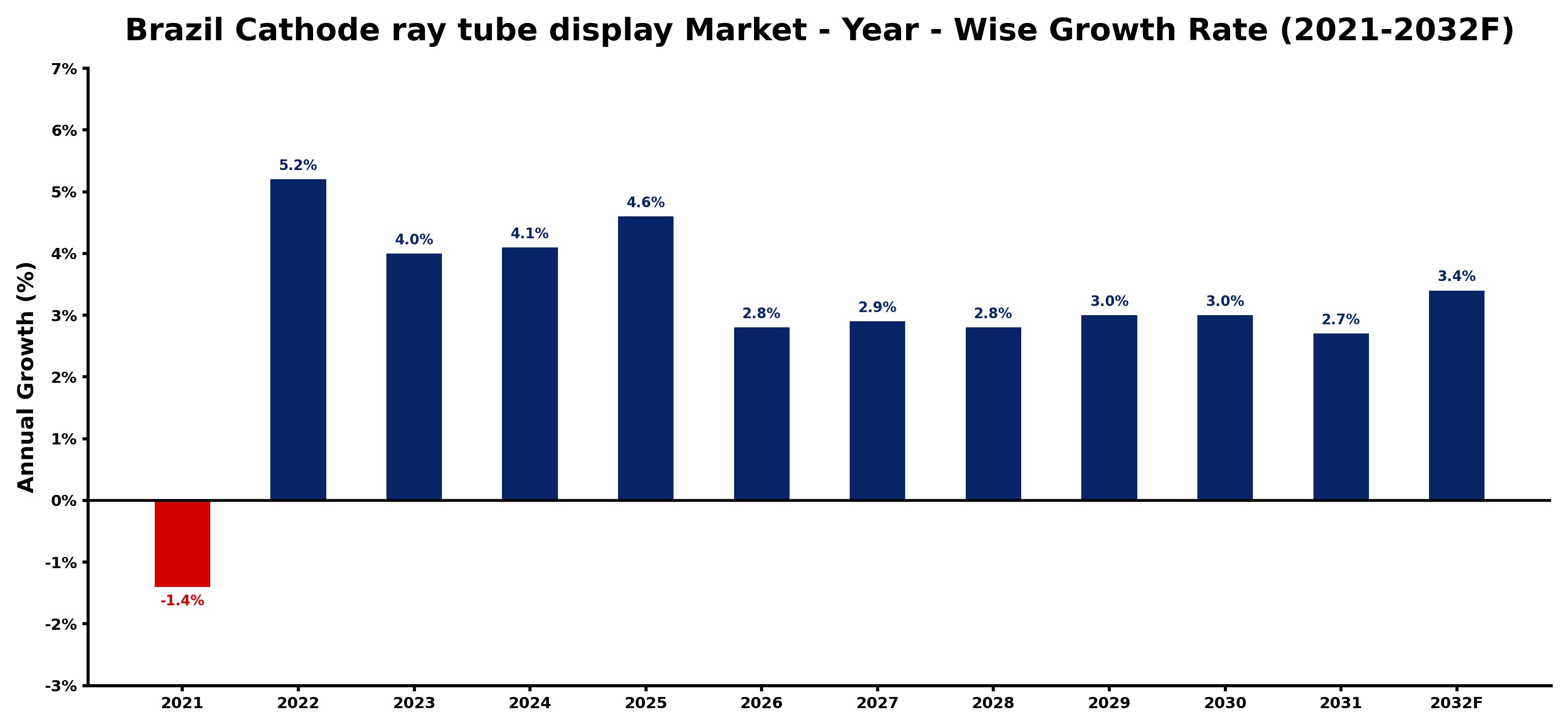
The table below presents the year‑wise growth rates along with the key drivers influencing the market
| Year | Growth Rate | Major Drivers |
| 2021 | -1.4% | Weak domestic demand curtailed investments in cathode ray tube production |
| 2022 | 5.2% | Domestic manufacturing recovery boosted demand for cathode ray tube components |
| 2023 | 4.0% | Domestic cathode ray tube manufacturing adapts to evolving export demands |
| 2024 | 4.1% | Higher cathode ray tube display production supports export market competitiveness |
| 2025 | 4.6% | Foundry modernization initiatives boosted cathode ray tube output efficiency |
| 2026 | 2.8% | Modernized foundry investments boost cathode ray tube output efficiency |
| 2027 | 2.9% | Higher investments in domestic CRT manufacturing boost export capabilities |
| 2028 | 2.8% | Foundry modernization projects boost local cathode ray tube production |
| 2029 | 3.0% | Domestic manufacturing recovery boosted cathode ray tube production rates |
| 2030 | 3.0% | Technology integration streamlined cathode ray tube production processes |
| 2031 | 2.7% | Domestic manufacturing recovery boosted cathode ray tube export capabilities |
| 2032 | 3.4% | Domestic manufacturing recovery boosted cathode ray tube display output |
Note - Market size estimations and growth projections presented in this report are based on 6Wresearch's advanced forecasting approach, validated with industry datasets as of June 2026.
Brazil Cathode ray tube display Market Synopsis
In Brazil, certain industries persist in utilizing CRT technology due to its unmatched image quality and durability, particularly in high-stakes environments like medical imaging and aircraft instrumentation. This enduring demand highlights the specific advantages of CRT displays that are hard to replicate with contemporary alternatives.
Moreover, as Brazil grapples with the complexities of electronic waste management, the market is seeing a shift towards sustainable disposal practices. This pivot not only addresses regulatory pressures but also opens avenues for innovative waste management solutions that can support the CRT display phase-out while catering to continued user requirements.
Brazil Cathode ray tube display Market Key Takeaways
- The Brazil CRT display market shows resilience through niche applications that rely on its superior image quality and durability.
- Government regulations on electronic waste management are becoming increasingly stringent, necessitating responsible practices from market players.
- Sustainable disposal methods are emerging as a critical factor in navigating the transition to newer display technologies.
- Healthcare, aviation, and industrial sectors represent key areas where CRT technology continues to thrive despite advancements in display technology.
- Continuous support and maintenance for existing CRT systems are crucial in maintaining market stability.
Evaluation of Restraints in Brazil Cathode ray tube display Market
The decline of the Brazil Cathode ray tube display market is significantly restrained by evolving technology and the shift towards more energy-efficient, eco-friendly display solutions. The mounting pressure from regulatory bodies concerning electronic waste management forces companies to rethink their end-of-life strategies for CRTs. Furthermore, the high cost of compliance with safety and environmental standards can serve as a barrier for smaller market players, leaving them at a disadvantage against larger corporations equipped to handle such challenges. Collectively, these factors hinder market growth and challenge the long-term viability of CRT displays in an increasingly modernized technological landscape.
Brazil Cathode ray tube display Market Trends
Recent trends indicate a heightened focus on eco-conscious practices within the Brazil CRT display market. Companies are exploring innovative recycling technologies to manage the challenges associated with electronic waste effectively. Furthermore, there is a growing interest in the refurbishment and repurposing of CRT displays, allowing businesses to extend the lifecycle of existing equipment. This not only caters to sustainability goals but also addresses budgetary constraints faced by sectors that depend on CRT technology.
Brazil Cathode ray tube display Market Opportunities
Opportunities lie in the integration of advanced technologies with CRT displays, enhancing their functionality while meeting modern standards. Collaboration with tech firms to develop hybrid solutions could capitalize on the unique strengths of CRT displays. Additionally, as regulatory frameworks evolve, there is a chance for market players to innovate in e-waste management, potentially leading to new business models focused on sustainability that can capture both domestic and international markets.
Government Initiatives in the Brazil Cathode ray tube display Market
The Brazilian government is increasingly focused on addressing electronic waste management through stringent policies aimed at promoting recycling and environmentally sound disposal practices. Public spending in the realm of waste management technology is on the rise, along with initiatives aimed at educating consumers about safe disposal methods. Programs that incentivize companies to adopt sustainable practices are also being implemented, providing market players with the necessary framework to navigate the complexities associated with CRT displays.
Future Insights of the Brazil Cathode ray tube display Market
Looking ahead to 2026-2032, the Brazil Cathode ray tube display market is expected to continue its modest growth trajectory, buoyed by its entrenched presence in critical industries. As electronic waste management technologies advance, there will be increasing demand for sustainable solutions for CRT disposal. Moreover, companies that can effectively blend traditional CRT benefits with modern technologies will likely find favorable market positioning. The transitional phase towards newer display technologies will challenge the market, yet presents an opportunity for strategic adaptations.
Brazil Cathode ray tube display Market Latest Developments (May 2025 - June 2026)
In recent months, the Brazilian CRT display market has witnessed a wave of initiatives aimed at improving electronic waste management processes. Companies are increasingly investing in research and development to create environmentally friendly disposal methods. Furthermore, collaborations between industry stakeholders and governmental bodies are on the rise, focusing on setting standards for safe CRT disposal. These trends indicate a proactive approach in dealing with the challenges posed by obsolete CRT technology while attempting to satisfy existing market demands.
Brazil Cathode ray tube display Market - Key Attractiveness of the Report
- 10 Years of Market Numbers
- Historical Data Starting from 2022 to 2025
- Base Year: 2025
- Forecast Data until 2032
- Key Performance Indicators Impacting the Market
- Major Upcoming Developments and Projects
Key Highlights of the Report:
- Brazil Cathode ray tube display Market Outlook
- Market Size of Brazil Cathode ray tube display Market, 2025
- Forecast of Brazil Cathode ray tube display Market, 2032
- Historical Data and Forecast of Brazil Cathode ray tube display Revenues & Volume for the Period 2022-2032F
- Brazil Cathode ray tube display Market Trend Evolution
- Brazil Cathode ray tube display Market Drivers and Challenges
- Brazil Cathode ray tube display Price Trends
- Brazil Cathode ray tube display Porter's Five Forces
- Brazil Cathode ray tube display Industry Life Cycle
- Historical Data and Forecast of Brazil Cathode ray tube display Market Revenues & Volume By Type for the Period 2022-2032F
- Historical Data and Forecast of Brazil Cathode ray tube display Market Revenues & Volume By Random Scan Display for the Period 2022-2032F
- Historical Data and Forecast of Brazil Cathode ray tube display Market Revenues & Volume By Raster Scan Display for the Period 2022-2032F
- Historical Data and Forecast of Brazil Cathode ray tube display Market Revenues & Volume By Screen Type for the Period 2022-2032F
- Historical Data and Forecast of Brazil Cathode ray tube display Market Revenues & Volume By Curved Screen for the Period 2022-2032F
- Historical Data and Forecast of Brazil Cathode ray tube display Market Revenues & Volume By Flat Screen for the Period 2022-2032F
- Historical Data and Forecast of Brazil Cathode ray tube display Market Revenues & Volume By Application for the Period 2022-2032F
- Historical Data and Forecast of Brazil Cathode ray tube display Market Revenues & Volume By Television Screen for the Period 2022-2032F
- Historical Data and Forecast of Brazil Cathode ray tube display Market Revenues & Volume By Desktop Computer Monitor for the Period 2022-2032F
- Historical Data and Forecast of Brazil Cathode ray tube display Market Revenues & Volume By Wireless Phone for the Period 2022-2032F
- Historical Data and Forecast of Brazil Cathode ray tube display Market Revenues & Volume By Portable IT Devices for the Period 2022-2032F
- Historical Data and Forecast of Brazil Cathode ray tube display Market Revenues & Volume By Others for the Period 2022-2032F
- Historical Data and Forecast of Brazil Cathode ray tube display Market Revenues & Volume By Industry Vertical for the Period 2022-2032F
- Historical Data and Forecast of Brazil Cathode ray tube display Market Revenues & Volume By Consumer Electronics for the Period 2022-2032F
- Historical Data and Forecast of Brazil Cathode ray tube display Market Revenues & Volume By Automotive for the Period 2022-2032F
- Historical Data and Forecast of Brazil Cathode ray tube display Market Revenues & Volume By Industrial for the Period 2022-2032F
- Historical Data and Forecast of Brazil Cathode ray tube display Market Revenues & Volume By Healthcare for the Period 2022-2032F
- Historical Data and Forecast of Brazil Cathode ray tube display Market Revenues & Volume By Others for the Period 2022-2032F
- Brazil Cathode ray tube display Import Export Trade Statistics
- Market Opportunity Assessment By Type
- Market Opportunity Assessment By Screen Type
- Market Opportunity Assessment By Application
- Market Opportunity Assessment By Industry Vertical
- Brazil Cathode ray tube display Top Companies Market Share
- Brazil Cathode ray tube display Competitive Benchmarking By Technical and Operational Parameters
- Brazil Cathode ray tube display Company Profiles
- Brazil Cathode ray tube display Key Strategic Recommendations






































