Brazil Cement and Concrete Market Summary
The brazil cement and concrete market was estimated at USD 199 Million in 2025 and is projected to reach USD 236 Million by 2032, growing at a CAGR of 2.7% from 2026 to 2032.
Brazil Cement and Concrete Market Year-wise Growth Rate and Key Drivers
This graph highlights how the Brazil Cement and Concrete Market has steadily grown over the past five years, supported by major growth factors.
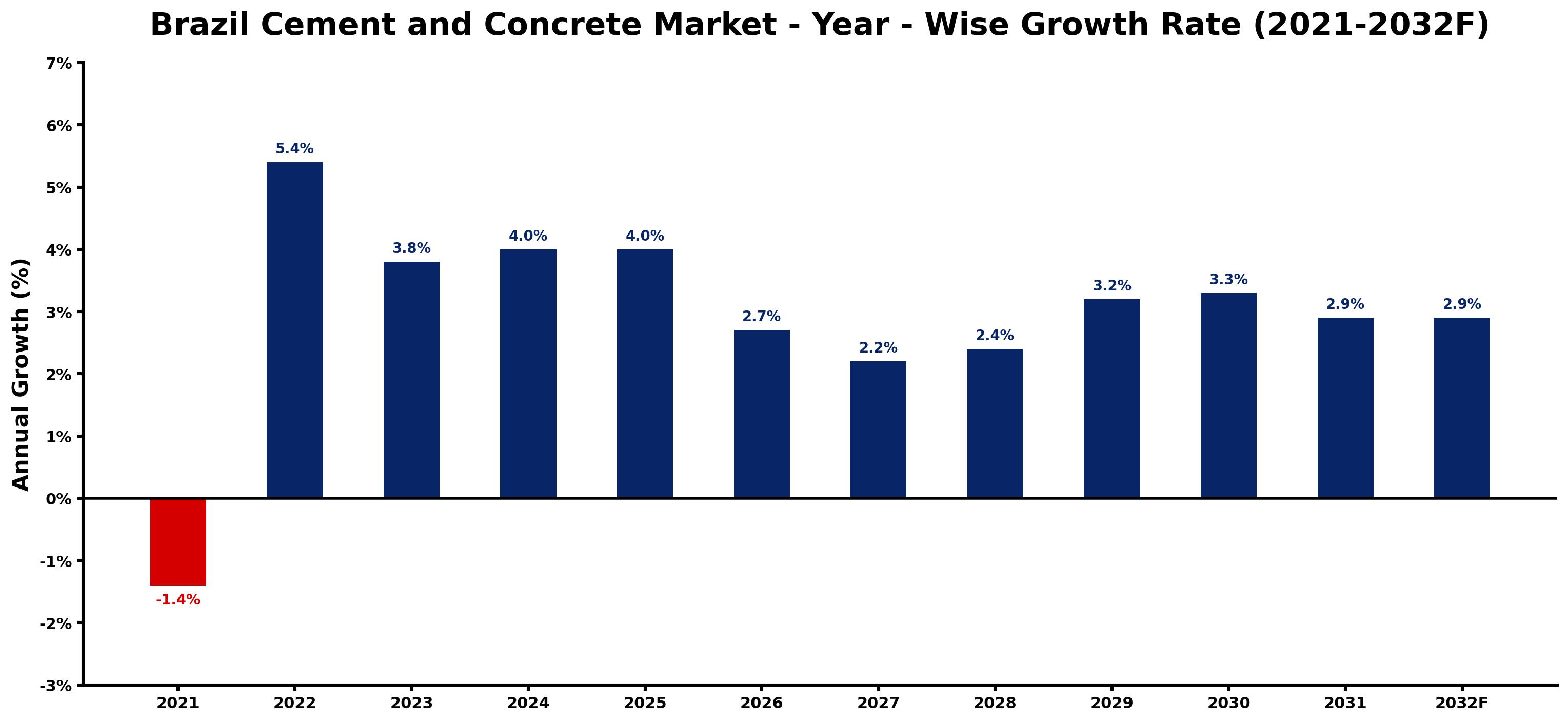
The table below presents the year wise growth rates along with the key drivers influencing the market
| Year | Growth Rate | Major Drivers |
| 2021 | -1.4% | Supply chain disruptions in the construction sector significantly hampered cement availability and project completions. |
| 2022 | 5.4% | Major infrastructure plans in Brazil prompted investment in cement production capabilities. |
| 2023 | 3.8% | Rural housing initiatives focused on sustainable materials expanded the concrete market significantly. |
| 2024 | 4.0% | Increased urbanization accelerated demand for concrete in residential and commercial developments. |
| 2025 | 4.0% | Investment in transportation infrastructure projects created new opportunities for the cement sector. |
| 2026 | 2.7% | Emerging technologies in concrete manufacturing improved efficiency and reduced costs considerably. |
| 2027 | 2.2% | Rising environmental awareness prompted shifts towards greener cement production methods. |
| 2028 | 2.4% | Integration of recycled materials into concrete formulations gained traction among manufacturers. |
| 2029 | 3.2% | Investment in regional logistics networks enhanced distribution efficiency for cement producers. |
| 2030 | 3.3% | Economic stabilization led to a resurgence in commercial real estate development activities. |
| 2031 | 2.9% | Collaborative ventures between local governments and contractors accelerated construction timelines. |
| 2032 | 2.9% | Favorable trade agreements with neighboring countries expanded market access for local producers. |
Note - Market size estimations and growth projections presented in this report are based on 6Wresearch's advanced forecasting approach, validated with industry datasets as of June 2026.
Brazil Cement and Concrete Market Synopsis
The Brazil Cement and Concrete Market is projected to reach 2.7% and witness significant growth during the forecast period (2026-2032). This market serves as a cornerstone for the country's construction and infrastructure sectors, driven by urbanization trends, government initiatives, and advancements in sustainable construction practices. The ongoing evolution of concrete technology, particularly through the introduction of eco-friendly and high-performance materials, plays a pivotal role in shaping the future landscape of the Brazil Cement and Concrete Market.
Brazil Cement and Concrete Market Growth Drivers
The Brazil Cement and Concrete Market's expansion is primarily linked to the vitality of the construction sector. Key growth drivers include:
- The increasing pace of urbanization in Brazil, leading to higher demand for residential and commercial construction, significantly boosts the requirement for cement and concrete products.
- Government infrastructure projects, such as road construction, bridges, and public buildings, bolster the market by providing substantial investment and generating demand for quality cement and concrete solutions.
- The trend towards sustainable construction practices encourages the use of innovative materials, including self-healing concrete and other eco-friendly alternatives, thereby shaping market dynamics.
- Technological advancements in concrete production and application, enhancing durability and performance, contribute to the attractiveness of new projects and renovations.
- The global emphasis on reducing carbon footprints drives local companies to adopt greener manufacturing processes, further stimulating market growth.
Brazil Cement and Concrete Market Challenges and Restraints
Despite the promising outlook for the Brazil Cement and Concrete Market, several challenges are affecting its trajectory:
- Fluctuations in infrastructure development activities can lead to market volatility, impacting demand for cement and concrete products.
- Environmental concerns related to cement production, including greenhouse gas emissions, necessitate adherence to stricter regulations, which can increase operational costs for companies.
- Raw material price volatility, particularly for crucial inputs like limestone and aggregates, poses a significant threat to profit margins and pricing strategies.
- Regulatory compliance with construction standards and sustainable practices can act as a barrier for manufacturers, requiring substantial investments in technology and training.
- The need to innovate continuously poses challenges for companies looking to remain competitive, especially in integrating new technologies and sustainable practices.
Brazil Cement and Concrete Market Government Investment and Initiatives
Government actions play a crucial role in shaping the Brazil Cement and Concrete Market. Key initiatives include:
- The Brazilian government emphasizes the adoption of sustainable construction practices, actively promoting research into alternative building materials.
- Public investments in large-scale infrastructure projects are designed to stimulate economic growth and improve national competitiveness, indirectly benefitting the cement and concrete market.
- Incentives for utilizing green construction technologies are being offered, aligning with global environmental agendas and enhancing local market capabilities.
- The safe and sustainable development of the cement and concrete industry is supported by regulations aimed at reducing the environmental impact of production processes.
- Collaborative ventures between the government and private sector aim to foster innovation in construction techniques and materials, ensuring a resilient and forward-looking market landscape.
Brazil Cement and Concrete Market Latest Developments (May 2025 - June 2026)
Recent developments within the Brazil Cement and Concrete Market from May 2025 to June 2026 indicate a trend towards diversification and sustainability. The industry is increasingly focusing on technological enhancements that promote greener manufacturing processes while addressing the rising environmental concerns linked to traditional cement production. Furthermore, there is a notable increase in government-supported initiatives aimed at enhancing infrastructure resilience and encouraging the use of advanced materials. The market is also witnessing a shift toward collaborative projects that integrate innovative construction practices, reflecting a broader shift towards sustainability and efficiency in response to both national and international market demands.
Brazil Cement and Concrete Market - Key Attractiveness of the Report
- 10 Years of Market Numbers
- Historical Data Starting from 2022 to 2025
- Base Year: 2025
- Forecast Data until 2032
- Key Performance Indicators Impacting the Market
- Major Upcoming Developments and Projects
Key Highlights of the Report:
- Brazil Cement and Concrete Market Outlook
- Market Size of Brazil Cement and Concrete Market, 2025
- Forecast of Brazil Cement and Concrete Market, 2032
- Historical Data and Forecast of Brazil Cement and Concrete Revenues & Volume for the Period 2022-2032F
- Brazil Cement and Concrete Market Trend Evolution
- Brazil Cement and Concrete Market Drivers and Challenges
- Brazil Cement and Concrete Price Trends
- Brazil Cement and Concrete Porter's Five Forces
- Brazil Cement and Concrete Industry Life Cycle
- Historical Data and Forecast of Brazil Cement and Concrete Market Revenues & Volume By Type for the Period 2022-2032F
- Historical Data and Forecast of Brazil Cement and Concrete Market Revenues & Volume By Cement for the Period 2022-2032F
- Historical Data and Forecast of Brazil Cement and Concrete Market Revenues & Volume By Ready-Mix Concrete for the Period 2022-2032F
- Historical Data and Forecast of Brazil Cement and Concrete Market Revenues & Volume By Concrete PipeBrickand Block for the Period 2022-2032F
- Historical Data and Forecast of Brazil Cement and Concrete Market Revenues & Volume By Others for the Period 2022-2032F
- Historical Data and Forecast of Brazil Cement and Concrete Market Revenues & Volume By Applications for the Period 2022-2032F
- Historical Data and Forecast of Brazil Cement and Concrete Market Revenues & Volume By Residential for the Period 2022-2032F
- Historical Data and Forecast of Brazil Cement and Concrete Market Revenues & Volume By Nonresidential for the Period 2022-2032F
- Brazil Cement and Concrete Import Export Trade Statistics
- Market Opportunity Assessment By Type
- Market Opportunity Assessment By Applications
- Brazil Cement and Concrete Top Companies Market Share
- Brazil Cement and Concrete Competitive Benchmarking By Technical and Operational Parameters
- Brazil Cement and Concrete Company Profiles
- Brazil Cement and Concrete Key Strategic Recommendations






































