Mexico Cement and Concrete Market Summary
The mexico cement and concrete market was estimated at USD 110 Million in 2025 and is projected to reach USD 128 Million by 2032, growing at a CAGR of 1.3% from 2026 to 2032.
Mexico Cement and Concrete Market Year-wise Growth Rate and Key Drivers
This graph highlights how the Mexico Cement and Concrete Market has steadily grown over the past five years, supported by major growth factors.
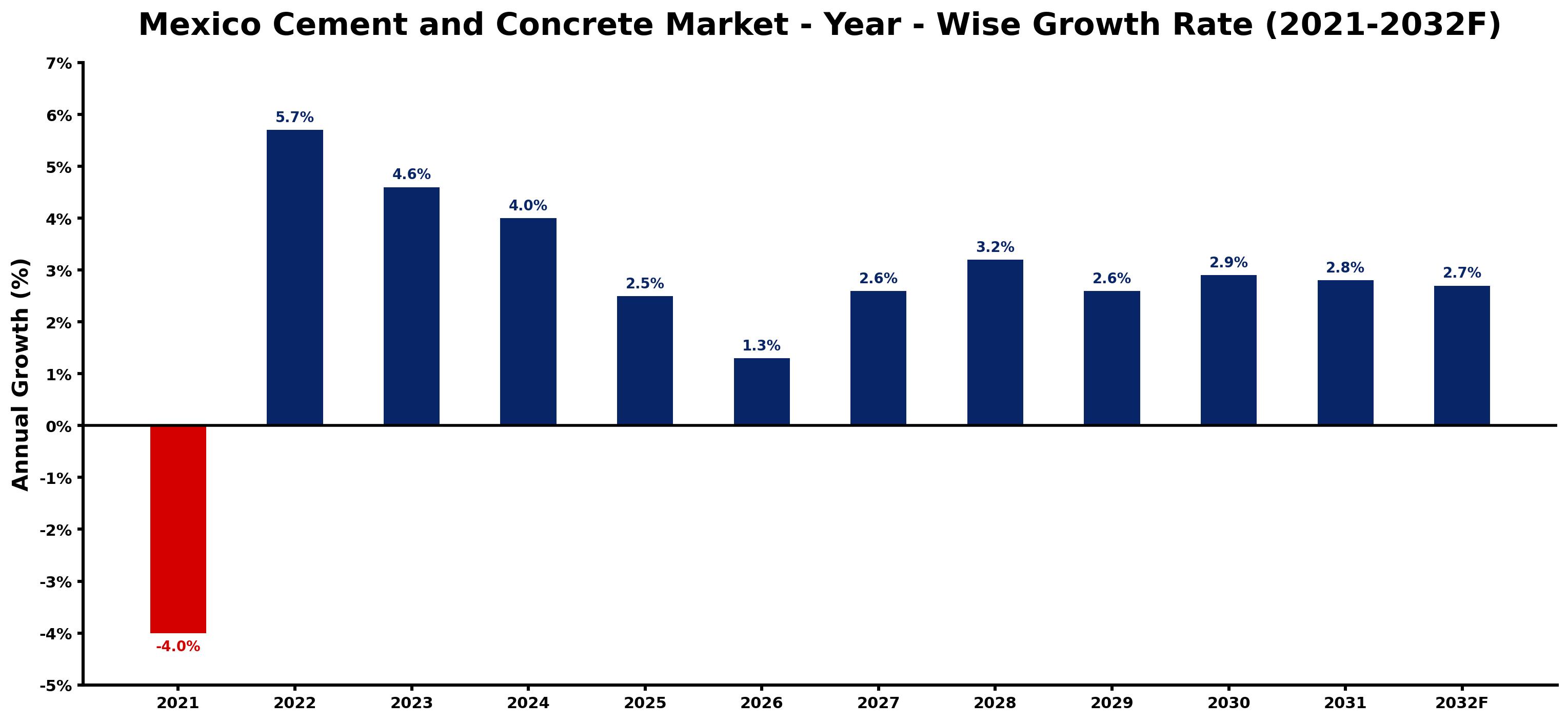
The table below presents the year wise growth rates along with the key drivers influencing the market
| Year | Growth Rate | Major Drivers |
| 2021 | -4.0% | Deteriorating construction activity due to pandemicrelated restrictions curtailed cement demand significantly throughout 2021. |
| 2022 | 5.7% | Infrastructure investment plans begin to materialize, enhancing market stability and growth. |
| 2023 | 4.6% | Increased urbanization drives demand for residential and commercial construction projects. |
| 2024 | 4.0% | Sustainable building practices shape preferences for eco-friendly concrete solutions. |
| 2025 | 2.5% | Technological advancements enable increased efficiency in cement production processes. |
| 2026 | 1.3% | Energy-efficient construction materials attract interest from developers and architects alike. |
| 2027 | 2.6% | Foreign investments flood into the market, spurring local industry expansion initiatives. |
| 2028 | 3.2% | Emerging trends in prefabricated concrete components streamline construction timelines noticeably. |
| 2029 | 2.6% | Public-private partnerships provide funding for large-scale infrastructure projects across Mexico. |
| 2030 | 2.9% | Urban redevelopment projects focus on modernizing aging infrastructure in major cities. |
| 2031 | 2.8% | Local manufacturers leverage advanced materials to meet evolving construction standards. |
| 2032 | 2.7% | Innovative recycling methods for concrete waste reduce environmental impact and costs. |
Note - Market size estimations and growth projections presented in this report are based on 6Wresearch's advanced forecasting approach, validated with industry datasets as of June 2026.
Mexico Cement and Concrete Market Synopsis
The Mexico Cement and Concrete Market is projected to reach 1.3% and witness significant growth during the forecast period (2026-2032). This growth is primarily attributed to an expanding construction industry and ongoing infrastructure projects across the country. Cement serves as a fundamental building material, while concrete plays a critical role in various infrastructure initiatives, including the construction of roads, bridges, and commercial buildings. The Mexican market is witnessing heightened investments in innovative technologies and sustainable production practices, aligning with the increasing demand for eco-friendly building materials.
Mexico Cement and Concrete Market Growth Drivers
The Mexico Cement and Concrete Market is being propelled forward by several pivotal factors:
- The robust construction sector is stimulated by massive public and private investments in infrastructure and housing projects, contributing significantly to the market's expansion.
- Urbanization trends are accelerating, with an influx of population into urban areas, leading to increased demand for both residential and commercial buildings.
- Government initiatives aimed at enhancing infrastructure facilities, including highways and public transport, are vital contributors to the surge in cement and concrete consumption.
- The ongoing economic recovery post-pandemic is further invigorating the construction landscape, encouraging further investments into cement and concrete applications.
- Advancements in construction technologies are allowing for more efficient use of materials, driving demand for innovative concrete solutions.
Mexico Cement and Concrete Market Challenges and Restraints
Despite the favorable growth scenario, the Mexico Cement and Concrete Market faces notable challenges:
- Environmental sustainability issues associated with cement production are causing increased scrutiny, necessitating the development of greener alternatives and processes.
- Infrastructure project delays, often attributed to regulatory complexities and funding constraints, pose risks to market stability and growth.
- Economic uncertainties, including fluctuations in construction activities, can impact demand for cement and concrete products adversely.
- The competitive landscape has evolved, with alternative building materials gaining popularity, potentially complicating the market for traditional cement and concrete manufacturers.
- Rising energy costs and supply chain disruptions may affect production and operational efficiencies, further challenging the market dynamics.
Mexico Cement and Concrete Market Government Investment and Initiatives
Government policy plays a crucial role in shaping the Mexico Cement and Concrete Market. Significant public investments are directed towards improving infrastructure and residential projects, which support market growth. Key initiatives include:
- Investment in public works programs aimed at enhancing road networks, bridges, and public transport systems, consequently increasing the demand for cement and concrete.
- Implementation of regulations that promote environmentally sustainable practices throughout the manufacturing processes, encouraging industry players to adopt greener technologies.
- Development of strategic plans to address housing shortages and urbanization challenges, leading to increased construction activities across major cities.
- Support for local manufacturers through subsidies or incentives aimed at boosting production capabilities and technological innovations.
- Collaboration with private sector stakeholders to enhance infrastructure funding, thereby ensuring timely project completions and sustained growth in the cement and concrete sectors.
Mexico Cement and Concrete Market Latest Developments (May 2025 - June 2026)
During the period from May 2025 to June 2026, the Mexico Cement and Concrete Market has witnessed several noteworthy developments:
- An increasing emphasis on sustainable construction practices has led to the adoption of recycled materials in concrete production, aligning with global trends towards eco-friendliness.
- Technological advancements have improved the efficiency of cement production, lowering the carbon footprint associated with manufacturing processes.
- Market participants are collaborating with governmental bodies to comply with evolving regulations aimed at reducing environmental impacts, thereby enhancing their operational standards.
- There has been a marked increase in public and private partnerships focusing on infrastructure projects, reflecting a proactive approach towards addressing the infrastructure deficit.
- Innovative financing solutions are being explored to facilitate major construction initiatives, ensuring stable cash flows and project viability in an uncertain economic environment.
Mexico Cement and Concrete Market - Key Attractiveness of the Report
- 10 Years of Market Numbers
- Historical Data Starting from 2022 to 2025
- Base Year: 2025
- Forecast Data until 2032
- Key Performance Indicators Impacting the Market
- Major Upcoming Developments and Projects
Key Highlights of the Report:
- Mexico Cement and Concrete Market Outlook
- Market Size of Mexico Cement and Concrete Market, 2025
- Forecast of Mexico Cement and Concrete Market, 2032
- Historical Data and Forecast of Mexico Cement and Concrete Revenues & Volume for the Period 2022-2032F
- Mexico Cement and Concrete Market Trend Evolution
- Mexico Cement and Concrete Market Drivers and Challenges
- Mexico Cement and Concrete Price Trends
- Mexico Cement and Concrete Porter's Five Forces
- Mexico Cement and Concrete Industry Life Cycle
- Historical Data and Forecast of Mexico Cement and Concrete Market Revenues & Volume By Type for the Period 2022-2032F
- Historical Data and Forecast of Mexico Cement and Concrete Market Revenues & Volume By Cement for the Period 2022-2032F
- Historical Data and Forecast of Mexico Cement and Concrete Market Revenues & Volume By Ready-Mix Concrete for the Period 2022-2032F
- Historical Data and Forecast of Mexico Cement and Concrete Market Revenues & Volume By Concrete PipeBrickand Block for the Period 2022-2032F
- Historical Data and Forecast of Mexico Cement and Concrete Market Revenues & Volume By Others for the Period 2022-2032F
- Historical Data and Forecast of Mexico Cement and Concrete Market Revenues & Volume By Applications for the Period 2022-2032F
- Historical Data and Forecast of Mexico Cement and Concrete Market Revenues & Volume By Residential for the Period 2022-2032F
- Historical Data and Forecast of Mexico Cement and Concrete Market Revenues & Volume By Nonresidential for the Period 2022-2032F
- Mexico Cement and Concrete Import Export Trade Statistics
- Market Opportunity Assessment By Type
- Market Opportunity Assessment By Applications
- Mexico Cement and Concrete Top Companies Market Share
- Mexico Cement and Concrete Competitive Benchmarking By Technical and Operational Parameters
- Mexico Cement and Concrete Company Profiles
- Mexico Cement and Concrete Key Strategic Recommendations






































