Brazil Chain Drivers Market Size, Share & Growth Rate
The Brazil Chain Drivers Market was estimated at USD 214 Million in 2025 and is projected to reach USD 296 Million by 2032, growing at a CAGR of 4.7% from 2026 to 2032. This growth trajectory is driven by an increasing demand for industrial machinery and conveyor systems, essential for efficient power transmission across various sectors. As Brazil's manufacturing and transportation infrastructure expands, the need for durable and reliable chain drivers will be pivotal in ensuring operational efficiency and reducing maintenance costs.
Brazil Chain Drivers Market Year-wise Growth Rate and Key Drivers
This graph highlights how the Brazil Chain Drivers Market has steadily grown over the years, supported by major growth factors.
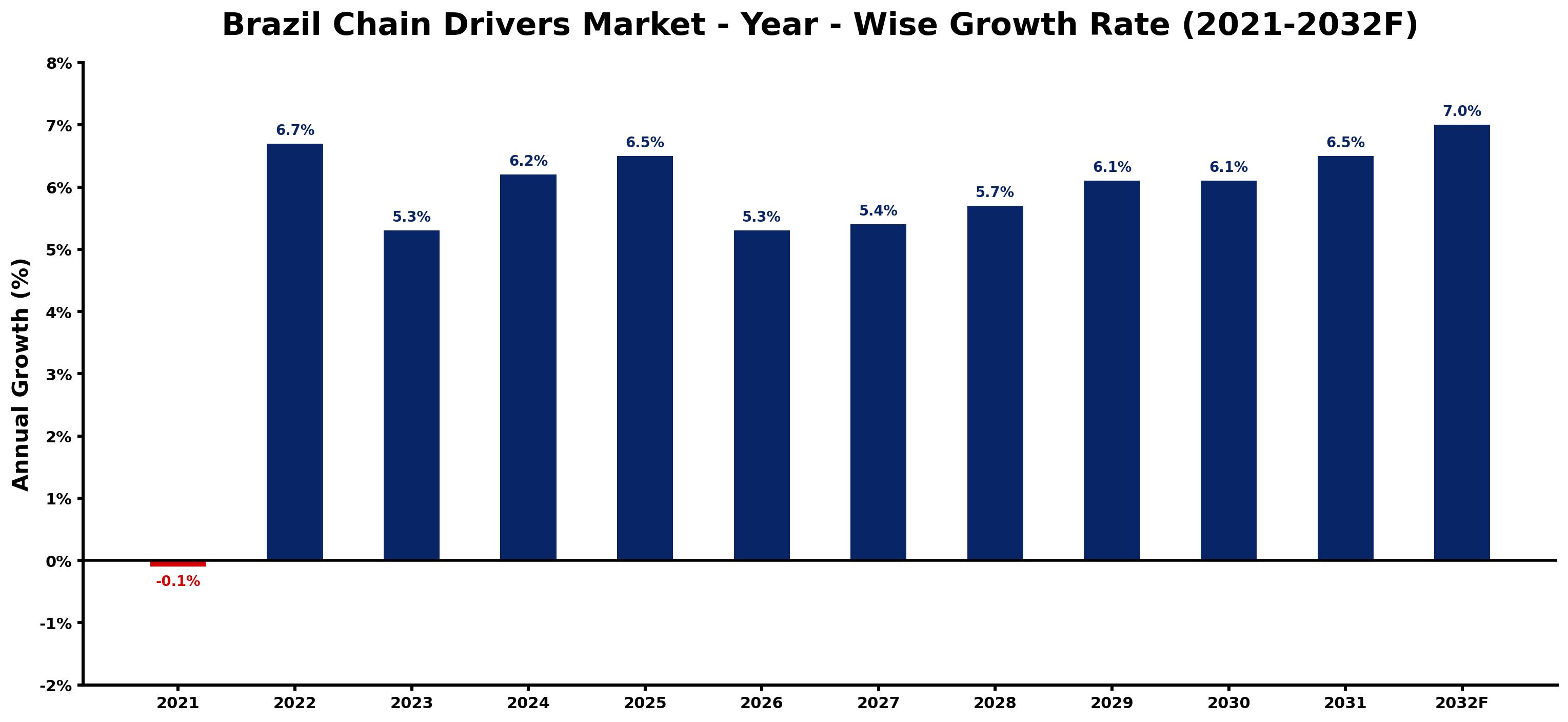
The table below presents the year‑wise growth rates along with the key drivers influencing the market
| Year | Growth Rate | Major Drivers |
| 2021 | -0.1% | Government infrastructure modernization initiatives |
| 2022 | 6.7% | Growing renewable energy integration projects |
| 2023 | 5.3% | Increasing industrial automation investments |
| 2024 | 6.2% | Increasing industrial automation investments |
| 2025 | 6.5% | Expansion of transportation and logistics networks |
| 2026 | 5.3% | Increasing adoption of advanced technologies |
| 2027 | 5.4% | Rising electricity demand across industries |
| 2028 | 5.7% | Rising electricity demand across industries |
| 2029 | 6.1% | Government infrastructure modernization initiatives |
| 2030 | 6.1% | Rapid growth in telecom and data center sectors |
| 2031 | 6.5% | Increasing industrial automation investments |
| 2032 | 7.0% | Expansion of transportation and logistics networks |
Note - Market size estimations and growth projections presented in this report are based on 6Wresearch’s advanced forecasting approach, validated with industry datasets as of June 2026.
Brazil Chain Drivers Market Synopsis
In recent years, the Brazil Chain Drivers Market has experienced considerable momentum, fueled by the resurgence of industrial activity post-pandemic. However, as the market looks ahead, it faces challenges stemming from economic fluctuations and evolving industrial demands. This dynamic landscape necessitates a keen focus on innovation and adaptability among manufacturers.
Looking forward, the market is expected to navigate a complex environment marked by competition and shifts in sector-specific requirements. The increasing integration of advanced technologies in power transmission systems presents both challenges and opportunities, compelling stakeholders to reassess their strategies to maintain competitiveness.
Brazil Chain Drivers Market Key Takeaways
- The Brazil Chain Drivers Market is set for robust growth, driven by increased industrial activities and evolving transportation infrastructures.
- Key applications include machinery, conveyors, bicycles, and motorcycles, emphasizing the versatility of chain drivers.
- Fluctuations in demand from key industries such as manufacturing and automotive assembly can impact market dynamics significantly.
- Government regulations aim to enhance safety standards and promote equipment reliability within the chain drivers sector.
- Competition from alternative power transmission solutions poses ongoing challenges for domestic manufacturers.
Evaluation of Restraints in Brazil Chain Drivers Market
The Brazil Chain Drivers Market faces several restraints that could hinder its potential for growth. Economic uncertainties, particularly in the manufacturing and agricultural sectors, create a volatile environment that affects demand for chain drives. Additionally, changes in industrial production levels may lead to inconsistent purchasing patterns among key clients. The competitive landscape is further complicated by the presence of alternative power transmission systems, as well as the pressure from imported chain drives, which can impact pricing strategies and market share for domestic producers.
Brazil Chain Drivers Market Trends
Several emerging trends are shaping the Brazil Chain Drivers Market. A notable shift towards automation and smart technologies in manufacturing processes is leading to increased adoption of advanced chain driver systems. Moreover, there is a growing emphasis on sustainability and energy efficiency, prompting manufacturers to innovate and develop eco-friendly chain solutions. As industries continue to evolve, the demand for customized chain drivers that meet specific operational requirements is also on the rise.
Brazil Chain Drivers Market Opportunities
The Brazil Chain Drivers Market presents genuine growth opportunities, particularly in sectors such as renewable energy and logistics. As businesses seek to improve efficiency and reduce operational costs, investing in advanced chain systems becomes increasingly attractive. Furthermore, the modernization of industrial facilities and the expansion of transportation infrastructure will require robust and reliable chain drives, creating avenues for investment and development. Companies that adapt to emerging technologies and focus on innovation will likely capture significant market share in the coming years.
Government Initiatives in the Brazil Chain Drivers Market
In Brazil, government initiatives aimed at regulating industrial machinery play a crucial role in the chain drivers market. Policies focus on enhancing workplace safety and promoting the reliability of equipment through established standards for chain design, installation, and maintenance. Additionally, government programs provide training and certification for chain driver operators, ensuring that personnel are equipped to maintain operational efficiency. Measures to enforce quality control standards further contribute to maintaining product integrity and safety across the industry.
Future Insights of the Brazil Chain Drivers Market
As we look towards 2026-2032, the Brazil Chain Drivers Market is poised for significant transformation. The intersection of technology and manufacturing will drive new applications for chain drivers, particularly in industries prioritizing automation and efficiency. Companies that leverage innovation to meet the evolving needs of their clients will have a competitive advantage. Additionally, the market may witness increased consolidation as players seek to optimize their operations and product offerings in response to fluctuating demands.
Brazil Chain Drivers Market Latest Developments (May 2025 - June 2026)
Recent developments in the Brazil Chain Drivers Market reflect a robust push towards innovation and enhanced efficiency. Companies are increasingly investing in research and development to introduce advanced chain systems that cater to specific industry needs. Simultaneously, there is a noticeable trend towards strategic collaborations aimed at integrating smart technologies into power transmission solutions. This progressive direction underscores a commitment to elevating the standards of performance and reliability in the market.
Brazil Chain Drivers Market - Key Attractiveness of the Report
- 10 Years of Market Numbers
- Historical Data Starting from 2022 to 2025
- Base Year: 2025
- Forecast Data until 2032
- Key Performance Indicators Impacting the Market
- Major Upcoming Developments and Projects
Key Highlights of the Report:
- Brazil Chain Drivers Market Outlook
- Market Size of Brazil Chain Drivers Market, 2025
- Forecast of Brazil Chain Drivers Market, 2032
- Historical Data and Forecast of Brazil Chain Drivers Revenues & Volume for the Period 2022-2032F
- Brazil Chain Drivers Market Trend Evolution
- Brazil Chain Drivers Market Drivers and Challenges
- Brazil Chain Drivers Price Trends
- Brazil Chain Drivers Porter's Five Forces
- Brazil Chain Drivers Industry Life Cycle
- Historical Data and Forecast of Brazil Chain Drivers Market Revenues & Volume By Product Type for the Period 2022-2032F
- Historical Data and Forecast of Brazil Chain Drivers Market Revenues & Volume By Roller Chains for the Period 2022-2032F
- Historical Data and Forecast of Brazil Chain Drivers Market Revenues & Volume By Silent Chains for the Period 2022-2032F
- Historical Data and Forecast of Brazil Chain Drivers Market Revenues & Volume By Leaf Chains for the Period 2022-2032F
- Historical Data and Forecast of Brazil Chain Drivers Market Revenues & Volume By Others for the Period 2022-2032F
- Historical Data and Forecast of Brazil Chain Drivers Market Revenues & Volume By Applications for the Period 2022-2032F
- Historical Data and Forecast of Brazil Chain Drivers Market Revenues & Volume By Industrial Sector for the Period 2022-2032F
- Historical Data and Forecast of Brazil Chain Drivers Market Revenues & Volume By Heavy Equipment Industry for the Period 2022-2032F
- Historical Data and Forecast of Brazil Chain Drivers Market Revenues & Volume By Agricultural Equipment Industry for the Period 2022-2032F
- Historical Data and Forecast of Brazil Chain Drivers Market Revenues & Volume By Others for the Period 2022-2032F
- Brazil Chain Drivers Import Export Trade Statistics
- Market Opportunity Assessment By Product Type
- Market Opportunity Assessment By Applications
- Brazil Chain Drivers Top Companies Market Share
- Brazil Chain Drivers Competitive Benchmarking By Technical and Operational Parameters
- Brazil Chain Drivers Company Profiles
- Brazil Chain Drivers Key Strategic Recommendations






































