Brazil Consumer IAM Market Size & Growth Rate (2026-2032)
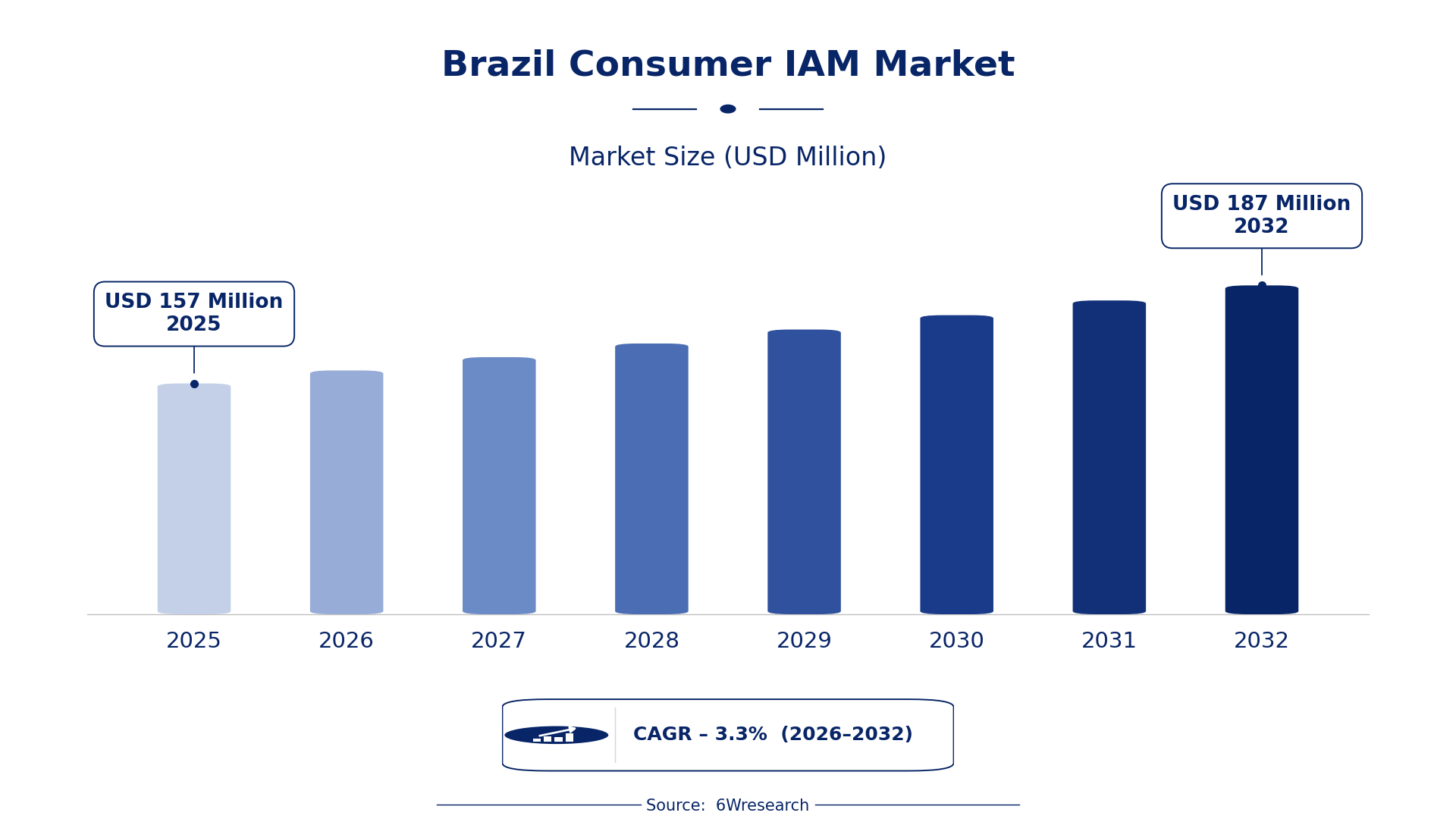
The Brazil Consumer IAM Market was estimated at USD 157 Million in 2025 and is projected to reach USD 187 Million by 2032, growing at a CAGR of 3.3% from 2026 to 2032.
Brazil Consumer IAM Market Synopsis
As digital channels become the primary means of consumer interaction in Brazil, businesses are investing heavily in Consumer Identity and Access Management (CIAM) solutions. The growing demand for personalized experiences and secure transactions drives the need for robust IAM frameworks that simplify access while ensuring high security.
With increasing regulatory scrutiny surrounding data protection, the Brazilian market is seeing a shift toward compliance-driven CIAM solutions. Organizations are tasked with not only streamlining user experiences but also with safeguarding consumer information in a landscape marked by evolving privacy regulations.
Brazil Consumer IAM Market Year-wise Growth Rate and Key Drivers
This graph illustrates the annual growth rates of the Brazil Consumer IAM Market from 2021 to 2032, highlighting a steady upward trajectory and projected expansion over the forecast period.
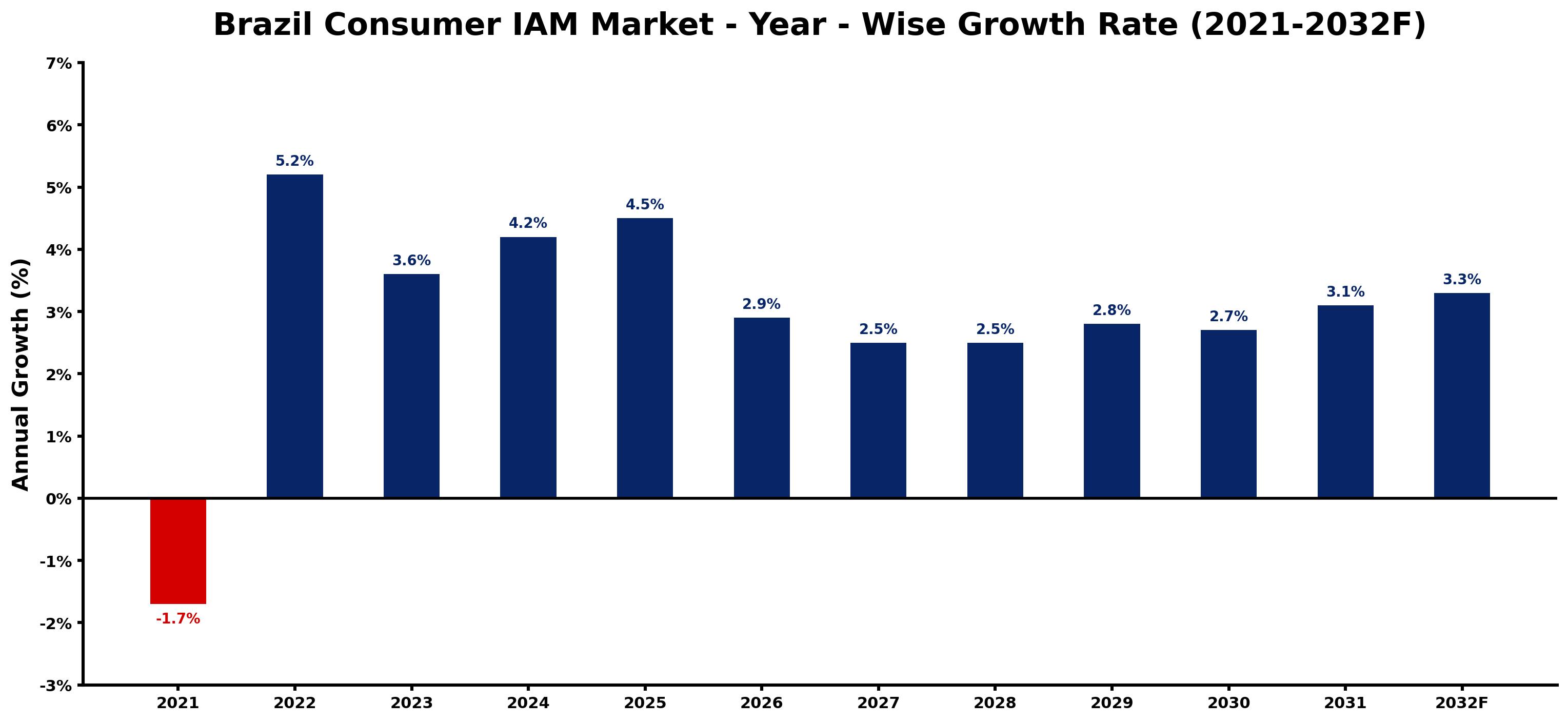
The table below presents the year‑wise growth rates along with the key drivers influencing the market
| Year | Growth Rate | Major Drivers |
| 2021 | -1.7% | Lack of trust in data protection regulations. |
| 2022 | 5.2% | Increased regulations on data privacy by ANPD. |
| 2023 | 3.6% | Rising cybersecurity threats driving demand for IAM solutions. |
| 2024 | 4.2% | Growing adoption of digital payments enhancing identity verification needs. |
| 2025 | 4.5% | Government initiatives promoting digital identity for public services. |
| 2026 | 2.9% | Surge in online banking functionalities requiring secure authentication. |
| 2027 | 2.5% | Digital transformation in SMEs increasing IAM service uptake. |
| 2028 | 2.5% | Higher consumer awareness of data security in shopping. |
| 2029 | 2.8% | Emergence of biometrics technology enhancing user authentication methods. |
| 2030 | 2.7% | Regulatory compliance mandates increasing IAM implementation in sectors. |
| 2031 | 3.1% | Adoption of multi-factor authentication by leading retail chains. |
| 2032 | 3.3% | Partnerships between fintechs and IAM vendors boosting market growth. |
Note: Market size estimations and growth projections presented in this report are based on 6Wresearch's proprietary forecasting methodology, utilizing the latest available industry data, government publications, and primary research inputs.
Brazil Consumer IAM Market Key Takeaways
Below are some of the specific key takeaways from the market, including:
- Consumer demand for personalized services accelerates the adoption of CIAM solutions.
- Businesses must balance user convenience with stringent security protocols.
- Compliance with evolving regulations is a primary market driver.
- Investment in advanced authentication methods is increasing among organizations.
- Privacy concerns among consumers continue to challenge IAM implementations.
Evaluation of Restraints in Brazil Consumer IAM Market
The Brazil Consumer IAM Market faces notable restraints that could impede its growth trajectory. One major hurdle is the varying levels of digital literacy among consumers, which complicates the implementation of complex authentication systems. Many users may find advanced security measures cumbersome, leading to potential disengagement. Additionally, privacy concerns persist, as consumers grow wary of how their personal information is managed and shared. Businesses must address these challenges head-on to ensure consumer trust and loyalty.
Brazil Consumer IAM Market Trends
A noticeable trend in the Brazil Consumer IAM Market is the shift toward AI and machine learning integration for enhanced user authentication. These technologies are helping organizations predict and mitigate fraud risks while streamlining user experiences. Another trend is the increasing focus on consent management; businesses are prioritizing transparency in data collection to align with consumer expectations and regulatory demands. The rise of mobile-first strategies is also shaping CIAM solutions, as organizations aim to provide easy access across devices while maintaining security.
Brazil Consumer IAM Market Opportunities
Significant growth opportunities lie in sectors like e-commerce and financial services, where personalized customer interactions are paramount. Companies that invest in innovative identity verification solutions will be well-positioned to capture a larger share of the market. on top of that, as small and medium enterprises (SMEs) increasingly adopt digital services, tailored CIAM solutions that cater to their unique needs can unlock new revenue streams.
Government Initiatives in the Brazil Consumer IAM Market
Government policies are increasingly shaping the Brazil Consumer IAM Market, with a clear focus on enhancing data protection and user privacy. Recent legislation aims to enforce stricter data management protocols, impacting how companies handle consumer identities. As regulations evolve, ongoing collaboration between governmental entities and industry stakeholders will be crucial for developing effective frameworks that benefit all parties involved.
- A regulatory framework introduced in 2025 mandating compliance with stringent data protection standards.
- A national digital infrastructure upgrade programme is currently underway, aimed at enhancing cybersecurity measures across sectors.
- A planned public-private initiative expected to facilitate consumer education on data privacy is set to launch in 2026.
- Ongoing consultations with technology leaders to develop a comprehensive framework addressing digital identity security concerns.
Future Insights of the Brazil Consumer IAM Market
Looking ahead to 2026-2032, the Brazil Consumer IAM Market is expected to witness a shift toward more sophisticated solutions that prioritize both security and user experience. As businesses adapt to stringent regulatory requirements, CIAM technologies will likely evolve to incorporate more intelligent algorithms and flexible privacy settings. Companies that stay ahead of the regulatory curve and embrace technological advancements will be better positioned to thrive in this competitive market.
Brazil Consumer IAM Market Latest Developments
Recent developments in the Brazil Consumer IAM Market indicate a surge in activity, driven by businesses' need for enhanced security solutions. The past year has seen many organizations reevaluating their IAM strategies to align with new regulations and consumer expectations.
- A leading technology vendor launched a new CIAM platform in Q3 2025 that integrates AI-based identity verification solutions, enhancing security measures for online transactions.
- An initiative that began in early 2025 and remains underway focuses on establishing industry benchmarks for data privacy compliance among CIAM providers.
- Development of a new multi-factor authentication (MFA) solution is expected to be completed by mid-2026, aimed at improving access security for consumers across digital channels.
- A partnership between local startups and established firms was announced in late 2025, aimed at developing user-centric authentication tools that enhance consumer experiences while maintaining security.
Brazil Consumer IAM Market - Key Attractiveness of the Report
- 10 Years of Market Numbers
- Historical Data Starting from 2022 to 2025
- Base Year: 2025
- Forecast Data until 2032
- Key Performance Indicators Impacting the Market
- Major Upcoming Developments and Projects
Key Highlights of the Report:
- Brazil Consumer IAM Market Outlook
- Market Size of Brazil Consumer IAM Market, 2025
- Forecast of Brazil Consumer IAM Market, 2032
- Historical Data and Forecast of Brazil Consumer IAM Revenues & Volume for the Period 2022-2032F
- Brazil Consumer IAM Market Trend Evolution
- Brazil Consumer IAM Market Drivers and Challenges
- Brazil Consumer IAM Price Trends
- Brazil Consumer IAM Porter's Five Forces
- Brazil Consumer IAM Industry Life Cycle
- Historical Data and Forecast of Brazil Consumer IAM Market Revenues & Volume By Component for the Period 2022-2032F
- Historical Data and Forecast of Brazil Consumer IAM Market Revenues & Volume By Solutions for the Period 2022-2032F
- Historical Data and Forecast of Brazil Consumer IAM Market Revenues & Volume By Services for the Period 2022-2032F
- Historical Data and Forecast of Brazil Consumer IAM Market Revenues & Volume By Solutions for the Period 2022-2032F
- Historical Data and Forecast of Brazil Consumer IAM Market Revenues & Volume By Identity Governance for the Period 2022-2032F
- Historical Data and Forecast of Brazil Consumer IAM Market Revenues & Volume By Identity Verification for the Period 2022-2032F
- Historical Data and Forecast of Brazil Consumer IAM Market Revenues & Volume By Authentication for the Period 2022-2032F
- Historical Data and Forecast of Brazil Consumer IAM Market Revenues & Volume By Vertical for the Period 2022-2032F
- Historical Data and Forecast of Brazil Consumer IAM Market Revenues & Volume By BFSI for the Period 2022-2032F
- Historical Data and Forecast of Brazil Consumer IAM Market Revenues & Volume By Hospitality for the Period 2022-2032F
- Historical Data and Forecast of Brazil Consumer IAM Market Revenues & Volume By Healthcare for the Period 2022-2032F
- Historical Data and Forecast of Brazil Consumer IAM Market Revenues & Volume By Retail and e-commerce for the Period 2022-2032F
- Historical Data and Forecast of Brazil Consumer IAM Market Revenues & Volume By Public Sector for the Period 2022-2032F
- Historical Data and Forecast of Brazil Consumer IAM Market Revenues & Volume By Automotive for the Period 2022-2032F
- Historical Data and Forecast of Brazil Consumer IAM Market Revenues & Volume By Education for the Period 2022-2032F
- Historical Data and Forecast of Brazil Consumer IAM Market Revenues & Volume By IT for the Period 2022-2032F
- Historical Data and Forecast of Brazil Consumer IAM Market Revenues & Volume By Deployment Mode for the Period 2022-2032F
- Historical Data and Forecast of Brazil Consumer IAM Market Revenues & Volume By Cloud for the Period 2022-2032F
- Historical Data and Forecast of Brazil Consumer IAM Market Revenues & Volume By On-Premises for the Period 2022-2032F
- Historical Data and Forecast of Brazil Consumer IAM Market Revenues & Volume By Organization Size for the Period 2022-2032F
- Historical Data and Forecast of Brazil Consumer IAM Market Revenues & Volume By Large Enterprises for the Period 2022-2032F
- Historical Data and Forecast of Brazil Consumer IAM Market Revenues & Volume By SMEs for the Period 2022-2032F
- Brazil Consumer IAM Import Export Trade Statistics
- Market Opportunity Assessment By Component
- Market Opportunity Assessment By Solutions
- Market Opportunity Assessment By Vertical
- Market Opportunity Assessment By Deployment Mode
- Market Opportunity Assessment By Organization Size
- Brazil Consumer IAM Top Companies Market Share
- Brazil Consumer IAM Competitive Benchmarking By Technical and Operational Parameters
- Brazil Consumer IAM Company Profiles
- Brazil Consumer IAM Key Strategic Recommendations






































