Brazil Contactless Payment Market Size & Growth Rate (2026-2032)
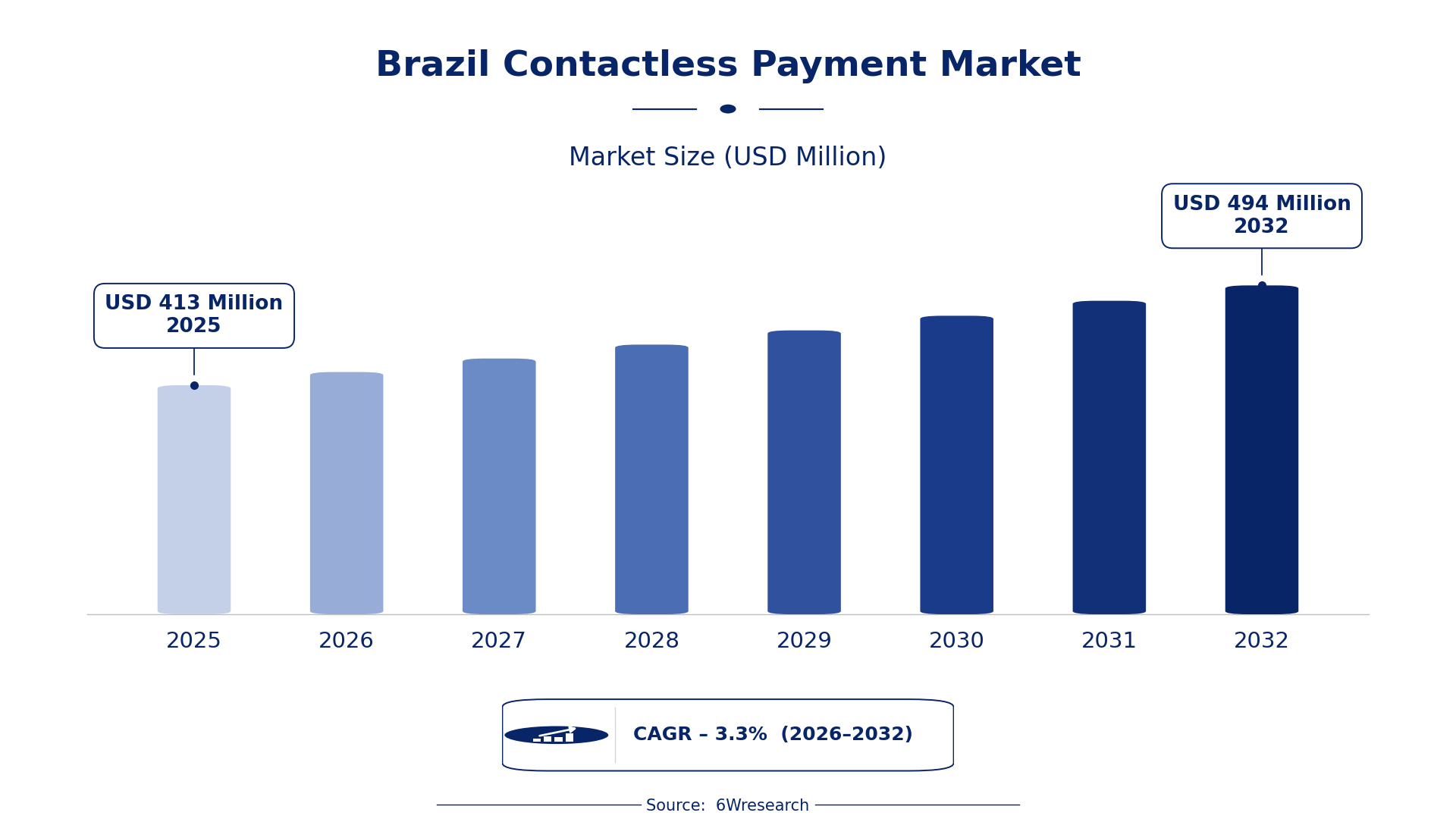
The Brazil Contactless Payment Market was estimated at USD 413 Million in 2025 and is projected to reach USD 494 Million by 2032, growing at a CAGR of 3.3% from 2026 to 2032.
Brazil Contactless Payment Market Synopsis
In Brazil, the shift towards contactless payment methods has gained remarkable traction, particularly in urban centers. As consumers increasingly demand efficient and hygienic payment options, merchants are responding by adopting contactless solutions, including mobile wallets and NFC-enabled cards. This growing acceptance is contributing significantly to the market's expansion.
The COVID-19 pandemic accelerated the adoption of contactless payments as safety became a priority. Retailers across the country are enhancing their payment infrastructures, making it easier for consumers to tap and pay. This trend not only caters to immediate consumer preferences but also aligns with broader government initiatives aimed at promoting digital payment solutions.
Brazil Contactless Payment Market Year-wise Growth Rate and Key Drivers
This graph illustrates the annual growth rates of the Brazil Contactless Payment Market from 2021 to 2032, highlighting a steady upward trajectory and projected expansion over the forecast period.
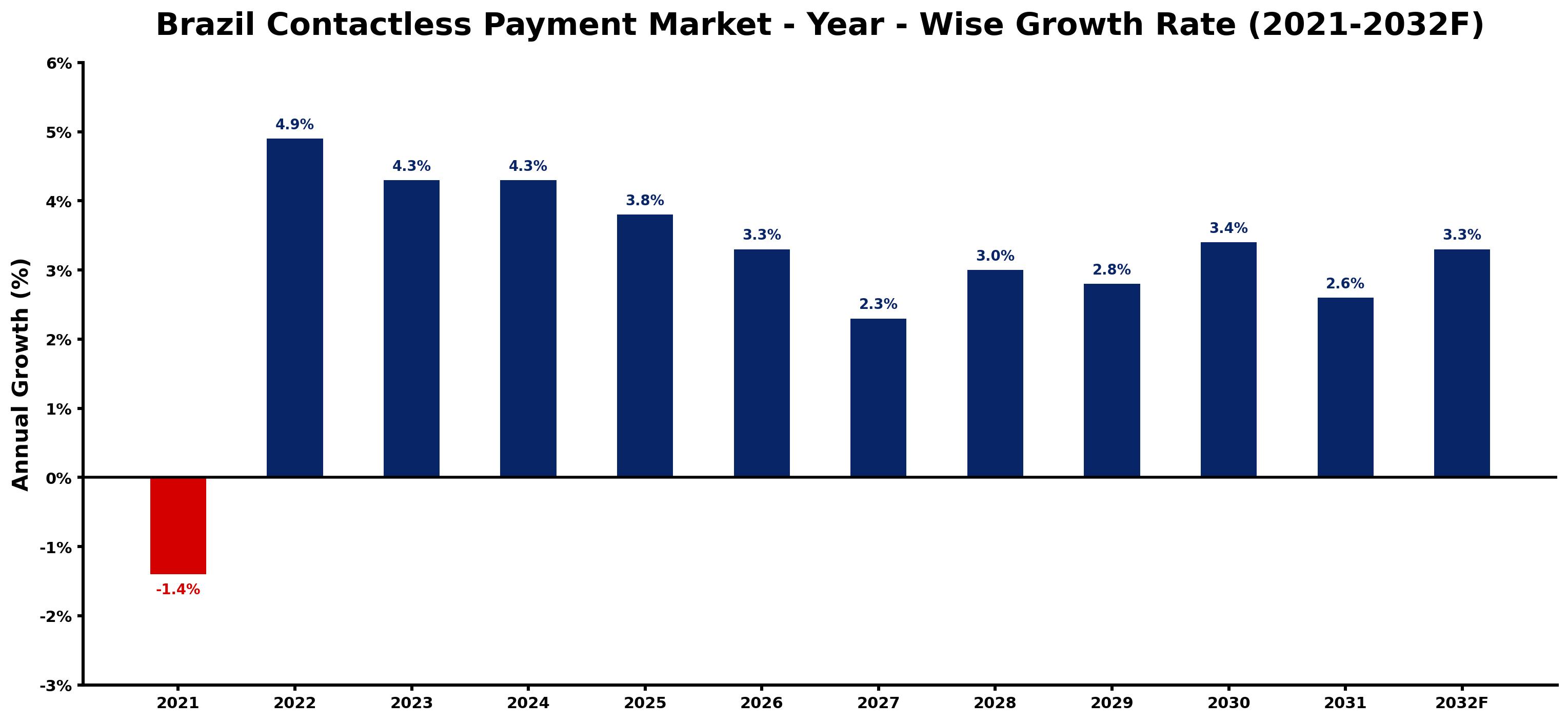
The table below presents the year‑wise growth rates along with the key drivers influencing the market
| Year | Growth Rate | Major Drivers |
| 2021 | -1.4% | Pfizer-BioNTech vaccine approval delayed by ANVISA regulations. |
| 2022 | 4.9% | Central Bank's initiative for instant payment systems implementation |
| 2023 | 4.3% | Increased smartphone penetration enhancing mobile payment adoption |
| 2024 | 4.3% | Integration of contactless payments in public transportation systems |
| 2025 | 3.8% | Rise of e-commerce driving demand for contactless transactions |
| 2026 | 3.3% | Banks promoting contactless cards via loyalty programs |
| 2027 | 2.3% | Emergence of fintech startups offering innovative payment solutions |
| 2028 | 3.0% | Consumer awareness campaigns on contactless payment security |
| 2029 | 2.8% | Retailers adopting contactless technology to streamline checkout |
| 2030 | 3.4% | Government support for digitizing small business transactions |
| 2031 | 2.6% | Continued investments in cybersecurity protecting contactless payments |
| 2032 | 3.3% | Growth of urban population increasing digital payment usage |
Note: Market size estimations and growth projections presented in this report are based on 6Wresearch's proprietary forecasting methodology, utilizing the latest available industry data, government publications, and primary research inputs.
Brazil Contactless Payment Market Key Takeaways
Below are some of the specific key takeaways from the market, including:
- Rising consumer demand for quick and secure payment options is driving market growth.
- Integration of NFC technology in various devices is facilitating the expansion of contactless payment solutions.
- Government policies are fostering an environment conducive to digital payment innovations.
- The retail and transportation sectors are at the forefront of adopting contactless payment systems.
- Increased focus on hygiene during transactions has made contactless payments more appealing to consumers.
Evaluation of Restraints in Brazil Contactless Payment Market
Despite the promising growth trajectory, the Brazil contactless payment market faces several challenges. Chief among these are concerns regarding data accuracy and privacy. The increasing reliance on digital payments raises questions about consumer trust and the security of personal data. Additionally, disparities in infrastructure across different regions can hinder the widespread adoption of contactless solutions, leaving some areas underserved.
Brazil Contactless Payment Market Trends
A notable trend in the Brazil contactless payment market is the rise of mobile wallets, which are gaining popularity for everyday transactions. These platforms not only provide convenience but also integrate loyalty programs, enhancing consumer engagement. on top of that, the push for financial inclusion is prompting banks and fintech companies to develop solutions tailored for the unbanked population, broadening the reach of contactless payments.
Partnerships between technology providers and retailers are becoming more common, as businesses seek to create tailored solutions that enhance the customer experience. This trend is expected to drive innovation, ultimately resulting in more diverse and accessible payment options.
Brazil Contactless Payment Market Opportunities
The market presents several avenues for growth, particularly in untapped segments such as rural areas where digital payment solutions remain limited. As internet penetration increases, opportunities to introduce contactless payments to these regions are ripe for exploration. on top of that, as businesses prioritize customer experience, the development of user-friendly applications that facilitate contactless transactions will likely see significant investment.
Government Initiatives in the Brazil Contactless Payment Market
The Brazilian government is actively supporting the growth of the contactless payment market through various initiatives aimed at enhancing digital payment infrastructure. By prioritizing policies that promote financial inclusion, the government is encouraging both consumers and businesses to transition towards cashless solutions. This support is crucial for fostering an ecosystem where contactless payments can thrive.
- A national initiative launched in 2025 aimed to enhance interoperability among payment systems, facilitating smoother transactions across platforms.
- Currently, the government is implementing a regulatory framework focused on protecting consumer data during digital transactions.
- Upcoming plans include an extensive public-private partnership intended to improve the digital payment infrastructure across rural Brazil.
- Recently completed pilot programs have successfully tested contactless payment solutions in public transportation, setting a precedent for broader adoption.
- Ongoing campaigns to educate consumers about the benefits of digital payments are enhancing overall market awareness.
Future Insights of the Brazil Contactless Payment Market
Looking ahead to 2026-2032, the Brazil contactless payment market is expected to continue its upward trajectory. As technology evolves and consumer expectations shift, businesses will need to adapt quickly. The integration of advanced technologies like biometric authentication will likely become more commonplace, further bolstering security and convenience. on top of that, sustained governmental support will be pivotal in overcoming existing barriers and driving the market towards a cashless future.
Brazil Contactless Payment Market Latest Developments
In the past year, the Brazil contactless payment market has witnessed significant developments as stakeholders respond to growing consumer demand. The push for seamless transactions has led to innovative partnerships and technology rollouts aimed at enhancing user experience. As companies adapt to changing market dynamics, the focus on security and convenience remains paramount.
- A leading technology vendor launched an upgraded mobile wallet application in Q1 2025, incorporating enhanced security features and user-friendly navigation.
- A major regional operator began a nationwide rollout of NFC-enabled payment terminals in retail outlets in mid-2025, aiming to improve transaction speeds.
- In early 2025, a collaborative initiative between banks and fintech companies was announced to develop new contactless payment solutions tailored for small businesses.
- Current pilot programs are testing contactless payment integrations in major urban transportation systems, expected to expand by late 2025.
- Upcoming projects involve partnerships with local merchants to incentivize contactless payment adoption through loyalty rewards, projected to launch in late 2026.
Brazil Contactless Payment Market - Key Attractiveness of the Report
- 10 Years of Market Numbers
- Historical Data Starting from 2022 to 2025
- Base Year: 2025
- Forecast Data until 2032
- Key Performance Indicators Impacting the Market
- Major Upcoming Developments and Projects
Key Highlights of the Report:
- Brazil Contactless Payment Market Outlook
- Market Size of Brazil Contactless Payment Market, 2025
- Forecast of Brazil Contactless Payment Market, 2032
- Historical Data and Forecast of Brazil Contactless Payment Revenues & Volume for the Period 2022-2032F
- Brazil Contactless Payment Market Trend Evolution
- Brazil Contactless Payment Market Drivers and Challenges
- Brazil Contactless Payment Price Trends
- Brazil Contactless Payment Porter's Five Forces
- Brazil Contactless Payment Industry Life Cycle
- Historical Data and Forecast of Brazil Contactless Payment Market Revenues & Volume By Component for the Period 2022-2032F
- Historical Data and Forecast of Brazil Contactless Payment Market Revenues & Volume By Hardware for the Period 2022-2032F
- Historical Data and Forecast of Brazil Contactless Payment Market Revenues & Volume By Solutions for the Period 2022-2032F
- Historical Data and Forecast of Brazil Contactless Payment Market Revenues & Volume By Services for the Period 2022-2032F
- Historical Data and Forecast of Brazil Contactless Payment Market Revenues & Volume By Vertical for the Period 2022-2032F
- Historical Data and Forecast of Brazil Contactless Payment Market Revenues & Volume By Retail for the Period 2022-2032F
- Historical Data and Forecast of Brazil Contactless Payment Market Revenues & Volume By Hospitality for the Period 2022-2032F
- Historical Data and Forecast of Brazil Contactless Payment Market Revenues & Volume By Healthcare for the Period 2022-2032F
- Historical Data and Forecast of Brazil Contactless Payment Market Revenues & Volume By Energy and Utilities for the Period 2022-2032F
- Historical Data and Forecast of Brazil Contactless Payment Market Revenues & Volume By Transportation and Logistics for the Period 2022-2032F
- Historical Data and Forecast of Brazil Contactless Payment Market Revenues & Volume By BFSI for the Period 2022-2032F
- Historical Data and Forecast of Brazil Contactless Payment Market Revenues & Volume By Others (Government, telecommunications, and education) for the Period 2022-2032F
- Brazil Contactless Payment Import Export Trade Statistics
- Market Opportunity Assessment By Component
- Market Opportunity Assessment By Vertical
- Brazil Contactless Payment Top Companies Market Share
- Brazil Contactless Payment Competitive Benchmarking By Technical and Operational Parameters
- Brazil Contactless Payment Company Profiles
- Brazil Contactless Payment Key Strategic Recommendations






































