United States (US) Contactless Payment Market Size & Growth Rate (2026-2032)
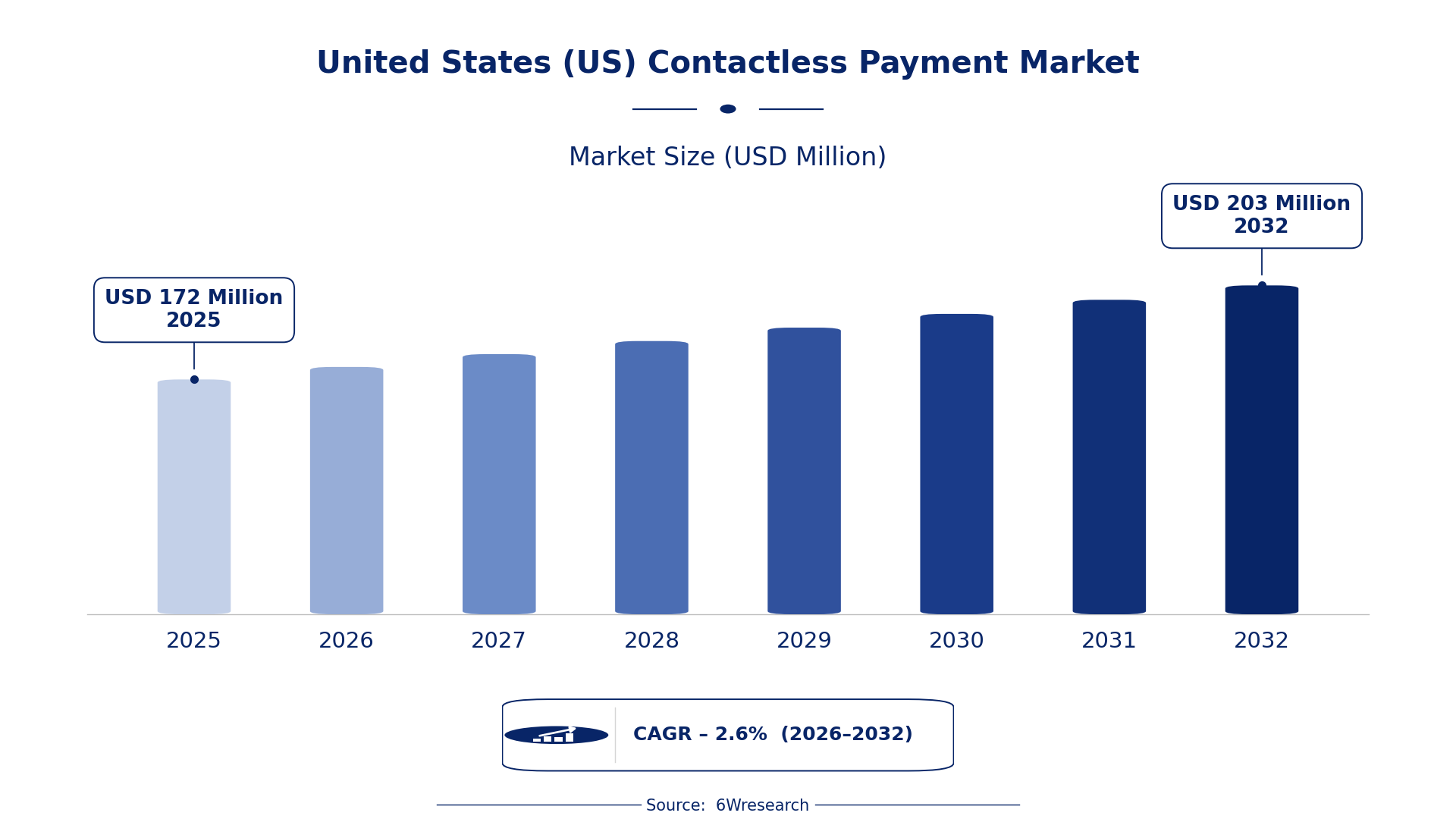
The United States (US) Contactless Payment Market was estimated at USD 172 Million in 2025 and is projected to reach USD 203 Million by 2032, growing at a CAGR of 2.6% from 2026 to 2032.
United States (US) Contactless Payment Market Synopsis
The US Contactless Payment Market has witnessed a surge in adoption driven by consumer preferences for speed and security. As businesses adapt to new payment technologies, the market is set for further expansion, reflecting a shift towards more efficient transaction methods.
Looking ahead, this momentum will likely continue, fueled by innovations in mobile wallets and enhanced payment security. The increasing inclination of consumers and businesses toward contactless solutions positions the market for sustained growth and transformation.
United States (US) Contactless Payment Market Year-wise Growth Rate and Key Drivers
This graph illustrates the annual growth rates of the United States (US) Contactless Payment Market from 2021 to 2032, highlighting a steady upward trajectory and projected expansion over the forecast period.
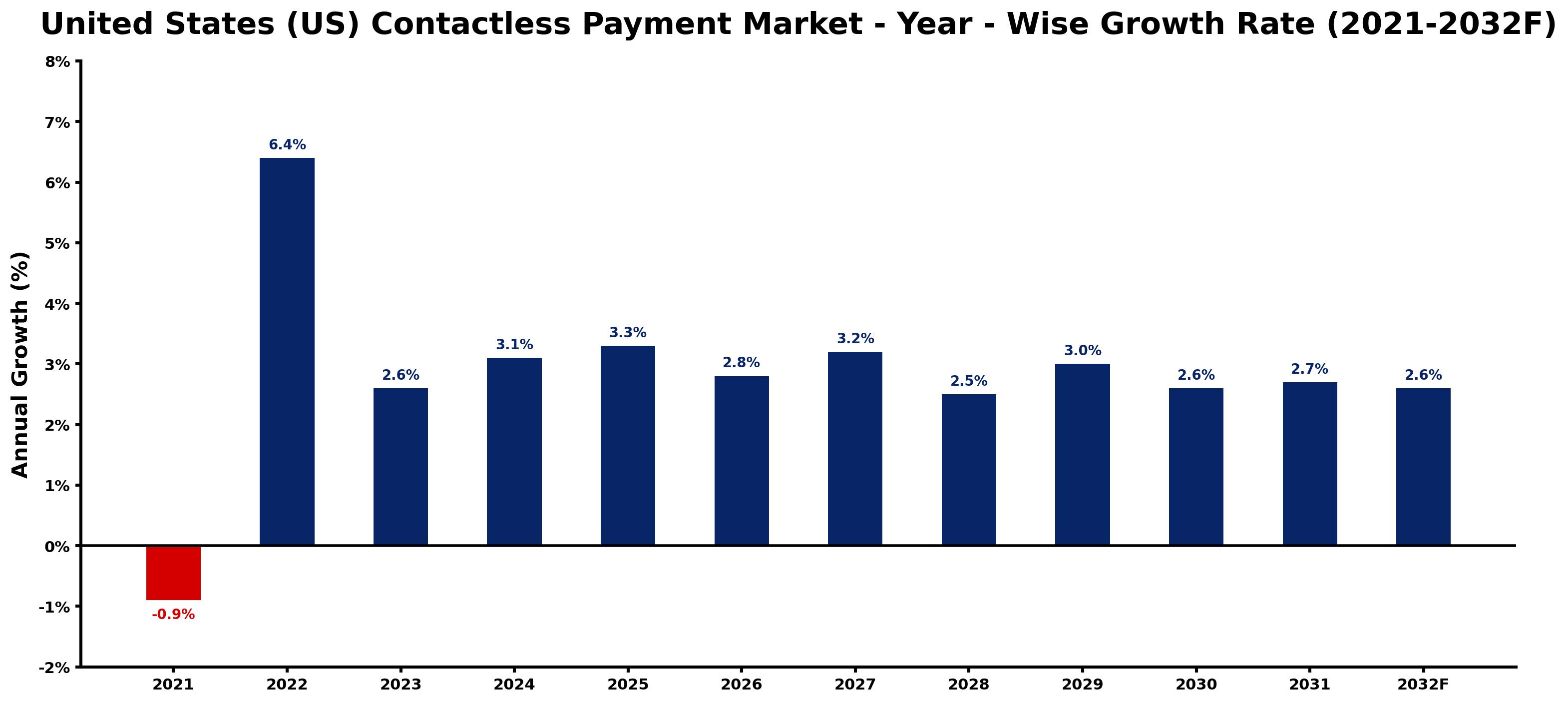
The table below presents the year‑wise growth rates along with the key drivers influencing the market
| Year | Growth Rate | Major Drivers |
| 2021 | -0.9% | Delay in EMV bin sponsorship implementation by major banks. |
| 2022 | 6.4% | Surge in smartphone adoption drives contactless usage. |
| 2023 | 2.6% | Implementation of EMVCo standards enhances transaction security. |
| 2024 | 3.1% | Increased consumer preference for frictionless payment solutions. |
| 2025 | 3.3% | Widespread hosting of digital wallets boosts merchant acceptance. |
| 2026 | 2.8% | Post-pandemic shift towards cashless transactions persists. |
| 2027 | 3.2% | Growing retail investments in contactless payment infrastructure. |
| 2028 | 2.5% | Enhanced loyalty programs incentivize contactless payment adoption. |
| 2029 | 3.0% | Continued rise in online shopping drives contactless demand. |
| 2030 | 2.6% | Expanding partnerships between banks and fintech companies. |
| 2031 | 2.7% | Consumer awareness of contactless benefits rises significantly. |
| 2032 | 2.6% | Increased regulatory support for digital payment innovations. |
Note: Market size estimations and growth projections presented in this report are based on 6Wresearch's proprietary forecasting methodology, utilizing the latest available industry data, government publications, and primary research inputs.
United States (US) Contactless Payment Market Key Takeaways
Below are some of the specific key takeaways from the market, including:
- The contactless payment methods are rapidly gaining traction among consumers due to their convenience and speed.
- Major technological advancements are enhancing security features in contactless transactions.
- The COVID-19 pandemic has accelerated the shift towards touchless payment options.
- Consumer education on the benefits of contactless payments remains crucial for broader adoption.
- Investment opportunities are emerging in mobile wallets and infrastructure upgrades.
Evaluation of Restraints in United States (US) Contactless Payment Market
Despite the strong growth potential, several factors are holding back the US Contactless Payment Market. A lingering hesitance among consumers, driven by security and privacy concerns, inhibits wider adoption. on top of that, not all merchants have embraced contactless technologies, limiting consumer options at the point of sale. A concerted effort to increase awareness about the advantages of these payment methods is necessary to address these challenges and stimulate market growth.
United States (US) Contactless Payment Market Trends
The current trend in the US Contactless Payment Market reflects a growing preference for mobile wallets and smart wearables. Retailers are increasingly integrating contactless payment systems into their infrastructure, aligning with consumer demand for quick and safe transactions. Additionally, innovations in biometric security are expected to enhance user confidence in contactless solutions, further driving acceptance.
United States (US) Contactless Payment Market Opportunities
With the rise in consumer adoption, various investment avenues are opening in the US Contactless Payment Market. Opportunities exist in developing advanced mobile payment solutions and enhancing the technological infrastructure that supports contactless transactions. Strategic collaborations with fintech firms can also create synergies that lead to innovative offerings and improved market penetration.
Government Initiatives in the United States (US) Contactless Payment Market
Government policies are playing an essential role in shaping the US Contactless Payment Market. Regulatory bodies are focused on ensuring consumer protection while fostering innovation and competition in the financial sector. This supportive framework is vital for encouraging the development of contactless payment technologies.
- A regulatory framework established in 2023 promotes transparency in electronic payment systems, enhancing consumer trust.
- Ongoing initiatives by the Consumer Financial Protection Bureau aim to educate consumers on the benefits and security of contactless payments.
- A national digital infrastructure upgrade program, currently underway, is expected to improve the technological backbone for contactless transactions.
- Upcoming legislation in 2024 aims to standardize security protocols for contactless payments, further protecting consumer data.
Future Insights of the United States (US) Contactless Payment Market
As we move towards 2032, the US Contactless Payment Market is positioned for substantial growth driven by a shift towards digital payments and the increasing demand for touchless solutions. The trend towards cashless transactions will persist, propelled by consumer habits formed during the pandemic. As technology continues to evolve, we expect to see an influx of innovative products and services that will enhance the payment experience for users.
United States (US) Contactless Payment Market Latest Developments
Recent developments in the US Contactless Payment Market reflect a dynamic environment where technology and consumer preferences are rapidly changing. Companies are actively launching new products and expanding their service offerings to meet market demand.
- A major technology vendor announced the rollout of a new mobile wallet feature in Q2 2025, enhancing user experience with biometric authentication.
- An initiative began in early 2025 to upgrade point-of-sale terminals across retail outlets, facilitating broader acceptance of contactless payments.
- Currently underway is a partnership between several financial institutions to enhance contactless payment security measures, projected to conclude by late 2025.
- A new marketing campaign focused on educating consumers about contactless payments is planned for launch in Q3 2025.
United States (US) Contactless Payment Market - Key Attractiveness of the Report
- 10 Years of Market Numbers
- Historical Data Starting from 2022 to 2025
- Base Year: 2025
- Forecast Data until 2032
- Key Performance Indicators Impacting the Market
- Major Upcoming Developments and Projects
Key Highlights of the Report:
- United States (US) Contactless Payment Market Outlook
- Market Size of United States (US) Contactless Payment Market, 2025
- Forecast of United States (US) Contactless Payment Market, 2032
- Historical Data and Forecast of United States (US) Contactless Payment Revenues & Volume for the Period 2022-2032F
- United States (US) Contactless Payment Market Trend Evolution
- United States (US) Contactless Payment Market Drivers and Challenges
- United States (US) Contactless Payment Price Trends
- United States (US) Contactless Payment Porter's Five Forces
- United States (US) Contactless Payment Industry Life Cycle
- Historical Data and Forecast of United States (US) Contactless Payment Market Revenues & Volume By Component for the Period 2022-2032F
- Historical Data and Forecast of United States (US) Contactless Payment Market Revenues & Volume By Hardware for the Period 2022-2032F
- Historical Data and Forecast of United States (US) Contactless Payment Market Revenues & Volume By Solutions for the Period 2022-2032F
- Historical Data and Forecast of United States (US) Contactless Payment Market Revenues & Volume By Services for the Period 2022-2032F
- Historical Data and Forecast of United States (US) Contactless Payment Market Revenues & Volume By Vertical for the Period 2022-2032F
- Historical Data and Forecast of United States (US) Contactless Payment Market Revenues & Volume By Retail for the Period 2022-2032F
- Historical Data and Forecast of United States (US) Contactless Payment Market Revenues & Volume By Hospitality for the Period 2022-2032F
- Historical Data and Forecast of United States (US) Contactless Payment Market Revenues & Volume By Healthcare for the Period 2022-2032F
- Historical Data and Forecast of United States (US) Contactless Payment Market Revenues & Volume By Energy and Utilities for the Period 2022-2032F
- Historical Data and Forecast of United States (US) Contactless Payment Market Revenues & Volume By Transportation and Logistics for the Period 2022-2032F
- Historical Data and Forecast of United States (US) Contactless Payment Market Revenues & Volume By BFSI for the Period 2022-2032F
- Historical Data and Forecast of United States (US) Contactless Payment Market Revenues & Volume By Others (Government, telecommunications, and education) for the Period 2022-2032F
- United States (US) Contactless Payment Import Export Trade Statistics
- Market Opportunity Assessment By Component
- Market Opportunity Assessment By Vertical
- United States (US) Contactless Payment Top Companies Market Share
- United States (US) Contactless Payment Competitive Benchmarking By Technical and Operational Parameters
- United States (US) Contactless Payment Company Profiles
- United States (US) Contactless Payment Key Strategic Recommendations






































