Brazil Converted Paper Products Market Summary
The brazil converted paper products market was estimated at USD 84 Million in 2025 and is projected to reach USD 99 Million by 2032, growing at a CAGR of 2.5% from 2026 to 2032.
Brazil Converted Paper Products Market Year-wise Growth Rate and Key Drivers
This graph highlights how the Brazil Converted Paper Products Market has steadily grown over the past five years, supported by major growth factors.
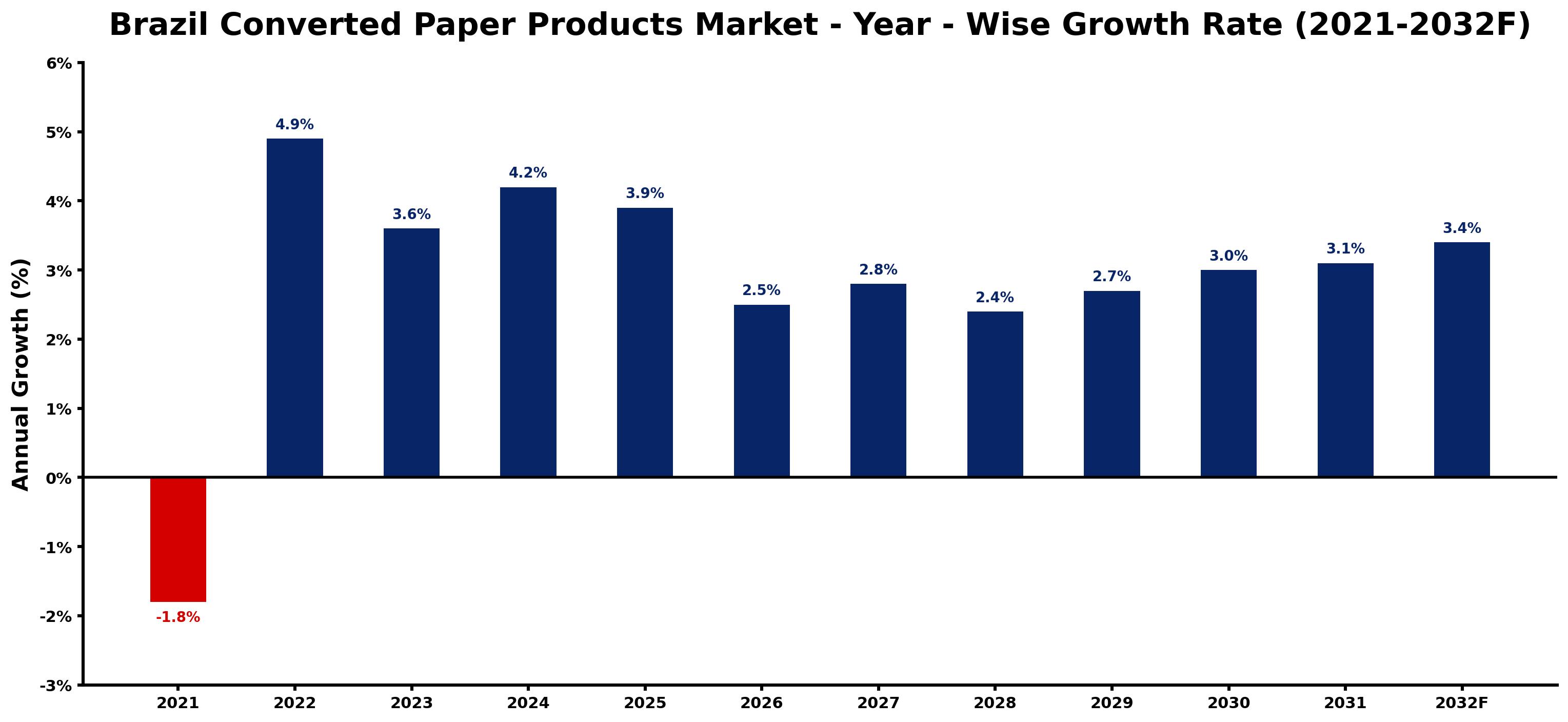
The table below presents the year wise growth rates along with the key drivers influencing the market
| Year | Growth Rate | Major Drivers |
| 2021 | -1.8% | Supply chain disruptions due to pandemicrelated restrictions hindered production capabilities, affecting market availability. |
| 2022 | 4.9% | Retailers focus on sustainable packaging, driving demand for converted paper products. |
| 2023 | 3.6% | Major brands commit to reducing plastic, boosting the paper products market substantially. |
| 2024 | 4.2% | E-commerce expansion necessitates innovative packaging solutions, enhancing paper product needs. |
| 2025 | 3.9% | Local manufacturers invest in advanced machinery, improving product quality and efficiency. |
| 2026 | 2.5% | Biodegradable products gain traction as consumers prioritize environmentally friendly options. |
| 2027 | 2.8% | Urbanization trends push for more sustainable packaging in fast-moving consumer goods. |
| 2028 | 2.4% | Collaboration between companies fosters innovation in paper recycling technologies and systems. |
| 2029 | 2.7% | The education sector increasingly opts for sustainable supplies, creating steady market demand. |
| 2030 | 3.0% | Corporate sustainability goals align with green paper product initiatives, driving growth. |
| 2031 | 3.1% | Investment in local supply chains enhances market resilience against global disruptions. |
| 2032 | 3.4% | Technological innovations in production processes create new opportunities within the sector. |
Note - Market size estimations and growth projections presented in this report are based on 6Wresearch's advanced forecasting approach, validated with industry datasets as of June 2026.
Brazil Converted Paper Products Market Synopsis
The Brazil Converted Paper Products Market is projected to reach 2.5% and witness significant growth during the forecast period (2026-2032). This market encompasses a diverse array of products, including packaging materials, tissues, and hygiene items that reflect the evolving consumer preferences and environmental expectations. As sustainability becomes a key driving force, the demand for eco-friendly paper products is reshaping the landscape of this market, leading to increased focus on innovative production techniques and responsible sourcing.
Brazil Converted Paper Products Market Growth Drivers
Several factors are propelling the growth of the Brazil Converted Paper Products Market. The foremost driver is the heightened consumer awareness regarding environmental sustainability, which compels manufacturers to adopt eco-friendly practices.
- The shift towards sustainable packaging solutions is paramount, with brands increasingly prioritizing materials that are recyclable or biodegradable.
- Government initiatives aimed at reducing waste and promoting recycling are creating a conducive environment for growth in eco-friendly product categories.
- Technological advancements in paper production, such as digital printing and automated manufacturing, are enhancing efficiency and product quality.
- The rise in disposable hygiene products, especially in response to the increased focus on health and sanitation, is driving demand across various product segments.
- Consumer trends indicate a growing preference for personalized and specialty paper products, which encourages manufacturers to diversify their offerings.
Brazil Converted Paper Products Market Challenges and Restraints
Despite the positive outlook, several challenges confront the Brazil Converted Paper Products Market. The transition towards a more digital landscape poses significant implications for traditional paper product consumption.
- The ongoing shift towards a paperless society is impacting the demand for conventional paper products, necessitating adaptation from manufacturers.
- Increased competition from alternative materials, such as plastics and digital solutions, threatens the market share of traditional paper items.
- Operational costs associated with sustainable sourcing and eco-friendly production methods can strain profit margins for businesses.
- The regulatory landscape regarding environmental compliance is becoming stringent, requiring continuous investment in sustainable practices.
- Market players face challenges in balancing consumer demands for innovation while maintaining cost efficiency in production.
Brazil Converted Paper Products Market Government Investment and Initiatives
The Brazilian government is actively investing in initiatives that promote sustainability within the converted paper products sector. Policies are being established to ensure responsible sourcing of raw materials, focusing on reducing environmental impact through effective waste management and recycling initiatives.
- Regulatory frameworks are encouraging manufacturers to adopt eco-friendly practices, with incentives for companies committed to sustainable operations.
- Public spending is being directed towards research and development in advanced manufacturing technologies that enhance production efficiency and reduce carbon footprints.
- Programs aimed at increasing public awareness about recycling and waste reduction are fostering a culture of sustainability among consumers.
- Collaboration between government and industry stakeholders is promoting the development of standards and guidelines for environmentally friendly packaging solutions.
- Financial incentives are provided for companies investing in innovations that contribute to circular economy principles within the paper products market.
Brazil Converted Paper Products Market Latest Developments (May 2025 - June 2026)
Recent developments in the Brazil Converted Paper Products Market indicate a robust transition towards sustainability and innovation. During this period, industry trends highlight a growing inclination towards eco-conscious manufacturing practices, supported by government policies encouraging environmentally friendly solutions.
- Manufacturers are increasingly investing in sustainable raw materials and production processes to align with consumer expectations and regulatory requirements.
- The market has witnessed a rise in collaborative initiatives aimed at enhancing recycling programs and waste management solutions across the supply chain.
- Technological advancements are being integrated into production lines, focusing on improving both efficiency and product quality through automation and innovation.
- Consumer preferences are shifting towards products that emphasize health and hygiene, resulting in increased demand for biodegradable and recyclable tissues and packaging.
- Industry stakeholders are actively participating in forums and discussions that promote best practices and knowledge sharing regarding sustainability within the paper products sector.
Brazil Converted Paper Products Market - Key Attractiveness of the Report
- 10 Years of Market Numbers
- Historical Data Starting from 2022 to 2025
- Base Year: 2025
- Forecast Data until 2032
- Key Performance Indicators Impacting the Market
- Major Upcoming Developments and Projects
Key Highlights of the Report:
- Brazil Converted Paper Products Market Outlook
- Market Size of Brazil Converted Paper Products Market, 2025
- Forecast of Brazil Converted Paper Products Market, 2032
- Historical Data and Forecast of Brazil Converted Paper Products Revenues & Volume for the Period 2022-2032F
- Brazil Converted Paper Products Market Trend Evolution
- Brazil Converted Paper Products Market Drivers and Challenges
- Brazil Converted Paper Products Price Trends
- Brazil Converted Paper Products Porter's Five Forces
- Brazil Converted Paper Products Industry Life Cycle
- Historical Data and Forecast of Brazil Converted Paper Products Market Revenues & Volume By Type for the Period 2022-2032F
- Historical Data and Forecast of Brazil Converted Paper Products Market Revenues & Volume By Paperboard Container for the Period 2022-2032F
- Historical Data and Forecast of Brazil Converted Paper Products Market Revenues & Volume By Sanitary Paper Product for the Period 2022-2032F
- Historical Data and Forecast of Brazil Converted Paper Products Market Revenues & Volume By Stationery Product for the Period 2022-2032F
- Historical Data and Forecast of Brazil Converted Paper Products Market Revenues & Volume By Paper Bag And Coated And Treated Paper for the Period 2022-2032F
- Historical Data and Forecast of Brazil Converted Paper Products Market Revenues & Volume By Other for the Period 2022-2032F
- Historical Data and Forecast of Brazil Converted Paper Products Market Revenues & Volume By End-Users for the Period 2022-2032F
- Historical Data and Forecast of Brazil Converted Paper Products Market Revenues & Volume By Packaging & Wrapping for the Period 2022-2032F
- Historical Data and Forecast of Brazil Converted Paper Products Market Revenues & Volume By Food Service for the Period 2022-2032F
- Historical Data and Forecast of Brazil Converted Paper Products Market Revenues & Volume By Printing for the Period 2022-2032F
- Historical Data and Forecast of Brazil Converted Paper Products Market Revenues & Volume By Others for the Period 2022-2032F
- Brazil Converted Paper Products Import Export Trade Statistics
- Market Opportunity Assessment By Type
- Market Opportunity Assessment By End-Users
- Brazil Converted Paper Products Top Companies Market Share
- Brazil Converted Paper Products Competitive Benchmarking By Technical and Operational Parameters
- Brazil Converted Paper Products Company Profiles
- Brazil Converted Paper Products Key Strategic Recommendations






































