Brazil Curtains and Window Blinds Market Size, Share & Growth Rate
The Brazil Curtains and Window Blinds Market was estimated at USD 265 Million in 2025 and is projected to reach USD 366 Million by 2032, growing at a CAGR of 4.7% from 2026 to 2032. This impressive growth trajectory is largely attributed to the ongoing urbanization in Brazil, which sees more households investing in aesthetic improvements to their living spaces. Additionally, rising disposable incomes are enabling consumers to spend more on high-quality window treatments, further propelling the market forward.
Brazil Curtains and Window Blinds Market Year-wise Growth Rate and Key Drivers
This graph highlights how the Brazil Curtains and Window Blinds Market has steadily grown over the years, supported by major growth factors.
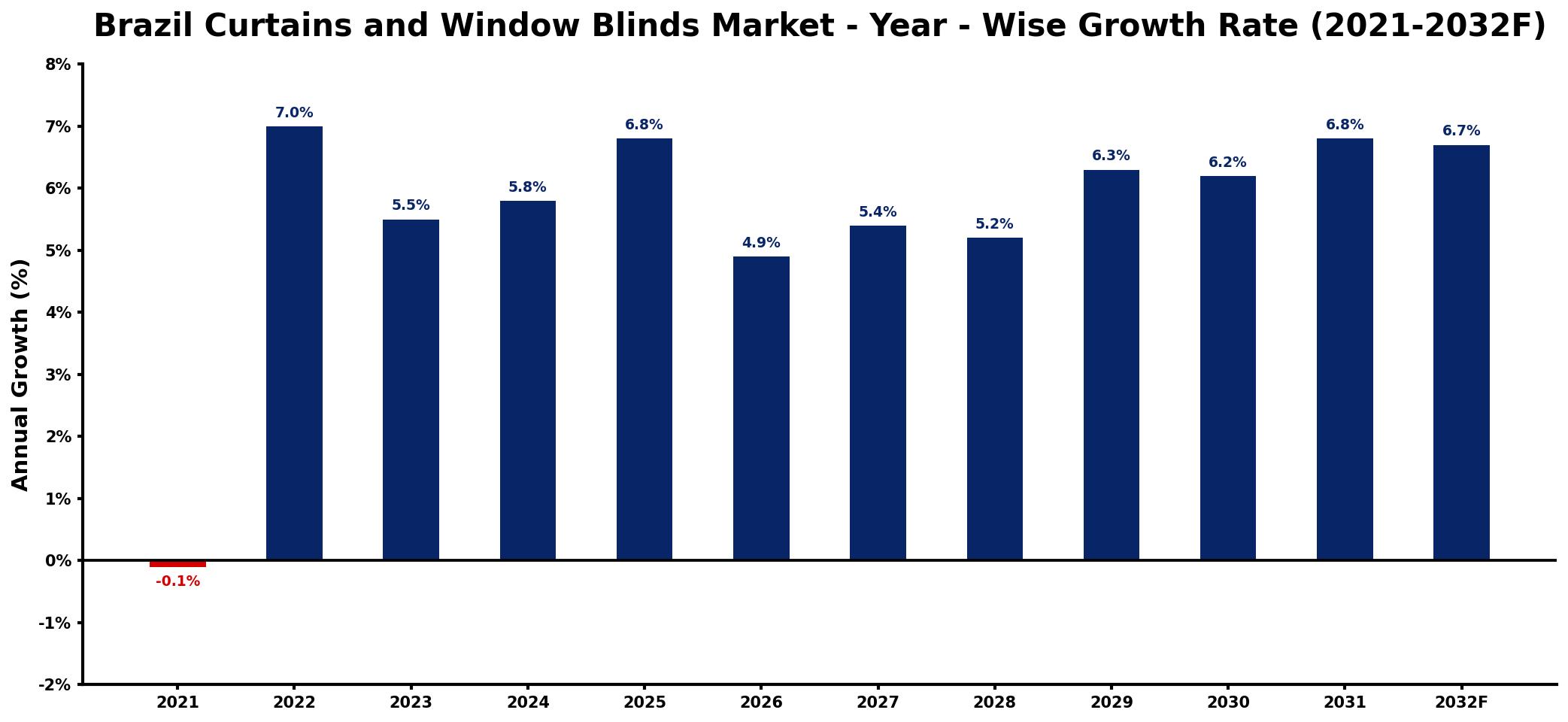
The table below presents the year‑wise growth rates along with the key drivers influencing the market
| Year | Growth Rate | Major Drivers |
| 2021 | -0.1% | shifts in consumer preferences |
| 2022 | 7.0% | rise in home renovation projects |
| 2023 | 5.5% | growing interest in smart homes |
| 2024 | 5.8% | increased disposable income levels |
| 2025 | 6.8% | expansion of urban housing market |
| 2026 | 4.9% | enhanced focus on sustainability |
| 2027 | 5.4% | growth in e-commerce sales |
| 2028 | 5.2% | surge in interior design trends |
| 2029 | 6.3% | rising demand for customization |
| 2030 | 6.2% | development of innovative materials |
| 2031 | 6.8% | increased investment in real estate |
| 2032 | 6.7% | strengthening of local manufacturing |
Note: Market size estimations and growth projections presented in this report are based on 6Wresearch's proprietary forecasting methodology, utilizing the latest available industry data, government publications, and primary research inputs.
Brazil Curtains and Window Blinds Market Synopsis
The Brazilian market is witnessing a notable shift towards innovative and eco-friendly window treatment solutions. This change is influenced by a growing awareness of environmental sustainability and the desire for energy-efficient products that help regulate indoor temperatures. As a result, manufacturers are increasingly introducing products made from recycled materials, meeting the demands of environmentally-conscious consumers.
Furthermore, the surge in new housing construction has created a vibrant demand for curtains and blinds that cater to modern interior design trends. As consumers become more design-savvy, they are seeking unique styles and functionalities that enhance their homes. This growing inclination towards personalized décor presents opportunities for brands to innovate and differentiate their product offerings.
Brazil Curtains and Window Blinds Market Key Takeaways
- Urbanization and rising incomes are primary drivers of market growth.
- Consumer preferences are shifting towards eco-friendly and modern window treatments.
- New housing construction is boosting demand for innovative curtain and blind designs.
- Market sensitivity to economic fluctuations affects consumer spending behavior.
- Government regulations ensure quality standards for materials used in production.
Evaluation of Restraints in Brazil Curtains and Window Blinds Market
Despite the promising growth prospects, the Brazilian curtains and window blinds market faces several restraints that could impact its trajectory. One significant concern is the fluctuating economic climate characterized by inflation and varying disposable income levels, which can affect consumer spending on non-essential home improvement items. Additionally, the increasing preference for modern, minimalistic designs may sideline traditional window treatments, leaving manufacturers needing to adapt quickly to changing tastes to remain competitive. These dynamics underscore the importance of understanding consumer behavior to navigate potential market challenges effectively.
Brazil Curtains and Window Blinds Market Trends
Emerging trends are shaping the curtains and window blinds market in Brazil, particularly the growing popularity of smart home technologies. Consumers are now looking for automated window treatments that integrate seamlessly with smart home systems, enhancing convenience and energy efficiency. Another significant trend is the increasing demand for customizable options, allowing consumers to select materials, colors, and patterns that reflect their individual style. As these trends evolve, they present opportunities for manufacturers to innovate and cater to the sophisticated tastes of Brazilian consumers.
Brazil Curtains and Window Blinds Market Opportunities
The market is ripe with opportunities, especially for companies that can pivot towards eco-friendly and sustainable product lines. With a significant consumer base now prioritizing environmentally responsible choices, businesses that focus on sustainability will likely gain a competitive edge. Additionally, tapping into the burgeoning online retail sector presents a chance to reach a broader audience and enhance customer engagement. As more consumers embrace e-commerce, brands can leverage digital platforms to showcase their innovative products and cater to diverse preferences across various demographics.
Government Initiatives in the Brazil Curtains and Window Blinds Market
The Brazilian government plays an essential role in regulating the curtains and window blinds market, focusing on consumer protection and industry standards. Policies are in place to ensure that materials used in manufacturing meet durability and safety requirements, providing consumers with confidence in their purchases. Furthermore, the government supports local production initiatives, which not only boosts the domestic economy but also addresses import regulation issues, fostering a favorable environment for local manufacturers to thrive.
Future Insights of the Brazil Curtains and Window Blinds Market
Looking ahead to 2026-2032, the Brazil curtains and window blinds market is anticipated to continue on its upward trajectory. The combined effects of sustained urbanization, increased disposable income, and a heightened focus on home aesthetics will drive demand for diverse window treatments. Moreover, technological advancements in product offerings, including energy-efficient designs and smart home compatibility, are expected to shape consumer preferences further. As the market evolves, companies that embrace innovation and sustainability will be well-positioned to capture emerging opportunities.
Brazil Curtains and Window Blinds Market Latest Developments (2025 - 2026)
Recent developments in the Brazilian curtains and window blinds market have highlighted a shift towards greater consumer engagement through innovative marketing strategies. Brands are increasingly utilizing digital channels to showcase their products and educate consumers on the benefits of new technologies. Additionally, collaborations between manufacturers and design influencers are helping to promote unique designs that resonate with the modern consumer. This evolving direction not only enhances brand visibility but also aligns with the growing trend of personalization in home décor.
Brazil Curtains and Window Blinds Market - Key Attractiveness of the Report
- 10 Years of Market Numbers
- Historical Data Starting from 2022 to 2025
- Base Year: 2025
- Forecast Data until 2032
- Key Performance Indicators Impacting the Market
- Major Upcoming Developments and Projects
Key Highlights of the Report:
- Brazil Curtains and Window Blinds Market Outlook
- Market Size of Brazil Curtains and Window Blinds Market, 2025
- Forecast of Brazil Curtains and Window Blinds Market, 2032
- Historical Data and Forecast of Brazil Curtains and Window Blinds Revenues & Volume for the Period 2022-2032F
- Brazil Curtains and Window Blinds Market Trend Evolution
- Brazil Curtains and Window Blinds Market Drivers and Challenges
- Brazil Curtains and Window Blinds Price Trends
- Brazil Curtains and Window Blinds Porter's Five Forces
- Brazil Curtains and Window Blinds Industry Life Cycle
- Historical Data and Forecast of Brazil Curtains and Window Blinds Market Revenues & Volume By Materials for the Period 2022-2032F
- Historical Data and Forecast of Brazil Curtains and Window Blinds Market Revenues & Volume By Curtains (Cotton, Linen, Polyester) for the Period 2022-2032F
- Historical Data and Forecast of Brazil Curtains and Window Blinds Market Revenues & Volume By Window Blinds (Cotton, Linen, Wood, PVC, Metal) for the Period 2022-2032F
- Historical Data and Forecast of Brazil Curtains and Window Blinds Market Revenues & Volume By Product for the Period 2022-2032F
- Historical Data and Forecast of Brazil Curtains and Window Blinds Market Revenues & Volume By Curtains (Box pleat curtains, Pinch pleat curtains & drapery, Goblet pleat curtains & drapery, Eyelet curtains & drapery) for the Period 2022-2032F
- Historical Data and Forecast of Brazil Curtains and Window Blinds Market Revenues & Volume By Window Blinds (Window Shades,, Window Screens, Connected) for the Period 2022-2032F
- Historical Data and Forecast of Brazil Curtains and Window Blinds Market Revenues & Volume By Distribution Channel for the Period 2022-2032F
- Historical Data and Forecast of Brazil Curtains and Window Blinds Market Revenues & Volume By B2B for the Period 2022-2032F
- Historical Data and Forecast of Brazil Curtains and Window Blinds Market Revenues & Volume By B2C for the Period 2022-2032F
- Historical Data and Forecast of Brazil Curtains and Window Blinds Market Revenues & Volume By E-commerce for the Period 2022-2032F
- Historical Data and Forecast of Brazil Curtains and Window Blinds Market Revenues & Volume By Price Range for the Period 2022-2032F
- Historical Data and Forecast of Brazil Curtains and Window Blinds Market Revenues & Volume By High for the Period 2022-2032F
- Historical Data and Forecast of Brazil Curtains and Window Blinds Market Revenues & Volume By Medium for the Period 2022-2032F
- Historical Data and Forecast of Brazil Curtains and Window Blinds Market Revenues & Volume By Low for the Period 2022-2032F
- Brazil Curtains and Window Blinds Import Export Trade Statistics
- Market Opportunity Assessment By Materials
- Market Opportunity Assessment By Product
- Market Opportunity Assessment By Distribution Channel
- Market Opportunity Assessment By Price Range
- Brazil Curtains and Window Blinds Top Companies Market Share
- Brazil Curtains and Window Blinds Competitive Benchmarking By Technical and Operational Parameters
- Brazil Curtains and Window Blinds Company Profiles
- Brazil Curtains and Window Blinds Key Strategic Recommendations






































