Peru Curtains And Window Blinds Market Top 5 Importing Countries and Market Competition (HHI) Analysis
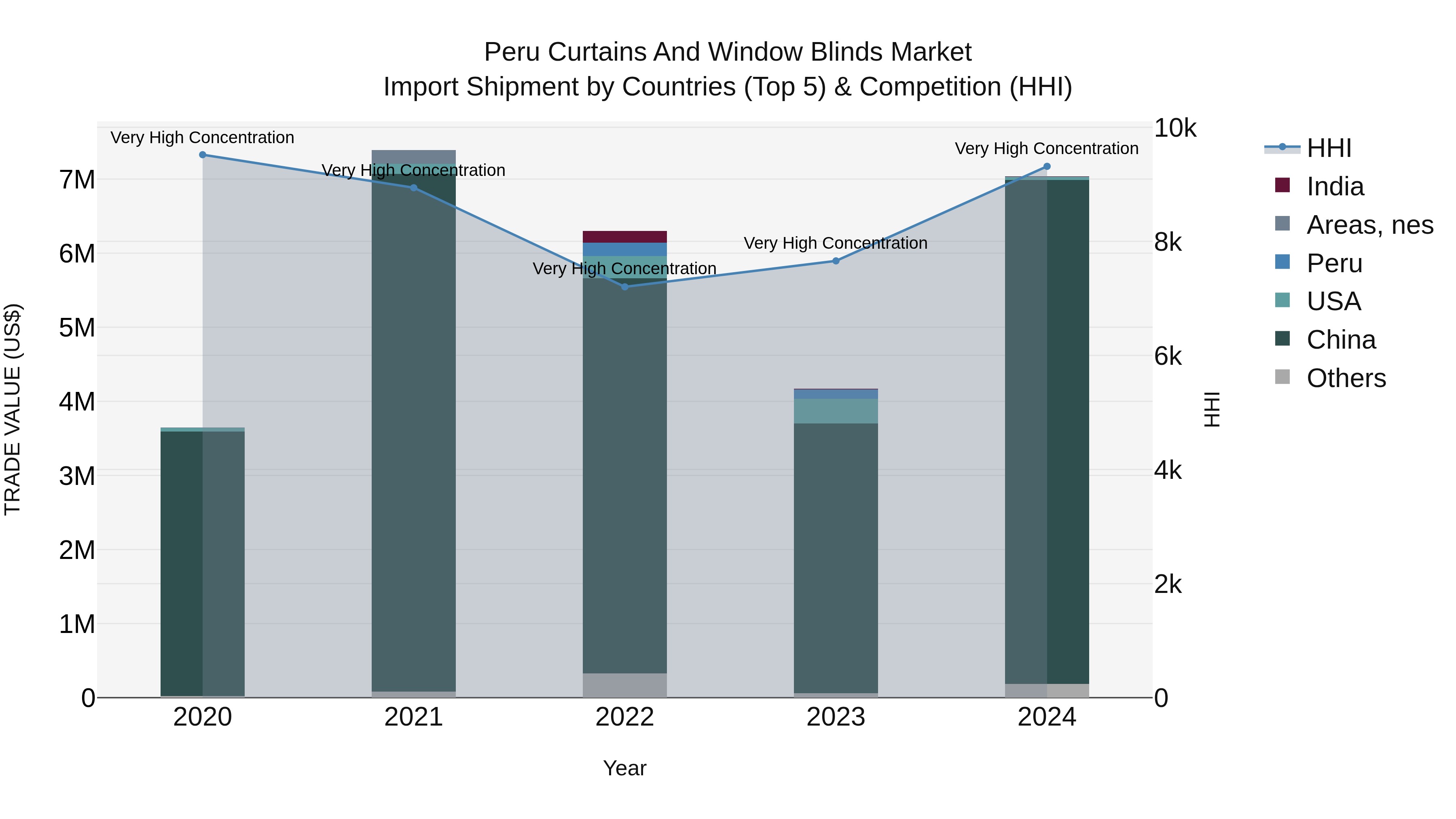
The import data for curtains and window blinds in Peru in 2024 shows a strong presence of top exporting countries including China, Free Zones, USA, Colombia, and Vietnam. The market continues to exhibit high concentration with a high HHI in 2024. The impressive compound annual growth rate (CAGR) of 17.87% from 2020 to 2024 indicates a robust expansion in the market. Furthermore, the remarkable growth rate of 68.84% from 2023 to 2024 highlights the increasing demand for curtains and window blinds in Peru. This data suggests a promising outlook for the industry in the coming years.
Peru Curtains and Window Blinds Market Synopsis
The Peru curtains and window blinds market is experiencing steady growth driven by factors such as increasing urbanization, rising disposable income, and growing awareness about home décor. Consumers are increasingly seeking stylish and functional window treatments to enhance the aesthetics of their homes. Key players in the market offer a wide range of products including curtains, drapes, blinds, shades, and shutters to cater to diverse consumer preferences. The market is also witnessing a shift towards eco-friendly and energy-efficient window coverings. Online retail channels are gaining popularity for convenient shopping and competitive pricing. Additionally, the demand for customized and high-quality window treatments is on the rise, leading to opportunities for innovative designs and materials in the Peru curtains and window blinds market.
Peru Curtains and Window Blinds Market Trends
The Peru Curtains and Window Blinds Market is witnessing a shift towards eco-friendly and sustainable materials, driven by increasing consumer awareness of environmental issues. There is a growing demand for curtains and blinds made from natural fibers such as linen, cotton, and bamboo, as well as recycled materials. Additionally, smart window treatments that offer automation and energy-efficient features are gaining popularity among consumers looking to enhance their home`s functionality and energy savings. Customization options, such as personalized designs and sizes, are also becoming more prevalent as consumers seek unique and tailored solutions for their living spaces. Overall, the market is evolving towards more environmentally conscious and technologically advanced products to meet the changing preferences of Peruvian consumers.
Peru Curtains and Window Blinds Market Challenges
In the Peru Curtains and Window Blinds Market, some challenges are faced due to economic fluctuations impacting consumer spending, regulatory complexities related to import/export regulations, and competition from both domestic and international players. The market is also influenced by changing consumer preferences and trends, requiring companies to continuously innovate and offer products that cater to evolving tastes. Additionally, the industry may face supply chain disruptions, particularly when relying on imported materials or components. To navigate these challenges successfully, companies in the Peru Curtains and Window Blinds Market need to stay updated on market dynamics, invest in research and development, and develop strategies to differentiate themselves in terms of quality, design, and pricing.
Peru Curtains and Window Blinds Market Investment Opportunities
The Peru Curtains and Window Blinds Market offers various investment opportunities due to the growing demand for home decor products in the country. Investors can capitalize on the increasing urbanization, rising disposable income, and a growing trend towards home renovation and interior decoration. Investing in innovative and high-quality curtain and window blind products that cater to the preferences of Peruvian consumers could be a lucrative option. Additionally, there is potential for expansion in the online retail sector to reach a wider customer base. Collaborating with local manufacturers or retailers to offer unique and culturally relevant products can also be a successful strategy in this market. Overall, the Peru Curtains and Window Blinds Market presents opportunities for investors to tap into the growing consumer interest in home decor and capitalize on the evolving lifestyle trends in the country.
Jordan Agar Market Government Policies
The government of Peru has implemented various regulations and policies to ensure the safety and quality of curtains and window blinds in the market. These include mandatory compliance with technical standards and regulations set by the National Institute for the Defense of Competition and Protection of Intellectual Property (INDECOPI) to guarantee product safety and quality. Additionally, there are import regulations and tariffs in place to promote domestic production and protect local manufacturers. The government also conducts regular inspections and enforces penalties for non-compliance with these regulations to safeguard consumer interests and maintain market integrity in the curtains and window blinds industry in Peru.
Peru Curtains and Window Blinds Market Future Outlook
The Peru Curtains and Window Blinds Market is expected to witness steady growth in the coming years due to increasing urbanization, rising disposable income levels, and growing awareness about interior design trends. Consumers are increasingly looking to enhance their living spaces with stylish and functional window treatments, driving demand for curtains and window blinds. Additionally, the market is likely to benefit from the expanding real estate sector and a growing number of commercial establishments requiring window coverings. With a focus on customization, eco-friendly materials, and smart home integration, manufacturers and retailers in Peru are expected to capitalize on these trends to offer innovative and high-quality products to meet the evolving preferences of consumers in the market.
Key Highlights of the Report:
- Peru Curtains and Window Blinds Market Outlook
- Market Size of Peru Curtains and Window Blinds Market, 2024
- Forecast of Peru Curtains and Window Blinds Market, 2031
- Historical Data and Forecast of Peru Curtains and Window Blinds Revenues & Volume for the Period 2021 - 2031
- Peru Curtains and Window Blinds Market Trend Evolution
- Peru Curtains and Window Blinds Market Drivers and Challenges
- Peru Curtains and Window Blinds Price Trends
- Peru Curtains and Window Blinds Porter's Five Forces
- Peru Curtains and Window Blinds Industry Life Cycle
- Historical Data and Forecast of Peru Curtains and Window Blinds Market Revenues & Volume By Materials for the Period 2021 - 2031
- Historical Data and Forecast of Peru Curtains and Window Blinds Market Revenues & Volume By Curtains (Cotton, Linen, Polyester) for the Period 2021 - 2031
- Historical Data and Forecast of Peru Curtains and Window Blinds Market Revenues & Volume By Window Blinds (Cotton, Linen, Wood, PVC, Metal) for the Period 2021 - 2031
- Historical Data and Forecast of Peru Curtains and Window Blinds Market Revenues & Volume By Product for the Period 2021 - 2031
- Historical Data and Forecast of Peru Curtains and Window Blinds Market Revenues & Volume By Curtains (Box pleat curtains, Pinch pleat curtains & drapery, Goblet pleat curtains & drapery, Eyelet curtains & drapery) for the Period 2021 - 2031
- Historical Data and Forecast of Peru Curtains and Window Blinds Market Revenues & Volume By Window Blinds (Window Shades,, Window Screens, Connected) for the Period 2021 - 2031
- Historical Data and Forecast of Peru Curtains and Window Blinds Market Revenues & Volume By Distribution Channel for the Period 2021 - 2031
- Historical Data and Forecast of Peru Curtains and Window Blinds Market Revenues & Volume By B2B for the Period 2021 - 2031
- Historical Data and Forecast of Peru Curtains and Window Blinds Market Revenues & Volume By B2C for the Period 2021 - 2031
- Historical Data and Forecast of Peru Curtains and Window Blinds Market Revenues & Volume By E-commerce for the Period 2021 - 2031
- Historical Data and Forecast of Peru Curtains and Window Blinds Market Revenues & Volume By Price Range for the Period 2021 - 2031
- Historical Data and Forecast of Peru Curtains and Window Blinds Market Revenues & Volume By High for the Period 2021 - 2031
- Historical Data and Forecast of Peru Curtains and Window Blinds Market Revenues & Volume By Medium for the Period 2021 - 2031
- Historical Data and Forecast of Peru Curtains and Window Blinds Market Revenues & Volume By Low for the Period 2021 - 2031
- Peru Curtains and Window Blinds Import Export Trade Statistics
- Market Opportunity Assessment By Materials
- Market Opportunity Assessment By Product
- Market Opportunity Assessment By Distribution Channel
- Market Opportunity Assessment By Price Range
- Peru Curtains and Window Blinds Top Companies Market Share
- Peru Curtains and Window Blinds Competitive Benchmarking By Technical and Operational Parameters
- Peru Curtains and Window Blinds Company Profiles
- Peru Curtains and Window Blinds Key Strategic Recommendations






































