South Korea Curtains and Window Blinds Market Size, Share & Growth Rate
The South Korea Curtains and Window Blinds Market was estimated at USD 818 Million in 2025 and is projected to reach USD 1349 Million by 2032, growing at a CAGR of 7.4% from 2026 to 2032. This growth trajectory is fueled by a combination of rising urbanization and increasing disposable incomes that are leading consumers to invest more in home decor. Additionally, the ongoing focus on creating aesthetically pleasing living environments has intensified the demand for high-quality window treatments that blend style with functionality.
South Korea Curtains and Window Blinds Market Year-wise Growth Rate and Key Drivers
This graph highlights how the South Korea Curtains and Window Blinds Market has steadily grown over the years, supported by major growth factors.
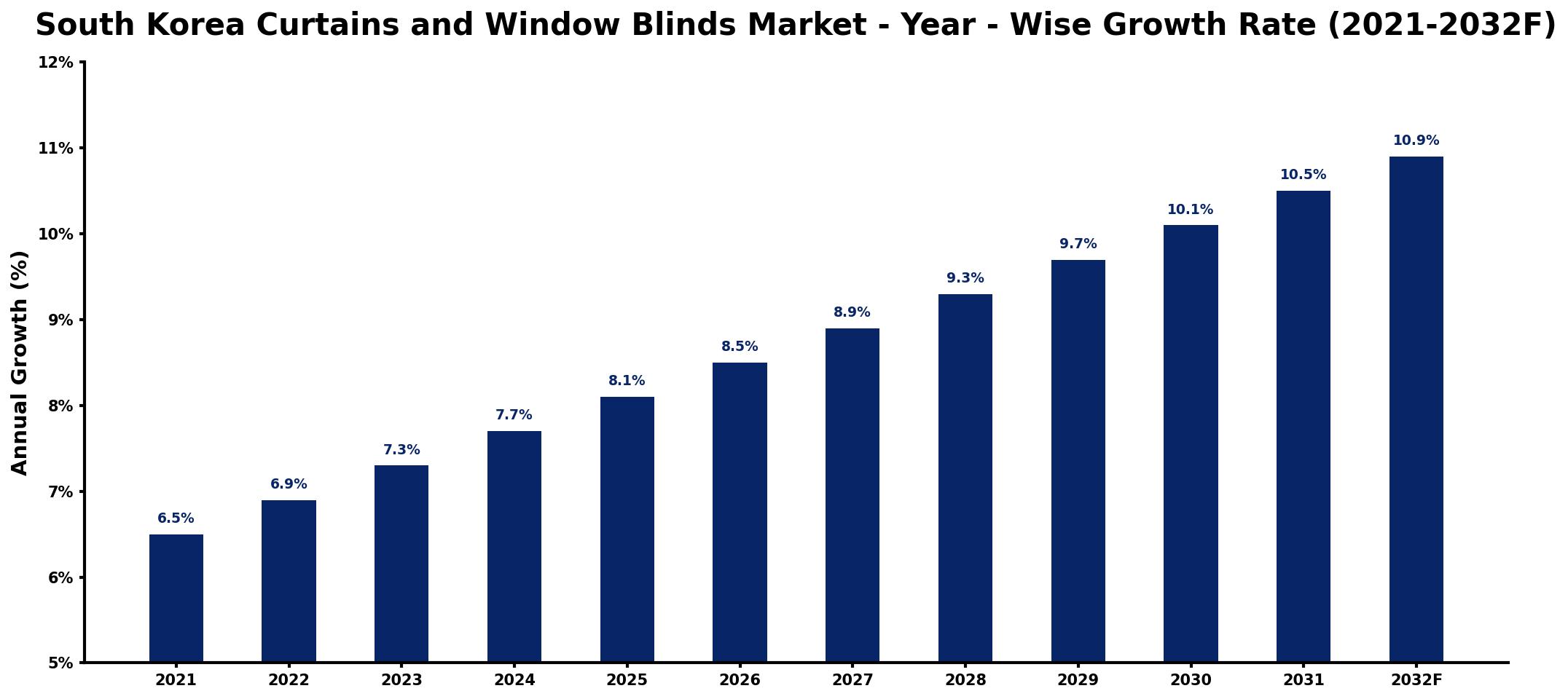
The table below presents the year‑wise growth rates along with the key drivers influencing the market
| Year | Growth Rate | Major Drivers |
| 2021 | 6.5% | Rising home renovation activities |
| 2022 | 6.9% | Increased urbanization trends globally |
| 2023 | 7.3% | Growing demand for smart homes |
| 2024 | 7.7% | Expansion of interior design market |
| 2025 | 8.1% | Surge in eco-friendly materials |
| 2026 | 8.5% | Investment in residential construction |
| 2027 | 8.9% | Popularity of minimalistic aesthetics |
| 2028 | 9.3% | Enhanced consumer disposable income |
| 2029 | 9.7% | Rise in online retail platforms |
| 2030 | 10.1% | Growing awareness of sustainability |
| 2031 | 10.5% | Increase in real estate transactions |
| 2032 | 10.9% | Emergence of innovative design trends |
Note: Market size estimations and growth projections presented in this report are based on 6Wresearch's proprietary forecasting methodology, utilizing the latest available industry data, government publications, and primary research inputs.
South Korea Curtains and Window Blinds Market Synopsis
Recent momentum in the South Korea curtains and window blinds market has highlighted a growing consumer preference for innovative and aesthetically appealing solutions. As lifestyle aspirations evolve, consumers are increasingly seeking products that not only enhance the beauty of their spaces but also offer smart features for convenience.
Looking ahead, the market is poised for transformation, characterized by significant advancements in technology and sustainability. With trends shifting towards eco-friendly materials and smart home integration, consumers are likely to continue their investment in quality curtains and blinds that reflect their values and preferences.
South Korea Curtains and Window Blinds Market Key Takeaways
- The market is witnessing robust growth driven by urbanization and rising disposable incomes.
- Consumer demand is shifting towards smart, energy-efficient, and eco-friendly window treatments.
- Customization and innovative designs are becoming essential to meet diverse consumer preferences.
- E-commerce is emerging as a critical channel for distribution, expanding product accessibility.
- Technological advancements in automation and smart home compatibility are reshaping product offerings.
Evaluation of Restraints in South Korea Curtains and Window Blinds Market
Despite the positive growth outlook, several constraints linger within the South Korea curtains and window blinds market. Intense competition from both local and international brands complicates differentiation efforts, making it crucial for companies to establish a strong brand identity. Fluctuating raw material costs can also pressure profit margins, while rapidly changing consumer preferences demand continuous innovation. Additionally, economic uncertainties can influence consumer spending, potentially impacting demand for these home decor products.
South Korea Curtains and Window Blinds Market Trends
Current trends indicate a robust demand for smart window treatments that combine aesthetic appeal with advanced functionality. Consumers are increasingly interested in products that offer features such as light control, temperature regulation, and integration with smart home systems. Moreover, the push for sustainability is prompting brands to explore eco-friendly materials and production methods, appealing to environmentally conscious consumers. Customization options are also gaining traction, as buyers seek unique designs tailored to their personal tastes.
South Korea Curtains and Window Blinds Market Opportunities
Investment opportunities abound in the South Korea curtains and window blinds market, particularly in areas that align with emerging consumer trends. Companies can benefit from developing innovative window treatment solutions, including smart blinds that incorporate automation and remote control features. Expanding the online retail segment is another promising avenue, capitalizing on the increasing number of consumers opting for e-commerce platforms for their shopping needs. Furthermore, forging partnerships with interior designers and home improvement stores can create additional pathways for market expansion.
Government Initiatives in the South Korea Curtains and Window Blinds Market
The South Korean government has implemented various initiatives aimed at enhancing energy efficiency and safety within the curtains and window blinds market. Regulations mandating certification for specific types of window treatments ensure compliance with safety standards. Additionally, incentives and subsidies have been introduced to encourage the adoption of energy-efficient products, further supporting sustainability goals. These initiatives are designed to bolster the overall quality and environmental responsibility of products within the market.
Future Insights of the South Korea Curtains and Window Blinds Market
As we look towards 2026-2032, the South Korea curtains and window blinds market is set for continued growth, spurred by evolving consumer preferences and lifestyle changes. The demand for aesthetically pleasing yet functional products is likely to escalate, complemented by advancements in technology such as automation and smart integrations. Online shopping's growing prominence will also enhance market accessibility, paving the way for innovative product introductions and expanded consumer choices.
South Korea Curtains and Window Blinds Market Latest Developments (2025 - 2026)
Recent developments in the curtains and window blinds sector have indicated a shift towards more technologically advanced solutions. Industry stakeholders have begun investing in research and development focused on integrating smart technologies into traditional products. Additionally, there is a noticeable trend towards greater emphasis on sustainability, with many brands exploring eco-friendly materials and sustainable production processes to attract a conscientious consumer base.
South Korea Curtains and Window Blinds Market - Key Attractiveness of the Report
- 10 Years of Market Numbers
- Historical Data Starting from 2022 to 2025
- Base Year: 2025
- Forecast Data until 2032
- Key Performance Indicators Impacting the Market
- Major Upcoming Developments and Projects
Key Highlights of the Report:
- South Korea Curtains and Window Blinds Market Outlook
- Market Size of South Korea Curtains and Window Blinds Market, 2025
- Forecast of South Korea Curtains and Window Blinds Market, 2032
- Historical Data and Forecast of South Korea Curtains and Window Blinds Revenues & Volume for the Period 2022-2032F
- South Korea Curtains and Window Blinds Market Trend Evolution
- South Korea Curtains and Window Blinds Market Drivers and Challenges
- South Korea Curtains and Window Blinds Price Trends
- South Korea Curtains and Window Blinds Porter's Five Forces
- South Korea Curtains and Window Blinds Industry Life Cycle
- Historical Data and Forecast of South Korea Curtains and Window Blinds Market Revenues & Volume By Materials for the Period 2022-2032F
- Historical Data and Forecast of South Korea Curtains and Window Blinds Market Revenues & Volume By Curtains (Cotton, Linen, Polyester) for the Period 2022-2032F
- Historical Data and Forecast of South Korea Curtains and Window Blinds Market Revenues & Volume By Window Blinds (Cotton, Linen, Wood, PVC, Metal) for the Period 2022-2032F
- Historical Data and Forecast of South Korea Curtains and Window Blinds Market Revenues & Volume By Product for the Period 2022-2032F
- Historical Data and Forecast of South Korea Curtains and Window Blinds Market Revenues & Volume By Curtains (Box pleat curtains, Pinch pleat curtains & drapery, Goblet pleat curtains & drapery, Eyelet curtains & drapery) for the Period 2022-2032F
- Historical Data and Forecast of South Korea Curtains and Window Blinds Market Revenues & Volume By Window Blinds (Window Shades,, Window Screens, Connected) for the Period 2022-2032F
- Historical Data and Forecast of South Korea Curtains and Window Blinds Market Revenues & Volume By Distribution Channel for the Period 2022-2032F
- Historical Data and Forecast of South Korea Curtains and Window Blinds Market Revenues & Volume By B2B for the Period 2022-2032F
- Historical Data and Forecast of South Korea Curtains and Window Blinds Market Revenues & Volume By B2C for the Period 2022-2032F
- Historical Data and Forecast of South Korea Curtains and Window Blinds Market Revenues & Volume By E-commerce for the Period 2022-2032F
- Historical Data and Forecast of South Korea Curtains and Window Blinds Market Revenues & Volume By Price Range for the Period 2022-2032F
- Historical Data and Forecast of South Korea Curtains and Window Blinds Market Revenues & Volume By High for the Period 2022-2032F
- Historical Data and Forecast of South Korea Curtains and Window Blinds Market Revenues & Volume By Medium for the Period 2022-2032F
- Historical Data and Forecast of South Korea Curtains and Window Blinds Market Revenues & Volume By Low for the Period 2022-2032F
- South Korea Curtains and Window Blinds Import Export Trade Statistics
- Market Opportunity Assessment By Materials
- Market Opportunity Assessment By Product
- Market Opportunity Assessment By Distribution Channel
- Market Opportunity Assessment By Price Range
- South Korea Curtains and Window Blinds Top Companies Market Share
- South Korea Curtains and Window Blinds Competitive Benchmarking By Technical and Operational Parameters
- South Korea Curtains and Window Blinds Company Profiles
- South Korea Curtains and Window Blinds Key Strategic Recommendations






































