Brazil Data Catalog Market Size & Growth Rate (2026-2032)
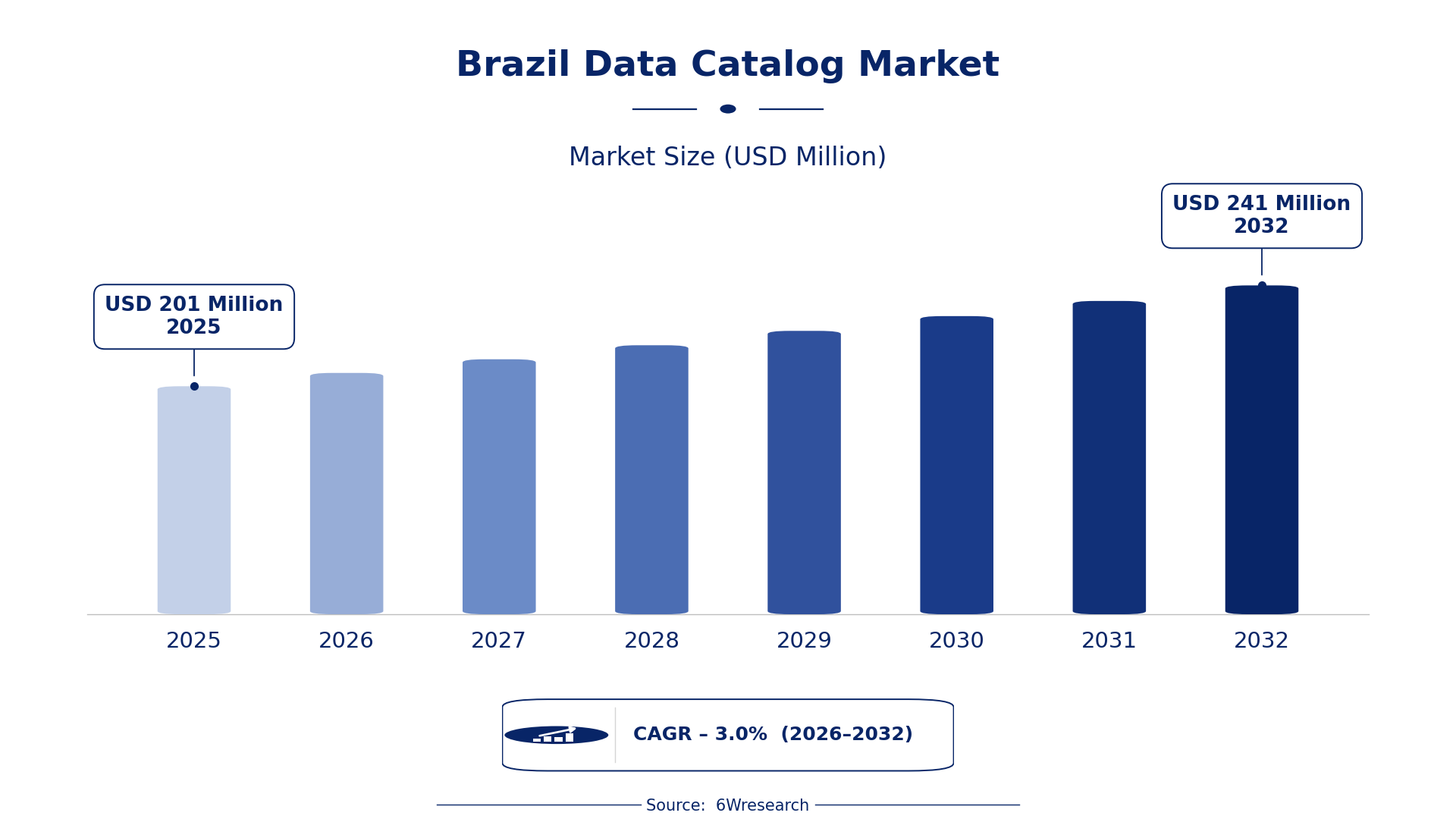
The Brazil Data Catalog Market was estimated at USD 201 Million in 2025 and is projected to reach USD 241 Million by 2032, growing at a CAGR of 3.0% from 2026 to 2032.
Brazil Data Catalog Market Synopsis
The most significant force currently driving the Brazil Data Catalog market is the urgent need for effective data management solutions. As organizations grapple with an ever-expanding sea of data, the demand for tools that facilitate data discovery and governance has surged. This trend reflects a broader recognition of data as a strategic asset essential for decision-making and compliance.
In Brazil, businesses across various sectors are adopting data catalog solutions to address the complexities of data governance. These tools are instrumental in ensuring data quality, compliance with regulations, and enhancing accessibility. As firms continue to unlock the potential of their data, the reliance on sophisticated cataloging solutions will only deepen.
Brazil Data Catalog Market Year-wise Growth Rate and Key Drivers
This graph illustrates the annual growth rates of the Brazil Data Catalog Market from 2021 to 2032, highlighting a steady upward trajectory and projected expansion over the forecast period.
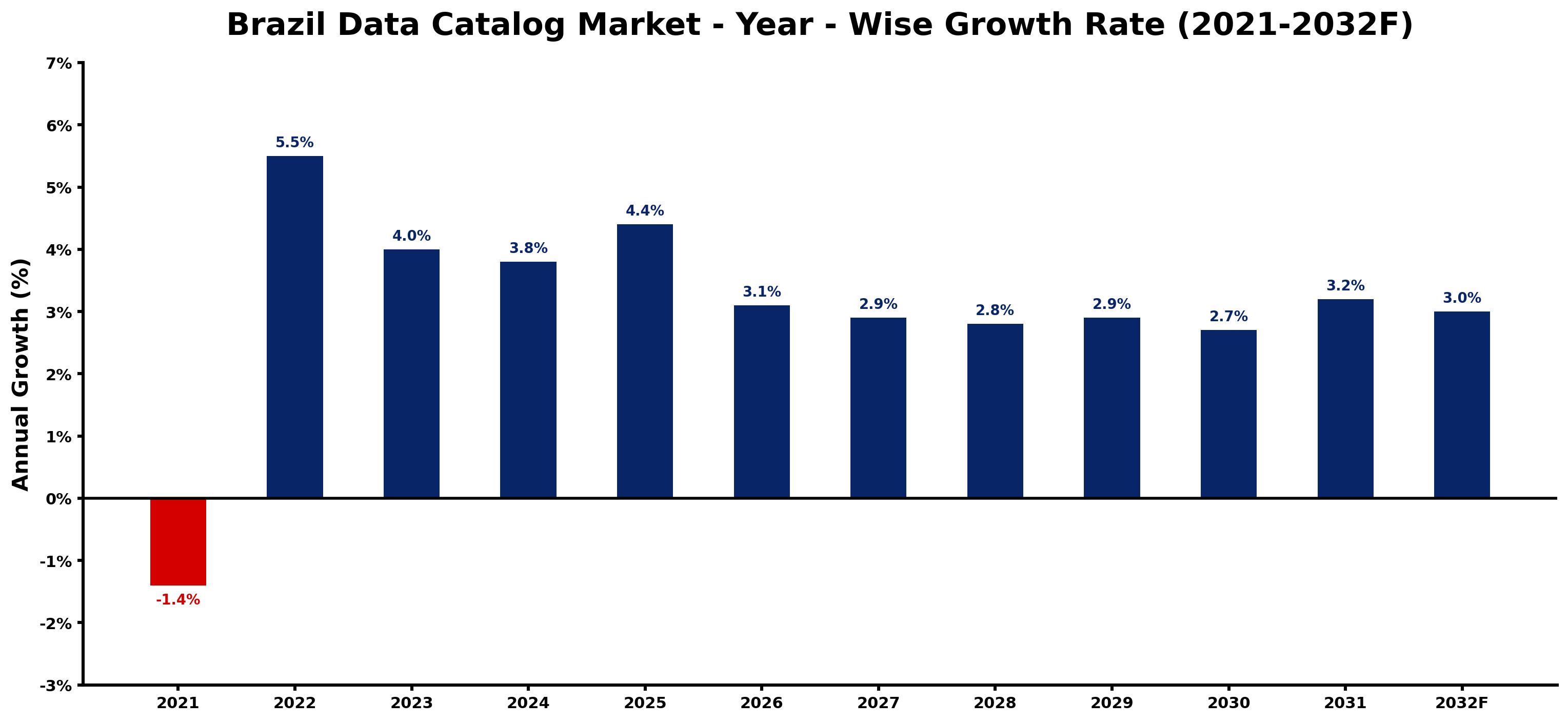
The table below presents the year‑wise growth rates along with the key drivers influencing the market
| Year | Growth Rate | Major Drivers |
| 2021 | -1.4% | Federal data privacy law hampering catalog adoption |
| 2022 | 5.5% | Launch of Brazilian Open Data initiative boosts demand |
| 2023 | 4.0% | Increased data transparency regulations driving catalog investments |
| 2024 | 3.8% | Growth in e-government projects requiring comprehensive data catalogs |
| 2025 | 4.4% | Surge in local startups needing access to data resources |
| 2026 | 3.1% | Expanded AI adoption mandates data organization and cataloging |
| 2027 | 2.9% | Rising data privacy concerns promote structured data usage |
| 2028 | 2.8% | Boost in digital public services enhances data catalog needs |
| 2029 | 2.9% | Collaborations between government and tech firms for data access |
| 2030 | 2.7% | Emerging analytics trends elevate importance of data catalogs |
| 2031 | 3.2% | Investment in smart cities fuels demand for data repositories |
| 2032 | 3.0% | Growing public demand for open data and accessibility |
Note: Market size estimations and growth projections presented in this report are based on 6Wresearch's proprietary forecasting methodology, utilizing the latest available industry data, government publications, and primary research inputs.
Brazil Data Catalog Market Key Takeaways
Below are some of the specific key takeaways from the market, including:
- The demand for data catalog solutions is rapidly increasing as organizations prioritize data governance.
- Data compliance and quality assurance are critical factors driving the adoption of cataloging tools.
- Businesses are recognizing data catalogs as vital for maximizing the value of data assets.
- Interoperability and standardization issues pose challenges that need addressing for market growth.
- Government regulations significantly influence the strategies organizations adopt in managing their data.
Evaluation of Restraints in Brazil Data Catalog Market
Despite its growth, the Brazil Data Catalog market faces several restraints that can impede progress. One of the primary concerns is ensuring data quality across diverse datasets. Organizations often struggle with inconsistencies and inaccuracies that can undermine the effectiveness of data catalogs. Compliance with stringent data protection regulations adds another layer of complexity, as companies must navigate a challenging regulatory environment. on top of that, interoperability issues between different data systems hinder seamless integration and usage of data catalogs. To overcome these obstacles, businesses need to adopt standardized practices and foster collaboration among stakeholders.
Brazil Data Catalog Market Trends
A key trend shaping the Brazil Data Catalog market is the rising integration of artificial intelligence and machine learning technologies. These advancements enhance the capabilities of data catalogs, allowing for smarter data discovery and classification. Additionally, there is a growing emphasis on user-friendly interfaces that enable non-technical users to access and utilize data effectively. This democratization of data access is crucial for organizations aiming to foster a data-driven culture.
Another trend is the increasing collaboration between public and private sectors to establish frameworks for data governance. As businesses seek to comply with evolving regulations, partnerships are forming to create standardized practices that promote data sharing and security. This collaborative approach is essential for addressing the challenges posed by data management and ensuring the responsible use of data assets.
Brazil Data Catalog Market Opportunities
The Brazil Data Catalog market presents numerous opportunities for growth and investment. As organizations strive to enhance their data governance practices, the demand for innovative catalog solutions is expected to rise. Companies that focus on developing AI-driven catalog tools with advanced analytics capabilities will likely capture a significant share of the market. on top of that, the ongoing digital transformation initiatives across various industries create fertile ground for deploying data catalog solutions, particularly in sectors like finance, healthcare, and retail, where data-driven decision-making is paramount.
Government Initiatives in the Brazil Data Catalog Market
Government policy plays a crucial role in shaping the Brazil Data Catalog market, as regulations around data governance and security impact how organizations manage their data. The Brazilian government is increasingly prioritizing data management initiatives to bolster compliance and enhance data accessibility. As public-sector priorities evolve, they significantly influence the strategies organizations adopt in their data catalog efforts.
- A recently completed initiative focused on establishing a national framework for data governance, aimed at promoting best practices in data management across various sectors.
- A current initiative involves ongoing efforts to enhance data protection regulations, ensuring organizations comply with stringent security standards.
- A planned public-private partnership set to launch in 2026 aims to improve data infrastructure, facilitating better access and management of data resources.
- The government is actively developing training programs to equip professionals with the necessary skills for effective data catalog implementation and management.
- An upcoming regulatory review scheduled for late 2026 will assess the effectiveness of existing data governance policies and propose enhancements.
Future Insights of the Brazil Data Catalog Market
Looking ahead to 2026-2032, the Brazil Data Catalog market is set for continued growth as organizations increasingly recognize the strategic importance of data management. Enhanced data governance frameworks and rising compliance requirements will drive demand for effective catalog solutions. Technological advancements, particularly in AI and machine learning, will further empower organizations to optimize their data practices. As the market matures, companies that can adapt to these changes and innovate will secure a competitive advantage.
Brazil Data Catalog Market Latest Developments
Recent developments in the Brazil Data Catalog market reflect an active and evolving industry. Over the past year, organizations have been increasingly focused on integrating advanced technologies into their data management practices. This trend indicates a growing recognition of the value that effective data catalog solutions can bring to businesses navigating complex data environments.
- A major technology vendor launched a new data catalog tool in Q3 2025, incorporating AI capabilities for automated data classification.
- A regional operator initiated a collaboration with local universities to develop training programs for data management professionals, which began in early 2025 and is currently underway.
- An ongoing project aimed at enhancing interoperability between various data systems was launched in mid-2025, with plans for completion by late 2026.
- A planned upgrade of data infrastructure for public institutions is expected to begin in early 2026, focusing on improving data access and security.
- A successful pilot program for data governance best practices was completed in Q1 2025, with plans to expand it across multiple sectors by mid-2026.
Brazil Data Catalog Market - Key Attractiveness of the Report
- 10 Years of Market Numbers
- Historical Data Starting from 2022 to 2025
- Base Year: 2025
- Forecast Data until 2032
- Key Performance Indicators Impacting the Market
- Major Upcoming Developments and Projects
Key Highlights of the Report:
- Brazil Data Catalog Market Outlook
- Market Size of Brazil Data Catalog Market, 2025
- Forecast of Brazil Data Catalog Market, 2032
- Historical Data and Forecast of Brazil Data Catalog Revenues & Volume for the Period 2022-2032F
- Brazil Data Catalog Market Trend Evolution
- Brazil Data Catalog Market Drivers and Challenges
- Brazil Data Catalog Price Trends
- Brazil Data Catalog Porter's Five Forces
- Brazil Data Catalog Industry Life Cycle
- Historical Data and Forecast of Brazil Data Catalog Market Revenues & Volume By Component for the Period 2022-2032F
- Historical Data and Forecast of Brazil Data Catalog Market Revenues & Volume By Solutions for the Period 2022-2032F
- Historical Data and Forecast of Brazil Data Catalog Market Revenues & Volume By Services for the Period 2022-2032F
- Historical Data and Forecast of Brazil Data Catalog Market Revenues & Volume By Data Consumer for the Period 2022-2032F
- Historical Data and Forecast of Brazil Data Catalog Market Revenues & Volume By Business Intelligence tools for the Period 2022-2032F
- Historical Data and Forecast of Brazil Data Catalog Market Revenues & Volume By Enterprise Applications for the Period 2022-2032F
- Historical Data and Forecast of Brazil Data Catalog Market Revenues & Volume By Mobile and Web Applications for the Period 2022-2032F
- Historical Data and Forecast of Brazil Data Catalog Market Revenues & Volume By Deployment Mode for the Period 2022-2032F
- Historical Data and Forecast of Brazil Data Catalog Market Revenues & Volume By Cloud for the Period 2022-2032F
- Historical Data and Forecast of Brazil Data Catalog Market Revenues & Volume By On-premises for the Period 2022-2032F
- Historical Data and Forecast of Brazil Data Catalog Market Revenues & Volume By Metadata Type for the Period 2022-2032F
- Historical Data and Forecast of Brazil Data Catalog Market Revenues & Volume By Technical Metadata for the Period 2022-2032F
- Historical Data and Forecast of Brazil Data Catalog Market Revenues & Volume By Business Metadata for the Period 2022-2032F
- Historical Data and Forecast of Brazil Data Catalog Market Revenues & Volume By Organization Size for the Period 2022-2032F
- Historical Data and Forecast of Brazil Data Catalog Market Revenues & Volume By SMEs for the Period 2022-2032F
- Historical Data and Forecast of Brazil Data Catalog Market Revenues & Volume By Large Enterprises for the Period 2022-2032F
- Historical Data and Forecast of Brazil Data Catalog Market Revenues & Volume By Vertical for the Period 2022-2032F
- Historical Data and Forecast of Brazil Data Catalog Market Revenues & Volume By BFSI for the Period 2022-2032F
- Historical Data and Forecast of Brazil Data Catalog Market Revenues & Volume By Retail and eCommerce for the Period 2022-2032F
- Historical Data and Forecast of Brazil Data Catalog Market Revenues & Volume By Manufacturing for the Period 2022-2032F
- Historical Data and Forecast of Brazil Data Catalog Market Revenues & Volume By Government and Defence for the Period 2022-2032F
- Historical Data and Forecast of Brazil Data Catalog Market Revenues & Volume By Healthcare and Life Sciences for the Period 2022-2032F
- Historical Data and Forecast of Brazil Data Catalog Market Revenues & Volume By Telecom for the Period 2022-2032F
- Historical Data and Forecast of Brazil Data Catalog Market Revenues & Volume By Media and Entertainment for the Period 2022-2032F
- Historical Data and Forecast of Brazil Data Catalog Market Revenues & Volume By Transportation and Logistics for the Period 2022-2032F
- Brazil Data Catalog Import Export Trade Statistics
- Market Opportunity Assessment By Component
- Market Opportunity Assessment By Data Consumer
- Market Opportunity Assessment By Deployment Mode
- Market Opportunity Assessment By Metadata Type
- Market Opportunity Assessment By Organization Size
- Market Opportunity Assessment By Vertical
- Brazil Data Catalog Top Companies Market Share
- Brazil Data Catalog Competitive Benchmarking By Technical and Operational Parameters
- Brazil Data Catalog Company Profiles
- Brazil Data Catalog Key Strategic Recommendations






































