Brazil Decentralized Identity Market Size & Growth Rate (2026-2032)
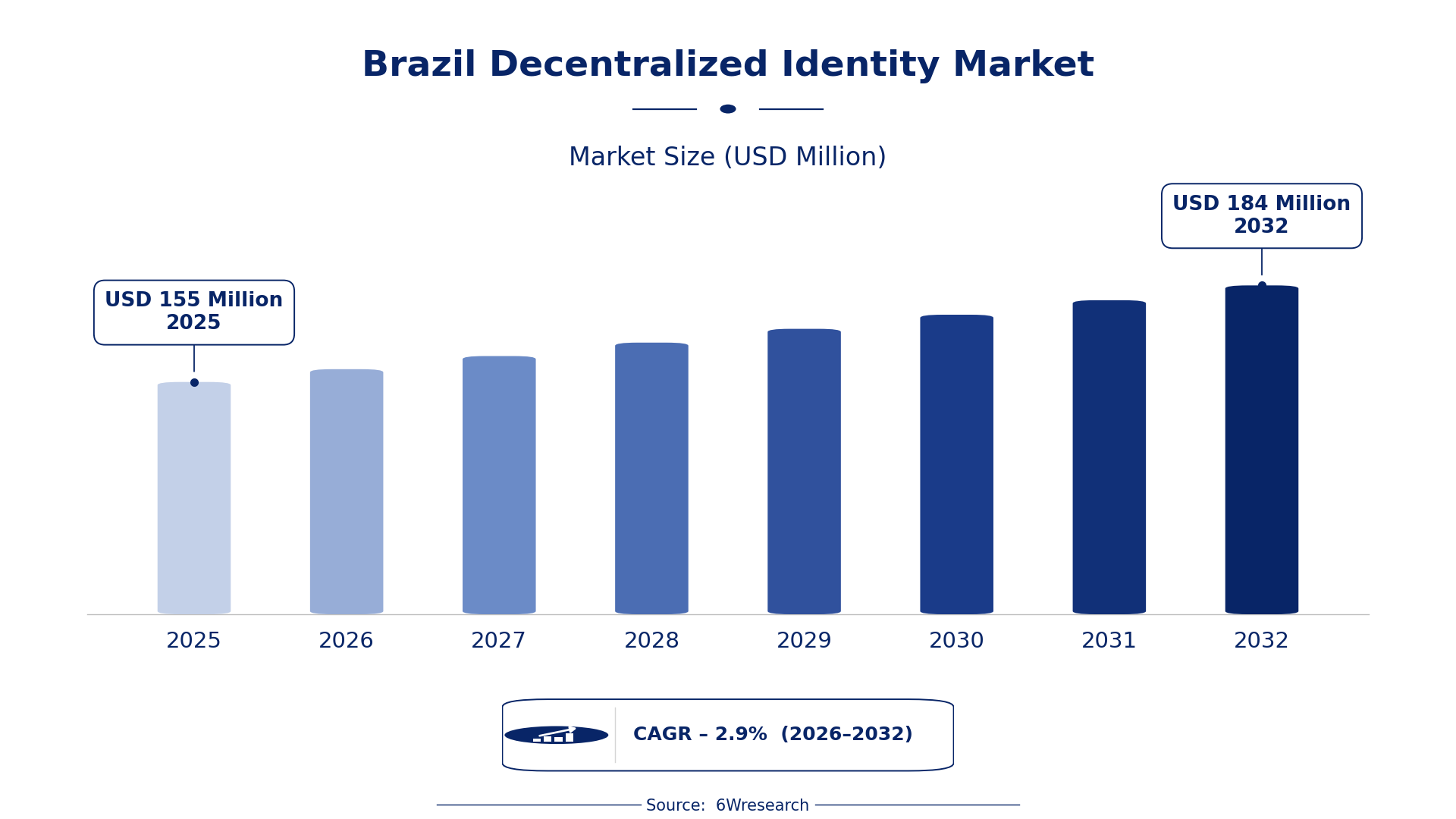
The Brazil Decentralized Identity Market was estimated at USD 155 Million in 2025 and is projected to reach USD 184 Million by 2032, growing at a CAGR of 2.9% from 2026 to 2032.
Brazil Decentralized Identity Market Synopsis
The growing emphasis on user privacy and data security is reshaping the Brazil Decentralized Identity Market. Organizations are increasingly seeking decentralized identity solutions that not only protect individual privacy but also enhance user control over personal information.
Adoption is driven by a mix of regulatory pressures and the demand for more efficient identity verification processes. Brazilian businesses are recognizing the necessity for innovative identity management solutions that minimize the risks associated with traditional systems, encouraging a shift toward decentralized technologies.
Brazil Decentralized Identity Market Year-wise Growth Rate and Key Drivers
This graph illustrates the annual growth rates of the Brazil Decentralized Identity Market from 2021 to 2032, highlighting a steady upward trajectory and projected expansion over the forecast period.
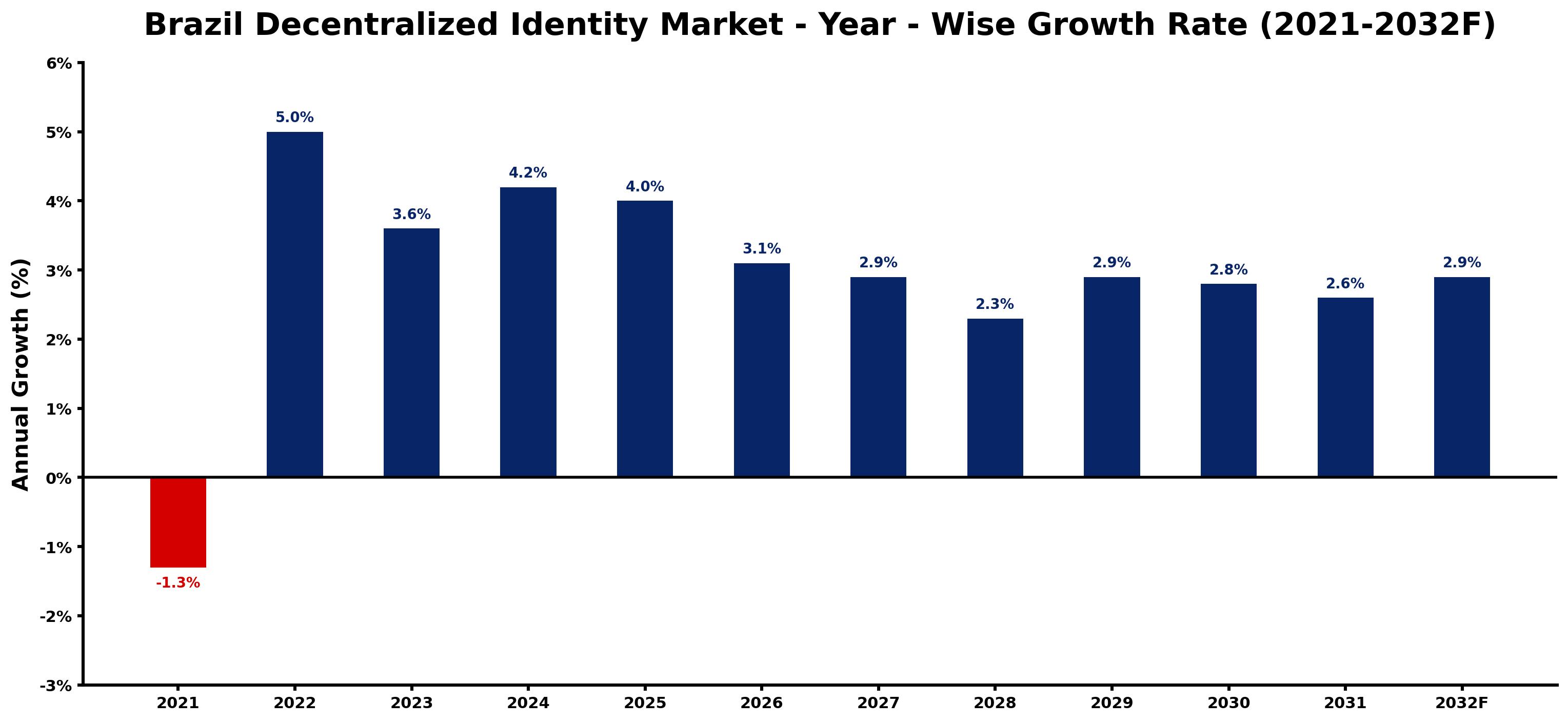
The table below presents the year‑wise growth rates along with the key drivers influencing the market
| Year | Growth Rate | Major Drivers |
| 2021 | -1.3% | Strict regulations from ANPD hindered ID innovation. |
| 2022 | 5.0% | Government support for digital identity regulations enhancement. |
| 2023 | 3.6% | Increased demand for KYC compliance in fintech sector. |
| 2024 | 4.2% | Adoption of biometric authentication for online services. |
| 2025 | 4.0% | Integration of decentralized identity in e-commerce platforms. |
| 2026 | 3.1% | Growing investment in cybersecurity frameworks by enterprises. |
| 2027 | 2.9% | Rising number of digital wallets requiring identity verification. |
| 2028 | 2.3% | Emergence of startups focusing on identity verification technologies. |
| 2029 | 2.9% | Collaboration between banks and tech firms on identities. |
| 2030 | 2.8% | Regulatory push for privacy-centric identity solutions. |
| 2031 | 2.6% | Increased digital transformation initiatives by government agencies. |
| 2032 | 2.9% | Local demand for streamlined remote working identity tools. |
Note: Market size estimations and growth projections presented in this report are based on 6Wresearch's proprietary forecasting methodology, utilizing the latest available industry data, government publications, and primary research inputs.
Brazil Decentralized Identity Market Key Takeaways
Below are some of the specific key takeaways from the market, including:
- The market is currently valued at USD 155 million and is expected to grow steadily.
- Organizations are pushing for solutions that prioritize user data control and privacy.
- Regulatory compliance is a critical factor influencing market dynamics.
- Interoperability challenges continue to affect the deployment of decentralized identity solutions.
- Public acceptance and education on decentralized identity benefits are key to wider adoption.
Evaluation of Restraints in Brazil Decentralized Identity Market
Despite its potential, the Brazil Decentralized Identity Market grapples with several limitations. First, regulatory compliance is a complex landscape that often varies across jurisdictions, making it challenging for businesses to implement standardized solutions. Additionally, interoperability issues hinder the seamless integration of different decentralized identity systems, creating barriers for widespread usage. Lastly, public awareness and trust in these technologies remain limited, requiring ongoing education and demonstration of their benefits to foster acceptance.
Brazil Decentralized Identity Market Trends
An uptick in partnerships between technology providers and governmental bodies is emerging, signaling a collective effort to establish a secure digital identity framework. Companies are also focusing on enhancing user experience through intuitive interfaces and simplified access protocols. As data privacy concerns escalate, the demand for decentralized identity solutions that align with stringent regulations is becoming increasingly pronounced. Blockchain technology is expected to play a crucial role in developing these solutions, ensuring data integrity and user trust.
Brazil Decentralized Identity Market Opportunities
The market presents substantial opportunities for investment, particularly in developing scalable identity management platforms. Startups focused on creating user-friendly decentralized identity solutions are well-positioned to capture market share. Additionally, there is potential for growth in collaboration with educational institutions and NGOs to promote awareness of decentralized identity benefits. Tailoring solutions for specific sectors, such as healthcare or finance, could also unlock new customer bases and revenue streams.
Government Initiatives in the Brazil Decentralized Identity Market
Government policy is instrumental in shaping the Brazil Decentralized Identity Market by establishing regulatory frameworks and promoting technological advancements. Recent initiatives emphasize enhancing digital identity security while fostering public trust in decentralized systems. Such efforts are crucial as Brazil seeks to modernize its identity verification processes amidst rising data privacy concerns.
- A national digital identity security enhancement initiative launched in early 2023 aims to standardize practices across sectors.
- Ongoing collaborations between tech firms and government agencies are focused on developing interoperable identity solutions.
- Planned legislation set for 2025 is expected to address the regulatory hurdles faced by decentralized identity systems.
- A pilot program for public-sector use of decentralized identities is currently underway, demonstrating practical applications.
Future Insights of the Brazil Decentralized Identity Market
Looking ahead to 2026-2032, the Brazil Decentralized Identity Market is likely to witness increased integration of artificial intelligence and machine learning to streamline identity verification processes. The ongoing focus on digital transformation across sectors will push for more robust decentralized identity systems. With regulatory bodies prioritizing secure digital identities, businesses that align their offerings with compliance requirements will be favored in the competitive landscape. As user awareness grows, consumer demand will further drive the evolution of this market.
Brazil Decentralized Identity Market Latest Developments
Recent developments in the Brazil Decentralized Identity Market reveal a vigorous push towards innovation and collaboration. Over the past year, organizations have been actively testing new technologies while fostering partnerships aimed at addressing security and interoperability challenges.
- An initiative that began in Q1 2023 focuses on enhancing blockchain infrastructure for identity management across public services.
- A recent partnership was formed between a major technology vendor and a national agency to pilot decentralized identity solutions in urban centers.
- Plans for a nationwide awareness campaign scheduled for late 2024 aim to educate the public on the benefits of decentralized identities.
- A project focusing on integrating decentralized identity systems into the banking sector is currently underway, expected to provide insights by mid-2025.
Brazil Decentralized Identity Market - Key Attractiveness of the Report
- 10 Years of Market Numbers
- Historical Data Starting from 2022 to 2025
- Base Year: 2025
- Forecast Data until 2032
- Key Performance Indicators Impacting the Market
- Major Upcoming Developments and Projects
Key Highlights of the Report:
- Brazil Decentralized Identity Market Outlook
- Market Size of Brazil Decentralized Identity Market, 2025
- Forecast of Brazil Decentralized Identity Market, 2032
- Historical Data and Forecast of Brazil Decentralized Identity Revenues & Volume for the Period 2022-2032F
- Brazil Decentralized Identity Market Trend Evolution
- Brazil Decentralized Identity Market Drivers and Challenges
- Brazil Decentralized Identity Price Trends
- Brazil Decentralized Identity Porter's Five Forces
- Brazil Decentralized Identity Industry Life Cycle
- Historical Data and Forecast of Brazil Decentralized Identity Market Revenues & Volume By Vertical for the Period 2022-2032F
- Historical Data and Forecast of Brazil Decentralized Identity Market Revenues & Volume By BFSI for the Period 2022-2032F
- Historical Data and Forecast of Brazil Decentralized Identity Market Revenues & Volume By Government for the Period 2022-2032F
- Historical Data and Forecast of Brazil Decentralized Identity Market Revenues & Volume By Healthcare and Life Sciences for the Period 2022-2032F
- Historical Data and Forecast of Brazil Decentralized Identity Market Revenues & Volume By Retail and eCommerce for the Period 2022-2032F
- Historical Data and Forecast of Brazil Decentralized Identity Market Revenues & Volume By Telecom and IT for the Period 2022-2032F
- Historical Data and Forecast of Brazil Decentralized Identity Market Revenues & Volume By Transport and Logistics for the Period 2022-2032F
- Historical Data and Forecast of Brazil Decentralized Identity Market Revenues & Volume By Real Estate for the Period 2022-2032F
- Historical Data and Forecast of Brazil BFSI Decentralized Identity Market Revenues & Volume By Others for the Period 2022-2032F
- Historical Data and Forecast of Brazil Decentralized Identity Market Revenues & Volume By Identity Type for the Period 2022-2032F
- Historical Data and Forecast of Brazil Decentralized Identity Market Revenues & Volume By Non- biometrics for the Period 2022-2032F
- Historical Data and Forecast of Brazil Decentralized Identity Market Revenues & Volume By Biometrics for the Period 2022-2032F
- Historical Data and Forecast of Brazil Decentralized Identity Market Revenues & Volume By End User for the Period 2022-2032F
- Historical Data and Forecast of Brazil Decentralized Identity Market Revenues & Volume By Enterprises for the Period 2022-2032F
- Historical Data and Forecast of Brazil Decentralized Identity Market Revenues & Volume By Individual for the Period 2022-2032F
- Historical Data and Forecast of Brazil Decentralized Identity Market Revenues & Volume By Organization Size for the Period 2022-2032F
- Historical Data and Forecast of Brazil Decentralized Identity Market Revenues & Volume By Large Enterprises for the Period 2022-2032F
- Historical Data and Forecast of Brazil Decentralized Identity Market Revenues & Volume By SMEs for the Period 2022-2032F
- Brazil Decentralized Identity Import Export Trade Statistics
- Market Opportunity Assessment By Vertical
- Market Opportunity Assessment By Identity Type
- Market Opportunity Assessment By End User
- Market Opportunity Assessment By Organization Size
- Brazil Decentralized Identity Top Companies Market Share
- Brazil Decentralized Identity Competitive Benchmarking By Technical and Operational Parameters
- Brazil Decentralized Identity Company Profiles
- Brazil Decentralized Identity Key Strategic Recommendations






































