Brazil Drilling Services Market Size, Share & Growth Rate
The Brazil Drilling Services Market was estimated at USD 434 Million in 2025 and is projected to reach USD 519 Million by 2032, growing at a CAGR of 2.6% from 2026 to 2032. This growth trajectory is primarily fueled by the ongoing expansion of oil and gas exploration activities in Brazil, particularly in offshore regions. Coupled with an increasing demand for mineral exploration and robust infrastructure projects, these factors are collectively shaping a positive outlook for the drilling services sector.
Brazil Drilling Services Market Year-wise Growth Rate and Key Drivers
This graph highlights how the Brazil Drilling Services Market has steadily grown over the years, supported by major growth factors.
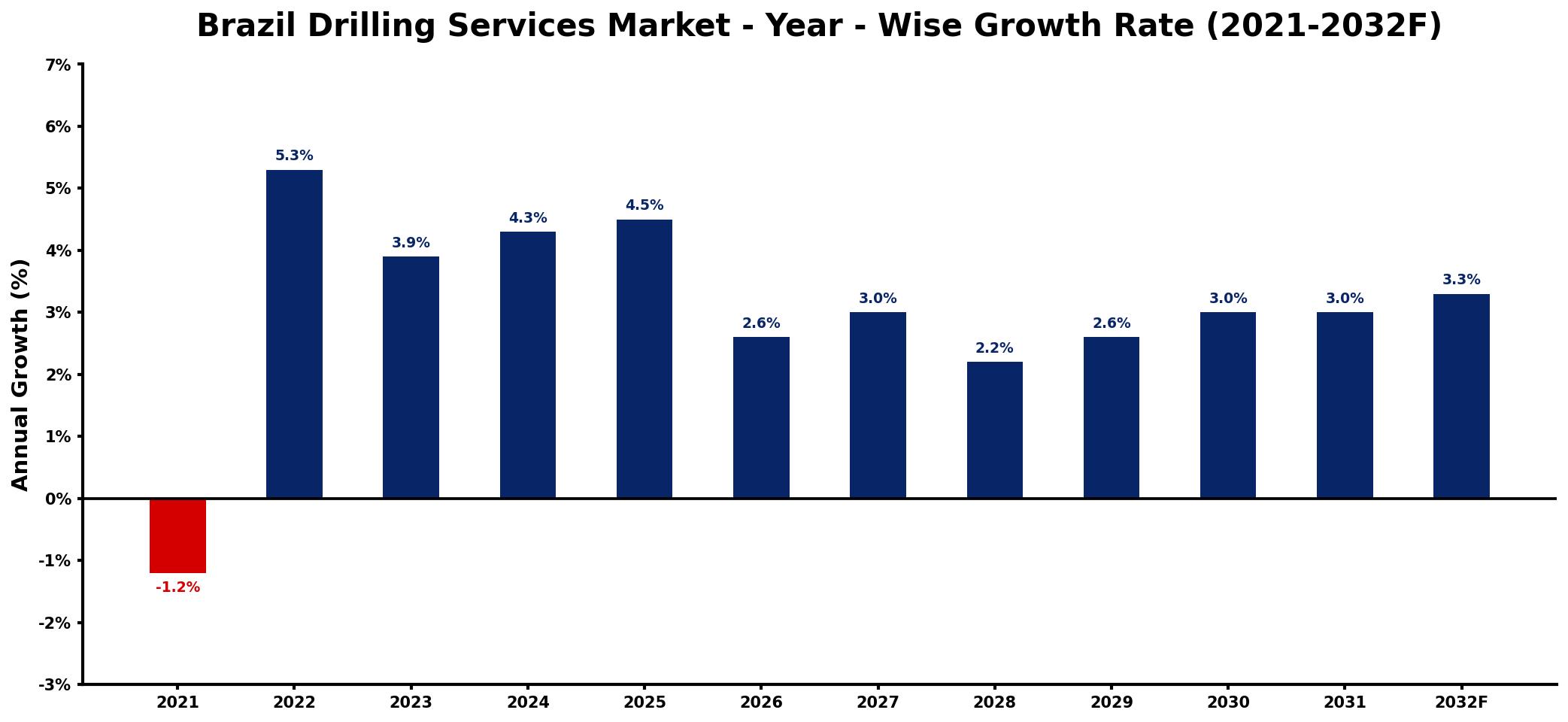
The table below presents the year‑wise growth rates along with the key drivers influencing the market
| Year | Growth Rate | Major Drivers |
| 2021 | -1.2% | global oil prices experienced downturn |
| 2022 | 5.3% | increased investment in infrastructure projects |
| 2023 | 3.9% | rising demand for energy resources |
| 2024 | 4.3% | expansion of renewable energy initiatives |
| 2025 | 4.5% | growth in exploration activities worldwide |
| 2026 | 2.6% | enhanced technology adoption in industry |
| 2027 | 3.0% | stronger regulatory support for exploration |
| 2028 | 2.2% | increased international collaboration efforts |
| 2029 | 2.6% | surge in private sector investments |
| 2030 | 3.0% | growing focus on sustainability practices |
| 2031 | 3.0% | emerging markets driving energy demand |
| 2032 | 3.3% | advancements in extraction technologies |
Note: Market size estimations and growth projections presented in this report are based on 6Wresearch's proprietary forecasting methodology, utilizing the latest available industry data, government publications, and primary research inputs.
Brazil Drilling Services Market Synopsis
The most significant force currently influencing the Brazil Drilling Services Market is the surge in oil and gas production activities. With Brazils vast reserves and technological advancements in drilling techniques, companies are eager to optimize operations and capitalize on untapped resources. This renewed focus is driving investments in advanced drilling equipment and services.
Additionally, environmental assessments and sustainable practices are becoming essential as regulatory bodies emphasize responsible resource extraction. Companies are increasingly integrating innovative drilling technologies that not only enhance efficiency but also reduce environmental impact, thereby aligning with government mandates and market expectations.
Brazil Drilling Services Market Key Takeaways
- The market is witnessing steady growth driven by oil and gas exploration activities.
- Technological advancements are enhancing drilling efficiency and sustainability.
- Government policies are establishing stringent regulations that shape market dynamics.
- Environmental concerns are prompting shifts towards eco-friendly drilling solutions.
- Investment in offshore drilling and mining projects is expanding market opportunities.
Evaluation of Restraints in Brazil Drilling Services Market
While the Brazil Drilling Services Market shows promise, it faces notable restraints that could hinder growth. Adapting services to Brazil's diverse geological conditions requires both significant expertise and investment, which can be challenging for service providers. Moreover, maintaining efficiency and accuracy during drilling operations is crucial for profitability, and any lapses can lead to increased costs. Environmental concerns related to drilling activities compel companies to invest in greener technologies and compliance measures, often straining resources. Lastly, competition from alternative drilling methods is intensifying, making it essential for traditional drilling services to innovate continuously to remain competitive.
Brazil Drilling Services Market Trends
Emerging trends in the Brazil Drilling Services Market indicate a marked shift towards digitalization and automation. Companies are increasingly adopting smart drilling technologies that leverage data analytics and artificial intelligence to enhance decision-making processes. Furthermore, there is a growing emphasis on health, safety, and environmental (HSE) management systems, aiming to minimize risk and comply with stringent regulations. Another significant trend is the integration of sustainable practices into drilling operations, which reflects a broader industry movement towards eco-consciousness and corporate social responsibility.
Brazil Drilling Services Market Opportunities
The Brazil Drilling Services Market presents several opportunities for growth and investment. The exploration of new oil and gas reserves, particularly in offshore locations, is set to drive demand for advanced drilling services. As mining operations expand in Brazil, the need for mineral exploration drilling will also create new avenues for service providers. Additionally, investment in infrastructure projects related to energy and utilities offers a fertile ground for companies specializing in geotechnical investigations and water well drilling. The push for environmentally responsible drilling techniques further opens doors for innovative solutions that meet regulatory demands while improving operational efficiencies.
Government Initiatives in the Brazil Drilling Services Market
Government policies play a crucial role in shaping the Brazil Drilling Services Market. Regulatory measures governing oil and gas exploration emphasize environmental protection and community engagement, ensuring that drilling activities adhere to safety standards and minimize ecological impacts. Public investment in infrastructure and energy projects further stimulates demand for drilling services, while licensing requirements help maintain market integrity by ensuring compliance with national and international standards. These initiatives are aimed at fostering a sustainable and responsible approach to resource extraction.
Future Insights of the Brazil Drilling Services Market
Looking ahead to the period from 2026 to 2032, the Brazil Drilling Services Market is poised for steady growth as exploration activities ramp up, driven by both domestic and foreign investments. The combination of technological advancements and stringent regulatory frameworks will compel service providers to innovate continually, ensuring they remain competitive. Additionally, as environmental concerns gain prominence, there will be a significant shift towards sustainable practices, which will not only enhance operational efficiencies but also align with global trends in resource management.
Brazil Drilling Services Market Latest Developments (2025 - 2026)
Recent developments in the Brazil Drilling Services Market suggest a strong focus on sustainability and technological integration. Many companies are prioritizing investments in advanced drilling technologies that enhance both productivity and environmental compliance. Additionally, there has been an uptick in collaborative efforts between government and private sectors to streamline regulatory processes, allowing for more efficient project implementation. Industry stakeholders are also engaging in dialogues around best practices in HSE management, reflecting a collective commitment to elevating standards across the market.
Brazil Drilling Services Market - Key Attractiveness of the Report
- 10 Years of Market Numbers
- Historical Data Starting from 2022 to 2025
- Base Year: 2025
- Forecast Data until 2032
- Key Performance Indicators Impacting the Market
- Major Upcoming Developments and Projects
Key Highlights of the Report:
- Brazil Drilling Services Market Outlook
- Market Size of Brazil Drilling Services Market, 2025
- Forecast of Brazil Drilling Services Market, 2032
- Historical Data and Forecast of Brazil Drilling Services Revenues & Volume for the Period 2022-2032F
- Brazil Drilling Services Market Trend Evolution
- Brazil Drilling Services Market Drivers and Challenges
- Brazil Drilling Services Price Trends
- Brazil Drilling Services Porter's Five Forces
- Brazil Drilling Services Industry Life Cycle
- Historical Data and Forecast of Brazil Drilling Services Market Revenues & Volume By Service for the Period 2022-2032F
- Historical Data and Forecast of Brazil Drilling Services Market Revenues & Volume By Directional Drilling for the Period 2022-2032F
- Historical Data and Forecast of Brazil Drilling Services Market Revenues & Volume By Non-Directional Drilling for the Period 2022-2032F
- Historical Data and Forecast of Brazil Drilling Services Market Revenues & Volume By Application for the Period 2022-2032F
- Historical Data and Forecast of Brazil Drilling Services Market Revenues & Volume By Onshore for the Period 2022-2032F
- Historical Data and Forecast of Brazil Drilling Services Market Revenues & Volume By Offshore for the Period 2022-2032F
- Historical Data and Forecast of Brazil Drilling Services Market Revenues & Volume By End-User for the Period 2022-2032F
- Historical Data and Forecast of Brazil Drilling Services Market Revenues & Volume By Oil & Gas for the Period 2022-2032F
- Historical Data and Forecast of Brazil Drilling Services Market Revenues & Volume By Mining for the Period 2022-2032F
- Historical Data and Forecast of Brazil Drilling Services Market Revenues & Volume By Water Exploration for the Period 2022-2032F
- Historical Data and Forecast of Brazil Drilling Services Market Revenues & Volume By Others for the Period 2022-2032F
- Brazil Drilling Services Import Export Trade Statistics
- Market Opportunity Assessment By Service
- Market Opportunity Assessment By Application
- Market Opportunity Assessment By End-User
- Brazil Drilling Services Top Companies Market Share
- Brazil Drilling Services Competitive Benchmarking By Technical and Operational Parameters
- Brazil Drilling Services Company Profiles
- Brazil Drilling Services Key Strategic Recommendations






































