Brazil Electroluminescent (EL) Panels Market Size, Share & Growth Rate
The Brazil Electroluminescent (EL) Panels Market was estimated at USD 183 Million in 2025 and is projected to reach USD 217 Million by 2032, growing at a CAGR of 2.5% from 2026 to 2032. This growth trajectory is largely driven by an increasing demand for energy-efficient lighting solutions and innovative display technologies across multiple sectors. Industries are increasingly recognizing the aesthetic and environmental benefits of EL panels, further catalyzing their adoption in applications ranging from signage to automotive interiors.
Brazil Electroluminescent (EL) Panels Market Year-wise Growth Rate and Key Drivers
This graph highlights how the Brazil Electroluminescent (EL) Panels Market has steadily grown over the years, supported by major growth factors.
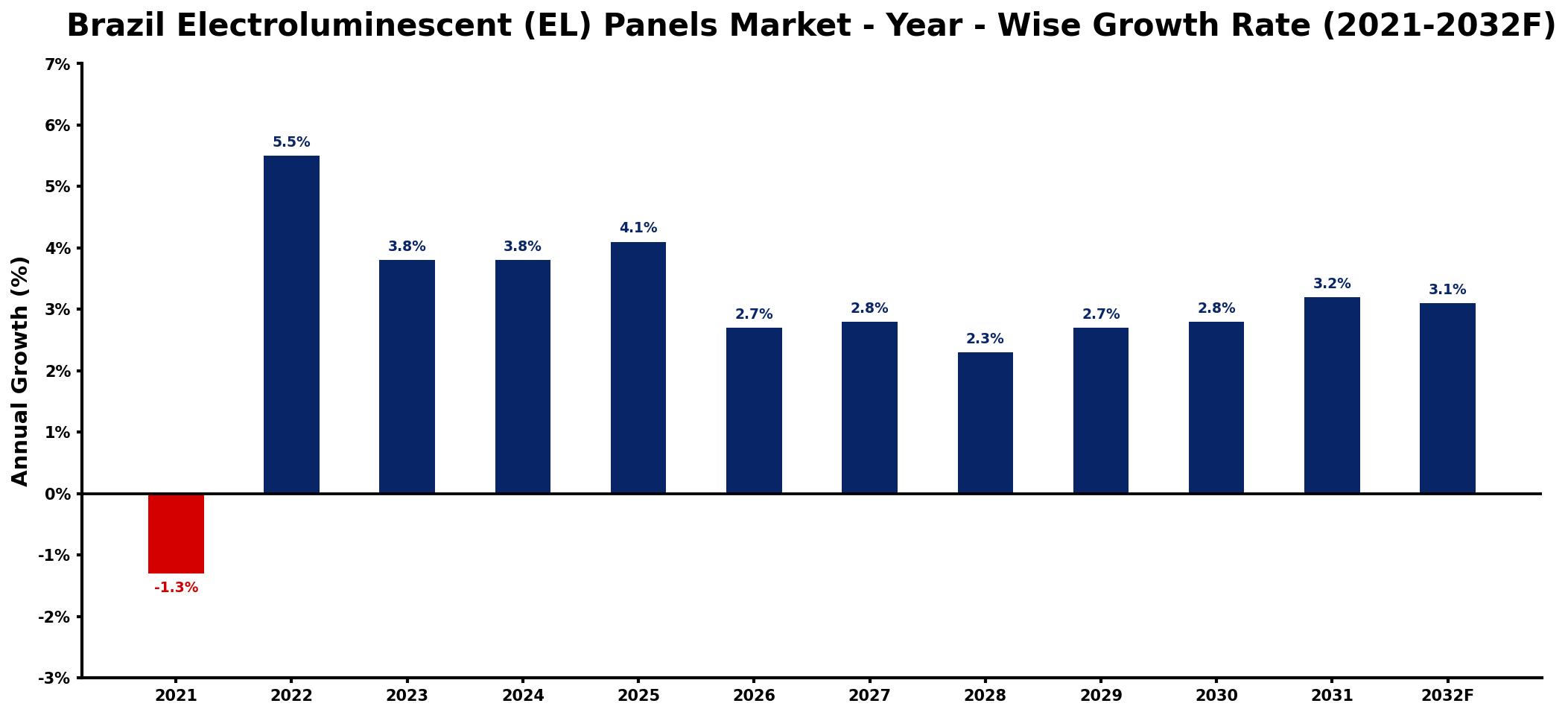
The table below presents the year‑wise growth rates along with the key drivers influencing the market
| Year | Growth Rate | Major Drivers |
| 2021 | -1.3% | decreased investment in technology sector |
| 2022 | 5.5% | stronger distribution network expansion |
| 2023 | 3.8% | increased adoption in automotive industry |
| 2024 | 3.8% | increased overall sector activity |
| 2025 | 4.1% | expansion of renewable energy initiatives |
| 2026 | 2.7% | increased focus on sustainable design |
| 2027 | 2.8% | growing demand from advertising sector |
| 2028 | 2.3% | advancements in manufacturing processes |
| 2029 | 2.7% | rising popularity of interactive displays |
| 2030 | 2.8% | increased government support for innovation |
| 2031 | 3.2% | increased domestic production output |
| 2032 | 3.1% | expanding manufacturing base activity |
Note: Market size estimations and growth projections presented in this report are based on 6Wresearch's proprietary forecasting methodology, utilizing the latest available industry data, government publications, and primary research inputs.
Brazil Electroluminescent (EL) Panels Market Synopsis
As the demand for sustainable and versatile lighting solutions intensifies in Brazil, the market for electroluminescent panels is rapidly evolving. With their unique properties of flexibility and low power consumption, EL panels are gaining traction in consumer electronics and automotive applications, marking a significant shift towards innovative display technologies.
Currently, industry players face the pressing need to educate the market about the numerous benefits of EL technology. Additionally, advancements in manufacturing techniques and an emphasis on energy efficiency remain pivotal in unlocking the full potential of this market in Brazil.
Brazil Electroluminescent (EL) Panels Market Key Takeaways
- The market is driven by growing demand for energy-efficient lighting solutions across various applications.
- Technological advancements are essential for overcoming manufacturing complexities.
- Consumer awareness and education about the benefits of EL panels are crucial for market expansion.
- Government policies focused on energy efficiency impact market dynamics significantly.
- Collaboration across industries can enhance product innovation and market penetration.
Evaluation of Restraints in Brazil Electroluminescent (EL) Panels Market
The Brazil Electroluminescent Panels market faces certain restraints that can hinder its growth. One of the significant challenges is the complexity associated with manufacturing EL panels, which can lead to increased production costs. Furthermore, the market grapples with competition from other lighting technologies that may offer similar benefits at a lower cost. This competition requires industry players to invest more in R&D to innovate and enhance product offerings. Additionally, the necessity for market education regarding the advantages of EL technology remains a crucial barrier. Without comprehensive understanding and awareness, consumer adoption may lag, limiting overall market growth.
Brazil Electroluminescent (EL) Panels Market Trends
Several trends are shaping the Brazil Electroluminescent Panels market, notably the shift towards eco-friendly technologies. Consumers and businesses alike are increasingly prioritizing sustainable solutions, which bolsters the demand for energy-efficient EL panels. Moreover, advancements in materials science are yielding more flexible and durable EL products, opening up new applications beyond traditional signage and automotive sectors. Additionally, an influx of smart technologies is prompting the integration of EL panels into connected devices, facilitating innovative display capabilities and further driving market interest.
Brazil Electroluminescent (EL) Panels Market Opportunities
The evolving landscape of the Brazil Electroluminescent Panels market presents numerous growth opportunities for stakeholders. The increasing incorporation of EL technology in the automotive sector, particularly for interior lighting and dashboards, offers a lucrative avenue for expansion. Furthermore, as urbanization continues and smart cities emerge, there is a growing need for innovative signage solutions that EL panels can effectively address. Investments in R&D to enhance product capabilities can also lead to the development of customized solutions for niche markets, increasing competitive advantage.
Government Initiatives in the Brazil Electroluminescent (EL) Panels Market
Government initiatives aimed at promoting energy efficiency and sustainability are significantly influencing the Brazil Electroluminescent Panels market. Policies encouraging the adoption of energy-efficient technologies align with the industry's objectives, facilitating a more conducive environment for growth. Public funding programs that support research and development in innovative lighting solutions also play a crucial role in fostering technological advancements. Compliance with safety and technological standards established by regulatory bodies is essential for manufacturers to ensure product acceptance and gain market access.
Future Insights of the Brazil Electroluminescent (EL) Panels Market
Looking ahead to 2026-2032, the Brazil Electroluminescent Panels market is expected to flourish, driven by the growing consumer preference for energy-efficient and versatile lighting solutions. As technological advancements continue to emerge, EL panels are likely to witness broader applications, particularly in smart devices and automotive sectors. The industry's focus on research and development will be crucial in addressing current manufacturing challenges, enhancing product features, and ensuring sustainability. Overall, the market appears poised for steady growth as stakeholders adapt to evolving consumer needs and regulatory landscapes.
Brazil Electroluminescent (EL) Panels Market Latest Developments (2025 - 2026)
In recent months, the Brazil Electroluminescent Panels market has witnessed a notable shift towards collaborations between manufacturers and tech developers aimed at enhancing product innovation. These partnerships focus on integrating EL technology with smart applications to cater to the growing demand for interactive displays. Additionally, initiatives targeting consumer education about the advantages of EL panels are gaining momentum, promoting wider adoption. As regulations evolve, manufacturers are increasingly aligning their product designs with new energy efficiency standards, ensuring compliance while fostering market growth.
Brazil Electroluminescent (EL) Panels Market - Key Attractiveness of the Report
- 10 Years of Market Numbers
- Historical Data Starting from 2022 to 2025
- Base Year: 2025
- Forecast Data until 2032
- Key Performance Indicators Impacting the Market
- Major Upcoming Developments and Projects
Key Highlights of the Report:
- Brazil Electroluminescent (EL) Panels Market Outlook
- Market Size of Brazil Electroluminescent (EL) Panels Market, 2025
- Forecast of Brazil Electroluminescent (EL) Panels Market, 2032
- Historical Data and Forecast of Brazil Electroluminescent (EL) Panels Revenues & Volume for the Period 2022-2032F
- Brazil Electroluminescent (EL) Panels Market Trend Evolution
- Brazil Electroluminescent (EL) Panels Market Drivers and Challenges
- Brazil Electroluminescent (EL) Panels Price Trends
- Brazil Electroluminescent (EL) Panels Porter's Five Forces
- Brazil Electroluminescent (EL) Panels Industry Life Cycle
- Historical Data and Forecast of Brazil Electroluminescent (EL) Panels Market Revenues & Volume By Shape for the Period 2022-2032F
- Historical Data and Forecast of Brazil Electroluminescent (EL) Panels Market Revenues & Volume By Rectangle for the Period 2022-2032F
- Historical Data and Forecast of Brazil Electroluminescent (EL) Panels Market Revenues & Volume By Square for the Period 2022-2032F
- Historical Data and Forecast of Brazil Electroluminescent (EL) Panels Market Revenues & Volume By Strip for the Period 2022-2032F
- Historical Data and Forecast of Brazil Electroluminescent (EL) Panels Market Revenues & Volume By Round for the Period 2022-2032F
- Historical Data and Forecast of Brazil Electroluminescent (EL) Panels Market Revenues & Volume By Others for the Period 2022-2032F
- Historical Data and Forecast of Brazil Electroluminescent (EL) Panels Market Revenues & Volume By Colour for the Period 2022-2032F
- Historical Data and Forecast of Brazil Electroluminescent (EL) Panels Market Revenues & Volume By White for the Period 2022-2032F
- Historical Data and Forecast of Brazil Electroluminescent (EL) Panels Market Revenues & Volume By Blue for the Period 2022-2032F
- Historical Data and Forecast of Brazil Electroluminescent (EL) Panels Market Revenues & Volume By Green for the Period 2022-2032F
- Historical Data and Forecast of Brazil Electroluminescent (EL) Panels Market Revenues & Volume By Red for the Period 2022-2032F
- Historical Data and Forecast of Brazil Electroluminescent (EL) Panels Market Revenues & Volume By Others for the Period 2022-2032F
- Brazil Electroluminescent (EL) Panels Import Export Trade Statistics
- Market Opportunity Assessment By Shape
- Market Opportunity Assessment By Colour
- Brazil Electroluminescent (EL) Panels Top Companies Market Share
- Brazil Electroluminescent (EL) Panels Competitive Benchmarking By Technical and Operational Parameters
- Brazil Electroluminescent (EL) Panels Company Profiles
- Brazil Electroluminescent (EL) Panels Key Strategic Recommendations






































