Brazil Enterprise Firewall Market Size & Growth Rate (2026-2032)
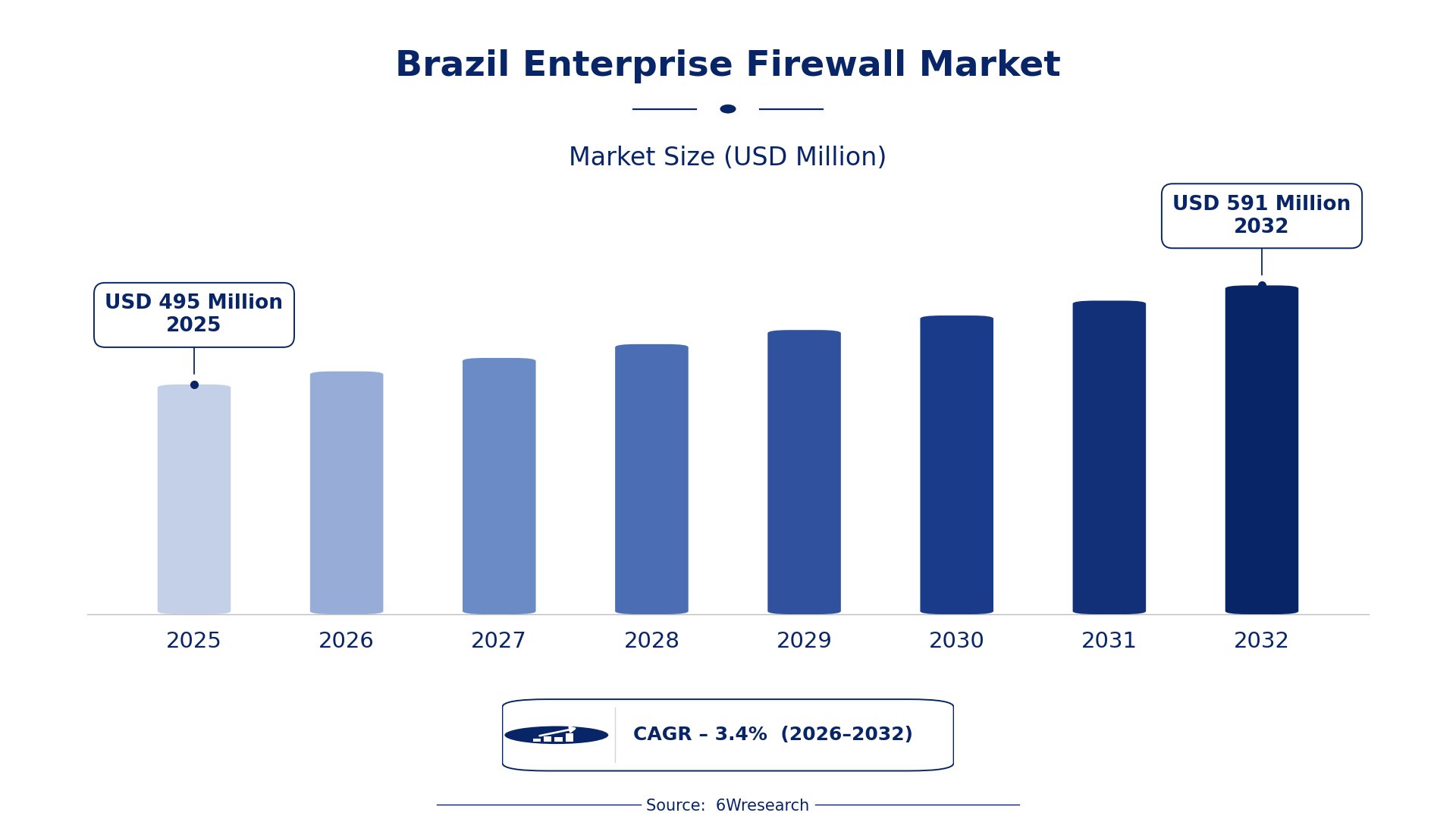
The Brazil Enterprise Firewall Market was estimated at USD 495 Million in 2025 and is projected to reach USD 591 Million by 2032, growing at a CAGR of 3.4% from 2026 to 2032.
Brazil Enterprise Firewall Market Synopsis
In the face of escalating cyber threats, the Brazil Enterprise Firewall market has emerged as a linchpin in network security strategies for organizations across the country. As businesses ramp up digital transformation initiatives, the demand for effective firewall solutions has surged, underscoring their role in safeguarding sensitive data and maintaining operational integrity.
Brazilian enterprises are increasingly acknowledging that conventional security measures may no longer suffice. The combination of remote work dynamics, cloud integration, and IoT expansion is amplifying the need for advanced firewalls capable of providing real-time threat detection and response. This has led to a noticeable shift towards next-generation firewall technologies.
Brazil Enterprise Firewall Market Year-wise Growth Rate and Key Drivers
This graph illustrates the annual growth rates of the Brazil Enterprise Firewall Market from 2021 to 2032, highlighting a steady upward trajectory and projected expansion over the forecast period.

The table below presents the year‑wise growth rates along with the key drivers influencing the market
| Year | Growth Rate | Major Drivers |
| 2021 | -1.4% | Decline in investment due to economic instability in Brazil. |
| 2022 | 4.8% | Rising cybersecurity regulations by the Brazilian government |
| 2023 | 4.2% | Increased digital transformation initiatives among Brazilian enterprises |
| 2024 | 3.7% | Growth in remote work leading to firewall demand |
| 2025 | 4.5% | Emerging data privacy laws stimulating firewall adoption |
| 2026 | 3.2% | Strengthened financial sector regulations driving cybersecurity investments |
| 2027 | 2.7% | Surge in cyber-attacks prompting enterprise firewall upgrades |
| 2028 | 2.4% | Local companies expanding digital infrastructure for security enhancement |
| 2029 | 2.8% | Collaboration with tech firms to bolster cybersecurity defenses |
| 2030 | 3.3% | Increased awareness of data protection among Brazilian businesses |
| 2031 | 2.7% | Legislative push for enhanced cybersecurity measures in Brazil |
| 2032 | 3.4% | Growing need for secure cloud services in enterprises |
Note: Market size estimations and growth projections presented in this report are based on 6Wresearch's proprietary forecasting methodology, utilizing the latest available industry data, government publications, and primary research inputs.
Brazil Enterprise Firewall Market Key Takeaways
Below are some of the specific key takeaways from the market, including:
- Growing recognition of firewalls as critical components of cybersecurity strategies.
- Increased adoption of next-generation firewalls with enhanced threat detection capabilities.
- Expansion of remote work and cloud services, broadening the attack surface for cyber threats.
- Regulatory compliance requirements driving demand for robust firewall solutions.
- Continuous evolution of cyber threats necessitating ongoing investment in security technologies.
Evaluation of Restraints in Brazil Enterprise Firewall Market
The Brazil Enterprise Firewall market faces real limitations primarily from the rapid evolution of cyber threats. This pace makes it challenging for firewall providers to keep up with the complexities of modern attacks. Many organizations are also constrained by budgetary limitations, which can hinder their ability to deploy the latest technologies. Additionally, integrating new firewall solutions into diverse IT environments poses significant challenges, as companies must ensure compatibility without sacrificing performance. Compliance with emerging regulations adds another layer of complexity, compelling businesses to invest in compliance-focused solutions that may not align perfectly with their existing systems.
Brazil Enterprise Firewall Market Trends
A marked trend in the Brazil Enterprise Firewall market is the growing preference for cloud-based firewall solutions. Companies are opting for scalable options that can seamlessly integrate with their cloud environments. There is also an increasing focus on artificial intelligence and machine learning capabilities within firewalls. These technologies enhance threat detection accuracy and reduce response times. on top of that, organizations are prioritizing user education and awareness to supplement technological defenses, recognizing that human factors significantly contribute to security vulnerabilities.
Brazil Enterprise Firewall Market Opportunities
Investment opportunities in the Brazil Enterprise Firewall market are abundant as organizations seek to bolster their cybersecurity frameworks. The ongoing shift towards remote work and digital services presents a ripe landscape for innovative firewall solutions. Additionally, companies that offer comprehensive services that integrate firewall technology with broader cybersecurity measures will find favorable market conditions. Partnerships between technology providers and regulatory bodies can also open new avenues for market growth, particularly in developing solutions that meet stringent compliance standards.
Government Initiatives in the Brazil Enterprise Firewall Market
Government policies are increasingly shaping the Brazil Enterprise Firewall market, reflecting a growing understanding of the necessity for robust cybersecurity measures. As cyber threats become more sophisticated, regulatory frameworks are being introduced to ensure that organizations implement effective firewall solutions. Compliance with these policies not only protects businesses but also promotes overall national security by safeguarding critical infrastructure.
- A national cybersecurity strategy implemented in early 2025 mandates higher standards for network protection across all sectors.
- Current initiatives focus on developing public-private partnerships aimed at enhancing cybersecurity infrastructure, underway since mid-2025.
- A planned regulatory framework expected to be introduced in 2026 will impose stringent requirements on businesses regarding firewall implementations.
- Ongoing workshops and training programs initiated by the government to increase cybersecurity awareness among businesses and employees.
Future Insights of the Brazil Enterprise Firewall Market
Looking towards 2026 and beyond, the Brazil Enterprise Firewall market is set to experience steady growth. As organizations become increasingly aware of the consequences of cyber threats, investment in advanced firewall technologies will continue to rise. The intersection of evolving regulations and emerging technologies will create both challenges and opportunities, pushing providers to innovate continuously. Firewalls equipped with artificial intelligence and machine learning will be at the forefront of this evolution, offering enhanced protection against sophisticated attacks.
Brazil Enterprise Firewall Market Latest Developments
Over the past year, significant activity has been observed within the Brazil Enterprise Firewall market, driven by both technological advancements and regulatory changes. Companies are enhancing their offerings to address the diverse needs of businesses adapting to new security challenges. As a result, the competitive landscape is evolving, with an emphasis on providing more integrated and efficient solutions for enterprise security.
- A major technology vendor launched an advanced firewall solution in Q1 2025 that incorporates AI-driven threat detection mechanisms.
- Ongoing partnerships between cybersecurity firms and local enterprises are enhancing the development of tailored firewall solutions for specific industries.
- In mid-2025, a new cloud-based firewall service was introduced, providing scalable solutions for small to medium-sized enterprises.
- Upcoming regulatory changes anticipated in late 2026 are expected to promote further innovations in firewall technology.
Brazil Enterprise Firewall Market - Key Attractiveness of the Report
- 10 Years of Market Numbers
- Historical Data Starting from 2022 to 2025
- Base Year: 2025
- Forecast Data until 2032
- Key Performance Indicators Impacting the Market
- Major Upcoming Developments and Projects
Key Highlights of the Report:
- Brazil Enterprise Firewall Market Outlook
- Market Size of Brazil Enterprise Firewall Market, 2025
- Forecast of Brazil Enterprise Firewall Market, 2032
- Historical Data and Forecast of Brazil Enterprise Firewall Revenues & Volume for the Period 2022-2032F
- Brazil Enterprise Firewall Market Trend Evolution
- Brazil Enterprise Firewall Market Drivers and Challenges
- Brazil Enterprise Firewall Price Trends
- Brazil Enterprise Firewall Porter's Five Forces
- Brazil Enterprise Firewall Industry Life Cycle
- Historical Data and Forecast of Brazil Enterprise Firewall Market Revenues & Volume By Types for the Period 2022-2032F
- Historical Data and Forecast of Brazil Enterprise Firewall Market Revenues & Volume By Next Generation for the Period 2022-2032F
- Historical Data and Forecast of Brazil Enterprise Firewall Market Revenues & Volume By Application for the Period 2022-2032F
- Historical Data and Forecast of Brazil Enterprise Firewall Market Revenues & Volume By Conventional for the Period 2022-2032F
- Historical Data and Forecast of Brazil Enterprise Firewall Market Revenues & Volume By Industry vertical for the Period 2022-2032F
- Historical Data and Forecast of Brazil Enterprise Firewall Market Revenues & Volume By Government & Public Utilities for the Period 2022-2032F
- Historical Data and Forecast of Brazil Enterprise Firewall Market Revenues & Volume By Healthcare for the Period 2022-2032F
- Historical Data and Forecast of Brazil Enterprise Firewall Market Revenues & Volume By Telecommunication for the Period 2022-2032F
- Historical Data and Forecast of Brazil Enterprise Firewall Market Revenues & Volume By Education for the Period 2022-2032F
- Historical Data and Forecast of Brazil Enterprise Firewall Market Revenues & Volume By Retail for the Period 2022-2032F
- Historical Data and Forecast of Brazil Enterprise Firewall Market Revenues & Volume By Entertainment & Media for the Period 2022-2032F
- Historical Data and Forecast of Brazil Enterprise Firewall Market Revenues & Volume By Manufacturing for the Period 2022-2032F
- Historical Data and Forecast of Brazil Enterprise Firewall Market Revenues & Volume By Education for the Period 2022-2032F
- Historical Data and Forecast of Brazil Enterprise Firewall Market Revenues & Volume By Organization Size for the Period 2022-2032F
- Historical Data and Forecast of Brazil Enterprise Firewall Market Revenues & Volume By Small and Medium Sized Enterprises (SMBs) for the Period 2022-2032F
- Historical Data and Forecast of Brazil Enterprise Firewall Market Revenues & Volume By Large Enterprises for the Period 2022-2032F
- Brazil Enterprise Firewall Import Export Trade Statistics
- Market Opportunity Assessment By Types
- Market Opportunity Assessment By Industry vertical
- Market Opportunity Assessment By Organization Size
- Brazil Enterprise Firewall Top Companies Market Share
- Brazil Enterprise Firewall Competitive Benchmarking By Technical and Operational Parameters
- Brazil Enterprise Firewall Company Profiles
- Brazil Enterprise Firewall Key Strategic Recommendations






































