Brazil Estradiol Market Top 5 Importing Countries and Market Competition (HHI) Analysis
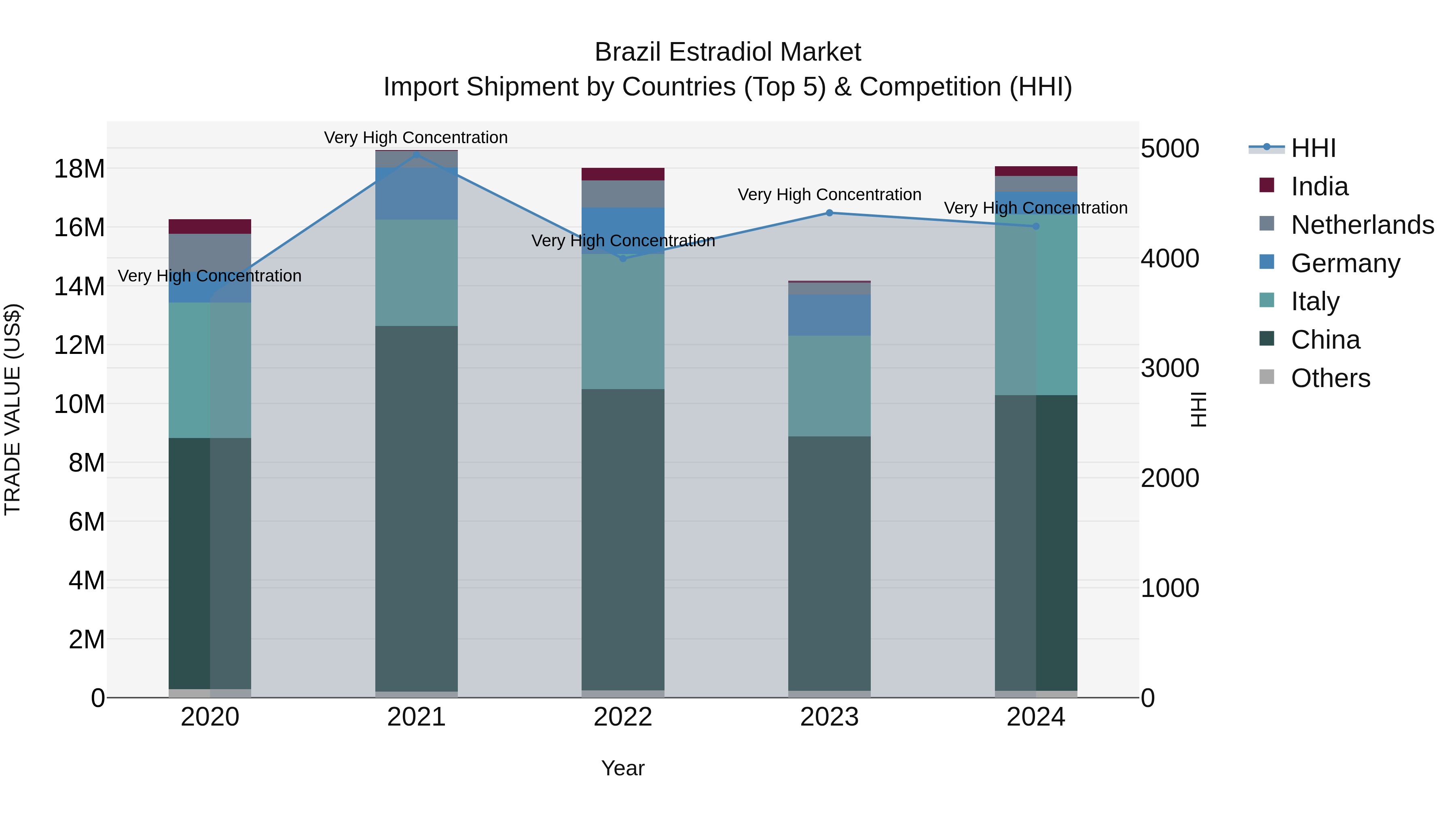
Brazil`s import shipments of estradiol in 2024 continued to be dominated by top exporting countries such as China, Italy, Germany, Netherlands, and India. The market saw a high Herfindahl-Hirschman Index (HHI) concentration, indicating a significant level of market control by key players. With a compound annual growth rate (CAGR) of 2.66% from 2020 to 2024, the industry showed steady growth. Notably, the growth rate spiked to 27.38% from 2023 to 2024, pointing towards a potential acceleration in market expansion and demand for estradiol in Brazil.
Brazil Estradiol Market Overview
The estradiol market in Brazil grapples with challenges related to healthcare regulations, patient safety, and market demand. Estradiol, a hormone medication, is used in various therapeutic applications, including hormone replacement therapy and contraception. Challenges include regulatory restrictions, concerns about hormone-related health risks, and fluctuations in market demand. Companies must navigate regulatory requirements, invest in research and development for safer formulations, and address patient education to ensure responsible use of estradiol medications.
Drivers of the market
The estradiol market in Brazil is primarily driven by the pharmaceutical and healthcare sectors` demand for hormone replacement therapies and contraceptives. Estradiol, a naturally occurring hormone, is used in various medications to treat menopausal symptoms and hormonal imbalances. Market growth is propelled by factors such as aging demographics, increasing awareness about women`s health, and advancements in hormone therapy formulations. Additionally, regulatory approvals for new drug formulations and expanded indications contribute to market expansion.
Challenges of the market
The estradiol market in Brazil faces challenges related to regulatory compliance, public health concerns, and market competition. Estradiol is a hormone used in hormone replacement therapy and contraception. Companies must adhere to strict regulatory standards, address potential health risks and side effects, and invest in research and development to improve product safety and efficacy. Additionally, educating healthcare professionals and consumers about proper usage and potential risks is essential for market sustainability.
Government Policy of the market
Government policies in Brazil concerning the estradiol market aim to ensure the safe and responsible use of this hormone in medical treatments and research while minimizing the risks of misuse and environmental contamination. Regulations include strict prescription requirements for estradiol-based medications, monitoring of pharmaceutical manufacturing and distribution, and guidelines for the disposal of medical waste containing estradiol. Additionally, the government supports research into alternative hormone therapies and promotes public awareness campaigns about the health effects of hormonal treatments
Key Highlights of the Report:
- Brazil Estradiol Market Outlook
- Market Size of Brazil Estradiol Market, 2024
- Forecast of Brazil Estradiol Market, 2031
- Historical Data and Forecast of Brazil Estradiol Revenues & Volume for the Period 2021-2031
- Brazil Estradiol Market Trend Evolution
- Brazil Estradiol Market Drivers and Challenges
- Brazil Estradiol Price Trends
- Brazil Estradiol Porter's Five Forces
- Brazil Estradiol Industry Life Cycle
- Historical Data and Forecast of Brazil Estradiol Market Revenues & Volume By Product Type for the Period 2021-2031
- Historical Data and Forecast of Brazil Estradiol Market Revenues & Volume By a-Estradiol for the Period 2021-2031
- Historical Data and Forecast of Brazil Estradiol Market Revenues & Volume By End-User for the Period 2021-2031
- Historical Data and Forecast of Brazil Estradiol Market Revenues & Volume By Pharmaceutical for the Period 2021-2031
- Historical Data and Forecast of Brazil Estradiol Market Revenues & Volume By Biological Research for the Period 2021-2031
- Historical Data and Forecast of Brazil Estradiol Market Revenues & Volume By Others for the Period 2021-2031
- Brazil Estradiol Import Export Trade Statistics
- Market Opportunity Assessment By Product Type
- Market Opportunity Assessment By End-User
- Brazil Estradiol Top Companies Market Share
- Brazil Estradiol Competitive Benchmarking By Technical and Operational Parameters
- Brazil Estradiol Company Profiles
- Brazil Estradiol Key Strategic Recommendations






































