United States (US) Estradiol Market Size, Share & Growth Rate
The United States (US) Estradiol Market was estimated at USD 216 Million in 2025 and is projected to reach USD 254 Million by 2032, growing at a CAGR of 2.3% from 2026 to 2032. This growth trajectory is fueled by a significant increase in awareness and diagnosis of hormonal disorders, particularly menopausal symptoms. As more women turn to hormone replacement therapy (HRT) for relief, the demand for various estradiol formulations continues to surge.
United States (US) Estradiol Market Year-wise Growth Rate and Key Drivers
This graph highlights how the United States (US) Estradiol Market has steadily grown over the years, supported by major growth factors.
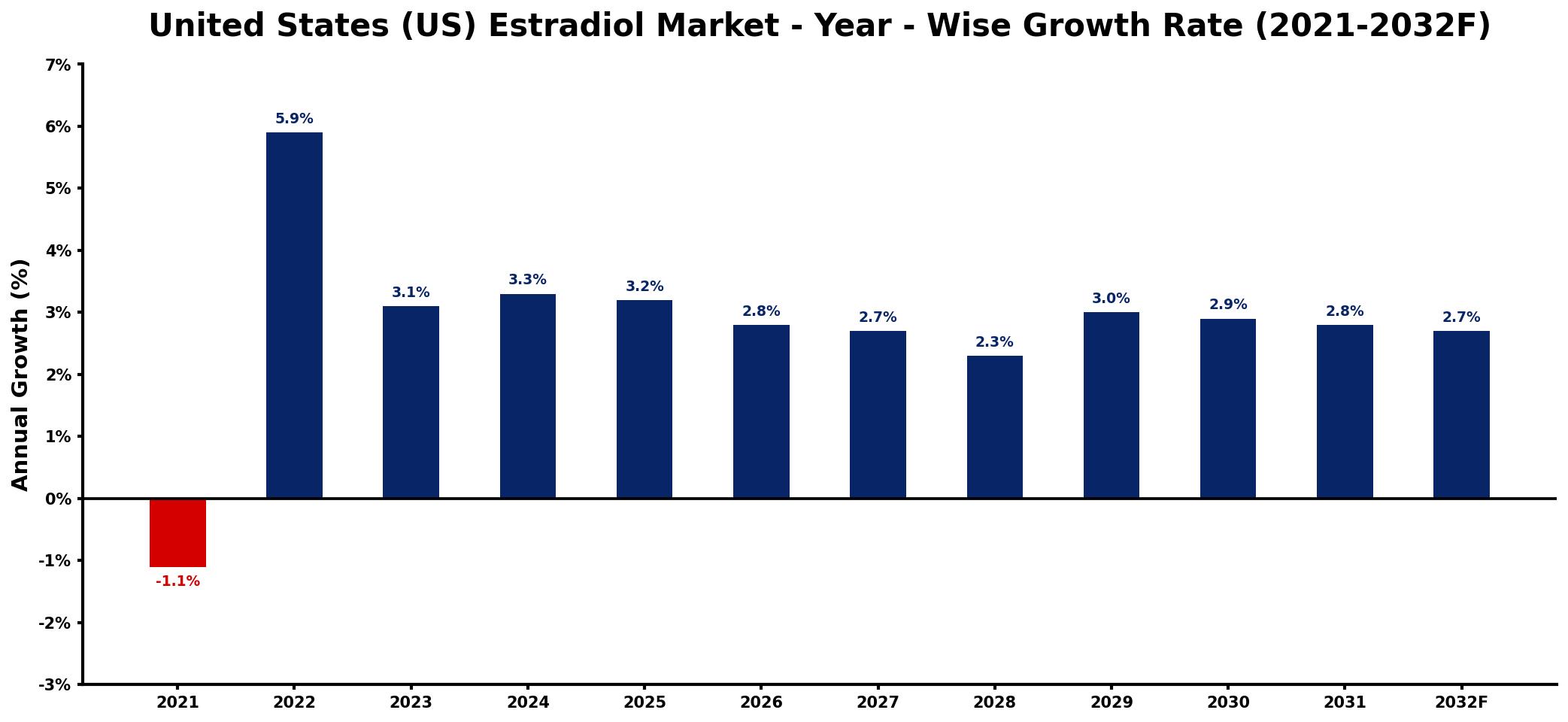
The table below presents the year‑wise growth rates along with the key drivers influencing the market
| Year | Growth Rate | Major Drivers |
| 2021 | -1.1% | Market demand for alternatives declines |
| 2022 | 5.9% | Increased investment in hormone therapies |
| 2023 | 3.1% | Growing awareness of health benefits |
| 2024 | 3.3% | Rising prevalence of hormonal disorders |
| 2025 | 3.2% | Expansion of healthcare access initiatives |
| 2026 | 2.8% | Increased research funding for therapies |
| 2027 | 2.7% | Emergence of new treatment options |
| 2028 | 2.3% | Strengthened partnerships in healthcare sector |
| 2029 | 3.0% | Growing focus on personalized medicine |
| 2030 | 2.9% | Heightened demand for preventive care |
| 2031 | 2.8% | Advancements in biotechnology applications |
| 2032 | 2.7% | Increased patient advocacy and education |
Note: Market size estimations and growth projections presented in this report are based on 6Wresearch's proprietary forecasting methodology, utilizing the latest available industry data, government publications, and primary research inputs.
United States (US) Estradiol Market Synopsis
The US Estradiol market is witnessing a marked increase in the utilization of transdermal delivery systems, such as patches and gels, which provide a more convenient option for patients. This shift is driven by the growing recognition of the importance of women's health and the desire for effective symptom management during menopause.
The market is not only bolstered by product variety but also by the expanding demographic of aging women seeking therapeutic solutions for conditions like osteoporosis. Such factors are expected to maintain a steady demand for estradiol products across the nation.
United States (US) Estradiol Market Key Takeaways
- The market is primarily driven by the increasing prevalence of hormonal disorders among women.
- Innovations in drug delivery systems are significantly enhancing patient compliance and treatment effectiveness.
- Regulatory bodies are continuously shaping the market through stringent safety and approval processes.
- The competitive landscape is evolving, with companies striving to capture market share through strategic collaborations and product enhancements.
- Awareness of HRT benefits is on the rise, contributing to increased consumption of estradiol therapies.
Evaluation of Restraints in United States (US) Estradiol Market
While the US Estradiol market is positioned for growth, it faces notable restraints. Regulatory complexities often lead to delays in product approvals, increasing operational costs for manufacturers. Furthermore, pricing pressures from generic alternatives can squeeze profit margins, challenging companies to differentiate their offerings. Intense competition necessitates constant innovation and adaptability, making it crucial for firms to navigate these constraints effectively to maintain a competitive edge.
United States (US) Estradiol Market Trends
The landscape of the US Estradiol market is evolving with trends that include a growing preference for bioidentical hormones and personalized treatment plans. Patients are increasingly favoring therapies that are tailored to their unique hormonal profiles. Additionally, there is a notable shift toward more holistic approaches to women's health, integrating lifestyle modifications alongside pharmacological interventions. This trend is further complemented by heightened educational initiatives aimed at empowering women regarding their health choices.
United States (US) Estradiol Market Opportunities
Opportunities abound in the US Estradiol market, particularly as the population ages and the incidence of menopausal symptoms rises. Investment potential exists in the development of novel delivery mechanisms that can enhance the convenience and efficacy of treatments. Moreover, companies that focus on innovative formulations or synergistic therapies may find lucrative avenues for expansion. The increasing public awareness surrounding women's health issues also creates a fertile ground for marketing and educational campaigns about the benefits of HRT.
Government Initiatives in the United States (US) Estradiol Market
The role of government in regulating the US Estradiol market is pivotal. The Food and Drug Administration (FDA) mandates rigorous safety and efficacy standards for all estradiol products before they can be marketed. Additionally, policies like the Drug Price Competition and Patent Term Restoration Act promote competitive pricing, enabling broader access to estradiol treatments. Medicare and Medicaid further influence the market by determining coverage policies, impacting how patients access these essential therapies.
Future Insights of the United States (US) Estradiol Market
The outlook for the US Estradiol market remains robust as we move toward 2032. The anticipated rise in hormone-related disorders and the increased adoption of HRT strategies position the market for continuous growth. Innovations in treatment delivery systems will likely enhance therapeutic outcomes and patient adherence, fostering an environment ripe for expansion. While challenges from regulation and competition persist, the overall demand for estradiol products is expected to drive the market forward, creating pathways for innovation and investment.
United States (US) Estradiol Market Latest Developments (2025 - 2026)
Recent trends in the US Estradiol market have focused on enhancing product formulations to better meet patient needs. Advances in transdermal delivery technologies are gaining attention, reflecting a commitment to improve user experience and therapeutic effectiveness. Companies are also increasingly investing in educational outreach initiatives aimed at raising awareness about HRT benefits, particularly among the aging female population.
United States (US) Estradiol Market - Key Attractiveness of the Report
- 10 Years of Market Numbers
- Historical Data Starting from 2022 to 2025
- Base Year: 2025
- Forecast Data until 2032
- Key Performance Indicators Impacting the Market
- Major Upcoming Developments and Projects
Key Highlights of the Report:
- United States (US) Estradiol Market Outlook
- Market Size of United States (US) Estradiol Market, 2025
- Forecast of United States (US) Estradiol Market, 2032
- Historical Data and Forecast of United States (US) Estradiol Revenues & Volume for the Period 2022-2032F
- United States (US) Estradiol Market Trend Evolution
- United States (US) Estradiol Market Drivers and Challenges
- United States (US) Estradiol Price Trends
- United States (US) Estradiol Porter's Five Forces
- United States (US) Estradiol Industry Life Cycle
- Historical Data and Forecast of United States (US) Estradiol Market Revenues & Volume By Product Type for the Period 2022-2032F
- Historical Data and Forecast of United States (US) Estradiol Market Revenues & Volume By a-Estradiol for the Period 2022-2032F
- Historical Data and Forecast of United States (US) Estradiol Market Revenues & Volume By End-User for the Period 2022-2032F
- Historical Data and Forecast of United States (US) Estradiol Market Revenues & Volume By Pharmaceutical for the Period 2022-2032F
- Historical Data and Forecast of United States (US) Estradiol Market Revenues & Volume By Biological Research for the Period 2022-2032F
- Historical Data and Forecast of United States (US) Estradiol Market Revenues & Volume By Others for the Period 2022-2032F
- United States (US) Estradiol Import Export Trade Statistics
- Market Opportunity Assessment By Product Type
- Market Opportunity Assessment By End-User
- United States (US) Estradiol Top Companies Market Share
- United States (US) Estradiol Competitive Benchmarking By Technical and Operational Parameters
- United States (US) Estradiol Company Profiles
- United States (US) Estradiol Key Strategic Recommendations






































