Brazil Facility Management Market Size & Growth Rate (2026-2032)
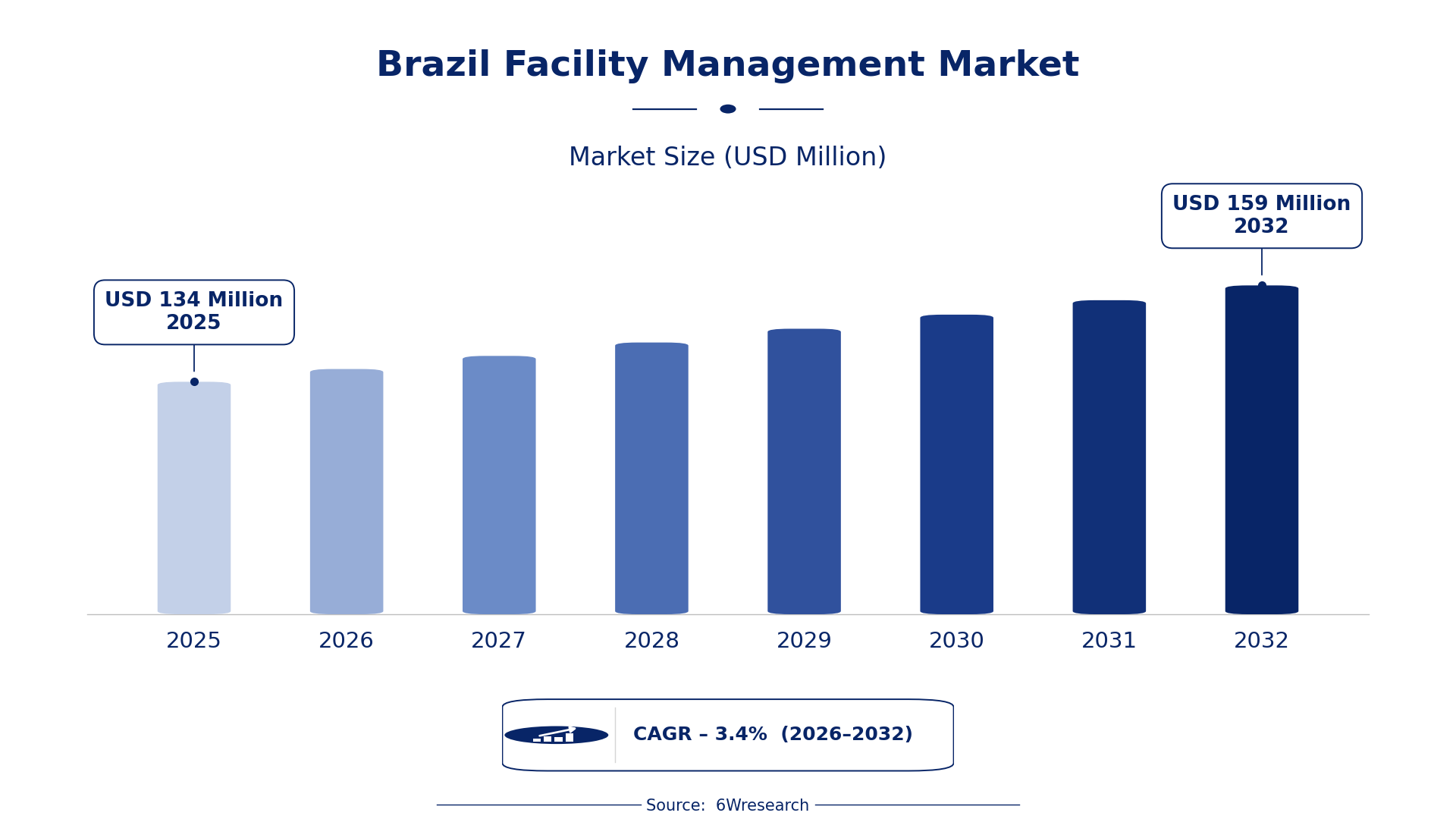
The Brazil Facility Management Market was estimated at USD 134 Million in 2025 and is projected to reach USD 159 Million by 2032, growing at a CAGR of 3.4% from 2026 to 2032.
Brazil Facility Management Market Synopsis
The primary force shaping the Brazil Facility Management Market is the increasing need for operational efficiency across various sectors. As organizations grapple with complex infrastructures, the demand for specialized facility management services has surged, driving growth in this domain.
Additionally, the integration of smart technologies is redefining how facilities are managed. Companies are not only focusing on cost reduction but are also prioritizing energy efficiency and sustainability, which aligns with global trends toward environmentally friendly practices.
Brazil Facility Management Market Year-wise Growth Rate and Key Drivers
This graph illustrates the annual growth rates of the Brazil Facility Management Market from 2021 to 2032, highlighting a steady upward trajectory and projected expansion over the forecast period.
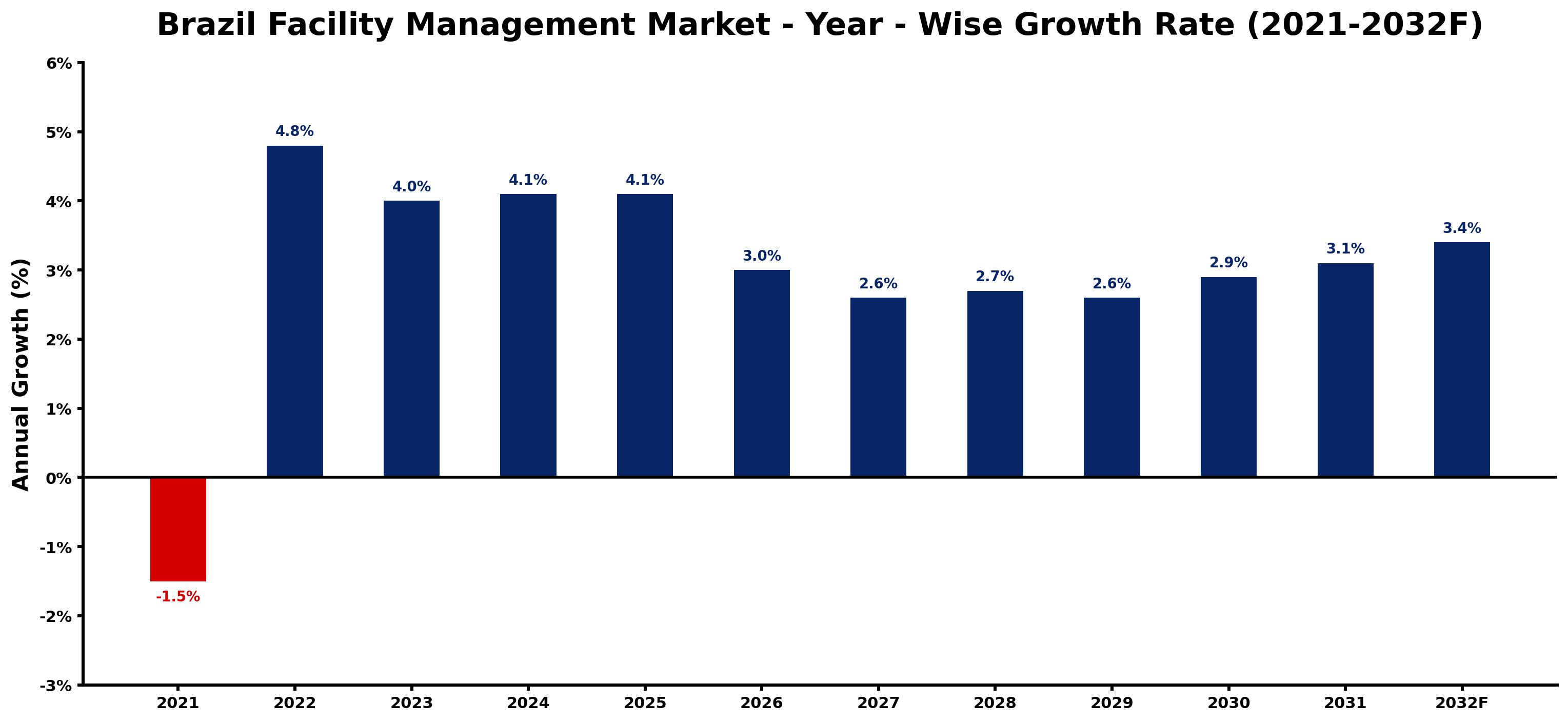
The table below presents the year‑wise growth rates along with the key drivers influencing the market
| Year | Growth Rate | Major Drivers |
| 2021 | -1.5% | Pandemic restrictions limited facility management service demand. |
| 2022 | 4.8% | Sustainability initiatives boost green facility management practices. |
| 2023 | 4.0% | New labor laws increase demand for maintenance services. |
| 2024 | 4.1% | Smart building technologies enhance operational efficiency demands. |
| 2025 | 4.1% | Growing population in urban areas boosts facility requirements. |
| 2026 | 3.0% | Corporate office renovations drive facility optimization strategies. |
| 2027 | 2.6% | Government incentives promote energy efficiency in buildings. |
| 2028 | 2.7% | Real estate investments fuel demand for facility management. |
| 2029 | 2.6% | Increased FDI in infrastructure strengthens facility support services. |
| 2030 | 2.9% | Regulatory compliance necessitates advanced facility management solutions. |
| 2031 | 3.1% | Post-pandemic strategies prioritize health safety in facilities. |
| 2032 | 3.4% | Rise in remote work increases commercial space management needs. |
Note: Market size estimations and growth projections presented in this report are based on 6Wresearch's proprietary forecasting methodology, utilizing the latest available industry data, government publications, and primary research inputs.
Brazil Facility Management Market Key Takeaways
Below are some of the specific key takeaways from the market, including:
- The market is witnessing a robust demand for integrated facility management solutions.
- Technological advancements are enabling smarter facility management practices.
- Outsourcing is increasingly viewed as a strategic approach to enhance operational focus.
- Sustainability initiatives are becoming critical for compliance and brand reputation.
- The market is responding to regulatory pressures for eco-friendly practices.
Evaluation of Restraints in Brazil Facility Management Market
While the Brazil Facility Management Market is growing, several restraints hold back its full potential. High upfront costs associated with implementing sustainable and smart technologies create a barrier for many organizations. This challenge is compounded by the skills gap in the workforce, as companies struggle to find personnel trained in advanced facility management practices. on top of that, the need to navigate complex regulations adds another layer of difficulty, especially for smaller firms looking to compete with established providers.
Brazil Facility Management Market Trends
Current trends indicate a strong move towards smart building technologies, including IoT and AI applications that enhance operational efficiencies. Companies are increasingly adopting predictive maintenance practices to minimize downtime and extend the lifespan of facilities. Additionally, a growing emphasis on employee wellness within managed spaces is reshaping facility management services, pushing firms to incorporate health-conscious design and operational practices.
Brazil Facility Management Market Opportunities
The market presents several growth opportunities, particularly in the sectors of energy management and sustainability consulting. As organizations seek to reduce their carbon footprints, facility management firms that can offer green solutions stand to gain a competitive edge. on top of that, the ongoing digital transformation opens avenues for providers to enhance service offerings through data analytics and automation, positioning them well for future growth.
Government Initiatives in the Brazil Facility Management Market
Government policy plays a crucial role in shaping the Brazil Facility Management Market. Regulatory frameworks are increasingly focused on sustainability, safety, and efficiency, driving companies to align their operations with national standards. Such policies not only promote eco-friendly practices but also ensure that facility management services meet compliance requirements.
- A regulatory framework introduced in 2025 mandating energy efficiency standards for commercial buildings.
- A national sustainability initiative launched in early 2025 to incentivize the adoption of green practices in facility management.
- Current projects aimed at improving workplace safety standards in public facilities, ongoing since mid-2025.
- A planned public-private partnership expected to enhance infrastructure management services by 2028.
- Initiatives focused on workforce training and development to meet the evolving demands of facility management.
Future Insights of the Brazil Facility Management Market
Looking ahead to 2026-2032, the Brazil Facility Management Market is expected to continue its upward trajectory. As technology becomes more embedded in operational practices, firms that adapt to these changes will likely thrive. The focus on sustainability will also intensify, pushing companies to innovate their service offerings. In this environment, those who embrace digital transformation and prioritize eco-friendly solutions will secure their positions as market leaders.
Brazil Facility Management Market Latest Developments
In the past year, the Brazil Facility Management Market has seen significant developments, particularly in technology integration and sustainability initiatives. Companies are actively seeking ways to enhance operational efficiencies while adhering to regulatory standards, reflecting a proactive approach to market demands.
- A major technology vendor initiated a pilot program for smart building solutions in Q1 2025, aiming to showcase energy-saving capabilities.
- An initiative that began in mid-2025 focuses on enhancing employee wellness through improved facility designs and services.
- Partnerships between facility management firms and tech startups are currently underway to develop AI-driven maintenance solutions.
- Plans for an upcoming national conference on sustainable facility management practices are scheduled for late 2026.
- A leading regional operator completed an upgrade of its service portfolio in early 2025 to include comprehensive sustainability assessments.
Brazil Facility Management Market - Key Attractiveness of the Report
- 10 Years of Market Numbers
- Historical Data Starting from 2022 to 2025
- Base Year: 2025
- Forecast Data until 2032
- Key Performance Indicators Impacting the Market
- Major Upcoming Developments and Projects
Key Highlights of the Report:
- Brazil Facility Management Market Outlook
- Market Size of Brazil Facility Management Market, 2025
- Forecast of Brazil Facility Management Market, 2032
- Historical Data and Forecast of Brazil Facility Management Revenues & Volume for the Period 2022-2032F
- Brazil Facility Management Market Trend Evolution
- Brazil Facility Management Market Drivers and Challenges
- Brazil Facility Management Price Trends
- Brazil Facility Management Porter's Five Forces
- Brazil Facility Management Industry Life Cycle
- Historical Data and Forecast of Brazil Facility Management Market Revenues & Volume By Component for the Period 2022-2032F
- Historical Data and Forecast of Brazil Facility Management Market Revenues & Volume By Solutions for the Period 2022-2032F
- Historical Data and Forecast of Brazil Facility Management Market Revenues & Volume By Services for the Period 2022-2032F
- Historical Data and Forecast of Brazil Facility Management Market Revenues & Volume By Deployment Mode for the Period 2022-2032F
- Historical Data and Forecast of Brazil Facility Management Market Revenues & Volume By Cloud for the Period 2022-2032F
- Historical Data and Forecast of Brazil Facility Management Market Revenues & Volume By On-premises for the Period 2022-2032F
- Historical Data and Forecast of Brazil Facility Management Market Revenues & Volume By Organization Size for the Period 2022-2032F
- Historical Data and Forecast of Brazil Facility Management Market Revenues & Volume By Large enterprises for the Period 2022-2032F
- Historical Data and Forecast of Brazil Facility Management Market Revenues & Volume By Small and medium-sized enterprises (SMEs) for the Period 2022-2032F
- Historical Data and Forecast of Brazil Facility Management Market Revenues & Volume By Vertical for the Period 2022-2032F
- Historical Data and Forecast of Brazil Facility Management Market Revenues & Volume By BFSI for the Period 2022-2032F
- Historical Data and Forecast of Brazil Facility Management Market Revenues & Volume By IT and Telecom for the Period 2022-2032F
- Historical Data and Forecast of Brazil Facility Management Market Revenues & Volume By Government and Public Administration for the Period 2022-2032F
- Historical Data and Forecast of Brazil Facility Management Market Revenues & Volume By Healthcare for the Period 2022-2032F
- Historical Data and Forecast of Brazil Facility Management Market Revenues & Volume By Education for the Period 2022-2032F
- Historical Data and Forecast of Brazil Facility Management Market Revenues & Volume By Retail for the Period 2022-2032F
- Historical Data and Forecast of Brazil Facility Management Market Revenues & Volume By Energy and Utilities for the Period 2022-2032F
- Historical Data and Forecast of Brazil Facility Management Market Revenues & Volume By Manufacturing for the Period 2022-2032F
- Brazil Facility Management Import Export Trade Statistics
- Market Opportunity Assessment By Component
- Market Opportunity Assessment By Deployment Mode
- Market Opportunity Assessment By Organization Size
- Market Opportunity Assessment By Vertical
- Brazil Facility Management Top Companies Market Share
- Brazil Facility Management Competitive Benchmarking By Technical and Operational Parameters
- Brazil Facility Management Company Profiles
- Brazil Facility Management Key Strategic Recommendations






































