Malaysia Facility Management Market Size & Growth Rate (2026-2032)
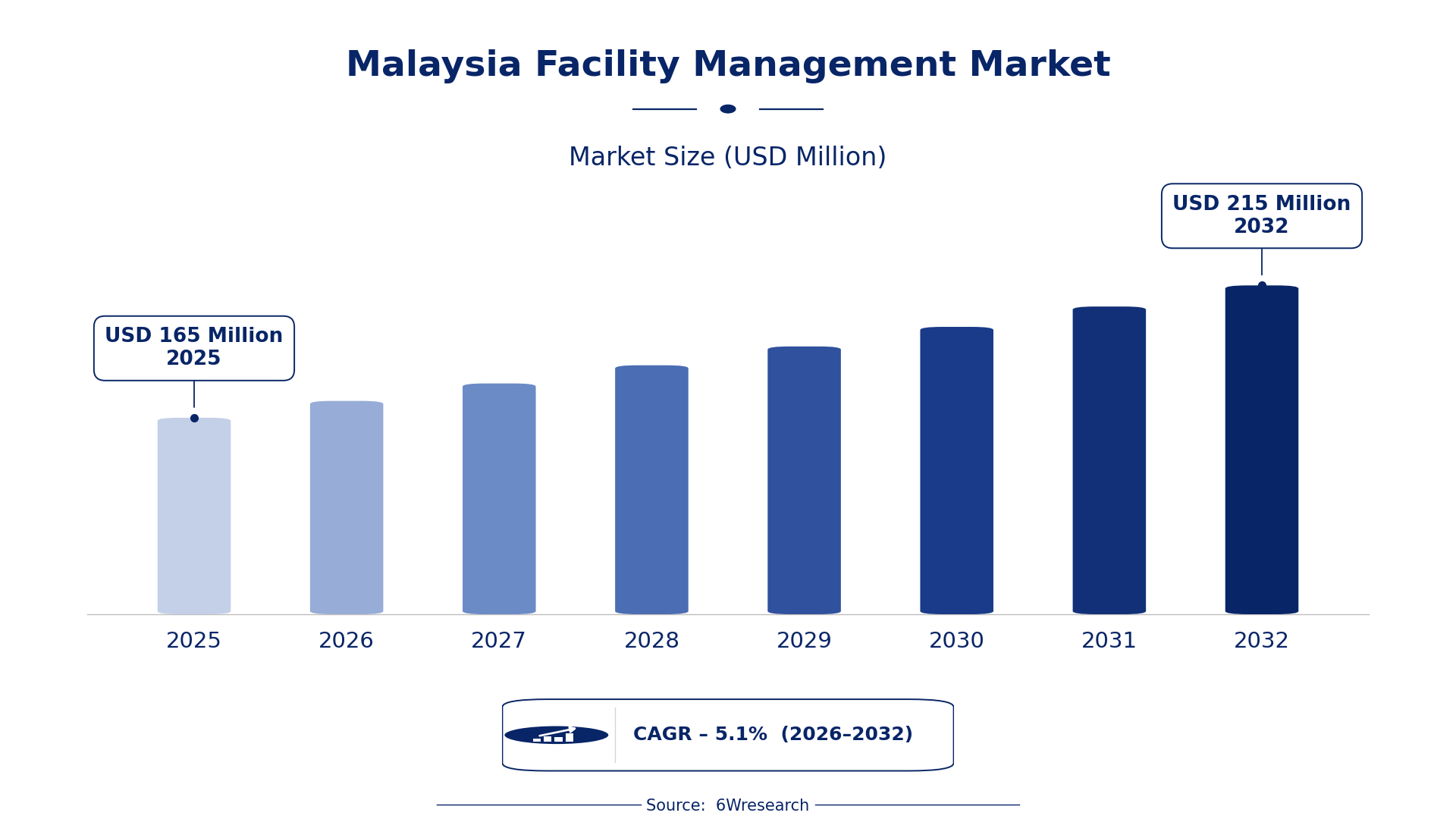
The Malaysia Facility Management Market was estimated at USD 165 Million in 2025 and is projected to reach USD 215 Million by 2032, growing at a CAGR of 5.1% from 2026 to 2032.
Malaysia Facility Management Market Synopsis
The facility management market in Malaysia is witnessing a surge, driven by the rapid expansion of both commercial and residential properties. As property owners increasingly recognize the value of outsourcing facility management services, the sector is evolving to meet demands for efficiency and sustainability.
Today, facility management encompasses a diverse range of services, from maintenance and cleaning to security and energy management. This shift not only enhances operational effectiveness but also aligns with growing expectations for green building practices and advanced technological integration.
Malaysia Facility Management Market Year-wise Growth Rate and Key Drivers
This graph illustrates the annual growth rates of the Malaysia Facility Management Market from 2021 to 2032, highlighting a steady upward trajectory and projected expansion over the forecast period.
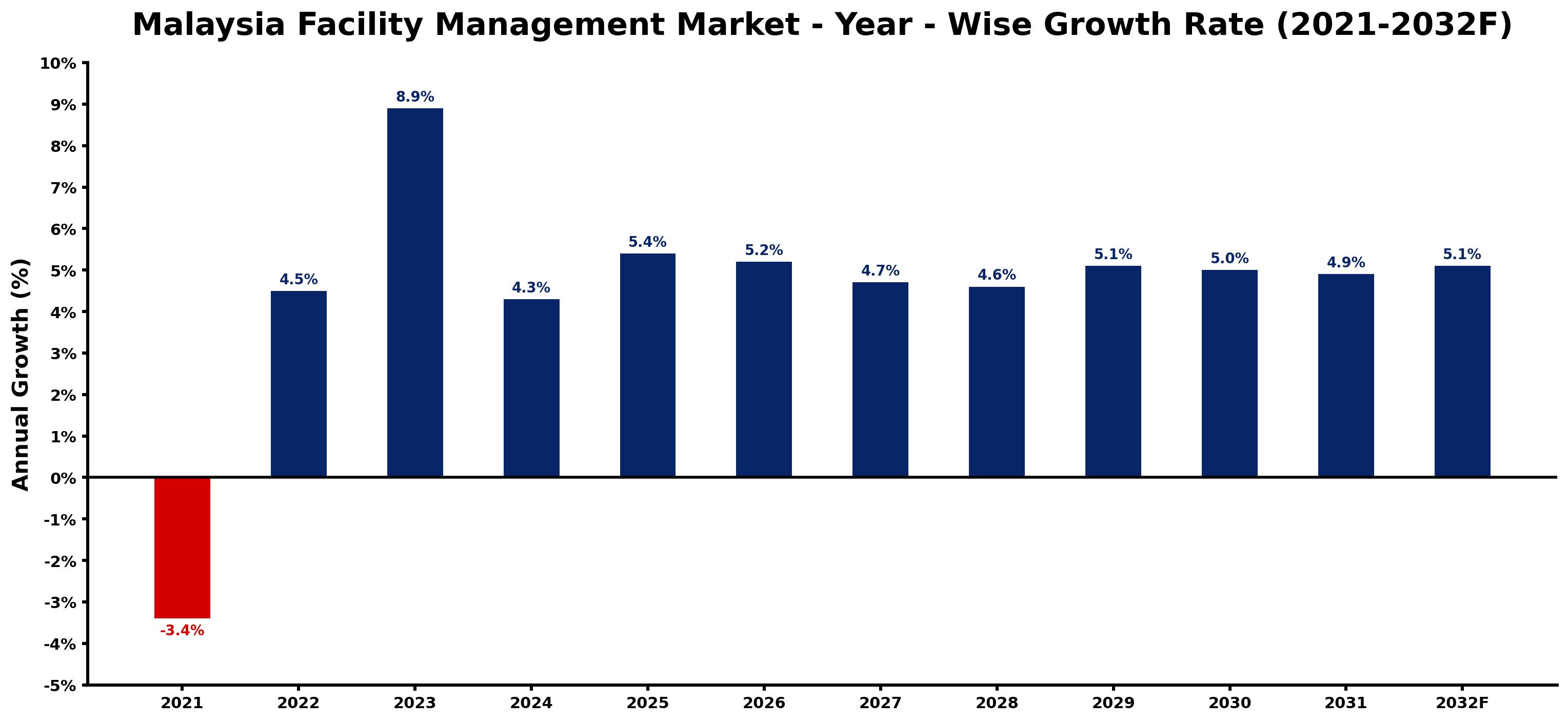
The table below presents the year‑wise growth rates along with the key drivers influencing the market
| Year | Growth Rate | Major Drivers |
| 2021 | -3.4% | Government lockdowns hindered facility maintenance services demand. |
| 2022 | 4.5% | Government's push for green building certifications. |
| 2023 | 8.9% | Post-pandemic workplace safety regulations enhancing facility services. |
| 2024 | 4.3% | Increasing property management standards from Malaysia's Urban Planning Department. |
| 2025 | 5.4% | Focus on sustainable facility operations driven by BREEAM initiatives. |
| 2026 | 5.2% | Growth in IT infrastructure boosting facility management technology adoption. |
| 2027 | 4.7% | Emergence of smart building regulations encouraging advanced management solutions. |
| 2028 | 4.6% | Rise in commercial real estate investments attracting facility services. |
| 2029 | 5.1% | Government incentives for energy efficiency in building maintenance. |
| 2030 | 5.0% | Local demand for integrated facilities services from new developments. |
| 2031 | 4.9% | Increased budget allocations for public sector facility management. |
| 2032 | 5.1% | Demand for enhanced security measures in commercial facilities. |
Note: Market size estimations and growth projections presented in this report are based on 6Wresearch's proprietary forecasting methodology, utilizing the latest available industry data, government publications, and primary research inputs.
Malaysia Facility Management Market Key Takeaways
Below are some of the specific key takeaways from the market, including:
- Outsourcing is on the rise as businesses focus on core competencies.
- The push for sustainability is reshaping service offerings in facility management.
- Smart technologies and IoT are becoming integral in facility operations.
- Property owners are increasingly prioritizing health and safety standards post-COVID-19.
- Local players are enhancing their service capabilities to compete with global firms.
Evaluation of Restraints in Malaysia Facility Management Market
Several factors continue to restrict the growth of the facility management market in Malaysia. A major concern is the need for sustainable practices, as many companies struggle to balance operational efficiency with environmental responsibility. on top of that, adapting to the rapid technological advancements in facility management requires substantial investment in training and resources, which can strain smaller operators.
Additionally, managing diverse client expectations and preferences can complicate service delivery, often leading to inconsistencies in quality. The ongoing challenge of data security amidst increased digital integration further complicates the landscape, requiring facility managers to adopt more stringent measures to protect sensitive information.
Malaysia Facility Management Market Trends
The move toward smart buildings is undeniably shaping the facility management sector in Malaysia. With the integration of IoT devices, property managers can now access real-time data, optimize energy consumption, and enhance security measures. This trend is further supported by a growing emphasis on sustainability, prompting many firms to adopt energy-efficient practices and green certifications.
on top of that, the COVID-19 pandemic has altered service demands, placing greater emphasis on health and safety protocols. As a result, facility management companies are innovating with touchless technologies and enhanced cleaning processes, creating safer environments for occupants.
Malaysia Facility Management Market Opportunities
Significant growth opportunities exist in the Malaysia facility management market, particularly in sectors focused on sustainability. Companies that can provide eco-friendly solutions and energy management services stand to benefit immensely. Additionally, the ongoing urbanization and expansion of infrastructure present a ripe environment for facility management services.
The increasing adoption of smart technologies also opens new avenues for specialized service offerings, particularly in automation and data analytics. As property owners seek enhanced operational efficiency and reduced costs, the demand for innovative facility management solutions will continue to rise.
Government Initiatives in the Malaysia Facility Management Market
The Malaysian government has been actively shaping the facility management market through various initiatives aimed at improving infrastructure and promoting sustainability. As environmental concerns take center stage, public policies are increasingly aligned with the goal of fostering greener buildings and efficient facility management practices.
- A regulatory framework introduced in 2025 mandating energy efficiency audits for commercial buildings.
- A national digital infrastructure upgrade programme now in its rollout phase, enhancing connectivity for smart facilities.
- Currently ongoing initiatives promoting green certifications for facility management services to boost sustainable practices.
- A planned public-private initiative expected to launch by 2028 aimed at enhancing disaster preparedness in facilities.
- Recent funding allocated for training programs in facility management skills to meet the industry's evolving needs.
Future Insights of the Malaysia Facility Management Market
Looking ahead to 2026-2032, the facility management market in Malaysia is set to evolve dramatically. The focus on energy efficiency and sustainability will drive demand for specialized services, particularly in the wake of increasing regulatory pressures. As technology continues to advance, integrating smart solutions into facility management will become a necessity rather than an option.
The ongoing urban development projects across the nation will further catalyze growth, providing ample opportunities for facility management firms to expand their service offerings and innovate. With the right strategies, businesses can harness these trends to capture a significant share of the growing market.
Malaysia Facility Management Market Latest Developments
In the past year, the Malaysia facility management market has seen notable activity, reflecting a shift towards modernization and sustainability. Companies are increasingly investing in advanced technologies to enhance service delivery and meet changing client expectations.
- A major technology vendor launched an innovative IoT-based platform in early 2025, aimed at automating facility management processes.
- In mid-2025, a leading regional operator expanded its service portfolio to include comprehensive energy management solutions.
- An initiative that began in late 2024 and remains underway focuses on integrating smart building technologies across newly constructed commercial properties.
- A rollout expected to begin in early 2026 aims to implement touchless systems in public facilities to enhance safety and hygiene.
- A collaborative project between local authorities and facility management firms initiated in Q1 2025 seeks to improve disaster readiness in urban areas.
Malaysia Facility Management Market - Key Attractiveness of the Report
- 10 Years of Market Numbers
- Historical Data Starting from 2022 to 2025
- Base Year: 2025
- Forecast Data until 2032
- Key Performance Indicators Impacting the Market
- Major Upcoming Developments and Projects
Key Highlights of the Report:
- Malaysia Facility Management Market Outlook
- Market Size of Malaysia Facility Management Market, 2025
- Forecast of Malaysia Facility Management Market, 2032
- Historical Data and Forecast of Malaysia Facility Management Revenues & Volume for the Period 2022-2032F
- Malaysia Facility Management Market Trend Evolution
- Malaysia Facility Management Market Drivers and Challenges
- Malaysia Facility Management Price Trends
- Malaysia Facility Management Porter's Five Forces
- Malaysia Facility Management Industry Life Cycle
- Historical Data and Forecast of Malaysia Facility Management Market Revenues & Volume By Component for the Period 2022-2032F
- Historical Data and Forecast of Malaysia Facility Management Market Revenues & Volume By Solutions for the Period 2022-2032F
- Historical Data and Forecast of Malaysia Facility Management Market Revenues & Volume By Services for the Period 2022-2032F
- Historical Data and Forecast of Malaysia Facility Management Market Revenues & Volume By Deployment Mode for the Period 2022-2032F
- Historical Data and Forecast of Malaysia Facility Management Market Revenues & Volume By Cloud for the Period 2022-2032F
- Historical Data and Forecast of Malaysia Facility Management Market Revenues & Volume By On-premises for the Period 2022-2032F
- Historical Data and Forecast of Malaysia Facility Management Market Revenues & Volume By Organization Size for the Period 2022-2032F
- Historical Data and Forecast of Malaysia Facility Management Market Revenues & Volume By Large enterprises for the Period 2022-2032F
- Historical Data and Forecast of Malaysia Facility Management Market Revenues & Volume By Small and medium-sized enterprises (SMEs) for the Period 2022-2032F
- Historical Data and Forecast of Malaysia Facility Management Market Revenues & Volume By Vertical for the Period 2022-2032F
- Historical Data and Forecast of Malaysia Facility Management Market Revenues & Volume By BFSI for the Period 2022-2032F
- Historical Data and Forecast of Malaysia Facility Management Market Revenues & Volume By IT and Telecom for the Period 2022-2032F
- Historical Data and Forecast of Malaysia Facility Management Market Revenues & Volume By Government and Public Administration for the Period 2022-2032F
- Historical Data and Forecast of Malaysia Facility Management Market Revenues & Volume By Healthcare for the Period 2022-2032F
- Historical Data and Forecast of Malaysia Facility Management Market Revenues & Volume By Education for the Period 2022-2032F
- Historical Data and Forecast of Malaysia Facility Management Market Revenues & Volume By Retail for the Period 2022-2032F
- Historical Data and Forecast of Malaysia Facility Management Market Revenues & Volume By Energy and Utilities for the Period 2022-2032F
- Historical Data and Forecast of Malaysia Facility Management Market Revenues & Volume By Manufacturing for the Period 2022-2032F
- Malaysia Facility Management Import Export Trade Statistics
- Market Opportunity Assessment By Component
- Market Opportunity Assessment By Deployment Mode
- Market Opportunity Assessment By Organization Size
- Market Opportunity Assessment By Vertical
- Malaysia Facility Management Top Companies Market Share
- Malaysia Facility Management Competitive Benchmarking By Technical and Operational Parameters
- Malaysia Facility Management Company Profiles
- Malaysia Facility Management Key Strategic Recommendations






































