Brazil Fencing Market Size, Share & Growth Rate
The Brazil Fencing Market was estimated at USD 443 Million in 2025 and is projected to reach USD 530 Million by 2032, growing at a CAGR of 2.6% from 2026 to 2032. This upward trend is propelled by urbanization and an escalating emphasis on security across various sectors, from residential to industrial. Additionally, the rising consumer preference for aesthetic yet durable fencing solutions is further fueling market expansion.
Brazil Fencing Market Growth Rate Analysis (2021-2032)
The Brazilian fencing market has exhibited a notable recovery following a downturn in 2021, evidenced by a growth surge of 5.3% in 2022. This rebound can be attributed to increased consumer demand driven by heightened awareness of security and property protection. From 2023 onwards, growth has stabilized at an average of 3.9% annually, reflecting ongoing investments in infrastructure and technological advancements. Factors such as the government's support for local manufacturing and a gradual shift towards sustainable practices have further boosted this sector. Looking ahead, predictions indicate continued growth, with an expected increase of 4.3% in 2025, bolstered by the energy transition and modernization efforts.
Brazil Fencing Market Year-wise Growth Rate and Key Drivers
This graph highlights how the Brazil Fencing Market has steadily grown over the past five years, supported by major growth factors.
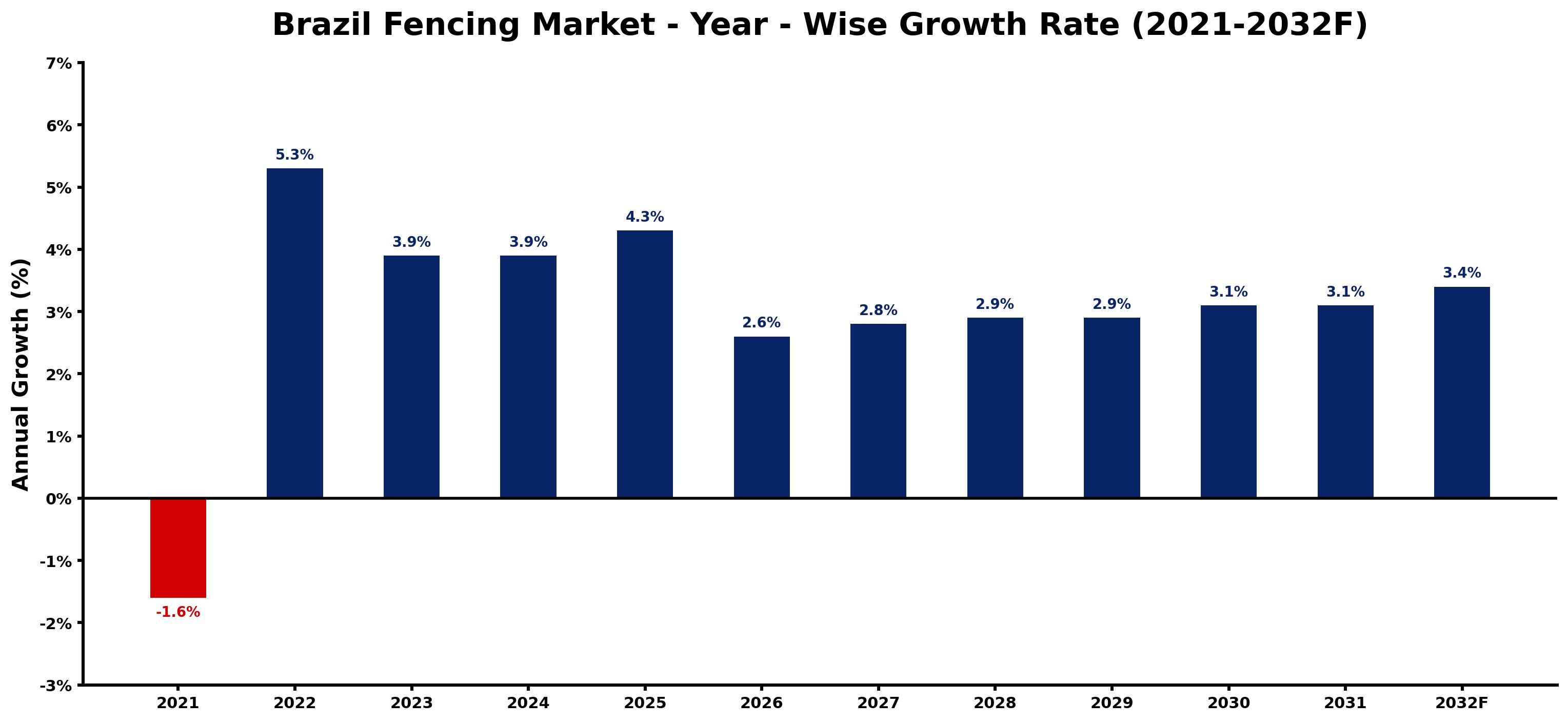
The table below presents the year‑wise growth rates along with the key drivers influencing the market
| Year | Growth Rate | Major Drivers |
| 2021 | -1.6% | Growing renewable energy integration projects |
| 2022 | 5.3% | Increasing industrial automation investments |
| 2023 | 3.9% | Expansion of commercial construction activities |
| 2024 | 3.9% | Growing urbanization and commercial development |
| 2025 | 4.3% | Government infrastructure modernization initiatives |
| 2026 | 2.6% | Growing renewable energy integration projects |
| 2027 | 2.8% | Government infrastructure modernization initiatives |
| 2028 | 2.9% | Increasing industrial automation investments |
| 2029 | 2.9% | Increasing adoption of advanced technologies |
| 2030 | 3.1% | Increasing industrial infrastructure investments |
| 2031 | 3.1% | Increasing industrial infrastructure investments |
| 2032 | 3.4% | Increasing adoption of advanced technologies |
Note - Market size estimations and growth projections presented in this report are based on 6Wresearch’s advanced forecasting approach, validated with industry datasets as of June 2026.
Brazil Fencing Market Synopsis
In Brazil, the demand for fencing materials is primarily driven by safety concerns and the need for property protection in densely populated urban areas. As cities continue to grow, the necessity for reliable perimeter security and aesthetically pleasing fencing options becomes critical.
Moreover, diverse customer preferences have led to an increased variety in fencing materials available, including wood, metal, vinyl, and composite options. This broad selection enables property owners to find solutions that align with both functionality and design aesthetics.
Brazil Fencing Market Key Takeaways
- The market is witnessing a steady growth trajectory, driven by urbanization and increasing safety concerns.
- A wide range of fencing materials is available to meet varied consumer preferences across residential, commercial, and industrial sectors.
- Government policies are shaping the market landscape by enforcing regulations related to safety and design.
- Competitive pressures from alternative materials necessitate innovation within the fencing industry.
- The growth potential is further supported by ongoing construction and infrastructure development projects.
Evaluation of Restraints in Brazil Fencing Market
Despite the positive outlook, several restraints hinder the Brazil fencing market's full potential. Economic fluctuations significantly impact demand from key sectors such as construction and agriculture, often leading to unpredictability in market growth. Furthermore, competition from alternative materials, such as concrete and composite products, adds pressure on traditional fencing providers. Compliance with stringent regulations and safety standards can also pose challenges for market players, requiring them to adapt their product designs and installation practices to meet evolving requirements.
Brazil Fencing Market Trends
Current trends indicate a strong shift towards sustainable and environmentally friendly fencing options in Brazil. Consumers are increasingly drawn to products that not only serve functional purposes but also align with environmental conservation initiatives. Moreover, technological advancements in fencing materials, including enhanced durability and innovative design features, are gaining traction, as they meet both safety and aesthetic demands.
Additionally, the rise of urban gardening and green spaces has influenced the fencing market, with an emphasis on wildlife-friendly fencing solutions that promote biodiversity and environmental health.
Brazil Fencing Market Opportunities
The Brazil fencing market presents numerous growth and investment opportunities, particularly in the realm of smart fencing solutions integrated with security technologies. As urban areas expand, the demand for advanced security features, such as motion sensors and surveillance systems, is on the rise. Furthermore, with ongoing investments in infrastructure projects, there is a potential for substantial demand in both public and private fencing initiatives. Companies that innovate and align their products with sustainability trends will likely find a significant competitive edge in this evolving market.
Government Initiatives in the Brazil Fencing Market
In Brazil, government initiatives focus on enhancing property protection, urban planning, and environmental sustainability. Regulatory frameworks ensure that fencing materials comply with safety standards while also promoting architectural compatibility within neighborhoods. Public programs encouraging sustainable fencing solutions support wildlife conservation and the preservation of green spaces, demonstrating the government's commitment to balancing urban development with environmental responsibilities.
Future Insights of the Brazil Fencing Market
Looking ahead to 2026-2032, the Brazil fencing market is poised for gradual growth, bolstered by urban expansion and a rising focus on security. Increased consumer awareness regarding the importance of property safety will continue to drive demand for robust fencing solutions. Additionally, advancements in fencing technology and materials are expected to create new avenues for innovation. As the market evolves, adaptability to changing consumer preferences and regulatory landscapes will be crucial for sustained success.
Brazil Fencing Market Latest Developments (May 2025 - June 2026)
Recent industry developments indicate a heightened focus on environmentally sustainable fencing solutions, as companies aim to align with government regulations on sustainability. Innovations in composite materials have also been noted, with improvements in durability and aesthetic versatility. Industry stakeholders are increasingly collaborating with local governments to enhance fencing standards in line with urban planning initiatives, demonstrating a commitment to both safety and community aesthetics.
Brazil Fencing Market - Key Attractiveness of the Report
- 10 Years of Market Numbers
- Historical Data Starting from 2022 to 2025
- Base Year: 2025
- Forecast Data until 2032
- Key Performance Indicators Impacting the Market
- Major Upcoming Developments and Projects
Key Highlights of the Report:
- Brazil Fencing Market Outlook
- Market Size of Brazil Fencing Market, 2025
- Forecast of Brazil Fencing Market, 2032
- Historical Data and Forecast of Brazil Fencing Revenues & Volume for the Period 2022-2032F
- Brazil Fencing Market Trend Evolution
- Brazil Fencing Market Drivers and Challenges
- Brazil Fencing Price Trends
- Brazil Fencing Porter's Five Forces
- Brazil Fencing Industry Life Cycle
- Historical Data and Forecast of Brazil Fencing Market Revenues & Volume By Material for the Period 2022-2032F
- Historical Data and Forecast of Brazil Fencing Market Revenues & Volume By Metal for the Period 2022-2032F
- Historical Data and Forecast of Brazil Fencing Market Revenues & Volume By Wood for the Period 2022-2032F
- Historical Data and Forecast of Brazil Fencing Market Revenues & Volume By Plastic & Composite for the Period 2022-2032F
- Historical Data and Forecast of Brazil Fencing Market Revenues & Volume By Concrete for the Period 2022-2032F
- Historical Data and Forecast of Brazil Fencing Market Revenues & Volume By Distribution Channel for the Period 2022-2032F
- Historical Data and Forecast of Brazil Fencing Market Revenues & Volume By Online for the Period 2022-2032F
- Historical Data and Forecast of Brazil Fencing Market Revenues & Volume By Retail for the Period 2022-2032F
- Historical Data and Forecast of Brazil Fencing Market Revenues & Volume By Installation for the Period 2022-2032F
- Historical Data and Forecast of Brazil Fencing Market Revenues & Volume By Do-It-Yourself for the Period 2022-2032F
- Historical Data and Forecast of Brazil Fencing Market Revenues & Volume By Contractor for the Period 2022-2032F
- Historical Data and Forecast of Brazil Fencing Market Revenues & Volume By Application for the Period 2022-2032F
- Historical Data and Forecast of Brazil Fencing Market Revenues & Volume By Residential for the Period 2022-2032F
- Historical Data and Forecast of Brazil Fencing Market Revenues & Volume By Agricultural for the Period 2022-2032F
- Historical Data and Forecast of Brazil Fencing Market Revenues & Volume By Industrial for the Period 2022-2032F
- Historical Data and Forecast of Brazil Fencing Market Revenues & Volume By End-users for the Period 2022-2032F
- Historical Data and Forecast of Brazil Fencing Market Revenues & Volume By Government for the Period 2022-2032F
- Historical Data and Forecast of Brazil Fencing Market Revenues & Volume By Petroleum & Chemicals for the Period 2022-2032F
- Historical Data and Forecast of Brazil Fencing Market Revenues & Volume By Military & Defense for the Period 2022-2032F
- Historical Data and Forecast of Brazil Fencing Market Revenues & Volume By Mining for the Period 2022-2032F
- Historical Data and Forecast of Brazil Fencing Market Revenues & Volume By Energy & Power for the Period 2022-2032F
- Historical Data and Forecast of Brazil Fencing Market Revenues & Volume By Transport for the Period 2022-2032F
- Historical Data and Forecast of Brazil Fencing Market Revenues & Volume By Others for the Period 2022-2032F
- Brazil Fencing Import Export Trade Statistics
- Market Opportunity Assessment By Material
- Market Opportunity Assessment By Distribution Channel
- Market Opportunity Assessment By Installation
- Market Opportunity Assessment By Application
- Market Opportunity Assessment By End-users
- Brazil Fencing Top Companies Market Share
- Brazil Fencing Competitive Benchmarking By Technical and Operational Parameters
- Brazil Fencing Company Profiles
- Brazil Fencing Key Strategic Recommendations






































