Brazil Flame Arrestor Market Top 5 Importing Countries and Market Competition (HHI) Analysis
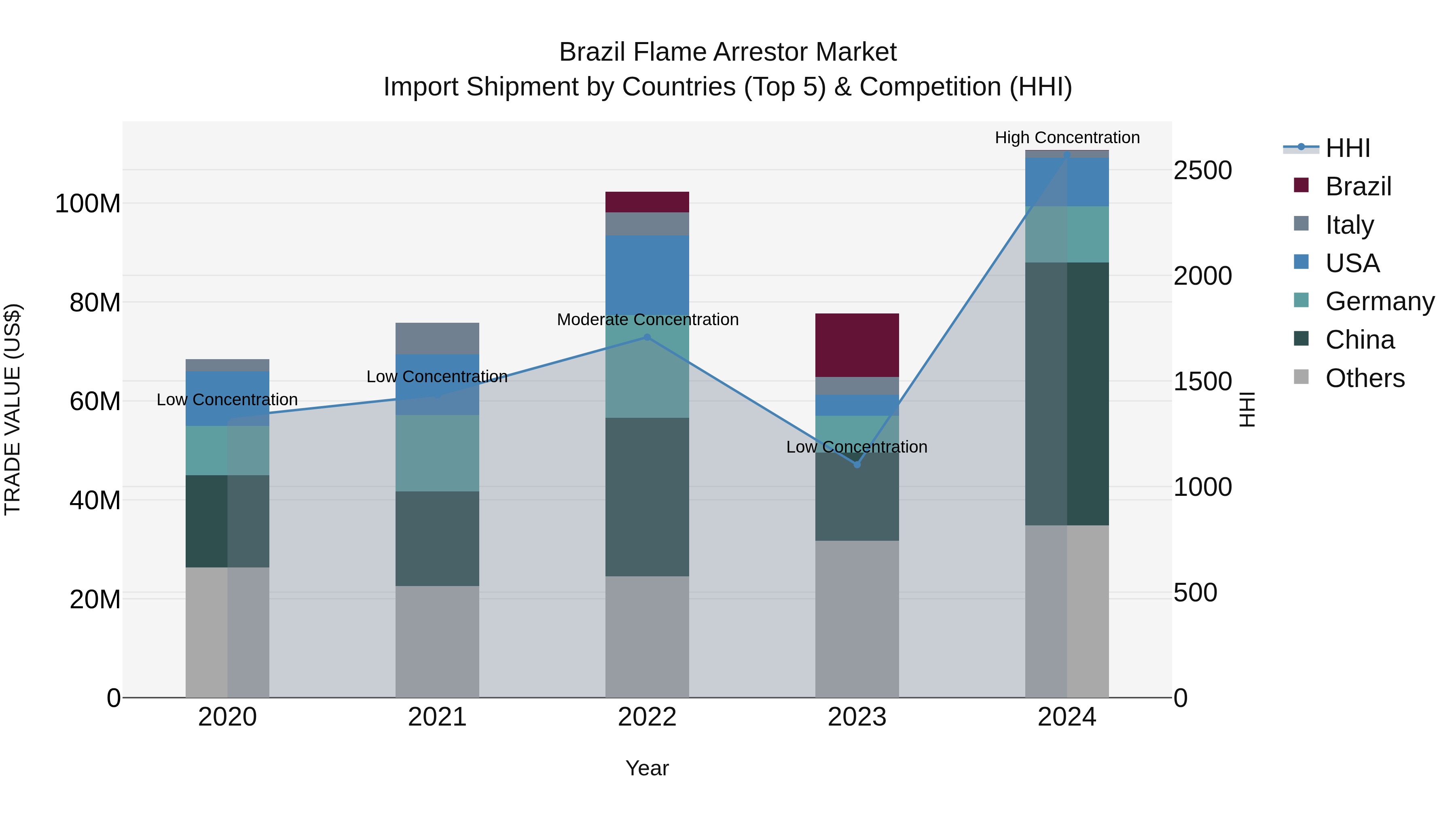
Brazil`s flame arrestor import market saw a significant shift in 2024, with China, Germany, USA, Thailand, and Canada emerging as the top exporters. The market experienced a notable increase in concentration, indicating a more competitive landscape. The compound annual growth rate (CAGR) from 2020 to 2024 stood at an impressive 12.76%, with a remarkable growth rate of 42.46% from 2023 to 2024. These trends suggest a growing demand for flame arrestors in Brazil, attracting key players from various countries to capitalize on the market opportunities.
Brazil Flame Arrestor Market Overview
The Brazil flame arrestor market is experiencing steady growth driven by strict safety regulations across industries such as oil & gas, chemicals, and mining. Flame arrestors are crucial for preventing the propagation of flames and protecting equipment and personnel from explosions. The market is witnessing increasing demand for advanced flame arrestor technologies that offer improved safety and efficiency. Key players in the Brazil market are focusing on product innovations, such as compact designs and enhanced durability, to cater to the evolving needs of end-users. Additionally, the rising awareness about industrial safety standards and the growing emphasis on risk mitigation strategies are further boosting the adoption of flame arrestors in Brazil. Overall, the Brazil flame arrestor market is poised for continued expansion as industries prioritize safety measures and compliance with regulatory requirements.
Brazil Flame Arrestor Market Trends
The Brazil flame arrestor market is experiencing a growing demand for advanced and reliable flame arrestor systems in various industries such as oil & gas, petrochemicals, and manufacturing. Companies are increasingly focusing on enhancing safety measures and regulatory compliance, driving the adoption of flame arrestors to prevent and mitigate the risk of explosions and fires. Key trends in the market include the development of innovative flame arrestor technologies to improve efficiency and effectiveness, the rising emphasis on environmental sustainability through the use of eco-friendly materials, and the integration of IoT and digital technologies for real-time monitoring and predictive maintenance. Additionally, market players are expanding their product portfolios and investing in research and development to cater to the evolving needs of the industry, driving further growth in the Brazil flame arrestor market.
Brazil Flame Arrestor Market Challenges
In the Brazil flame arrestor market, some of the key challenges faced include stringent regulatory requirements and compliance standards, which can vary across different industries and regions. Ensuring that flame arrestors meet these standards while also providing effective protection against potential explosions can be a complex task for manufacturers and suppliers. Additionally, the market is highly competitive, with a wide range of products available, making it essential for companies to differentiate themselves through innovation, quality, and cost-effectiveness. Economic fluctuations and volatility in raw material prices can also impact the market, affecting production costs and pricing strategies. Overall, navigating these challenges requires a deep understanding of the market dynamics, regulatory landscape, and technological advancements to stay competitive and meet the evolving needs of customers in Brazil.
Brazil Flame Arrestor Market Investment Opportunities
The Brazil flame arrestor market presents attractive investment opportunities due to the increasing focus on safety regulations and standards in industries such as oil and gas, petrochemical, and manufacturing. With the growing demand for flame arrestors to prevent and mitigate the risk of explosions and fires, there is a rising need for advanced and reliable flame arrestor technologies in Brazil. Investing in innovative flame arrestor solutions that offer improved efficiency, durability, and compliance with industry requirements can yield significant returns in this market. Additionally, partnerships with local distributors and manufacturers can help investors establish a strong presence and distribution network in Brazil, capitalizing on the projected growth of the flame arrestor market in the region.
Brazil Flame Arrestor Market Government Policy
In Brazil, the flame arrestor market is subject to government regulations aimed at ensuring safety in various industries where flammable gases and liquids are present. The Brazilian government has established standards and requirements for flame arrestors to be used in equipment, machinery, and facilities to prevent the spread of fires and explosions. These regulations are typically enforced by government agencies such as the National Institute of Metrology, Quality, and Technology (Inmetro) and the Ministry of Labor and Employment (MTE). Compliance with these regulations is mandatory for companies operating in sectors such as oil and gas, petrochemicals, and mining to protect workers, the environment, and surrounding communities from potential fire hazards.
Brazil Flame Arrestor Market Future Outlook
The future outlook for the Brazil flame arrestor market appears promising, driven by increasing industrial activities across sectors such as oil & gas, chemicals, and automotive. Stringent safety regulations mandating the installation of flame arrestors in industrial facilities to prevent fires and explosions are expected to fuel market growth. Additionally, the growing awareness about the importance of worker safety and the need to prevent environmental hazards is likely to boost the demand for flame arrestors in Brazil. Technological advancements leading to the development of more efficient and cost-effective flame arrestors are anticipated to further drive market expansion. Overall, with a favorable regulatory environment and a growing emphasis on safety measures, the Brazil flame arrestor market is poised for steady growth in the coming years.
Key Highlights of the Report:
- Brazil Flame Arrestor Market Outlook
- Market Size of Brazil Flame Arrestor Market,2024
- Forecast of Brazil Flame Arrestor Market, 2031
- Historical Data and Forecast of Brazil Flame Arrestor Revenues & Volume for the Period 2021-2031
- Brazil Flame Arrestor Market Trend Evolution
- Brazil Flame Arrestor Market Drivers and Challenges
- Brazil Flame Arrestor Price Trends
- Brazil Flame Arrestor Porter's Five Forces
- Brazil Flame Arrestor Industry Life Cycle
- Historical Data and Forecast of Brazil Flame Arrestor Market Revenues & Volume By Type for the Period 2021-2031
- Historical Data and Forecast of Brazil Flame Arrestor Market Revenues & Volume By End-of-Line Flame Arresters for the Period 2021-2031
- Historical Data and Forecast of Brazil Flame Arrestor Market Revenues & Volume By In-Line Flame Arresters for the Period 2021-2031
- Historical Data and Forecast of Brazil Flame Arrestor Market Revenues & Volume By Application for the Period 2021-2031
- Historical Data and Forecast of Brazil Flame Arrestor Market Revenues & Volume By Petrochemical Industry for the Period 2021-2031
- Historical Data and Forecast of Brazil Flame Arrestor Market Revenues & Volume By Chemical Industry for the Period 2021-2031
- Historical Data and Forecast of Brazil Flame Arrestor Market Revenues & Volume By Oil & Gas for the Period 2021-2031
- Historical Data and Forecast of Brazil Flame Arrestor Market Revenues & Volume By Pharmaceuticals for the Period 2021-2031
- Historical Data and Forecast of Brazil Flame Arrestor Market Revenues & Volume By End-Use for the Period 2021-2031
- Historical Data and Forecast of Brazil Flame Arrestor Market Revenues & Volume By Industrial for the Period 2021-2031
- Historical Data and Forecast of Brazil Flame Arrestor Market Revenues & Volume By Commercial for the Period 2021-2031
- Historical Data and Forecast of Brazil Flame Arrestor Market Revenues & Volume By Residential for the Period 2021-2031
- Brazil Flame Arrestor Import Export Trade Statistics
- Market Opportunity Assessment By Type
- Market Opportunity Assessment By Application
- Market Opportunity Assessment By End-Use
- Brazil Flame Arrestor Top Companies Market Share
- Brazil Flame Arrestor Competitive Benchmarking By Technical and Operational Parameters
- Brazil Flame Arrestor Company Profiles
- Brazil Flame Arrestor Key Strategic Recommendations






































