Brazil Flushing System Market Size, Share & Growth Rate
The Brazil Flushing System Market was estimated at USD 110 Million in 2025 and is projected to reach USD 130 Million by 2032, growing at a CAGR of 2.4% from 2026 to 2032. This growth trajectory is supported by the rapid urbanization across Brazilian cities, leading to increased demand for reliable and water-efficient sanitation solutions. Furthermore, the adoption of stringent building codes and plumbing standards enhances the necessity for modern flushing systems, driving both residential and commercial investments.
Brazil Flushing System Market Year-wise Growth Rate and Key Drivers
This graph highlights how the Brazil Flushing System Market has steadily grown over the years, supported by major growth factors.
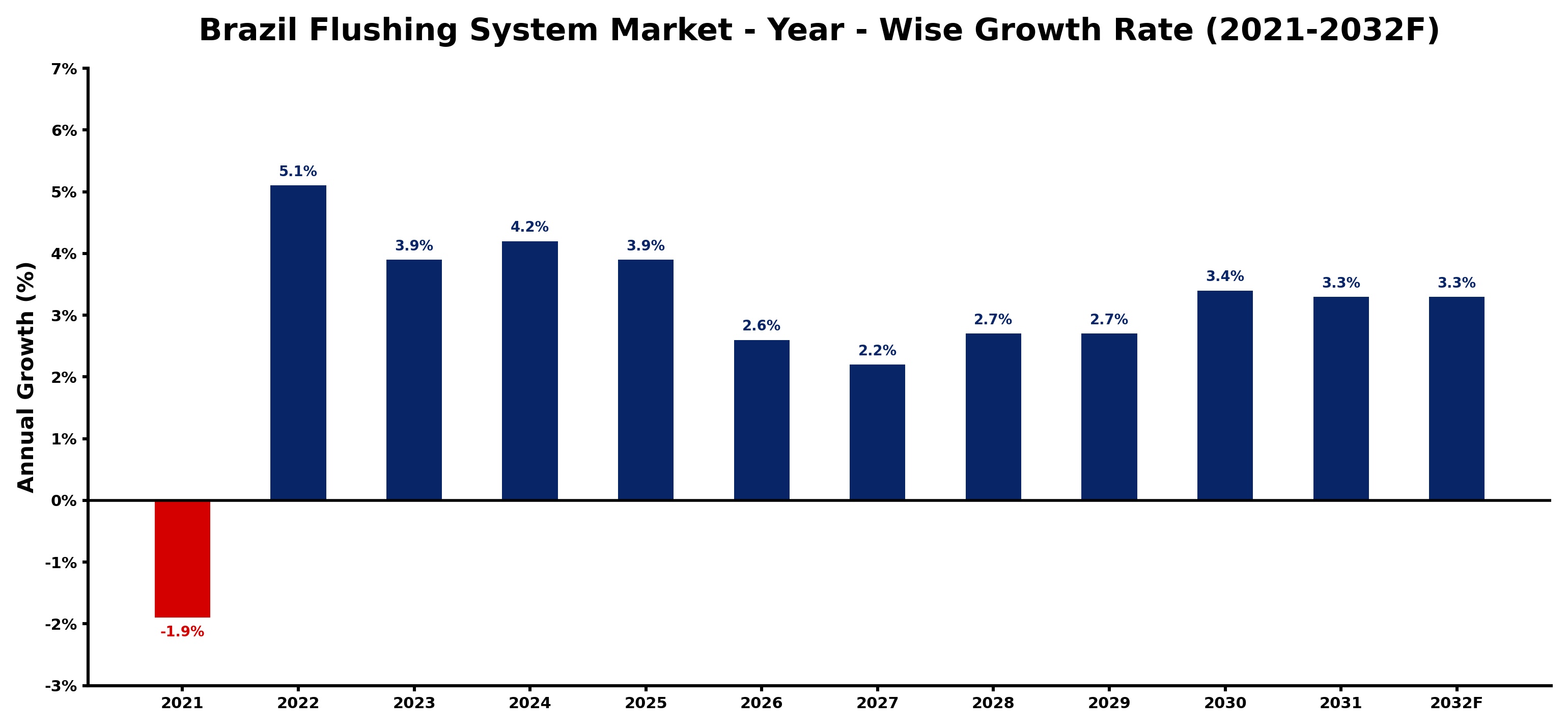
The table below presents the year‑wise growth rates along with the key drivers influencing the market
| Year | Growth Rate | Major Drivers |
| 2021 | -1.9% | Expansion of manufacturing activities |
| 2022 | 5.1% | Expansion of transportation and logistics networks |
| 2023 | 3.9% | Rapid growth in telecom and data center sectors |
| 2024 | 4.2% | Increasing industrial infrastructure investments |
| 2025 | 3.9% | Expansion of commercial construction activities |
| 2026 | 2.6% | Increasing industrial infrastructure investments |
| 2027 | 2.2% | Expansion of commercial construction activities |
| 2028 | 2.7% | Increasing industrial infrastructure investments |
| 2029 | 2.7% | Rising electricity demand across industries |
| 2030 | 3.4% | Expansion of transportation and logistics networks |
| 2031 | 3.3% | Increasing industrial infrastructure investments |
| 2032 | 3.3% | Growing urbanization and commercial development |
Note - Market size estimations and growth projections presented in this report are based on 6Wresearch’s advanced forecasting approach, validated with industry datasets as of June 2026.
Brazil Flushing System Market Synopsis
In Brazil, the demand for water-efficient flushing systems is surging, fueled by heightened awareness of environmental sustainability. As urban areas expand, a concurrent increase in residential and commercial building projects propels the need for advanced sanitation solutions that align with water conservation initiatives.
Moreover, consumer preferences are shifting towards innovative flushing technologies, such as dual-flush systems, which allow for greater control over water usage. This pivot not only meets regulatory requirements but also reflects a growing inclination for smarter, environmentally-friendly options in sanitation.
Brazil Flushing System Market Key Takeaways
- The market is significantly influenced by urbanization and the growing building sector in Brazil.
- Adoption of water-efficient technologies is crucial for meeting regulatory standards and consumer expectations.
- Government policies aimed at promoting water conservation are shaping market dynamics.
- Competitive pressures are compelling manufacturers to innovate and enhance product reliability.
- Fragmentation in the market presents both challenges and opportunities for new entrants and established players alike.
Evaluation of Restraints in Brazil Flushing System Market
The Brazil Flushing System Market faces notable constraints that can impede its growth trajectory. Regulatory frameworks emphasizing water conservation present challenges for manufacturers who must continuously innovate to ensure compliance while maintaining product affordability. Market players are also contending with significant competition from alternative toilet flushing mechanisms that can potentially disrupt traditional sales channels. Furthermore, issues related to product reliability and installation compatibility can detract from customer satisfaction, impacting overall market growth.
Brazil Flushing System Market Trends
Current trends in the Brazil Flushing System Market reflect a growing emphasis on smart technology and sustainability. As the awareness of environmental impact rises, manufacturers are focusing on developing advanced flushing systems that utilize less water without compromising performance. Additionally, the rise of smart homes is influencing consumer demand for integrated flushing systems that can be controlled remotely, aligning with broader technological advancements in home automation.
Brazil Flushing System Market Opportunities
Opportunities for growth within the Brazil Flushing System Market abound, particularly in the realm of sustainable solutions. As the government continues to implement and enforce water conservation policies, there is an increasing demand for innovative flushing systems that not only comply with regulations but also exceed consumer expectations in efficiency. Additionally, the expansion of residential and commercial construction projects opens avenues for collaborations and partnerships aimed at integrating state-of-the-art plumbing solutions.
Government Initiatives in the Brazil Flushing System Market
Brazilian government initiatives significantly impact the flushing system market through the implementation of regulations and incentives aimed at promoting water conservation. Policies designed to enhance plumbing standards and encourage the adoption of water-efficient technologies are increasingly prevalent. Furthermore, initiatives aimed at regulating the import and distribution of flushing system components ensure compliance with national standards, thereby fostering a competitive and sustainable market landscape.
Future Insights of the Brazil Flushing System Market
Looking forward to 2026-2032, the Brazil Flushing System Market is expected to continue its growth trend, fueled by ongoing urbanization and increased consumer emphasis on water conservation. Innovations in technology, such as smart flush systems, are poised to capture market share as homeowners and businesses alike seek effective solutions that align with their sustainability goals. As regulations evolve and consumer preferences shift, the market landscape will likely transform, offering ample opportunities for both established players and new entrants.
Brazil Flushing System Market Latest Developments (May 2025 - June 2026)
Recent developments within the Brazil Flushing System Market showcase a heightened focus on sustainability and technological advancement. Companies are launching new, eco-friendly flushing technologies that cater to evolving consumer demands for efficient sanitation solutions. Additionally, partnerships between manufacturers and urban developers are becoming more common, aiming to integrate modern flushing systems into upcoming infrastructure projects across the country.
Brazil Flushing System Market - Key Attractiveness of the Report
- 10 Years of Market Numbers
- Historical Data Starting from 2022 to 2025
- Base Year: 2025
- Forecast Data until 2032
- Key Performance Indicators Impacting the Market
- Major Upcoming Developments and Projects
Key Highlights of the Report:
- Brazil Flushing System Market Outlook
- Market Size of Brazil Flushing System Market, 2025
- Forecast of Brazil Flushing System Market, 2032
- Historical Data and Forecast of Brazil Flushing System Revenues & Volume for the Period 2022-2032F
- Brazil Flushing System Market Trend Evolution
- Brazil Flushing System Market Drivers and Challenges
- Brazil Flushing System Price Trends
- Brazil Flushing System Porter's Five Forces
- Brazil Flushing System Industry Life Cycle
- Historical Data and Forecast of Brazil Flushing System Market Revenues & Volume By Type for the Period 2022-2032F
- Historical Data and Forecast of Brazil Flushing System Market Revenues & Volume By Gravity Flush for the Period 2022-2032F
- Historical Data and Forecast of Brazil Flushing System Market Revenues & Volume By Dual Flush for the Period 2022-2032F
- Historical Data and Forecast of Brazil Flushing System Market Revenues & Volume By Pressure-assisted Flush for the Period 2022-2032F
- Historical Data and Forecast of Brazil Flushing System Market Revenues & Volume By Tornado Flush for the Period 2022-2032F
- Historical Data and Forecast of Brazil Flushing System Market Revenues & Volume By Others for the Period 2022-2032F
- Historical Data and Forecast of Brazil Flushing System Market Revenues & Volume By Technology for the Period 2022-2032F
- Historical Data and Forecast of Brazil Flushing System Market Revenues & Volume By Manual for the Period 2022-2032F
- Historical Data and Forecast of Brazil Flushing System Market Revenues & Volume By Sensors for the Period 2022-2032F
- Historical Data and Forecast of Brazil Flushing System Market Revenues & Volume By Remote Control for the Period 2022-2032F
- Historical Data and Forecast of Brazil Flushing System Market Revenues & Volume By Waterless Flushing for the Period 2022-2032F
- Historical Data and Forecast of Brazil Flushing System Market Revenues & Volume By Installation Type for the Period 2022-2032F
- Historical Data and Forecast of Brazil Flushing System Market Revenues & Volume By Surface Flush for the Period 2022-2032F
- Historical Data and Forecast of Brazil Flushing System Market Revenues & Volume By Rear Wall Mounting for the Period 2022-2032F
- Historical Data and Forecast of Brazil Flushing System Market Revenues & Volume By Others for the Period 2022-2032F
- Historical Data and Forecast of Brazil Flushing System Market Revenues & Volume By End User for the Period 2022-2032F
- Historical Data and Forecast of Brazil Flushing System Market Revenues & Volume By Residential for the Period 2022-2032F
- Historical Data and Forecast of Brazil Flushing System Market Revenues & Volume By Commercial for the Period 2022-2032F
- Brazil Flushing System Import Export Trade Statistics
- Market Opportunity Assessment By Type
- Market Opportunity Assessment By Technology
- Market Opportunity Assessment By Installation Type
- Market Opportunity Assessment By End User
- Brazil Flushing System Top Companies Market Share
- Brazil Flushing System Competitive Benchmarking By Technical and Operational Parameters
- Brazil Flushing System Company Profiles
- Brazil Flushing System Key Strategic Recommendations






































