Brazil Foot Care Products Market Size, Share & Growth Rate
The Brazil Foot Care Products Market was estimated at USD 317 Million in 2025 and is projected to reach USD 379 Million by 2032, growing at a CAGR of 2.6% from 2026 to 2032. This growth trajectory is driven by rising awareness among consumers regarding foot health and hygiene, coupled with the increasing demand for personal grooming products. As lifestyles evolve and foot-related issues become more prevalent, Brazilians are increasingly turning to specialized foot care solutions that address dryness, calluses, and overall foot comfort.
Brazil Foot Care Products Market Year-wise Growth Rate and Key Drivers
This graph highlights how the Brazil Foot Care Products Market has steadily grown over the years, supported by major growth factors.
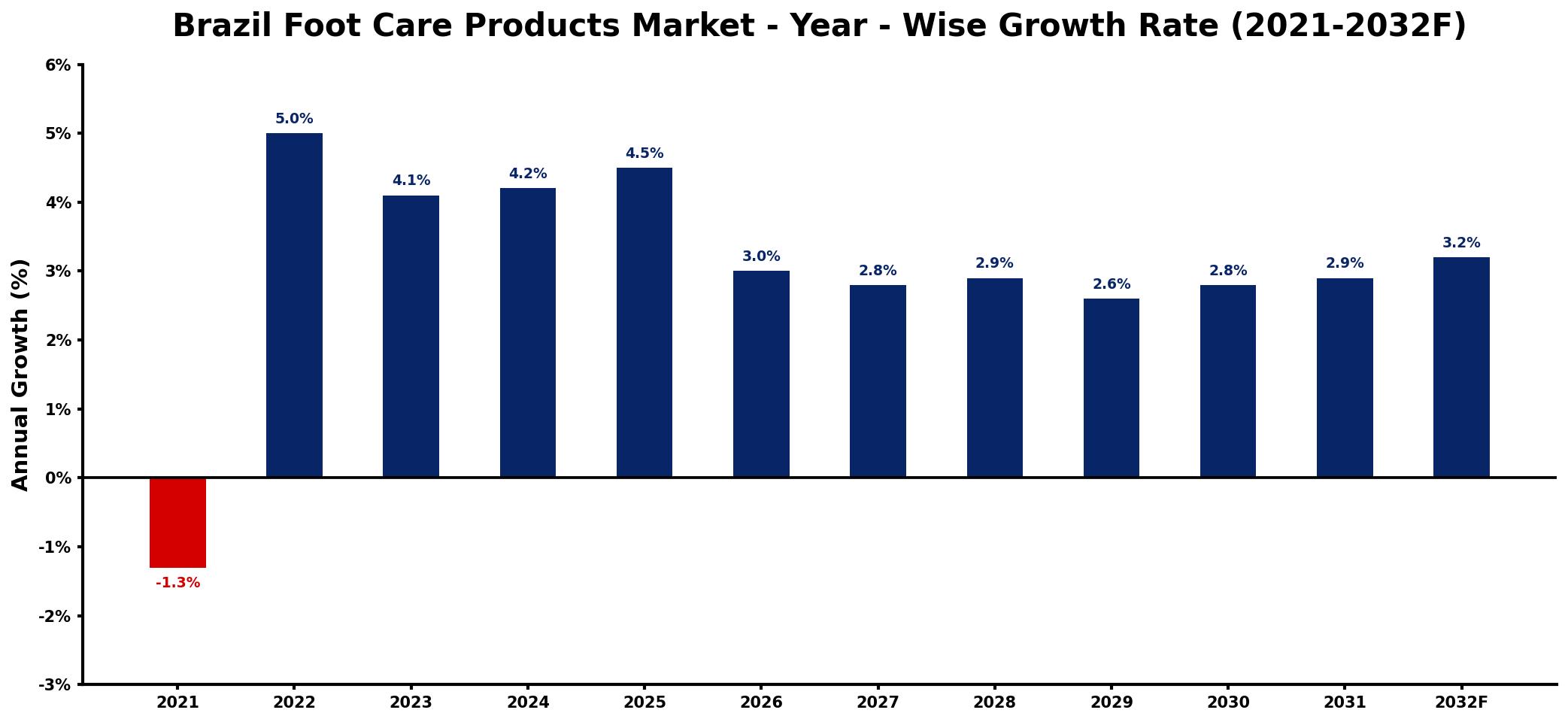
The table below presents the year‑wise growth rates along with the key drivers influencing the market
| Year | Growth Rate | Major Drivers |
| 2021 | -1.3% | decreased consumer spending habits |
| 2022 | 5.0% | rising health awareness trends |
| 2023 | 4.1% | increased online shopping adoption |
| 2024 | 4.2% | expanding retail distribution channels |
| 2025 | 4.5% | growing demand for natural ingredients |
| 2026 | 3.0% | increased investment in innovation |
| 2027 | 2.8% | emerging wellness industry partnerships |
| 2028 | 2.9% | heightened focus on preventive health |
| 2029 | 2.6% | expanding industrial usage applications |
| 2030 | 2.8% | increased consumer education initiatives |
| 2031 | 2.9% | expansion of premium product lines |
| 2032 | 3.2% | enhanced marketing strategies effectiveness |
Note: Market size estimations and growth projections presented in this report are based on 6Wresearch's proprietary forecasting methodology, utilizing the latest available industry data, government publications, and primary research inputs.
Brazil Foot Care Products Market Synopsis
The Brazilian market for foot care products is undergoing notable expansion, characterized by a burgeoning interest in health and wellness. Consumers are now more engaged in their foot care routines, seeking effective solutions that emphasize both comfort and aesthetics.
Innovative formulations, including those featuring natural and organic ingredients, are gaining traction, reflecting a shift in consumer preferences towards safer, environmentally friendly products. This trend is further supported by the expanding beauty and personal care sector, which continues to amplify the variety and availability of foot care items across the market.
Brazil Foot Care Products Market Key Takeaways
- The market is anticipated to grow significantly, driven by increasing consumer awareness of foot health.
- Innovations in product formulations are reshaping consumer preferences, with a notable shift towards organic options.
- The expansion of distribution channels is enhancing product accessibility for Brazilian consumers.
- Rising disposable incomes among the population are fostering greater investments in personal grooming.
- Foot care products are increasingly integrated into broader wellness regimens, reflecting changing lifestyle trends.
Evaluation of Restraints in Brazil Foot Care Products Market
Despite its growth potential, the Brazil Foot Care Products Market faces several constraints that could hinder its advancement. One major factor is the challenge of balancing consumer demand for natural and organic ingredients with the costs associated with developing such formulations. Additionally, ensuring product efficacy and safety is paramount; therefore, companies must invest heavily in research and development. Educating the public on foot health and hygiene remains a significant hurdle, as awareness levels vary widely across different demographics. Lastly, competition from alternative foot care remedies can divert consumer attention from traditional products, challenging market players to continually innovate and differentiate.
Brazil Foot Care Products Market Trends
Current trends in the Brazil Foot Care Products Market indicate a growing consumer preference for sustainable and natural formulations, as more individuals seek to align their purchases with eco-conscious values. The rise of e-commerce has also transformed how consumers shop for foot care products, with online platforms providing access to a wider range of brands and innovations. Additionally, there is an increasing focus on multifunctional products that address multiple foot concerns in one application, appealing to the busy lifestyles of modern consumers.
Brazil Foot Care Products Market Opportunities
The market presents several growth and investment opportunities, particularly in the realm of product innovation. Brands that can effectively develop and market natural and organic foot care solutions are well-positioned to capture an enthusiastic consumer base. Furthermore, expanding distribution networks, particularly through online retail, can enhance market penetration. As the trend towards self-care continues to rise, there is significant potential for marketing strategies that emphasize personal wellness and holistic care approaches.
Government Initiatives in the Brazil Foot Care Products Market
The Brazilian government plays a crucial role in regulating the foot care products market through policies that ensure product safety and efficacy. Recent initiatives focus on enhancing transparency in labeling and ingredient lists, empowering consumers to make informed choices. Additionally, there are ongoing discussions about advertising standards to ensure that marketing claims align with actual product benefits, which could foster greater consumer confidence in foot care products.
Future Insights of the Brazil Foot Care Products Market
Looking ahead to the period from 2026 to 2032, the Brazil Foot Care Products Market is set to experience transformative growth fueled by increasing consumer interest in health and wellness. As individuals prioritize self-care, demand for effective and safe foot care products will rise. Additionally, companies that leverage technological advancements to create innovative formulations and enhance customer engagement will likely thrive. The continued focus on sustainability and natural ingredients will shape the competitive landscape, encouraging brands to adapt swiftly to evolving consumer expectations.
Brazil Foot Care Products Market Latest Developments (2025 - 2026)
In recent months, the Brazil Foot Care Products Market has seen notable shifts as brands increasingly adopt sustainable practices in their manufacturing processes. The introduction of new product lines featuring organic and eco-friendly ingredients reflects consumer demand for safer alternatives. Additionally, digital marketing campaigns have ramped up, engaging consumers through educational content on foot health. This proactive approach aims to elevate awareness and drive sales, positioning companies favorably within this growing market.
Brazil Foot Care Products Market - Key Attractiveness of the Report
- 10 Years of Market Numbers
- Historical Data Starting from 2022 to 2025
- Base Year: 2025
- Forecast Data until 2032
- Key Performance Indicators Impacting the Market
- Major Upcoming Developments and Projects
Key Highlights of the Report:
- Brazil Foot Care Products Market Outlook
- Market Size of Brazil Foot Care Products Market, 2025
- Forecast of Brazil Foot Care Products Market, 2032
- Historical Data and Forecast of Brazil Foot Care Products Revenues & Volume for the Period 2022-2032F
- Brazil Foot Care Products Market Trend Evolution
- Brazil Foot Care Products Market Drivers and Challenges
- Brazil Foot Care Products Price Trends
- Brazil Foot Care Products Porter's Five Forces
- Brazil Foot Care Products Industry Life Cycle
- Historical Data and Forecast of Brazil Foot Care Products Market Revenues & Volume By Application for the Period 2022-2032F
- Historical Data and Forecast of Brazil Foot Care Products Market Revenues & Volume By Sports & Athletics for the Period 2022-2032F
- Historical Data and Forecast of Brazil Foot Care Products Market Revenues & Volume By Medical for the Period 2022-2032F
- Historical Data and Forecast of Brazil Foot Care Products Market Revenues & Volume By Personal Comfort for the Period 2022-2032F
- Historical Data and Forecast of Brazil Foot Care Products Market Revenues & Volume By Distribution Channel for the Period 2022-2032F
- Historical Data and Forecast of Brazil Foot Care Products Market Revenues & Volume By Drug Stores & Pharmacies for the Period 2022-2032F
- Historical Data and Forecast of Brazil Foot Care Products Market Revenues & Volume By Hospitals & Specialty Clinics for the Period 2022-2032F
- Historical Data and Forecast of Brazil Foot Care Products Market Revenues & Volume By Online Stores for the Period 2022-2032F
- Historical Data and Forecast of Brazil Foot Care Products Market Revenues & Volume By Others for the Period 2022-2032F
- Brazil Foot Care Products Import Export Trade Statistics
- Market Opportunity Assessment By Application
- Market Opportunity Assessment By Distribution Channel
- Brazil Foot Care Products Top Companies Market Share
- Brazil Foot Care Products Competitive Benchmarking By Technical and Operational Parameters
- Brazil Foot Care Products Company Profiles
- Brazil Foot Care Products Key Strategic Recommendations






































