United States (US) Foot Care Products Market Size, Share & Growth Rate
The United States (US) Foot Care Products Market was estimated at USD 110 Million in 2025 and is projected to reach USD 130 Million by 2032, growing at a CAGR of 2.4% from 2026 to 2032. This growth trajectory is largely influenced by the rising incidence of diabetes and obesity in the country, both of which significantly contribute to foot-related health issues. Additionally, the growing focus on personal grooming and hygiene, spurred by evolving consumer preferences, is driving demand for a variety of foot care products, from moisturizers to specialized creams and oils.
United States (US) Foot Care Products Market Growth Rate Analysis (2021-2032)
The United States foot care products market has shown a pronounced recovery following a brief decline of 0.5% in 2021, as consumer awareness regarding foot health surged in the wake of the pandemic. Growth rebounded significantly with a 6.2% increase in 2022, spurred by heightened demand for wellness and self-care products. Sustained growth is anticipated, with projections of 3.0% in 2023, followed by consistent increases ranging from 2.6% to 3.3% through 2032. This upward trend is driven by advancements in product technology, increased investments in research and development, and a growing emphasis on preventive healthcare. Furthermore, digitalization has facilitated better consumer engagement, bolstering brand loyalty and expanding market reach.
United States (US) Foot Care Products Market Year-wise Growth Rate and Key Drivers
This graph highlights how the United States (US) Foot Care Products Market has steadily grown over the past five years, supported by major growth factors.
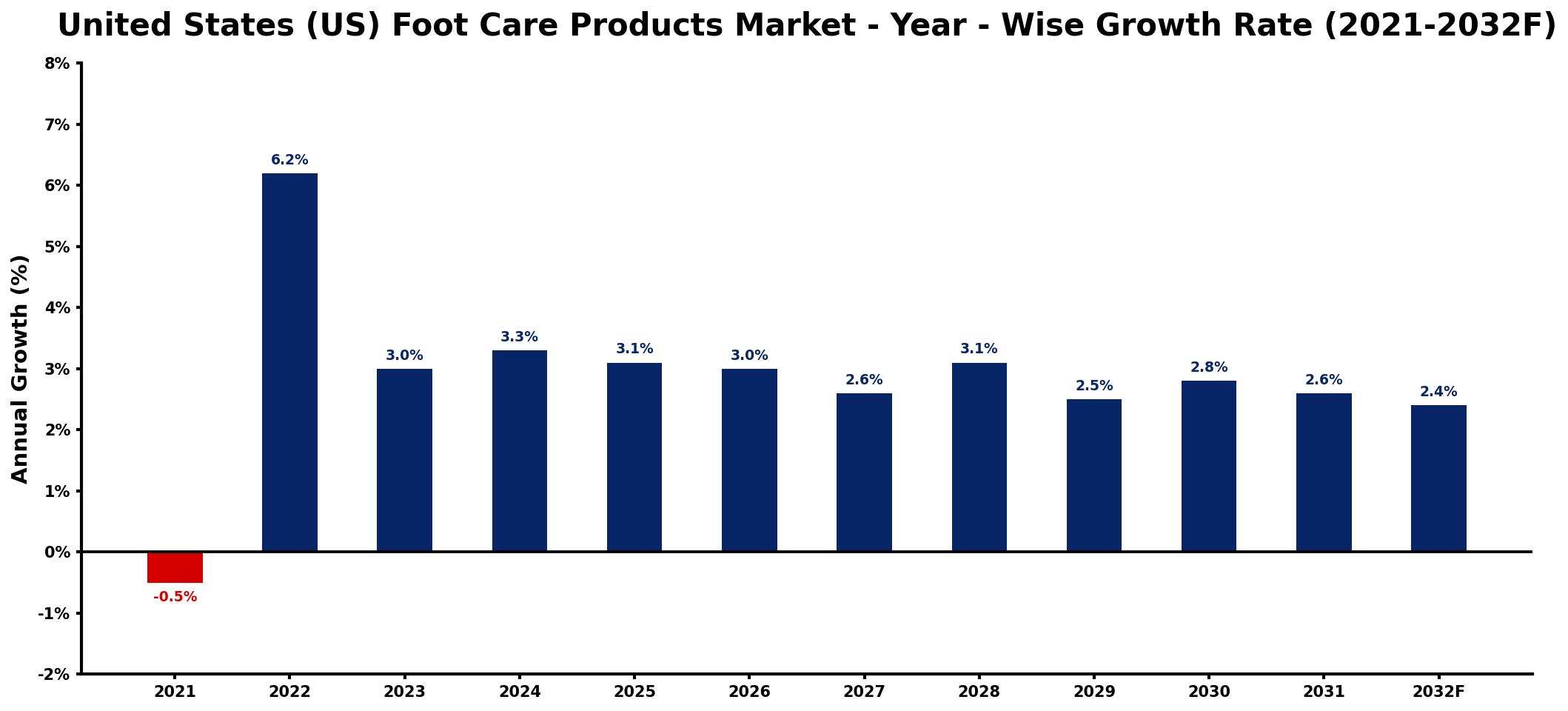
The table below presents the year‑wise growth rates along with the key drivers influencing the market
| Year | Growth Rate | Major Drivers |
| 2021 | -0.5% | Decrease in consumer spending habits |
| 2022 | 6.2% | Rising interest in wellness trends |
| 2023 | 3.0% | Increase in online shopping popularity |
| 2024 | 3.3% | Expansion of retail distribution channels |
| 2025 | 3.1% | Growing awareness of preventative health |
| 2026 | 3.0% | Surge in aging population demographics |
| 2027 | 2.6% | Innovations in product formulations |
| 2028 | 3.1% | Increased marketing investment strategies |
| 2029 | 2.5% | Emergence of lifestyle influencer endorsements |
| 2030 | 2.8% | Growth in eco-friendly alternatives |
| 2031 | 2.6% | Strengthened e-commerce adoption rates |
| 2032 | 2.4% | increased overall sector activity |
Note: Market size estimations and growth projections presented in this report are based on 6Wresearch's proprietary forecasting methodology, utilizing the latest available industry data, government publications, and primary research inputs.
United States (US) Foot Care Products Market Synopsis
The foot care products market in the United States has seen robust momentum in recent years, primarily due to an increased awareness of foot health, particularly among demographics affected by chronic diseases. However, as the market evolves, consumers are now seeking innovative solutions that align with their lifestyle choices and preferences for natural ingredients.
Looking ahead, the market is set to transition from basic foot care products to more advanced offerings, including those enriched with natural and organic ingredients. This shift indicates a growing consumer demand for products that are not only effective but also environmentally friendly, thus reshaping the product development landscape.
United States (US) Foot Care Products Market Key Takeaways
- The market is witnessing a significant shift towards natural ingredient-based products, responding to consumer demand for safer and eco-friendly options.
- Increased spending on personal care items has broadened the consumer base, allowing for greater market penetration and expansion.
- The prevalence of diabetes and obesity is a key driver of growth, emphasizing the need for specialized foot care solutions.
- Innovative marketing strategies focusing on hygiene and grooming are elevating brand visibility and consumer engagement.
- Growth opportunities are further bolstered by higher disposable incomes, enabling consumers to prioritize foot health and beauty care.
Evaluation of Restraints in United States (US) Foot Care Products Market
Despite the positive outlook, several restraints are impacting the growth of the US foot care products market. A lack of awareness about specific foot health issues among certain demographics limits consumer engagement with specialized products. Furthermore, competition from alternative personal care segments can divert attention and spending away from foot care. Economic fluctuations may also affect discretionary spending, leading to caution among consumers in purchasing higher-end foot care items. These factors necessitate targeted education and marketing strategies to effectively capture market potential.
United States (US) Foot Care Products Market Trends
Several trends are shaping the landscape of the foot care products market. The growing preference for wellness and self-care routines has led to the popularity of at-home foot care treatments. Consumers are increasingly looking for multi-functional products that offer added benefits, such as antifungal properties or revitalizing effects. Digital platforms also play a crucial role in this sector; the rise of e-commerce has shifted purchasing behavior, making it easier for consumers to access diverse foot care options from the comfort of their homes.
United States (US) Foot Care Products Market Opportunities
There are numerous opportunities for growth within the US foot care products market. Brands that prioritize sustainability and natural ingredients can capture an expanding segment of health-conscious consumers. Additionally, the development of innovative marketing campaigns that highlight the importance of foot health can enhance consumer awareness and engagement. By investing in research and development, companies can explore new formulations that address specific foot health concerns, tapping into a market that is increasingly seeking targeted solutions.
Government Initiatives in the United States (US) Foot Care Products Market
Government initiatives aimed at improving health awareness and promoting wellness can significantly benefit the foot care products market. Various public health programs focus on chronic disease prevention and management, specifically targeting conditions such as diabetes and obesity. By fostering a culture of health and hygiene, these initiatives encourage consumers to invest in preventative foot care products. Public health campaigns that educate on the importance of foot health may also create a more informed consumer base, fostering growth in the sector.
Future Insights of the United States (US) Foot Care Products Market
From 2026 to 2032, the US foot care products market is anticipated to continue its upward trajectory, buoyed by an aging population and a rise in lifestyle-related health issues. The demand for products featuring natural and innovative ingredients is likely to gain further momentum, with companies expected to invest in product differentiation and consumer education. As e-commerce and digital engagement evolve, brands that successfully leverage technology to enhance customer experience will emerge as frontrunners in this competitive landscape.
United States (US) Foot Care Products Market Latest Developments (2025 - 2026)
Recently, the US foot care products market has experienced significant shifts as companies focus on expanding their product lines to cater to the increasing demand for natural and organic ingredients. Emerging brands are gaining traction with innovative formulations that address specific foot health concerns, such as moisturizers infused with essential oils and advanced antifungal treatments. Additionally, digital marketing strategies have become more sophisticated, engaging consumers through targeted campaigns and influencer partnerships to build brand loyalty and awareness.
United States (US) Foot Care Products Market - Key Attractiveness of the Report
- 10 Years of Market Numbers
- Historical Data Starting from 2022 to 2025
- Base Year: 2025
- Forecast Data until 2032
- Key Performance Indicators Impacting the Market
- Major Upcoming Developments and Projects
Key Highlights of the Report:
- United States (US) Foot Care Products Market Outlook
- Market Size of United States (US) Foot Care Products Market, 2025
- Forecast of United States (US) Foot Care Products Market, 2032
- Historical Data and Forecast of United States (US) Foot Care Products Revenues & Volume for the Period 2022-2032F
- United States (US) Foot Care Products Market Trend Evolution
- United States (US) Foot Care Products Market Drivers and Challenges
- United States (US) Foot Care Products Price Trends
- United States (US) Foot Care Products Porter's Five Forces
- United States (US) Foot Care Products Industry Life Cycle
- Historical Data and Forecast of United States (US) Foot Care Products Market Revenues & Volume By Application for the Period 2022-2032F
- Historical Data and Forecast of United States (US) Foot Care Products Market Revenues & Volume By Sports & Athletics for the Period 2022-2032F
- Historical Data and Forecast of United States (US) Foot Care Products Market Revenues & Volume By Medical for the Period 2022-2032F
- Historical Data and Forecast of United States (US) Foot Care Products Market Revenues & Volume By Personal Comfort for the Period 2022-2032F
- Historical Data and Forecast of United States (US) Foot Care Products Market Revenues & Volume By Distribution Channel for the Period 2022-2032F
- Historical Data and Forecast of United States (US) Foot Care Products Market Revenues & Volume By Drug Stores & Pharmacies for the Period 2022-2032F
- Historical Data and Forecast of United States (US) Foot Care Products Market Revenues & Volume By Hospitals & Specialty Clinics for the Period 2022-2032F
- Historical Data and Forecast of United States (US) Foot Care Products Market Revenues & Volume By Online Stores for the Period 2022-2032F
- Historical Data and Forecast of United States (US) Foot Care Products Market Revenues & Volume By Others for the Period 2022-2032F
- United States (US) Foot Care Products Import Export Trade Statistics
- Market Opportunity Assessment By Application
- Market Opportunity Assessment By Distribution Channel
- United States (US) Foot Care Products Top Companies Market Share
- United States (US) Foot Care Products Competitive Benchmarking By Technical and Operational Parameters
- United States (US) Foot Care Products Company Profiles
- United States (US) Foot Care Products Key Strategic Recommendations






































