Tunisia Foot Care Products Market Size, Share & Growth Rate
The Tunisia Foot Care Products Market was estimated at USD 337 Million in 2025 and is projected to reach USD 463 Million by 2032, growing at a CAGR of 4.6% from 2026 to 2032. This growth is being driven by a rising awareness of foot health, coupled with an expanding middle class that increasingly prioritizes self-care and personal grooming. Consumers are leaning towards products that promise hydration and repair, while also showing a strong preference for natural ingredients and innovative solutions.
Tunisia Foot Care Products Market Year-wise Growth Rate and Key Drivers
This graph highlights how the Tunisia Foot Care Products Market has steadily grown over the years, supported by major growth factors.
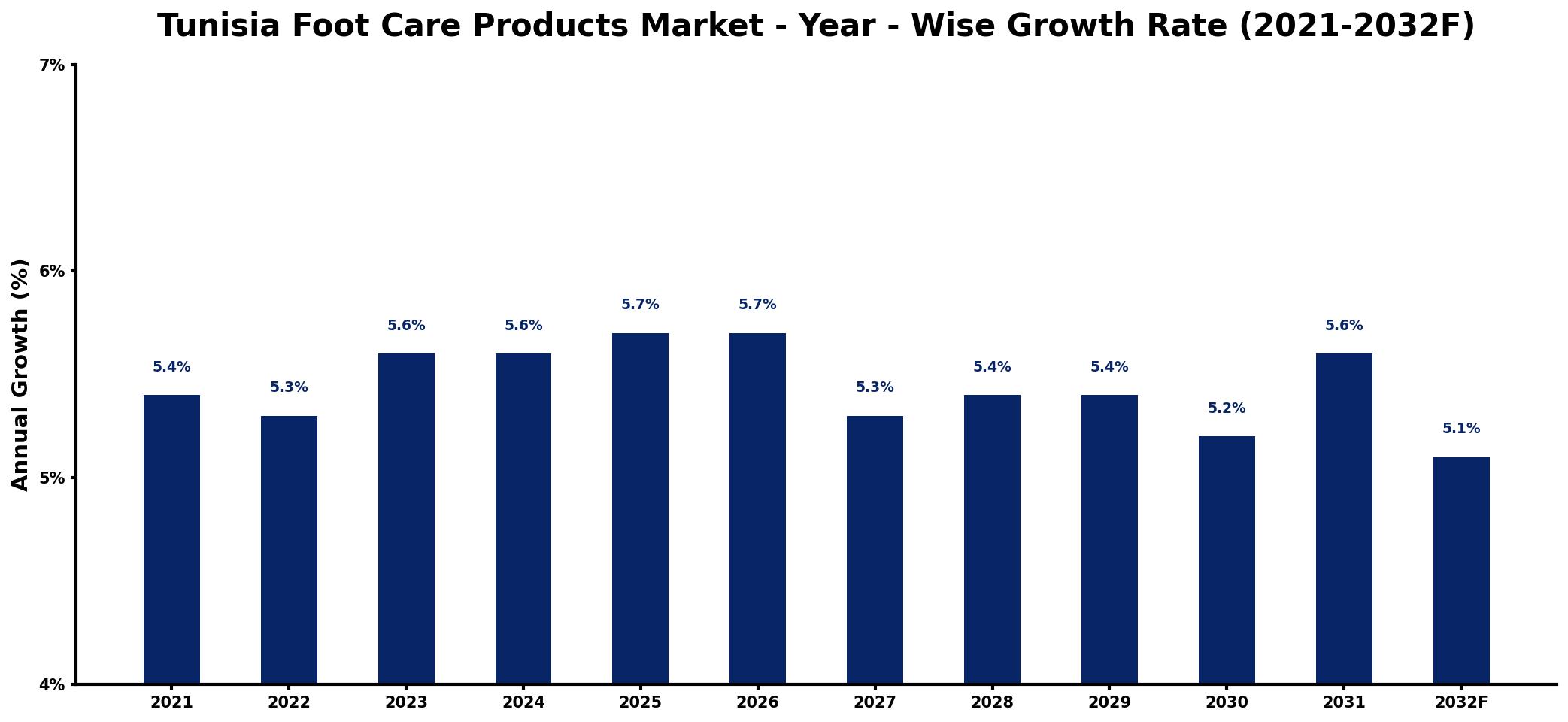
The table below presents the year‑wise growth rates along with the key drivers influencing the market
| Year | Growth Rate | Major Drivers |
| 2021 | 5.4% | Rising health awareness among consumers |
| 2022 | 5.3% | Increased disposable income levels |
| 2023 | 5.6% | Growth of online retail channels |
| 2024 | 5.6% | Expansion of local manufacturing facilities |
| 2025 | 5.7% | Emergence of innovative product formulations |
| 2026 | 5.7% | Growing demand for natural ingredients |
| 2027 | 5.3% | Surge in consumer education initiatives |
| 2028 | 5.4% | Increased focus on preventative wellness |
| 2029 | 5.4% | rising demand from electronics |
| 2030 | 5.2% | growing downstream application demand |
| 2031 | 5.6% | Growth in wellness tourism sector |
| 2032 | 5.1% | Emerging interest in holistic health |
Note: Market size estimations and growth projections presented in this report are based on 6Wresearch's proprietary forecasting methodology, utilizing the latest available industry data, government publications, and primary research inputs.
Tunisia Foot Care Products Market Synopsis
The most significant force shaping the Tunisia Foot Care Products Market today is the growing consumer awareness surrounding foot health. This shift is largely a result of increasing information dissemination regarding common foot ailments and the availability of effective treatments. As a result, products such as creams, scrubs, and masks are witnessing heightened interest among consumers seeking both preventive and remedial solutions.
Moreover, the trend towards organic and natural ingredients is gaining momentum, reflecting a broader global shift in consumer preferences. This demand is not only reshaping product offerings but is also prompting companies to innovate, ensuring they cater to an evolving market that values both efficacy and eco-friendliness.
Tunisia Foot Care Products Market Key Takeaways
- Steady growth of the market is projected, driven by increasing awareness of foot health.
- Consumer preference is shifting towards natural and multifunctional foot care products.
- The rising middle-class population is fueling demand for specialized self-care solutions.
- Innovative formulations incorporating natural ingredients are increasingly popular.
- Companies are focused on expanding their distribution channels to reach more consumers.
Evaluation of Restraints in Tunisia Foot Care Products Market
Despite its growth potential, the Tunisia Foot Care Products Market faces several real challenges that may hinder its development. A significant restraint is the limited consumer awareness about the importance of foot care, which translates to a smaller market size than potential. Additionally, there is often a lack of access to specialized foot care products and services, compounded by inadequate distribution channels. Economic factors, including varying disposable income levels among consumers, may lead to price sensitivity, causing premium products to be viewed as luxuries rather than necessities. Furthermore, traditional home remedies and DIY solutions present considerable competition, requiring strategic approaches to educate consumers and capture market share.
Tunisia Foot Care Products Market Trends
Key trends shaping the Tunisia Foot Care Products Market include a pronounced shift towards natural ingredients, reflecting a growing consumer preference for chemical-free solutions. Additionally, there is a notable increase in the popularity of multifunctional products that combine various benefits—hydration, exfoliation, and soothing properties—all in a single formula. Foot masks and creams targeting specific concerns such as cracked heels and odor are gaining traction. Sustainability is also becoming a focal point, with consumers favoring eco-friendly packaging and brands that demonstrate a commitment to environmental consciousness.
Tunisia Foot Care Products Market Opportunities
The market presents substantial investment opportunities, particularly as awareness of foot health and wellness continues to grow. The appetite for specialized products such as creams, scrubs, and orthotics is evident among a population increasingly valuing hygiene and grooming. Investors have the chance to capitalize on local preferences by developing products that incorporate traditional remedies and natural ingredients. Additionally, forging partnerships with local spas, beauty salons, and healthcare providers could enhance distribution and expand the customer base significantly. Investing in research and development to create high-quality products tailored to meet specific local needs may yield substantial rewards in this dynamic landscape.
Government Initiatives in the Tunisia Foot Care Products Market
The Tunisian government has established regulations aimed at ensuring the safety and quality of foot care products available in the market. These regulations encompass product registration, labeling requirements, and quality standards designed to protect consumers from substandard items. Furthermore, strict guidelines govern product advertising to prevent misleading claims. Import regulations also help maintain compliance with local standards, supporting the overall growth and safety of the foot care products industry.
Future Insights of the Tunisia Foot Care Products Market
Looking ahead to the period from 2026 to 2032, the Tunisia Foot Care Products Market is expected to maintain its upward trajectory. Factors such as rising disposable incomes, increased urbanization, and an evolving emphasis on self-care are likely to continue driving demand. Moreover, the aging population and the prevalence of diabetes-related foot issues will further stimulate interest in foot care products. Manufacturers will need to stay ahead of trends by introducing innovative solutions featuring natural ingredients and advanced technologies. The role of e-commerce will be vital in expanding market reach, offering consumers greater convenience and access to an array of foot care options.
Tunisia Foot Care Products Market Latest Developments (2025 - 2026)
In recent months, the industry has seen a flurry of activity aimed at aligning product offerings with consumer demands for natural and effective solutions. Companies are increasingly launching innovative foot care products that cater to specific ailments, while simultaneously enhancing their marketing strategies to build brand awareness. The utilization of e-commerce platforms is also on the rise, allowing for a greater reach into the market and facilitating easier access for consumers. As awareness of foot care continues to grow, so too does the interest in products that promote overall wellness and self-care.
Tunisia Foot Care Products Market - Key Attractiveness of the Report
- 10 Years of Market Numbers
- Historical Data Starting from 2022 to 2025
- Base Year: 2025
- Forecast Data until 2032
- Key Performance Indicators Impacting the Market
- Major Upcoming Developments and Projects
Key Highlights of the Report:
- Tunisia Foot Care Products Market Outlook
- Market Size of Tunisia Foot Care Products Market, 2025
- Forecast of Tunisia Foot Care Products Market, 2032
- Historical Data and Forecast of Tunisia Foot Care Products Revenues & Volume for the Period 2022-2032F
- Tunisia Foot Care Products Market Trend Evolution
- Tunisia Foot Care Products Market Drivers and Challenges
- Tunisia Foot Care Products Price Trends
- Tunisia Foot Care Products Porter's Five Forces
- Tunisia Foot Care Products Industry Life Cycle
- Historical Data and Forecast of Tunisia Foot Care Products Market Revenues & Volume By Application for the Period 2022-2032F
- Historical Data and Forecast of Tunisia Foot Care Products Market Revenues & Volume By Sports & Athletics for the Period 2022-2032F
- Historical Data and Forecast of Tunisia Foot Care Products Market Revenues & Volume By Medical for the Period 2022-2032F
- Historical Data and Forecast of Tunisia Foot Care Products Market Revenues & Volume By Personal Comfort for the Period 2022-2032F
- Historical Data and Forecast of Tunisia Foot Care Products Market Revenues & Volume By Distribution Channel for the Period 2022-2032F
- Historical Data and Forecast of Tunisia Foot Care Products Market Revenues & Volume By Drug Stores & Pharmacies for the Period 2022-2032F
- Historical Data and Forecast of Tunisia Foot Care Products Market Revenues & Volume By Hospitals & Specialty Clinics for the Period 2022-2032F
- Historical Data and Forecast of Tunisia Foot Care Products Market Revenues & Volume By Online Stores for the Period 2022-2032F
- Historical Data and Forecast of Tunisia Foot Care Products Market Revenues & Volume By Others for the Period 2022-2032F
- Tunisia Foot Care Products Import Export Trade Statistics
- Market Opportunity Assessment By Application
- Market Opportunity Assessment By Distribution Channel
- Tunisia Foot Care Products Top Companies Market Share
- Tunisia Foot Care Products Competitive Benchmarking By Technical and Operational Parameters
- Tunisia Foot Care Products Company Profiles
- Tunisia Foot Care Products Key Strategic Recommendations






































