Japan Foot Care Products Market Size, Share & Growth Rate
The Japan Foot Care Products Market was estimated at USD 241 Million in 2025 and is projected to reach USD 259 Million by 2032, growing at a CAGR of 1.0% from 2026 to 2032. This steady growth trajectory is primarily driven by a heightened consumer awareness regarding foot health and an expanding aging population that increasingly demands effective foot care solutions. As more individuals prioritize comfort and pain relief, the market is witnessing a significant shift towards specialized products that cater to diverse foot care needs.
Japan Foot Care Products Market Year-wise Growth Rate and Key Drivers
This graph highlights how the Japan Foot Care Products Market has steadily grown over the years, supported by major growth factors.
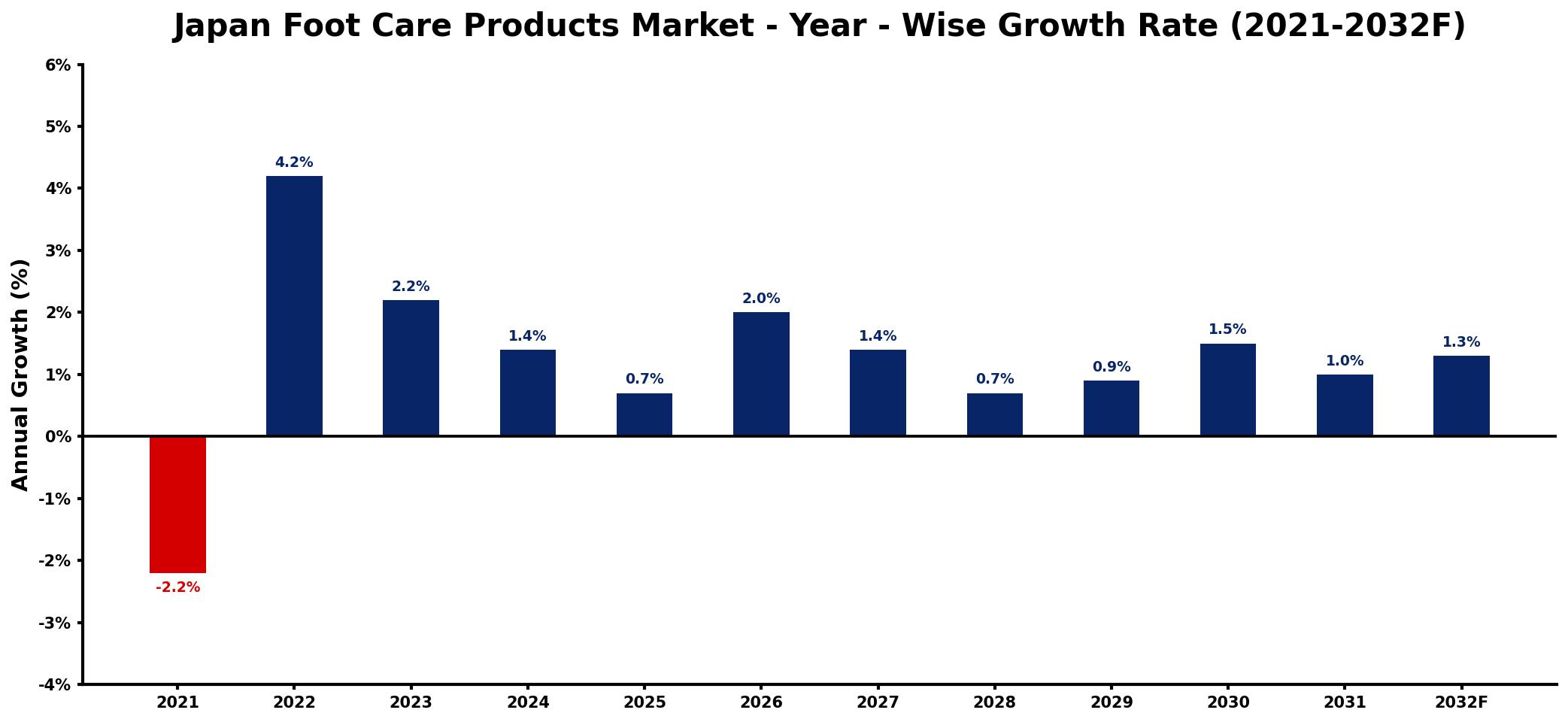
The table below presents the year‑wise growth rates along with the key drivers influencing the market
| Year | Growth Rate | Major Drivers |
| 2021 | -2.2% | decrease in consumer spending habits |
| 2022 | 4.2% | rising health awareness among consumers |
| 2023 | 2.2% | increased online retail penetration |
| 2024 | 1.4% | growing demand for wellness solutions |
| 2025 | 0.7% | expansion of retail distribution channels |
| 2026 | 2.0% | surge in preventive health measures |
| 2027 | 1.4% | increased investment in marketing strategies |
| 2028 | 0.7% | growing popularity of eco-friendly options |
| 2029 | 0.9% | emergence of innovative technology applications |
| 2030 | 1.5% | increased overall sector activity |
| 2031 | 1.0% | increased production capacity utilization |
| 2032 | 1.3% | growth in cross-industry collaborations |
Note: Market size estimations and growth projections presented in this report are based on 6Wresearch's proprietary forecasting methodology, utilizing the latest available industry data, government publications, and primary research inputs.
Japan Foot Care Products Market Synopsis
The Japan Foot Care Products Market has recently experienced consistent momentum, propelled by a growing focus on wellness and self-care among consumers. As the market progresses, it is expected to evolve further, characterized by innovative solutions that address not just ailments but also enhance overall foot comfort and aesthetics.
As consumer preferences shift toward products featuring natural ingredients and advanced technologies, manufacturers are adapting their offerings accordingly. With an array of both domestic and international brands competing in the space, the landscape is vibrant and constantly evolving, reflecting the dynamic nature of consumer demand for foot care products in Japan.
Japan Foot Care Products Market Key Takeaways
- The market is significantly influenced by the aging population, increasing the demand for specialized foot care solutions.
- Consumer awareness of foot health is driving growth, with more individuals seeking effective remedies for common foot issues.
- Innovation plays a crucial role, with brands focusing on products that combine functionality with aesthetic benefits.
- Retail channels are diversifying, with e-commerce becoming increasingly important for foot care product distribution.
- Natural and organic ingredients are gaining traction, reflecting a broader trend towards health-conscious consumer choices.
Evaluation of Restraints in Japan Foot Care Products Market
Despite the positive growth outlook, the Japan Foot Care Products Market faces certain restraints that hinder its potential. The intense competition among both domestic and international brands creates pressure on profit margins, leading to price wars that can impact product quality. Moreover, the demand for natural and organic products necessitates continuous innovation from manufacturers, which can be resource-intensive. Regulatory hurdles related to product approval and strict quality standards may also complicate market entry for new players, affecting the overall competitiveness of the sector.
Japan Foot Care Products Market Trends
Current trends in the Japan Foot Care Products Market highlight a shift towards innovative solutions that emphasize both functionality and convenience. Consumers are increasingly attracted to products that not only alleviate common foot ailments but also provide relaxation and enhance overall well-being. The popularity of natural ingredients is on the rise, as health-conscious individuals seek products free from harmful chemicals. Additionally, technological advancements are paving the way for high-tech solutions such as smart insoles and electronic foot massagers, creating personalized foot care experiences.
Japan Foot Care Products Market Opportunities
The Japan Foot Care Products Market presents numerous investment opportunities, particularly in the realm of health and wellness. As consumers become increasingly focused on foot comfort and health, there is a growing demand for innovative products like orthopedic insoles and specialized footwear that offer substantial support. The surge in self-care trends is also driving interest in at-home foot care devices, creating a fertile ground for investment. Collaborations with healthcare professionals, particularly podiatrists, can enhance brand credibility and lead to lucrative partnerships within the market.
Government Initiatives in the Japan Foot Care Products Market
Government policies in Japan play a pivotal role in shaping the foot care products market. Under the Pharmaceutical Affairs Law, foot care products are subject to stringent regulations concerning labeling and safety standards. The Japan Ministry of Health, Labour and Welfare oversees the approval process to ensure products meet necessary quality and efficacy requirements. Additionally, public health campaigns aimed at promoting foot health awareness are supported by the Consumer Affairs Agency, emphasizing the significance of proper foot care.
Future Insights of the Japan Foot Care Products Market
Looking ahead to 2026-2032, the Japan Foot Care Products Market is poised for steady expansion. As personal grooming and wellness continue to gain traction, the demand for foot care products is expected to rise correspondingly. The prevalence of foot-related issues, coupled with an increasingly health-conscious population, will drive consumer interest in innovative products. Furthermore, the aging demographic will necessitate the development of specialized solutions tailored to their needs, providing ample opportunities for market growth and new product launches.
Japan Foot Care Products Market Latest Developments (2025 - 2026)
In the recent period, the Japan Foot Care Products Market has seen notable developments as brands enhance their focus on innovation and sustainability. There is an increasing integration of advanced technologies in product design, with a particular emphasis on personalized foot care solutions. Furthermore, industry stakeholders are launching marketing initiatives aimed at educating consumers about the importance of foot health, coinciding with rising awareness driven by public health campaigns. The product landscape is also becoming more diverse, reflecting shifting consumer preferences toward natural and organic ingredients.
Japan Foot Care Products Market - Key Attractiveness of the Report
- 10 Years of Market Numbers
- Historical Data Starting from 2022 to 2025
- Base Year: 2025
- Forecast Data until 2032
- Key Performance Indicators Impacting the Market
- Major Upcoming Developments and Projects
Key Highlights of the Report:
- Japan Foot Care Products Market Outlook
- Market Size of Japan Foot Care Products Market, 2025
- Forecast of Japan Foot Care Products Market, 2032
- Historical Data and Forecast of Japan Foot Care Products Revenues & Volume for the Period 2022-2032F
- Japan Foot Care Products Market Trend Evolution
- Japan Foot Care Products Market Drivers and Challenges
- Japan Foot Care Products Price Trends
- Japan Foot Care Products Porter's Five Forces
- Japan Foot Care Products Industry Life Cycle
- Historical Data and Forecast of Japan Foot Care Products Market Revenues & Volume By Application for the Period 2022-2032F
- Historical Data and Forecast of Japan Foot Care Products Market Revenues & Volume By Sports & Athletics for the Period 2022-2032F
- Historical Data and Forecast of Japan Foot Care Products Market Revenues & Volume By Medical for the Period 2022-2032F
- Historical Data and Forecast of Japan Foot Care Products Market Revenues & Volume By Personal Comfort for the Period 2022-2032F
- Historical Data and Forecast of Japan Foot Care Products Market Revenues & Volume By Distribution Channel for the Period 2022-2032F
- Historical Data and Forecast of Japan Foot Care Products Market Revenues & Volume By Drug Stores & Pharmacies for the Period 2022-2032F
- Historical Data and Forecast of Japan Foot Care Products Market Revenues & Volume By Hospitals & Specialty Clinics for the Period 2022-2032F
- Historical Data and Forecast of Japan Foot Care Products Market Revenues & Volume By Online Stores for the Period 2022-2032F
- Historical Data and Forecast of Japan Foot Care Products Market Revenues & Volume By Others for the Period 2022-2032F
- Japan Foot Care Products Import Export Trade Statistics
- Market Opportunity Assessment By Application
- Market Opportunity Assessment By Distribution Channel
- Japan Foot Care Products Top Companies Market Share
- Japan Foot Care Products Competitive Benchmarking By Technical and Operational Parameters
- Japan Foot Care Products Company Profiles
- Japan Foot Care Products Key Strategic Recommendations






































