Turkey Foot Care Products Market Size, Share & Growth Rate
The Turkey Foot Care Products Market was estimated at USD 373 Million in 2025 and is projected to reach USD 517 Million by 2032, growing at a CAGR of 4.8% from 2026 to 2032. This growth trajectory is propelled by a combination of factors, including increasing consumer awareness regarding foot health and a rising elderly population, both of which are contributing to a heightened demand for specialized foot care solutions. Moreover, the shift towards natural and organic ingredients is influencing buying behavior, emphasizing the need for products that promote overall well-being.
Turkey Foot Care Products Market Year-wise Growth Rate and Key Drivers
This graph highlights how the Turkey Foot Care Products Market has steadily grown over the years, supported by major growth factors.
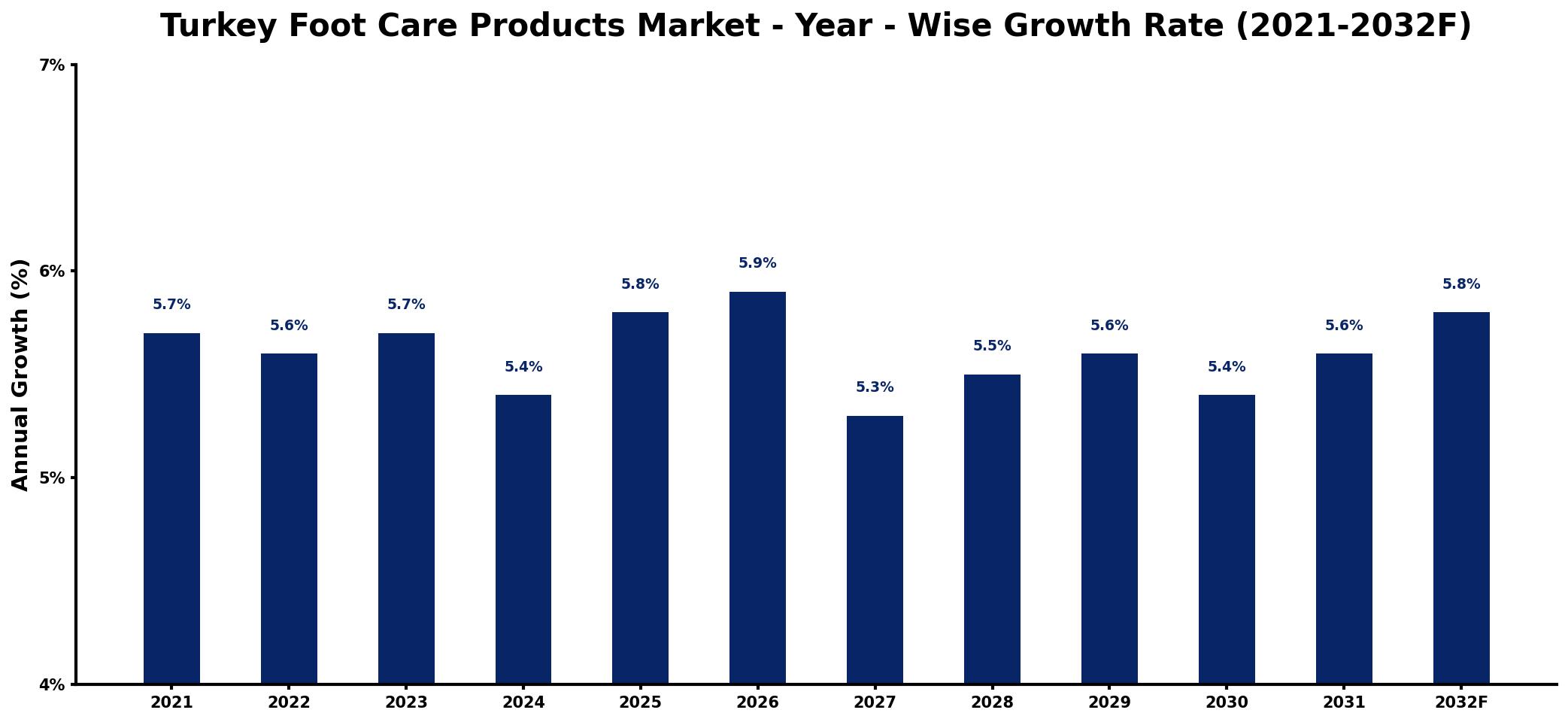
The table below presents the year‑wise growth rates along with the key drivers influencing the market
| Year | Growth Rate | Major Drivers |
| 2021 | 5.7% | Rising awareness of hygiene standards |
| 2022 | 5.6% | Increase in online shopping platforms |
| 2023 | 5.7% | Growth in wellness tourism sector |
| 2024 | 5.4% | Expansion of retail distribution channels |
| 2025 | 5.8% | Surge in health-conscious consumers |
| 2026 | 5.9% | Development of innovative formulations |
| 2027 | 5.3% | increased domestic production output |
| 2028 | 5.5% | Growth of e-commerce market segments |
| 2029 | 5.6% | Rise in disposable income levels |
| 2030 | 5.4% | improved raw material availability |
| 2031 | 5.6% | increased pharmaceutical industry usage |
| 2032 | 5.8% | rising demand from electronics |
Note: Market size estimations and growth projections presented in this report are based on 6Wresearch's proprietary forecasting methodology, utilizing the latest available industry data, government publications, and primary research inputs.
Turkey Foot Care Products Market Synopsis
The Turkey Foot Care Products Market is witnessing a surge in demand for specialized products, as consumers become increasingly aware of the significance of maintaining foot health. With a diverse range of offerings including creams, balms, and orthopedic insoles, the market caters to various consumer needs while aligning with the growing trend of natural and organic formulations.
In Turkey, consumers are seeking multifunctional foot care products that deliver multiple benefits, such as hydration and exfoliation, in a single application. This has driven brands to innovate continuously, enhancing product appeal and meeting the sophisticated tastes of todays consumers, while also addressing common foot ailments like fungal infections and cracked heels.
Turkey Foot Care Products Market Key Takeaways
- The market is experiencing significant growth due to increasing awareness of foot health among consumers.
- There is a rising demand for products featuring natural and organic ingredients, reflecting broader wellness trends.
- Specialized tools and devices for foot care, including electric callus removers, are gaining popularity.
- E-commerce platforms are becoming preferred channels for purchasing foot care products, driving online sales growth.
- The aging population in Turkey is contributing to the increased need for effective foot care solutions.
Evaluation of Restraints in Turkey Foot Care Products Market
Despite the growth opportunities, the Turkey Foot Care Products Market faces several limitations. Increased competition from both local and international brands makes it challenging for companies to capture market share. Moreover, there remains a pressing need to educate consumers on the advantages of specialized foot care products, as many are still unaware of their benefits. Economic fluctuations may also affect consumer spending on non-essential items. Regulatory compliance adds another layer of complexity, as brands must navigate stringent guidelines regarding product safety and efficacy to maintain consumer trust.
Turkey Foot Care Products Market Trends
A notable trend in the Turkey Foot Care Products Market is the increasing preference for products that incorporate natural and organic ingredients. As consumers grow more discerning about the products they use, the demand for items that contain botanical extracts and essential oils continues to rise. Additionally, multifunctional products that offer a blend of benefits, such as hydration and anti-inflammatory properties, are becoming more desirable. Furthermore, the interest in innovative foot care tools, including massagers and electronic devices, signifies a shift toward integrating technology into personal care routines.
Turkey Foot Care Products Market Opportunities
The Turkey Foot Care Products Market presents abundant investment opportunities, particularly within the realm of premium and innovative solutions. With consumers placing greater importance on personal grooming and wellness, theres a pronounced market potential for specialized foot creams, orthopedic inserts, and advanced foot care tools. Additionally, the expanding e-commerce sector offers a strategic avenue for reaching broader audiences, enabling brands to capitalize on the convenience and variety that online shopping provides.
Government Initiatives in the Turkey Foot Care Products Market
The Turkish government has established a robust regulatory framework to ensure consumer safety and product quality within the Foot Care Products Market. Mandatory registration and approval processes for products before they enter the market are enforced, alongside specific labeling requirements that aim to provide transparent information to consumers. Regulatory oversight also includes monitoring the ingredients used in foot care products, which helps safeguard against harmful substances, thereby promoting trust and quality within the market.
Future Insights of the Turkey Foot Care Products Market
Looking ahead to 2026-2032, the Turkey Foot Care Products Market is positioned for continued expansion, driven by a growing awareness of foot health and an increasing focus on personal grooming among consumers. The rising disposable incomes of Turkish consumers will likely support spending on specialized foot care products. Moreover, as the elderly population continues to grow, the demand for targeted solutions addressing age-related foot issues will amplify, leading brands to innovate and adapt their offerings in line with consumer needs.
Turkey Foot Care Products Market Latest Developments (2025 - 2026)
Recent developments in the Turkey Foot Care Products Market indicate a shift towards sustainability, with several brands beginning to incorporate eco-friendly packaging solutions. Innovations in product formulation, particularly those using organic ingredients, are gaining traction as consumers demonstrate a preference for environmentally responsible options. Additionally, the rise of digital marketing strategies is enabling brands to engage more effectively with consumers, thus increasing brand loyalty and expanding their customer base.
Turkey Foot Care Products Market - Key Attractiveness of the Report
- 10 Years of Market Numbers
- Historical Data Starting from 2022 to 2025
- Base Year: 2025
- Forecast Data until 2032
- Key Performance Indicators Impacting the Market
- Major Upcoming Developments and Projects
Key Highlights of the Report:
- Turkey Foot Care Products Market Outlook
- Market Size of Turkey Foot Care Products Market, 2025
- Forecast of Turkey Foot Care Products Market, 2032
- Historical Data and Forecast of Turkey Foot Care Products Revenues & Volume for the Period 2022-2032F
- Turkey Foot Care Products Market Trend Evolution
- Turkey Foot Care Products Market Drivers and Challenges
- Turkey Foot Care Products Price Trends
- Turkey Foot Care Products Porter's Five Forces
- Turkey Foot Care Products Industry Life Cycle
- Historical Data and Forecast of Turkey Foot Care Products Market Revenues & Volume By Application for the Period 2022-2032F
- Historical Data and Forecast of Turkey Foot Care Products Market Revenues & Volume By Sports & Athletics for the Period 2022-2032F
- Historical Data and Forecast of Turkey Foot Care Products Market Revenues & Volume By Medical for the Period 2022-2032F
- Historical Data and Forecast of Turkey Foot Care Products Market Revenues & Volume By Personal Comfort for the Period 2022-2032F
- Historical Data and Forecast of Turkey Foot Care Products Market Revenues & Volume By Distribution Channel for the Period 2022-2032F
- Historical Data and Forecast of Turkey Foot Care Products Market Revenues & Volume By Drug Stores & Pharmacies for the Period 2022-2032F
- Historical Data and Forecast of Turkey Foot Care Products Market Revenues & Volume By Hospitals & Specialty Clinics for the Period 2022-2032F
- Historical Data and Forecast of Turkey Foot Care Products Market Revenues & Volume By Online Stores for the Period 2022-2032F
- Historical Data and Forecast of Turkey Foot Care Products Market Revenues & Volume By Others for the Period 2022-2032F
- Turkey Foot Care Products Import Export Trade Statistics
- Market Opportunity Assessment By Application
- Market Opportunity Assessment By Distribution Channel
- Turkey Foot Care Products Top Companies Market Share
- Turkey Foot Care Products Competitive Benchmarking By Technical and Operational Parameters
- Turkey Foot Care Products Company Profiles
- Turkey Foot Care Products Key Strategic Recommendations






































