Qatar Foot Care Products Market Size, Share & Growth Rate
The Qatar Foot Care Products Market was estimated at USD 951 Million in 2025 and is projected to reach USD 1377 Million by 2032, growing at a CAGR of 5.4% from 2026 to 2032. This growth is primarily driven by heightened awareness of foot health and hygiene among consumers, along with an increasing aging population that requires specialized foot care solutions. As lifestyle changes promote active living and the growth of athleisure, the demand for high-quality, supportive foot care products is surging.
Qatar Foot Care Products Market Year-wise Growth Rate and Key Drivers
This graph highlights how the Qatar Foot Care Products Market has steadily grown over the years, supported by major growth factors.
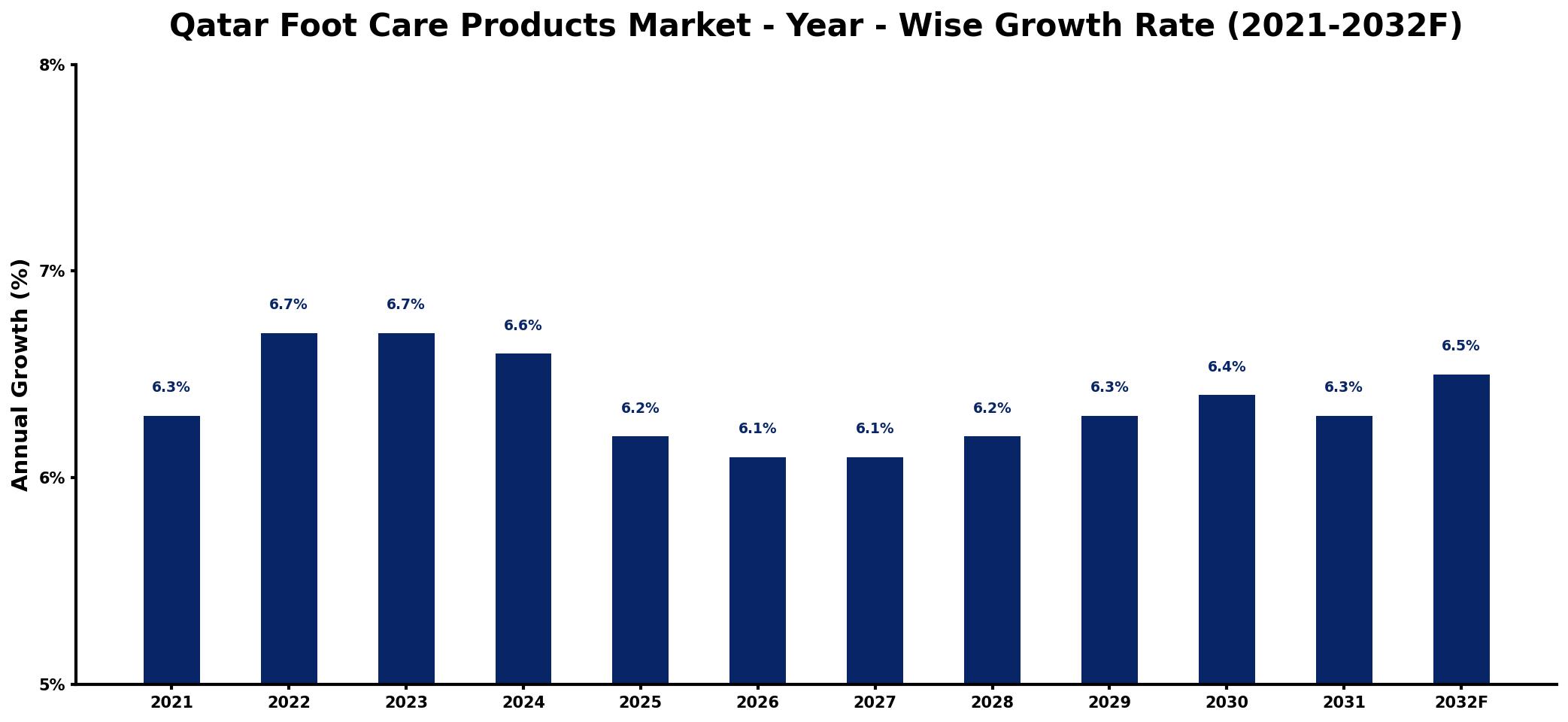
The table below presents the year‑wise growth rates along with the key drivers influencing the market
| Year | Growth Rate | Major Drivers |
| 2021 | 6.3% | Rising health awareness among consumers |
| 2022 | 6.7% | Increased disposable income levels |
| 2023 | 6.7% | Growing demand for wellness solutions |
| 2024 | 6.6% | Expansion of retail distribution channels |
| 2025 | 6.2% | Innovations in ingredient formulations |
| 2026 | 6.1% | Shift towards natural alternatives |
| 2027 | 6.1% | Surge in online shopping trends |
| 2028 | 6.2% | Increased focus on preventive measures |
| 2029 | 6.3% | rising end-use demand growth |
| 2030 | 6.4% | Emergence of influencer marketing strategies |
| 2031 | 6.3% | Heightened interest in sustainability practices |
| 2032 | 6.5% | Development of personalized wellness plans |
Note: Market size estimations and growth projections presented in this report are based on 6Wresearch's proprietary forecasting methodology, utilizing the latest available industry data, government publications, and primary research inputs.
Qatar Foot Care Products Market Synopsis
In Qatar, the foot care products market is witnessing a notable shift as more consumers recognize the significance of maintaining foot health. This awareness is leading to increased sales of creams, ointments, and specialized insoles that offer comfort and address common foot ailments. The expansion of retail channels, including online platforms, is further facilitating access to a wider range of foot care products.
Furthermore, with a growing focus on personal grooming and wellness, consumers are increasingly investing in foot care as part of their overall health regime. This trend is reflected in the rising popularity of innovative foot care items, such as smart insoles that enhance comfort during physical activities, catering specifically to health-conscious individuals.
Qatar Foot Care Products Market Key Takeaways
- The market is projected to experience robust growth due to increasing consumer awareness about foot health.
- A significant driver is the expanding aging population, which requires specialized foot care solutions.
- The rise of athleisure and sports activities has led to heightened demand for targeted foot care products.
- Educational initiatives and product innovation are essential for overcoming consumer awareness gaps.
- The market landscape is competitive, with both local and imported brands vying for consumer attention.
Evaluation of Restraints in Qatar Foot Care Products Market
Despite promising growth prospects, the Qatar foot care products market faces several constraints. A primary challenge is the general lack of consumer awareness about the importance of foot health. Many potential customers may not fully understand the wide array of products available or the specific benefits they offer. This knowledge gap creates obstacles for manufacturers and retailers aiming to promote their solutions effectively. Moreover, the competitive environment, dominated by established brands and imported products, intensifies the struggle for market penetration and brand loyalty.
Qatar Foot Care Products Market Trends
Current trends in the Qatar foot care products market reveal a growing inclination towards natural and organic formulations. Consumers are increasingly seeking products that align with their health-conscious lifestyles, driving innovation in ingredient sourcing. Additionally, the integration of technology, such as mobile apps and connected devices, enhances customer engagement and personalizes foot care experiences. Sustainability is also becoming a focal point, with brands exploring eco-friendly packaging and production methods to attract environmentally aware consumers.
Qatar Foot Care Products Market Opportunities
The Qatar foot care products market presents numerous growth and investment opportunities. Companies can capitalize on the increasing trend of personalized foot care solutions tailored to individual needs, particularly within the aging population. Furthermore, expanding distribution channels, including e-commerce and mobile shopping, offers a viable pathway to reach a broader customer base. Collaborations with fitness centers and wellness providers could also enhance market visibility and stimulate demand for specialized products.
Government Initiatives in the Qatar Foot Care Products Market
The Qatari government has implemented various initiatives to promote health and wellness among its citizens, which indirectly supports the foot care products market. Campaigns that focus on personal hygiene and health awareness are vital in educating the population about foot care. Additionally, public health programs that encourage physical activity among citizens can further spur demand for supportive foot care products, as more individuals seek to maintain an active lifestyle.
Future Insights of the Qatar Foot Care Products Market
Looking ahead to 2026-2032, the Qatar foot care products market is poised for significant transformation driven by evolving consumer preferences and technological advancements. With a heightened focus on health and wellness, consumers will likely continue to prioritize foot care in their daily routines. Innovations in product formulations, coupled with increased access through digital platforms, will play a critical role in shaping the market's growth trajectory. By addressing consumer needs with effective education and tailored solutions, companies can capitalize on the expanding market potential.
Qatar Foot Care Products Market Latest Developments (2025 - 2026)
Recent developments in the Qatar foot care products market indicate a shift towards innovation, with several brands launching new product lines designed for specific demographics, including athletes and older adults. Collaborations between brands and health professionals are becoming more common, focusing on educating consumers about foot health. Additionally, advancements in e-commerce platforms are enhancing the shopping experience, making it easier for consumers to discover and purchase foot care solutions tailored to their needs.
Qatar Foot Care Products Market - Key Attractiveness of the Report
- 10 Years of Market Numbers
- Historical Data Starting from 2022 to 2025
- Base Year: 2025
- Forecast Data until 2032
- Key Performance Indicators Impacting the Market
- Major Upcoming Developments and Projects
Key Highlights of the Report:
- Qatar Foot Care Products Market Outlook
- Market Size of Qatar Foot Care Products Market, 2025
- Forecast of Qatar Foot Care Products Market, 2032
- Historical Data and Forecast of Qatar Foot Care Products Revenues & Volume for the Period 2022-2032F
- Qatar Foot Care Products Market Trend Evolution
- Qatar Foot Care Products Market Drivers and Challenges
- Qatar Foot Care Products Price Trends
- Qatar Foot Care Products Porter's Five Forces
- Qatar Foot Care Products Industry Life Cycle
- Historical Data and Forecast of Qatar Foot Care Products Market Revenues & Volume By Application for the Period 2022-2032F
- Historical Data and Forecast of Qatar Foot Care Products Market Revenues & Volume By Sports & Athletics for the Period 2022-2032F
- Historical Data and Forecast of Qatar Foot Care Products Market Revenues & Volume By Medical for the Period 2022-2032F
- Historical Data and Forecast of Qatar Foot Care Products Market Revenues & Volume By Personal Comfort for the Period 2022-2032F
- Historical Data and Forecast of Qatar Foot Care Products Market Revenues & Volume By Distribution Channel for the Period 2022-2032F
- Historical Data and Forecast of Qatar Foot Care Products Market Revenues & Volume By Drug Stores & Pharmacies for the Period 2022-2032F
- Historical Data and Forecast of Qatar Foot Care Products Market Revenues & Volume By Hospitals & Specialty Clinics for the Period 2022-2032F
- Historical Data and Forecast of Qatar Foot Care Products Market Revenues & Volume By Online Stores for the Period 2022-2032F
- Historical Data and Forecast of Qatar Foot Care Products Market Revenues & Volume By Others for the Period 2022-2032F
- Qatar Foot Care Products Import Export Trade Statistics
- Market Opportunity Assessment By Application
- Market Opportunity Assessment By Distribution Channel
- Qatar Foot Care Products Top Companies Market Share
- Qatar Foot Care Products Competitive Benchmarking By Technical and Operational Parameters
- Qatar Foot Care Products Company Profiles
- Qatar Foot Care Products Key Strategic Recommendations






































