Qatar Access and Home Network Market (2026-2032) | Outlook, Competitive, Pricing Analysis, Segments, Growth, Competition, Size, Share, Revenue, Companies, Strategic Insights, Demand, Restraints, Value, Industry, Strategy, Analysis, Consumer Insights, Supply, Trends, Forecast, Challenges, Drivers, Investment Trends, Segmentation, Opportunities
Market Forecast By Network Type (Wi-Fi Networks, Powerline Networks, Mesh Networks, Hybrid Networks), By Technology (802.11ax/802.11be, PLC Technology, Self-Optimizing, Integration with 5G), By Application (Residential Broadband, Extended Connectivity, Large Homes, Smart Homes), By End User (Homeowners, Small Offices, Consumers, IoT Enthusiasts) And Competitive Landscape
| Product Code: ETC11754915 | Publication Date: Jul 2026 | Updated Date: Jan 1970 | Product Type: Market Research Report | |
| Publisher: 6Wresearch | Author: Sachin Kumar Rai | No. of Pages: 70 | No. of Figures: 35 | No. of Tables: 5 |
Qatar Access and Home Network Market Growth Rate
According to 6Wresearch internal databases and industry insights, the Qatar Access and Home Network Market is projected to grow at a steady compound annual growth rate (CAGR) of 7.38% during the forecast period 2026–2032.
Qatar Access and Home Network Market Year-wise Growth Rate and Key Drivers (2022-2032)
This graph illustrates the annual growth rates of the Qatar Access and Home Network Market from 2022 to 2032, highlighting a steady upward trajectory and projected market expansion over the forecast period.
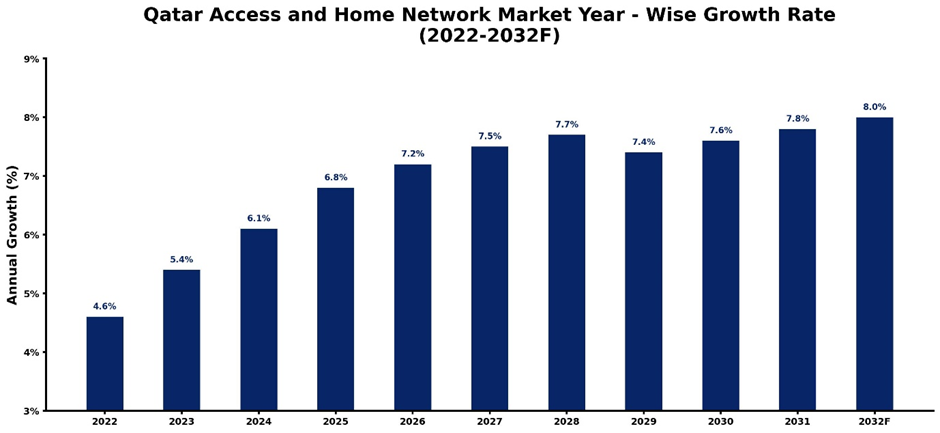
The following table summarizes the historical and forecasted growth rates of the Qatar Access and Home Network Market, along with the rationale behind each year’s performance.
| Year | Estimated Growth (%) | Market Rationale |
| 2022 | 4.6% | Rising fiber-to-home penetration |
| 2023 | 5.4% | Increased smart device adoption |
| 2024 | 6.1% | Expansion of 5G fixed wireless access |
| 2025 | 6.8% | Strong demand for mesh Wi-Fi systems |
| 2026 | 7.2% | Accelerated smart home integration |
| 2027 | 7.5% | Wi-Fi 7 commercialization begins |
| 2028 | 7.7% | Growth in AI-based network optimization |
| 2029 | 7.4% | Market stabilization phase with premium upgrades |
| 2030 | 7.6% | Expansion of hybrid fiber-wireless homes |
| 2031 | 7.8% | IoT density increases per household |
| 2032 | 8% | Mature smart ecosystem penetration |
Topics Covered in the Qatar Access and Home Network Market Report
The Qatar Access and Home Network Industry report covers the market by network type, technology, application, and end user. The report provides a detailed analysis of ongoing market trends, high-growth segments, and strategic drivers shaping the future of residential connectivity in Qatar.
Qatar Access and Home Network Market Highlights
| Report Name | Qatar Access and Home Network Market |
| Forecast period | 2026-2032 |
| CAGR | 7.38% |
| Growing Sector | Smart Home Connectivity Solutions |
Qatar Access and Home Network Market Synopsis
The Qatar Access and Home Network Market is evolving into a highly advanced residential connectivity ecosystem. It is encouraged by nationwide fiber infrastructure, high smartphone penetration, and rapid adoption of smart home technologies, and the industry comprises Wi-Fi routers, mesh systems, powerline networking, and hybrid fiber-5G solutions that ensure seamless broadband distribution across homes, villas, and small offices. The rising need for high-definition streaming, cloud-based applications, and IoT-enabled home automation is majorly proliferating the need for high-capacity, low-latency networking solutions.
Evaluation of Growth Drivers in Qatar Access and Home Network Market (2026–2032)
Below are some major drivers and their influence on the market dynamics:
| Drivers | Primary Segment Affected | Why This Matters (Evidence) |
| Smart home ecosystem expansion | Smart Homes / IoT Enthusiasts | Increasing use of connected appliances and automation systems is boosting demand for high-performance Wi-Fi networks |
| Nationwide fiber connectivity rollout | Residential Broadband | Qatar’s near-universal fiber access enables ultra-fast home internet services |
| Rising multi-device households | Consumers / Homeowners | Higher number of connected devices per home increases bandwidth requirements |
| Hybrid work culture | Small Offices / Homeowners | Reliable home connectivity is essential for remote work environments |
| Integration of 5G with home networks | Hybrid Networks | Enhances backup connectivity and supports seamless failover systems |
The Qatar Access and Home Network Market is projected to grow at a CAGR of 7.38% during 2026–2032, driven by rapid smart home adoption, increasing fiber broadband penetration, and rising demand for seamless multi-device connectivity across residential ecosystems. This steady expansion is further reinforced by rising consumer preference for high-speed, low-latency networking solutions. It facilitates advanced digital lifestyles, including smart automation, 4K/8K streaming, and IoT-driven home environments and persistent advancements in Wi-Fi 6/7 technologies and hybrid fiber–wireless integration are predicted to majorly augment network performance.
Evaluation of Restraints in Qatar Access and Home Network Market
Below are some major restraints and their influence on the market dynamics:
| Restraints | Primary Segment Affected | What This Means (Evidence) |
| High cost of advanced networking equipment | Homeowners | Premium Wi-Fi 7 and mesh systems remain expensive for mass adoption |
| Cybersecurity risks in connected homes | IoT Ecosystem | Increased connectivity raises vulnerability to cyber threats |
| Integration complexity | Hybrid Networks | Combining fiber, Wi-Fi, and 5G requires technical expertise |
| Rapid technology upgrades | Consumers | Frequent product obsolescence increases replacement pressure |
| Dependency on ISP infrastructure | Residential Broadband | Performance varies based on telecom service quality |
Qatar Access and Home Network Market Challenges
The Qatar Access and Home Network Industry face challenges such as balancing affordability with advanced networking performance, especially in premium Wi-Fi 7 and mesh systems. Additionally, cybersecurity issues in highly connected smart homes and interoperability issues between legacy and next-generation devices make adoption complexities. Continuous upgrades in networking standards also lead to shorter product lifecycles and higher consumer replacement costs. Moreover, lack of technical awareness among some end-users regarding advanced home networking configuration further decreases optimal utilization of high-performance systems.
Qatar Access and Home Network Market Trends
Important drivers of innovation in Qatar Access and Home Network Market comprise the following:
- Rising Adoption of Next-Generation Wi-Fi Standards (Wi-Fi 6E & Wi-Fi 7): Increasing demand for high-bandwidth applications such as AR/VR, cloud gaming, and 8K streaming is accelerating deployment of advanced wireless technologies.
- Rapid Expansion of Mesh Networking Solutions in Large Residences:Growing need for seamless, whole-home coverage in villas and multi-story properties is driving strong uptake of mesh-based connectivity systems.
- Integration of AI-Powered Self-Optimizing Network Routers:Advanced routers with AI capabilities are highly utilised to automatically manage bandwidth allocation.
- Growth of IoT-Enabled Smart Home Ecosystems:Increasing deployment of connected devices such as smart appliances, security systems, and automation tools is raising the requirement for stable, high-capacity multi-device connectivity.
Investment Opportunities in the Qatar Access and Home Network Market
Below are the major growth-linked investment opportunities shaping the Qatar Access and Home Network Market:
- Expansion of Wi-Fi 7 Router Manufacturing and Distribution:Increasing need for ultra-high-speed connectivity is supporting manufacturers to scale production.
- Development of AI-Based Network Management Platforms for Smart Homes:Increasing complexity of connected home ecosystems is spurring the requirement for intelligent platforms.
- Growth in Mesh Networking Solutions for Luxury Residential Projects:High-end villas and large residential properties are deploying mesh systems to make sure uninterrupted, whole-home Wi-Fi coverage.
Top Players in Qatar Access and Home Network Market
Below are some of the leading companies in the Qatar Access and Home Network Market:
1. Ooredoo Qatar
| Company Name | Ooredoo Qatar |
|---|---|
| Established | 1987 |
| Headquarters | Doha, Qatar |
| Official Website | Click Here |
Ooredoo Qatar is the leading telecom operator in the country, leading the deployment of fiber-to-the-home (FTTH), 5G wireless broadband, and advanced residential internet services.
2. Vodafone Qatar
| Company Name | Vodafone Qatar |
|---|---|
| Established | 2009 |
| Headquarters | Doha, Qatar |
| Official Website | Click Here |
Vodafone Qatar is a major telecommunications provider offering competitive 5G fixed wireless access and home broadband solutions.
3. Qatar National Broadband Network (QNBN)
| Company Name | Qatar National Broadband Network (QNBN) |
|---|---|
| Established | 2010 |
| Headquarters | Doha, Qatar |
| Official Website | Click Here |
Qatar National Broadband Network (QNBN) is a government-backed infrastructure provider responsible for developing and managing an open-access fiber-optic passive network across the country.
4. MEEZA
| Company Name | MEEZA |
|---|---|
| Established | 2008 |
| Headquarters | Doha, Qatar |
| Official Website | Click Here |
MEEZA is a leading managed IT and data center services provider that encourages enterprise and residential digital infrastructure.
5. Gulf Bridge International (GBI)
| Company Name | Gulf Bridge International (GBI) |
|---|---|
| Established | 2008 |
| Headquarters | Doha, Qatar |
| Official Website | Click Here |
Gulf Bridge International is a worldwide connectivity and managed services provider that ensures Qatar’s networks are seamlessly integrated with international data routes.
Government Initiatives Being Implemented in the Qatar Access and Home Network Market
According to Qatar’s government data, they are actively promoting digital transformation through various initiatives. They include Qatar Smart Nation Strategy, National Broadband Plan expansion, and digital infrastructure modernization under Qatar National Vision 2030 and these programs support broader fiber deployment, smart home adoption, and integration of 5G-enabled residential connectivity. Additionally, telecom regulators are encouraging initiatives that augment broadband affordability. It also ensures nationwide access to high-speed internet, particularly in residential communities and new urban developments like Lusail City and The Pearl-Qatar.
Future Insights of the Qatar Access and Home Network Market
The Qatar Access and Home Network Market Growth is expected to evolve and it will progress into a fully integrated smart connectivity ecosystem where AI-driven routers, 5G hybrid networks, and IoT-based automation systems become standard in residential environments. Increasing demand for ultra-reliable low-latency connectivity will further accelerate adoption of Wi-Fi 7 and advanced mesh networking solutions across both luxury and mid-income housing segments. Additionally, growing investments in smart city infrastructure and digital housing projects will further strengthen the deployment of next-generation home networking solutions.
Market Segmentation Analysis
The report offers a comprehensive study of the following market segments and their leading categories:
By Network Type – Wi-Fi Networks Dominate While Mesh Networks Expand Rapidly
According to Sachin Kumar Rai, Senior Research Analyst, 6Wresearch, Wi-Fi Networks secured a dominant 46.20% of the Qatar Access and Home Network Market Share in 2025. It is proliferated by broader residential broadband adoption and robust router penetration. Conversely, mesh Networks are estimated to expand at a robust CAGR of 8.40% during 2026–2032. It is accelerated by increasing demand for seamless whole-home coverage.
By Technology – 802.11ax/802.11be Leads While 5G Integration Accelerates
By technology, 802.11ax/802.11be standards accounted for 49.35% of the Qatar Access and Home Network Market revenue in 2025. It is encouraged by their high-speed data transmission and strong compatibility with modern smart home ecosystems. Whereas integration with 5G technologies is expected to grow at a robust CAGR of 9.12% during 2026–2032, bolstered by rising need for hybrid connectivity models that ensure uninterrupted internet access and enhanced network resilience.
By End User – Homeowners Lead While IoT Enthusiasts Grow Rapidly
By end user, Homeowners accounted for 44.80% of the Qatar Access and Home Network Market size in 2025. It is driven by strong demand for high-speed internet connectivity across residential properties and villas. On the other hand, IoT Enthusiasts are anticipated to register the fastest CAGR of 9.30% during 2026–2032, supported by increasing adoption of connected devices and smart ecosystems.
Note: Market size estimations and growth projections presented in this report are based on 6Wresearch's proprietary forecasting methodology, utilizing the latest available industry data, government publications, and primary research inputs.
Key Attractiveness of the Report
- 10 Years of Market Numbers
- Historical Data Starting from 2022 to 2025
- Base Year: 2025
- Forecast Data until 2032
- Key Performance Indicators Impacting the Market
- Major Upcoming Developments and Projects
Key Highlights of the Report:
- Qatar Access and Home Network Market Outlook
- Market Size of Qatar Access and Home Network Market, 2025
- Forecast of Qatar Access and Home Network Market, 2032
- Historical Data and Forecast of Qatar Access and Home Network Revenues & Volume for the Period 2022-2032
- Qatar Access and Home Network Market Trend Evolution
- Qatar Access and Home Network Market Drivers and Challenges
- Qatar Access and Home Network Price Trends
- Qatar Access and Home Network Porter's Five Forces
- Qatar Access and Home Network Industry Life Cycle
- Historical Data and Forecast of Qatar Access and Home Network Market Revenues & Volume By Network Type for the Period 2022-2032
- Historical Data and Forecast of Qatar Access and Home Network Market Revenues & Volume By Wi-Fi Networks for the Period 2022-2032
- Historical Data and Forecast of Qatar Access and Home Network Market Revenues & Volume By Powerline Networks for the Period 2022-2032
- Historical Data and Forecast of Qatar Access and Home Network Market Revenues & Volume By Mesh Networks for the Period 2022-2032
- Historical Data and Forecast of Qatar Access and Home Network Market Revenues & Volume By Hybrid Networks for the Period 2022-2032
- Historical Data and Forecast of Qatar Access and Home Network Market Revenues & Volume By Technology for the Period 2022-2032
- Historical Data and Forecast of Qatar Access and Home Network Market Revenues & Volume By 802.11ax/802.11be for the Period 2022-2032
- Historical Data and Forecast of Qatar Access and Home Network Market Revenues & Volume By PLC Technology for the Period 2022-2032
- Historical Data and Forecast of Qatar Access and Home Network Market Revenues & Volume By Self-Optimizing for the Period 2022-2032
- Historical Data and Forecast of Qatar Access and Home Network Market Revenues & Volume By Integration with 5G for the Period 2022-2032
- Historical Data and Forecast of Qatar Access and Home Network Market Revenues & Volume By Application for the Period 2022-2032
- Historical Data and Forecast of Qatar Access and Home Network Market Revenues & Volume By Residential Broadband for the Period 2022-2032
- Historical Data and Forecast of Qatar Access and Home Network Market Revenues & Volume By Extended Connectivity for the Period 2022-2032
- Historical Data and Forecast of Qatar Access and Home Network Market Revenues & Volume By Large Homes for the Period 2022-2032
- Historical Data and Forecast of Qatar Access and Home Network Market Revenues & Volume By Smart Homes for the Period 2022-2032
- Historical Data and Forecast of Qatar Access and Home Network Market Revenues & Volume By End User for the Period 2022-2032
- Historical Data and Forecast of Qatar Access and Home Network Market Revenues & Volume By Homeowners for the Period 2022-2032
- Historical Data and Forecast of Qatar Access and Home Network Market Revenues & Volume By Small Offices for the Period 2022-2032
- Historical Data and Forecast of Qatar Access and Home Network Market Revenues & Volume By Consumers for the Period 2022-2032
- Historical Data and Forecast of Qatar Access and Home Network Market Revenues & Volume By IoT Enthusiasts for the Period 2022-2032
- Qatar Access and Home Network Import Export Trade Statistics
- Market Opportunity Assessment By Network Type
- Market Opportunity Assessment By Technology
- Market Opportunity Assessment By Application
- Market Opportunity Assessment By End User
- Qatar Access and Home Network Top Companies Market Share
- Qatar Access and Home Network Competitive Benchmarking By Technical and Operational Parameters
- Qatar Access and Home Network Company Profiles
- Qatar Access and Home Network Key Strategic Recommendations
Market Covered
The report offers an extensive study of the following market segments:
By Network Type
- Wi-Fi Networks
- Powerline Networks
- Mesh Networks
- Hybrid Networks
By Technology
- 802.11ax/802.11be
- PLC Technology
- Self-Optimizing Networks
- Integration with 5G
By Application
- Residential Broadband
- Extended Connectivity
- Large Homes
- Smart Homes
By End User
- Homeowners
- Small Offices
- Consumers
- IoT Enthusiasts
Qatar Access and Home Network Market (2026-2032): FAQs
The Qatar Access and Home Network Market is expected to grow at a CAGR of 7.38% during 2026–2032, driven by smart home expansion and fiber broadband adoption.
Major drivers consist of smart home penetration and fiber connectivity expansion.
The market goes through challenges such as high costs of advanced Wi-Fi 7 and mesh networking systems and increasing cybersecurity risks due to expanded IoT adoption.
Telecom regulations in Qatar promote fair competition among service providers while ensuring high-quality broadband standards.
6Wresearch actively monitors the Qatar Access and Home Network Market and publishes its comprehensive annual report, highlighting emerging trends, growth drivers, revenue analysis, and forecast outlook. Our insights help businesses to make data-backed strategic decisions with ongoing market dynamics. Our analysts track relevent industries related to the Qatar Access and Home Network Market, allowing our clients with actionable intelligence and reliable forecasts tailored to emerging regional needs.
Yes, we provide customisation as per your requirements. To learn more, feel free to contact us on sales@6wresearch.com
| 1 Executive Summary |
| 2 Introduction |
| 2.1 Key Highlights of the Report |
| 2.2 Report Description |
| 2.3 Market Scope & Segmentation |
| 2.4 Research Methodology |
| 2.5 Assumptions |
| 3 Qatar Access and Home Network Market Overview |
| 3.1 Qatar Country Macro Economic Indicators |
| 3.2 Qatar Access and Home Network Market Revenues & Volume, 2022 & 2032F |
| 3.3 Qatar Access and Home Network Market - Industry Life Cycle |
| 3.4 Qatar Access and Home Network Market - Porter's Five Forces |
| 3.5 Qatar Access and Home Network Market Revenues & Volume Share, By Network Type, 2022 & 2032F |
| 3.6 Qatar Access and Home Network Market Revenues & Volume Share, By Technology, 2022 & 2032F |
| 3.7 Qatar Access and Home Network Market Revenues & Volume Share, By Application, 2022 & 2032F |
| 3.8 Qatar Access and Home Network Market Revenues & Volume Share, By End User, 2022 & 2032F |
| 4 Qatar Access and Home Network Market Dynamics |
| 4.1 Impact Analysis |
| 4.2 Market Drivers |
| 4.3 Market Restraints |
| 5 Qatar Access and Home Network Market Trends |
| 6 Qatar Access and Home Network Market, By Types |
| 6.1 Qatar Access and Home Network Market, By Network Type |
| 6.1.1 Overview and Analysis |
| 6.1.2 Qatar Access and Home Network Market Revenues & Volume, By Network Type, 2022 - 2032F |
| 6.1.3 Qatar Access and Home Network Market Revenues & Volume, By Wi-Fi Networks, 2022 - 2032F |
| 6.1.4 Qatar Access and Home Network Market Revenues & Volume, By Powerline Networks, 2022 - 2032F |
| 6.1.5 Qatar Access and Home Network Market Revenues & Volume, By Mesh Networks, 2022 - 2032F |
| 6.1.6 Qatar Access and Home Network Market Revenues & Volume, By Hybrid Networks, 2022 - 2032F |
| 6.2 Qatar Access and Home Network Market, By Technology |
| 6.2.1 Overview and Analysis |
| 6.2.2 Qatar Access and Home Network Market Revenues & Volume, By 802.11ax/802.11be, 2022 - 2032F |
| 6.2.3 Qatar Access and Home Network Market Revenues & Volume, By PLC Technology, 2022 - 2032F |
| 6.2.4 Qatar Access and Home Network Market Revenues & Volume, By Self-Optimizing, 2022 - 2032F |
| 6.2.5 Qatar Access and Home Network Market Revenues & Volume, By Integration with 5G, 2022 - 2032F |
| 6.3 Qatar Access and Home Network Market, By Application |
| 6.3.1 Overview and Analysis |
| 6.3.2 Qatar Access and Home Network Market Revenues & Volume, By Residential Broadband, 2022 - 2032F |
| 6.3.3 Qatar Access and Home Network Market Revenues & Volume, By Extended Connectivity, 2022 - 2032F |
| 6.3.4 Qatar Access and Home Network Market Revenues & Volume, By Large Homes, 2022 - 2032F |
| 6.3.5 Qatar Access and Home Network Market Revenues & Volume, By Smart Homes, 2022 - 2032F |
| 6.4 Qatar Access and Home Network Market, By End User |
| 6.4.1 Overview and Analysis |
| 6.4.2 Qatar Access and Home Network Market Revenues & Volume, By Homeowners, 2022 - 2032F |
| 6.4.3 Qatar Access and Home Network Market Revenues & Volume, By Small Offices, 2022 - 2032F |
| 6.4.4 Qatar Access and Home Network Market Revenues & Volume, By Consumers, 2022 - 2032F |
| 6.4.5 Qatar Access and Home Network Market Revenues & Volume, By IoT Enthusiasts, 2022 - 2032F |
| 7 Qatar Access and Home Network Market Import-Export Trade Statistics |
| 7.1 Qatar Access and Home Network Market Export to Major Countries |
| 7.2 Qatar Access and Home Network Market Imports from Major Countries |
| 8 Qatar Access and Home Network Market Key Performance Indicators |
| 9 Qatar Access and Home Network Market - Opportunity Assessment |
| 9.1 Qatar Access and Home Network Market Opportunity Assessment, By Network Type, 2022 & 2032F |
| 9.2 Qatar Access and Home Network Market Opportunity Assessment, By Technology, 2022 & 2032F |
| 9.3 Qatar Access and Home Network Market Opportunity Assessment, By Application, 2022 & 2032F |
| 9.4 Qatar Access and Home Network Market Opportunity Assessment, By End User, 2022 & 2032F |
| 10 Qatar Access and Home Network Market - Competitive Landscape |
| 10.1 Qatar Access and Home Network Market Revenue Share, By Companies, 2025 |
| 10.2 Qatar Access and Home Network Market Competitive Benchmarking, By Operating and Technical Parameters |
| 11 Company Profiles |
| 12 Recommendations |
| 13 Disclaimer |
Global Go To Market Strategy - 2030
Export potential enables firms to identify high-growth global markets with greater confidence by combining advanced trade intelligence with a structured quantitative methodology. The framework analyzes emerging demand trends and country-level import patterns while integrating macroeconomic and trade datasets such as GDP and population forecasts, bilateral import–export flows, tariff structures, elasticity differentials between developed and developing economies, geographic distance, and import demand projections. Using weighted trade values from 2020–2024 as the base period to project country-to-country export potential for 2030, these inputs are operationalized through calculated drivers such as gravity model parameters, tariff impact factors, and projected GDP per-capita growth. Through an analysis of hidden potentials, demand hotspots, and market conditions that are most favorable to success, this method enables firms to focus on target countries, maximize returns, and global expansion with data, backed by accuracy.
By factoring in the projected importer demand gap that is currently unmet and could be potential opportunity, it identifies the potential for the Exporter (Country) among 190 countries, against the general trade analysis, which identifies the biggest importer or exporter.
To discover high-growth global markets and optimize your business strategy:
Click Here
Pricing
- Single User License$ 1,995
- Department License$ 2,400
- Site License$ 3,120
- Global License$ 3,795

Leadership Perspectives from Industry Events
Search
Thought Leadership and Analyst Meet





Our Clients








6WResearch In News
- India Export Attractiveness Tracker 2026
- India Air Conditioner Market Set for Strong Rebound in 2026 After Weather-Led Correction and GST-Driven Recovery: 6Wresearch
- ADAS in India: How Automatic Emergency Braking, Blind Spot Detection & Driver Monitoring are Transforming Road Safety
- Doha a strategic location for EV manufacturing hub: IPA Qatar
- Demand for luxury TVs surging in the GCC, says Samsung
- Empowering Growth: The Thriving Journey of Bangladesh’s Cable Industry
Latest Reports
- Qatar Access and Home Network Market (2026-2032)
- Nicaragua RPG Gaming Market (2026-2032)
- New Zealand RPG Gaming Market (2026-2032)
- Netherlands RPG Gaming Market (2026-2032)
- Nauru RPG Gaming Market (2026-2032)
- Namibia RPG Gaming Market (2026-2032)
- Mozambique RPG Gaming Market (2026-2032)
- Montenegro RPG Gaming Market (2026-2032)
- Mongolia RPG Gaming Market (2026-2032)
- Monaco RPG Gaming Market (2026-2032)
Industry Events and Analyst Meet

EV India Expo 2026

HIMTEX 2026

India Refining Summit 2026

India EV Show 2026

EV tech India Expo 2026
Whitepaper
- Middle East & Africa Commercial Security Market Click here to view more.
- Middle East & Africa Fire Safety Systems & Equipment Market Click here to view more.
- GCC Drone Market Click here to view more.
- Middle East Lighting Fixture Market Click here to view more.
- GCC Physical & Perimeter Security Market Click here to view more.


