Nigeria Tire Market Size & Growth Rate
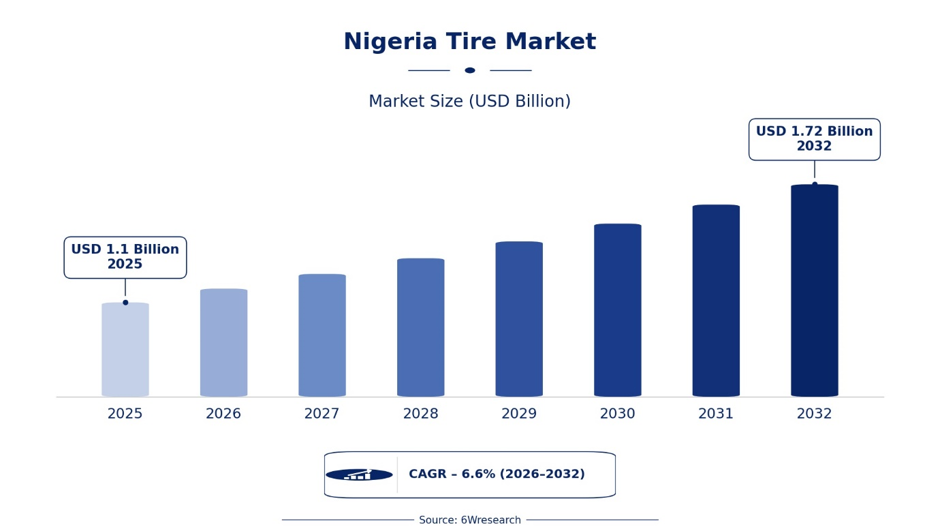
According to 6Wresearch internal database and industry insights, the Nigeria Tire Market was valued at USD 1.10 billion in 2025 and is projected to reach USD 1.72 billion by 2032, growing at a CAGR of approximately 6.6% during 2026–2032.
Nigeria Tire Market Highlights
|
Report Metric |
Details |
|
Report Name |
Nigeria Tire Market |
|
Market Size 2025 |
USD 1.10 billion |
|
Market Size 2032 |
USD 1.72 billion |
|
Absolute Growth 2025–2032 |
USD 0.62 billion |
|
CAGR 2026–2032 |
6.6% |
|
Peak Annual Growth |
8.0% in 2028 |
|
Forecast Period |
2026–2032 |
|
Historical Data |
2022–2025 |
|
Base Year |
2025 |
|
Leading Type, 2025 |
Radial Tires (62% share) |
|
Leading End User, 2025 |
Replacement (82% share) |
|
Fastest-Growing End User |
OEM (8.0% CAGR) |
|
Leading Vehicle Type, 2025 |
Passenger Cars (38% share) |
|
Fastest-Growing Vehicle Type |
Two-Wheelers (8.4% CAGR) |
|
Growing Sector |
Road freight, urban mobility and local vehicle assembly |
|
Key End Users |
Vehicle assemblers, logistics and haulage operators, public transport operators, ride-hailing and delivery fleets, individual vehicle owners, tyre dealers and distributors |
Nigeria Tire Market Year-wise Growth Rate and Key Drivers (2022–2032)
This graph illustrates the annual growth rates of the market from 2022 to 2032, highlighting gradual market development in the historical period and stronger expansion during the forecast period.
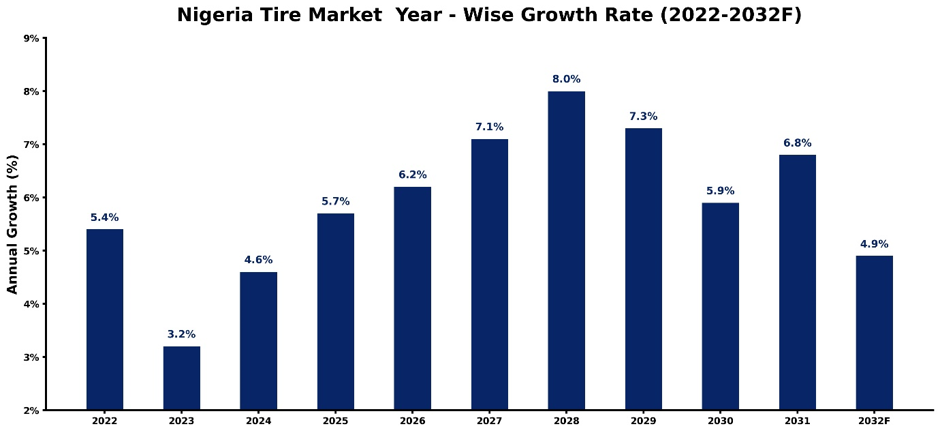
The following table presents the estimated annual growth rate for each year together with the principal factor influencing market performance.
| Year | Estimated Annual Growth (%) | Market Rationale |
| 2022 | 5.4% | Post-pandemic reopening restored freight and commuter movement across Nigeria, lifting tyre demand from depressed 2021 levels. |
| 2023 | 3.2% | Fuel subsidy removal in May 2023 and the naira float raised landed costs and restrained consumer tyre purchases. |
| 2024 | 4.6% | Importers rebuilt inventories after the currency adjustment, and recovering commercial transport activity supported a partial rebound in tyre sales. |
| 2025 | 5.7% | A steadier naira in 2025 allowed dealers to restore stock levels and brought forward postponed replacement purchases. |
| 2026 | 6.2% | Lower currency volatility and gradually easing inflation are expected to improve affordability and support steady retail demand. |
| 2027 | 7.1% | Completed sections of major highway projects are expected to raise road freight movement and commercial tyre consumption. |
| 2028 | 8% | Expanding domestic vehicle assembly and wider gas-powered vehicle adoption are expected to create peak new-vehicle tyre fitment. |
| 2029 | 7.3% | Fitment from the first wave of assembled vehicles is expected to normalise as initial delivery programmes mature. |
| 2030 | 5.9% | Fleet renewal cycles are expected to complete and radial adoption to saturate in major cities, moderating volume growth. |
| 2031 | 6.8% | Regional trade expansion under the African Continental Free Trade Area is expected to revive cross-border road haulage and tyre turnover. |
| 2032 | 4.9% | Market normalisation is expected as radial penetration matures and demand growth settles close to long-run population growth. |
Note: Market size estimations and growth projections presented in this report are based on 6Wresearch’s proprietary forecasting methodology, utilizing the latest available industry data, government publications, and primary research inputs.
Nigeria Tire Market Synopsis
The Nigeria Tire Market comprises radial and bias tyres for passenger cars, light trucks, trucks and buses, and two-wheelers, supplied through vehicle assemblers and the replacement trade. Growth is supported by a population above 220 million, expanding port-linked road freight, rising local vehicle assembly under the Nigeria Automotive Industry Development Plan, and growing commercial interest in gas-powered mobility. However, heavy dependence on imports and exposure to naira volatility raise landed costs, while part-worn and unrated tyres weaken quality standards across retail channels.
Market Dynamics Impact Analysis (2026–2032)
| Factor | Type | Impact | Primary Segment Affected |
| Expansion of road freight through Nigerian ports | Driver | High | Trucks and Bus |
| Rising local vehicle assembly | Driver | Medium | OEM |
| Dealer-led fitment and service centre networks | Opportunity | Medium | Replacement |
| Demand for fuel-efficient radial construction | Opportunity | High | Radial Tires |
| Naira volatility and import cost pass-through | Restraint | High | Radial Tires |
| Inflation and weak consumer purchasing power | Restraint | Medium | Passenger Cars |
| Uneven quality enforcement across retail outlets | Challenge | Medium | Replacement |
| Thin distribution outside major cities | Challenge | Medium | Two-Wheelers |
Evaluation of Drivers in Nigeria Tire Market (2026–2032)
Below mentioned are some major drivers and their influence on market dynamics.
| Drivers | Primary Segment Affected | Why It Matters (Evidence) |
| Road-dependent freight movement | Trucks and Bus | Most goods move by road, so higher cargo volumes directly increase tyre wear and purchase frequency. The Lekki Deep Sea Port began operations in 2023 and added a new container gateway feeding long-haul trucking. |
| Heavy wear on a stretched road network | Replacement | Poor surfaces and overloading shorten tyre life, which shortens purchase cycles. The federal network of about 35,000 km carries heavy mixed traffic, so tyre changes are frequent. |
| Large population and urban mobility needs | Two-Wheelers | Motorcycles serve last-mile transport and delivery where public transport is limited, so rider numbers rise with urban growth. Nigeria’s population exceeds 220 million, which sustains a deep base of daily users. |
| Domestic vehicle assembly | OEM | Local assembly lines need factory-fitted tyres, creating contract demand ahead of retail sales. Innoson Vehicle Manufacturing in Nnewi, established in 2010, shows that indigenous assembly capacity already exists. |
| Fuel cost sensitivity | Radial Tires | Higher pump prices make rolling resistance and fuel economy a buying criterion, favouring radial construction on longer routes. Fuel subsidy removal in May 2023 more than doubled pump prices. |
Market growth is supported by rising private investment in downstream energy and logistics, which keeps heavy haulage fleets in constant operation. The Dangote Refinery, with a capacity of 650,000 barrels per day, creates sustained product distribution movements across the country. Urban expansion in Lagos, home to more than 15 million residents, increases daily vehicle use and commercial delivery activity. Rising adoption of digital ride-hailing, online retail and delivery platforms is widening the number of high-mileage vehicles. Growth in the technician workforce at branded service centres improves product availability, while greater awareness of load ratings and fuel economy encourages buyers to purchase higher-specification products.
Evaluation of Restraints in Nigeria Tire Market
Below mentioned are some major restraints and their influence on market dynamics.
| Market Restraint | Primary Segment Affected | Why It Matters (Evidence) |
| Naira depreciation and import cost pass-through | Radial Tires | Nearly all tyres are imported and priced in foreign currency, so depreciation raises shelf prices and delays purchases. The naira moved from around 460 to over 1,500 per US dollar between mid-2023 and late 2024. |
| High inflation and weak purchasing power | Passenger Cars | Households divert income to food and fuel, so owners postpone tyre changes and buy lower-priced options. Consumer price inflation exceeded 34 per cent in late 2024. |
| Part-worn and low-cost unrated imports | Replacement | Cheaper imports undercut branded suppliers and lower average selling prices, while weak load ratings reduce safety. Informal roadside retail remains a major channel for such products. |
| Port congestion and clearance delays | Trucks and Bus | Delays at Apapa and Tin Can Island raise demurrage and holding costs, which importers pass on to buyers. Larger commercial sizes are most exposed because of container volume. |
| Costly credit for fleet operators | Light Trucks | Operators defer tyre purchases or buy cheaper brands when financing is expensive. The Central Bank of Nigeria policy rate stood at 27.5 per cent after its late-2024 increase. |
Nigeria Tire Market Challenges
The market faces several operational challenges. Dealer networks remain thin outside Lagos, Abuja and Port Harcourt, so northern buyers depend on informal sellers and carry higher delivery costs. Quality enforcement is uneven because the Standards Organisation of Nigeria must cover retail points across 36 states and the Federal Capital Territory, allowing mislabelled products to circulate. Since 2023, dealers have had to pre-fund dollar imports with lead times of around eight weeks, which limits inventory depth. Buyers still choose on price rather than load rating, weakening brand loyalty and service life.
Trends in the Nigeria Tire Market
Below mentioned are some of the trends shaping the Nigeria Tire Market growth.
- Shift from Bias to Radial Construction in Long-Haul Operations: Haulage operators are moving towards radial tyres because lower rolling resistance reduces diesel consumption on long routes. Port-linked trucking corridors from Lagos and Port Harcourt show this change most clearly. Suppliers with certified radial truck ranges and casing management services are better placed to win fleet contracts.
- Transition from Informal Roadside Retail to Branded Fitment Centres: Buyers in Lagos, Abuja and Port Harcourt increasingly prefer outlets that offer balancing, alignment and verified product origin over unbranded roadside sellers. Online marketplaces also list tyres with fitment booking. This favours distributors that invest in trained technicians, warranty support and transparent pricing.
- Local Assembly Emerging as a Source of Factory-Fit Demand: Assembly activity in clusters such as Nnewi, supported by the refreshed automotive industry plan, is creating demand for factory-fitted tyres. Assemblers need dependable supply schedules and size ranges matched to local vehicles. Suppliers that qualify with assemblers early secure volume that retail channels cannot provide.
Investment Opportunities in the Nigeria Tire Market
Some of the investment opportunities in the Nigeria Tire Market are mentioned below.
- Regional Distribution and Bonded Warehousing: Long import lead times and thin northern coverage create room for stocking hubs near Lagos ports and in Kano and Kaduna. Investors can supply container-load inventory, last-mile delivery and credit terms to dealers. Entry is simplest through partnerships with established local distributors that already hold customs and dealer relationships.
- Commercial Tyre Retreading Plants: Cost-conscious fleet operators need cheaper casings that can be reused several times. Investment in cold-process retreading equipment, casing inspection and tread rubber supply can serve haulage companies. A joint venture with a fleet operator and product certification from the Standards Organisation of Nigeria would secure early volume.
- Branded Fitment and Alignment Centres: Urban buyers want trusted fitting, balancing and alignment with warranty support. Franchise-style centres in Lagos, Abuja and Port Harcourt can combine tyre retail, wheel services and pressure monitoring. Entry works well through local franchise partners that control prime roadside sites and customer traffic.
- Natural Rubber Processing and Compounding: Edo and Delta states produce natural rubber that is largely exported or used in low-value processing. Investors can build processing and compounding units to supply tyre makers and retreaders. Collaboration with the Rubber Research Institute of Nigeria and local plantation operators would reduce feedstock risk.
Leading Players in Nigeria Tire Market
Stated below are some of the leading companies contributing significantly to the Nigeria Tire Market share.
1. Continental AG
|
Company Name |
Continental AG |
|
Headquarters |
Hanover, Germany |
|
Established Year |
1871 |
|
Official Website |
Continental AG is a global tyre manufacturer producing tyres for passenger cars, commercial trucks, buses, agricultural vehicles and industrial applications.
2. Yokohama Rubber Company Limited
|
Company Name |
Yokohama Rubber Company Limited |
|
Headquarters |
Hiratsuka, Kanagawa, Japan |
|
Established Year |
1917 |
|
Official Website |
Description: The Yokohama Rubber Company manufactures tyres for passenger cars, trucks, buses, construction equipment and industrial vehicles. Its product portfolio includes commercial and off-road tyres designed for demanding transportation, mining and construction applications.
3. Zhongce Rubber Group
|
Company Name |
Zhongce Rubber Group |
|
Headquarters |
Hangzhou, Zhejiang, China |
|
Established Year |
1958 |
|
Official Website |
Zhongce Rubber Group is a major Chinese tyre manufacturer producing tyres under brands such as Westlake, Goodride, Chaoyang and Arisun.
Government Initiatives in the Nigeria Tire Market
The Nigeria Automotive Industry Development Plan, issued in 2013 and refreshed as NAIDP 2023, uses import duty and levy measures of 35 per cent each on fully built vehicles to encourage local assembly. The Presidential Compressed Natural Gas Initiative, launched in 2023, promotes gas-powered transport. The African Continental Free Trade Area, in force for Nigeria since 2021, supports cross-border road trade.
Implementation is led by the National Automotive Design and Development Council, which administers assembly incentives and licensing. The Federal Roads Maintenance Agency maintains a federal network of about 35,000 km, while the Lagos–Calabar Coastal Highway of roughly 700 km, launched in 2024, adds a major freight corridor. The Standards Organisation of Nigeria enforces tyre quality standards at ports and retail points.
Future Insight of the Nigeria Tire Market
Future growth will be supported by sustained infrastructure investment, deeper regional trade integration, digital retail adoption and the energy transition in road transport. New highways and port corridors are expected to raise vehicle utilisation and tyre wear. Wider cross-border trade will increase the movement of goods by road, while online ordering and fleet management tools will improve product availability. The National Integrated Infrastructure Master Plan targets about USD 2.3 trillion of infrastructure investment by 2043, and the African Continental Free Trade Area covers roughly 1.3 billion consumers. Gradual adoption of gas-powered vehicles will encourage demand for load-rated products.
Market Segmentation Analysis
The report offers a comprehensive study of the following market segments and their leading categories in the market.
By Types – Radial Tires Leads and Records the Fastest Growth
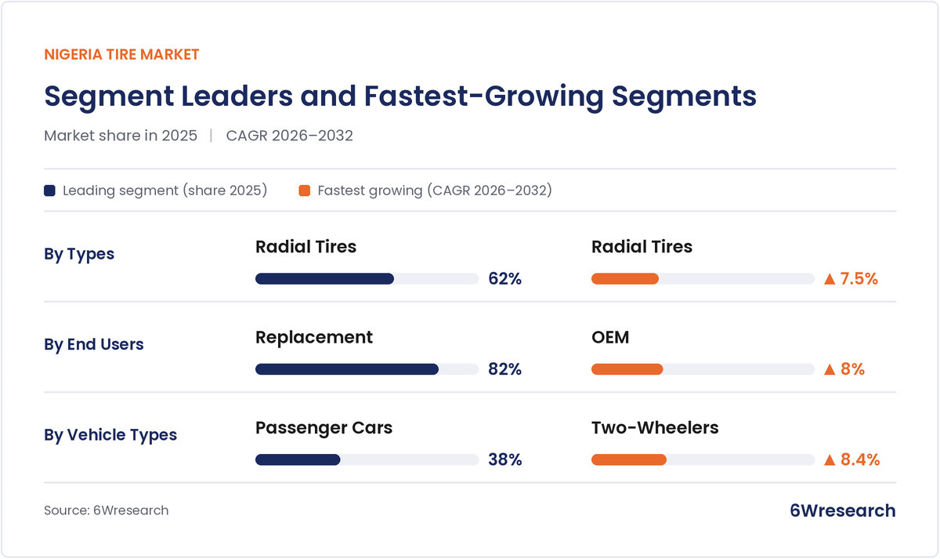
According to Ravi Bhandari, Research Head at 6Wresearch, Radial Tires accounted for 62% of the market in 2025, as car and truck buyers favour products that cut fuel use on long and congested routes. Radial Tires are also expected to grow at a CAGR of 7.5% during 2026–2032, as port-linked haulage corridors and assembler specifications move further towards radial construction.
By End Users – Replacement Leads, OEM Expected to Grow Fastest
Replacement held an 82% share in 2025, because the large imported used-vehicle fleet and rough road surfaces create frequent tyre changes. OEM is expected to expand at a CAGR of 8.0% during 2026–2032, as assembly clusters such as Nnewi scale up under the refreshed automotive industry plan.
By Vehicle Types – Passenger Cars Leads, Two-Wheelers Expected to Grow Fastest
Passenger Cars accounted for 38% of the market in 2025, supported by the dependence of urban households and ride-hailing drivers on private vehicles in Lagos and Abuja. Two-Wheelers are projected to grow at a CAGR of 8.4% during 2026–2032, as motorcycle taxis and delivery riders fill last-mile transport gaps in Nigerian cities.
Key Attractiveness of the Report
- 10 Years of Market Numbers
- Historical Data Starting from 2022 to 2025
- Base Year 2025
- Forecast Data until 2032
- Key Performance Indicators Impacting the Market
- Major Upcoming Developments and Projects
Key Highlights of the Report:
- Nigeria Tire Market Outlook
- Market Size of Nigeria Tire Market, 2025
- Forecast of Nigeria Tire Market, 2032
- Historical Data and Forecast of Tire Revenues & Volume for the Period 2022-2032
- Nigeria Tire Market Trend Evolution
- Nigeria Tire Market Drivers and Challenges
- Tire Price Trends
- Tire Porter’s Five Forces
- Tire Industry Life Cycle
- Historical Data and Forecast of Nigeria Tire Market Revenues & Volume By Types for the Period 2022-2032
- Historical Data and Forecast of Nigeria Tire Market Revenues & Volume By Radial Tires for the Period 2022-2032
- Historical Data and Forecast of Nigeria Tire Market Revenues & Volume By Bias Tires for the Period 2022-2032
- Historical Data and Forecast of Nigeria Tire Market Revenues & Volume By End Users for the Period 2022-2032
- Historical Data and Forecast of Nigeria Tire Market Revenues & Volume By OEM for the Period 2022-2032
- Historical Data and Forecast of Nigeria Tire Market Revenues & Volume By Replacement for the Period 2022-2032
- Historical Data and Forecast of Nigeria Tire Market Revenues & Volume By Vehicle Types for the Period 2022-2032
- Historical Data and Forecast of Nigeria Tire Market Revenues & Volume By Trucks and Bus for the Period 2022-2032
- Historical Data and Forecast of Nigeria Tire Market Revenues & Volume By Light Trucks for the Period 2022-2032
- Historical Data and Forecast of Nigeria Tire Market Revenues & Volume By Two-Wheelers for the Period 2022-2032
- Historical Data and Forecast of Nigeria Tire Market Revenues & Volume By Passenger Cars for the Period 2022-2032
- Tire Import Export Trade Statistics
- Market Opportunity Assessment By Types
- Market Opportunity Assessment By End Users
- Market Opportunity Assessment By Vehicle Types
- Tire Top Companies Market Share
- Tire Competitive Benchmarking By Technical and Operational Parameters
- Tire Company Profiles
- Tire Key Strategic Recommendations
Market Covered
The report offers an extensive study of the following market segments.
By Types
- Radial Tires
- Bias Tires
By End Users
- OEM
- Replacement
By Vehicle Types
- Trucks and Bus
- Light Trucks
- Two-Wheelers
- Passenger Cars