Brazil Gas Equipment Market Size, Share & Growth Rate
The Brazil Gas Equipment Market was estimated at USD 91 Million in 2025 and is projected to reach USD 108 Million by 2032, growing at a CAGR of 2.5% from 2026 to 2032. This growth trajectory is primarily driven by Brazil's expanding industrial base and the increasing demand for efficient gas solutions across various sectors, including energy, manufacturing, and healthcare. As industries leverage natural gas for diverse processes, the need for robust gas equipment, such as storage tanks and valves, continues to surge.
Brazil Gas Equipment Market Growth Rate Analysis (2021-2032)
The Brazilian gas equipment market has experienced notable fluctuations in recent years, starting with a decline of 1.4% in 2021, largely due to pandemic-related disruptions and reduced industrial activity. However, the market rebounded significantly in 2022, achieving a robust 5.0% growth spurred by rising energy demand and government incentives for cleaner energy solutions. This upward trend is projected to continue, with growth rates estimated at 4.0% in 2023 and gradually stabilizing around 2.7% by 2032. Key drivers include increased investments in infrastructure, advancements in technology, and a shift towards energy transition policies promoting natural gas. Consumer demand for efficient energy solutions remains strong, enhancing the overall market landscape.
Brazil Gas Equipment Market Year-wise Growth Rate and Key Drivers
This graph highlights how the Brazil Gas Equipment Market has steadily grown over the past five years, supported by major growth factors.
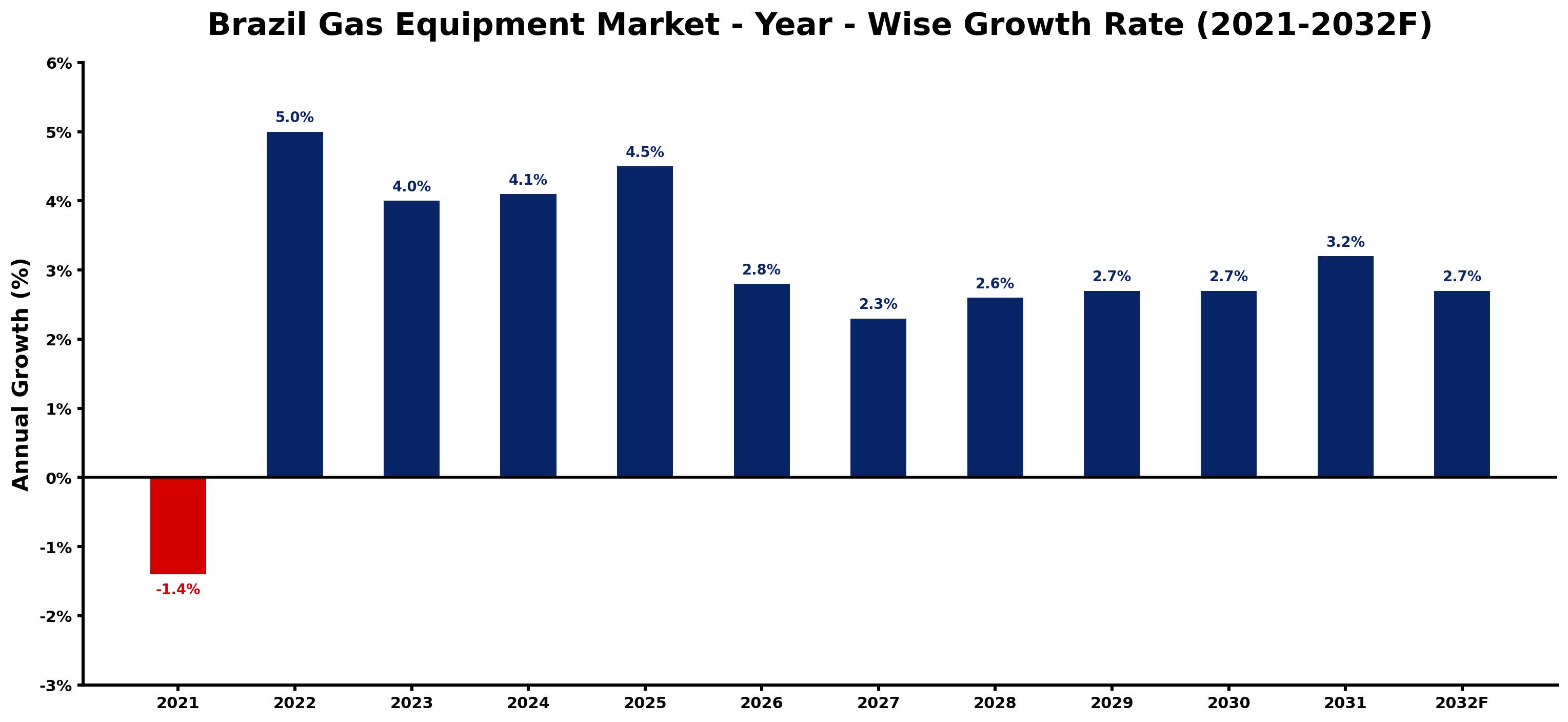
The table below presents the year‑wise growth rates along with the key drivers influencing the market
| Year | Growth Rate | Major Drivers |
| 2021 | -1.4% | Growing urbanization and commercial development |
| 2022 | 5.0% | Growing renewable energy integration projects |
| 2023 | 4.0% | Growing renewable energy integration projects |
| 2024 | 4.1% | Rapid growth in telecom and data center sectors |
| 2025 | 4.5% | Increasing adoption of advanced technologies |
| 2026 | 2.8% | Increasing industrial automation investments |
| 2027 | 2.3% | Expansion of commercial construction activities |
| 2028 | 2.6% | Rapid growth in telecom and data center sectors |
| 2029 | 2.7% | Rapid growth in telecom and data center sectors |
| 2030 | 2.7% | Growing renewable energy integration projects |
| 2031 | 3.2% | Expansion of transportation and logistics networks |
| 2032 | 2.7% | Increasing industrial infrastructure investments |
Note - Market size estimations and growth projections presented in this report are based on 6Wresearch’s advanced forecasting approach, validated with industry datasets as of June 2026.
Brazil Gas Equipment Market Synopsis
In Brazil, the gas equipment sector is witnessing a transformation fueled by a notable shift towards cleaner energy alternatives. This transition is not only evident in residential applications, where households increasingly favor gas for cooking and heating, but also across industrial landscapes that prioritize sustainability and efficiency.
The emphasis on regulatory compliance and safety standards shapes market dynamics significantly. Companies within this landscape must navigate a web of quality control measures while simultaneously adapting to evolving customer demands for innovation and reliability in gas equipment.
Brazil Gas Equipment Market Key Takeaways
- The market is fueled by the increasing reliance on natural gas across various sectors in Brazil.
- Compliance with strict regulatory frameworks presents both a challenge and an opportunity for innovation.
- Supply chain disruptions remain a pressing concern, necessitating robust strategies for resilience.
- Government initiatives are fostering industry growth and promoting energy efficiency.
- Investment in R&D is critical for companies aiming to stay competitive in a rapidly evolving market.
Evaluation of Restraints in Brazil Gas Equipment Market
Despite the promising outlook, several restraints impact the Brazil Gas Equipment Market. Compliance with regulatory requirements and safety standards is paramount, yet navigating the complex frameworks can be daunting for manufacturers. The costs and time associated with obtaining necessary approvals can deter potential entrants. Additionally, the market remains sensitive to supply chain vulnerabilities. Factors such as raw material shortages, geopolitical tensions, and transportation delays can disrupt operations, compelling companies to rethink their supply chain strategies.
Brazil Gas Equipment Market Trends
A shift towards sustainable practices is evident, with an increasing focus on innovative gas solutions that meet stringent environmental standards. Moreover, technology advancements are paving the way for smarter gas equipment, characterized by enhanced efficiency and safety features. Consumer preferences are also evolving, with a growing awareness of energy-efficient products driving demand.
Brazil Gas Equipment Market Opportunities
As Brazil's industrial landscape continues to expand, opportunities for investment in gas equipment are abundant. The ongoing infrastructure development, coupled with government incentives aimed at fostering the adoption of gas technologies, presents a conducive environment for growth. Companies willing to invest in research and development will find opportunities to innovate and meet the burgeoning demand for advanced gas solutions.
Government Initiatives in the Brazil Gas Equipment Market
The Brazilian government is actively promoting policies to enhance energy efficiency and ensure the safety and performance of gas equipment. Initiatives may include financial incentives for adopting new technologies, regulations mandating compliance with safety standards, and funding for research and development aimed at improving equipment functionality. Furthermore, educational programs to inform consumers about the benefits of gas equipment are essential for encouraging broader adoption.
Future Insights of the Brazil Gas Equipment Market
Looking ahead to 2026-2032, the Brazil Gas Equipment Market is set to evolve, driven by technological advancements and a persistent push for cleaner energy solutions. As Brazil invests in infrastructure and expands its industrial capabilities, the demand for reliable gas equipment will likely see sustained growth. Companies that prioritize innovation, adhere to regulatory standards, and adapt to market dynamics will position themselves favorably in this competitive landscape.
Brazil Gas Equipment Market Latest Developments (May 2025 - June 2026)
Recent months have seen a notable increase in investment in research and development aimed at enhancing gas equipment performance and safety. Companies are exploring partnerships and collaborations to leverage technology, promoting smarter, more efficient gas solutions. Additionally, industry stakeholders are actively engaging with regulatory bodies to ensure compliance while advocating for policies that support sustainable growth within the sector.
Brazil Gas Equipment Market - Key Attractiveness of the Report
- 10 Years of Market Numbers
- Historical Data Starting from 2022 to 2025
- Base Year: 2025
- Forecast Data until 2032
- Key Performance Indicators Impacting the Market
- Major Upcoming Developments and Projects
Key Highlights of the Report:
- Brazil Gas Equipment Market Outlook
- Market Size of Brazil Gas Equipment Market, 2025
- Forecast of Brazil Gas Equipment Market, 2032
- Historical Data and Forecast of Brazil Gas Equipment Revenues & Volume for the Period 2022-2032F
- Brazil Gas Equipment Market Trend Evolution
- Brazil Gas Equipment Market Drivers and Challenges
- Brazil Gas Equipment Price Trends
- Brazil Gas Equipment Porter's Five Forces
- Brazil Gas Equipment Industry Life Cycle
- Historical Data and Forecast of Brazil Gas Equipment Market Revenues & Volume By Equipment Type for the Period 2022-2032F
- Historical Data and Forecast of Brazil Gas Equipment Market Revenues & Volume By Gas Delivery Systems for the Period 2022-2032F
- Historical Data and Forecast of Brazil Gas Equipment Market Revenues & Volume By Gas Regulators for the Period 2022-2032F
- Historical Data and Forecast of Brazil Gas Equipment Market Revenues & Volume By Flow Devices for the Period 2022-2032F
- Historical Data and Forecast of Brazil Gas Equipment Market Revenues & Volume By Purifiers & Filters for the Period 2022-2032F
- Historical Data and Forecast of Brazil Gas Equipment Market Revenues & Volume By Gas Generating Systems for the Period 2022-2032F
- Historical Data and Forecast of Brazil Gas Equipment Market Revenues & Volume By Gas Detection Systems for the Period 2022-2032F
- Historical Data and Forecast of Brazil Gas Equipment Market Revenues & Volume By Cryogenic Products for the Period 2022-2032F
- Historical Data and Forecast of Brazil Gas Delivery Systems Gas Equipment Market Revenues & Volume By Accessories for the Period 2022-2032F
- Historical Data and Forecast of Brazil Gas Equipment Market Revenues & Volume By Process for the Period 2022-2032F
- Historical Data and Forecast of Brazil Gas Equipment Market Revenues & Volume By Gas Generation for the Period 2022-2032F
- Historical Data and Forecast of Brazil Gas Equipment Market Revenues & Volume By Gas Storage for the Period 2022-2032F
- Historical Data and Forecast of Brazil Gas Equipment Market Revenues & Volume By Gas Detection for the Period 2022-2032F
- Historical Data and Forecast of Brazil Gas Equipment Market Revenues & Volume By Gas Transportation for the Period 2022-2032F
- Historical Data and Forecast of Brazil Gas Equipment Market Revenues & Volume By End-Gas for the Period 2022-2032F
- Historical Data and Forecast of Brazil Gas Equipment Market Revenues & Volume By Nitrogen for the Period 2022-2032F
- Historical Data and Forecast of Brazil Gas Equipment Market Revenues & Volume By Hydrogen for the Period 2022-2032F
- Historical Data and Forecast of Brazil Gas Equipment Market Revenues & Volume By Helium for the Period 2022-2032F
- Historical Data and Forecast of Brazil Gas Equipment Market Revenues & Volume By Oxygen for the Period 2022-2032F
- Historical Data and Forecast of Brazil Gas Equipment Market Revenues & Volume By Carbon Dioxide for the Period 2022-2032F
- Historical Data and Forecast of Brazil Gas Equipment Market Revenues & Volume By Others for the Period 2022-2032F
- Historical Data and Forecast of Brazil Gas Equipment Market Revenues & Volume By End-Users for the Period 2022-2032F
- Historical Data and Forecast of Brazil Gas Equipment Market Revenues & Volume By Metal Fabrication for the Period 2022-2032F
- Historical Data and Forecast of Brazil Gas Equipment Market Revenues & Volume By Chemicals for the Period 2022-2032F
- Historical Data and Forecast of Brazil Gas Equipment Market Revenues & Volume By Healthcare for the Period 2022-2032F
- Historical Data and Forecast of Brazil Gas Equipment Market Revenues & Volume By Oil and Gas for the Period 2022-2032F
- Historical Data and Forecast of Brazil Gas Equipment Market Revenues & Volume By Food and Beverage for the Period 2022-2032F
- Historical Data and Forecast of Brazil Gas Equipment Market Revenues & Volume By Others for the Period 2022-2032F
- Brazil Gas Equipment Import Export Trade Statistics
- Market Opportunity Assessment By Equipment Type
- Market Opportunity Assessment By Process
- Market Opportunity Assessment By End-Gas
- Market Opportunity Assessment By End-Users
- Brazil Gas Equipment Top Companies Market Share
- Brazil Gas Equipment Competitive Benchmarking By Technical and Operational Parameters
- Brazil Gas Equipment Company Profiles
- Brazil Gas Equipment Key Strategic Recommendations






































