Brazil General Minerals Market Size, Share & Growth Rate
The Brazil General Minerals Market was estimated at USD 317 Million in 2025 and is projected to reach USD 379 Million by 2032, growing at a CAGR of 2.6% from 2026 to 2032. This growth trajectory is primarily fueled by the ongoing infrastructure development initiatives across the country, as well as the rising demand for raw materials in construction and manufacturing sectors. Additionally, advancements in mining technology and increased industrial applications are also contributing to market expansion.
Brazil General Minerals Market Year-wise Growth Rate and Key Drivers
This graph highlights how the Brazil General Minerals Market has steadily grown over the years, supported by major growth factors.
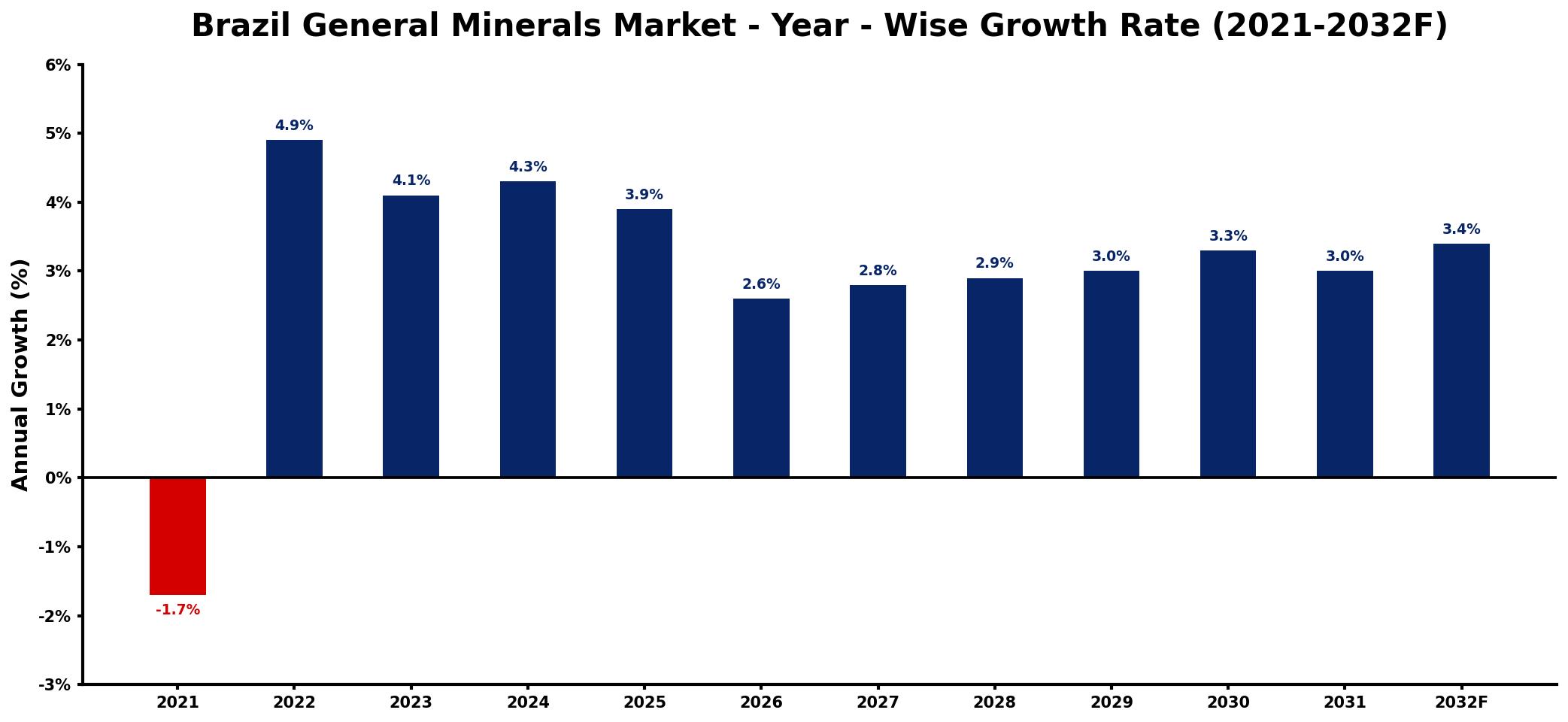
The table below presents the year‑wise growth rates along with the key drivers influencing the market
| Year | Growth Rate | Major Drivers |
| 2021 | -1.7% | decreased industrial production capacity |
| 2022 | 4.9% | increased infrastructure development projects |
| 2023 | 4.1% | growing renewable energy investments |
| 2024 | 4.3% | expansion of construction activities |
| 2025 | 3.9% | rising demand for technology applications |
| 2026 | 2.6% | enhanced mining operational efficiencies |
| 2027 | 2.8% | expanding international trade agreements |
| 2028 | 2.9% | increased urbanization trends observed |
| 2029 | 3.0% | growing automotive manufacturing sector |
| 2030 | 3.3% | surge in green technology adoption |
| 2031 | 3.0% | increased consumer electronics demand |
| 2032 | 3.4% | enhanced product quality standards |
Note: Market size estimations and growth projections presented in this report are based on 6Wresearch's proprietary forecasting methodology, utilizing the latest available industry data, government publications, and primary research inputs.
Brazil General Minerals Market Synopsis
In recent years, Brazil's general minerals market has demonstrated resilience amid economic fluctuations, driven by robust construction projects and industrial growth. The strategic utilization of minerals such as limestone, gypsum, and quartz has become essential for various applications, from manufacturing to agriculture.
As demand for these minerals continues to surge, mining companies are increasingly focusing on sustainable practices to address environmental concerns. This shift not only enhances compliance with regulatory frameworks but also aligns with global trends towards responsible resource extraction.
Brazil General Minerals Market Key Takeaways
- The market is projected to grow steadily, reaching USD 379 Million by 2032.
- Infrastructure development is a key driver, fostering demand across various sectors.
- Mining companies are innovating to meet both industry needs and sustainability standards.
- Environmental regulations are pushing for more responsible mining practices.
- Government investments in construction projects are pivotal for market growth.
Evaluation of Restraints in Brazil General Minerals Market
While the Brazil General Minerals Market shows promising growth potential, it is not without its constraints. One of the most significant challenges is price volatility, which can severely impact profitability for mining companies and affect investment decisions. Additionally, strict regulatory compliance presents a daunting landscape, as companies must adapt to evolving policies that govern environmental protection and sustainable practices. The balancing act of ensuring responsible resource extraction while meeting market demands adds another layer of complexity to the operational framework.
Brazil General Minerals Market Trends
Several trends are currently shaping the Brazil General Minerals Market. The increasing integration of advanced mining technologies is facilitating more efficient extraction processes, thereby reducing costs and environmental impact. Furthermore, a shift towards sustainable materials and practices is influencing consumer preferences, prompting companies to innovate their product offerings. This is coupled with a growing awareness of ecological conservation among stakeholders, which is reshaping industry standards.
Brazil General Minerals Market Opportunities
The opportunities in the Brazil General Minerals Market are vast, especially as government initiatives focus on upgrading infrastructure. Significant investments in road construction, public transportation, and housing projects are expected to drive demand for general minerals. Additionally, as mining companies enhance their sustainability practices, there is a ripe opportunity for stakeholders to invest in greener technologies and practices, further appealing to environmentally conscious consumers and businesses.
Government Initiatives in the Brazil General Minerals Market
Government policies in Brazil are designed to promote responsible mining and resource management. Regulatory agencies are implementing comprehensive frameworks that set stringent standards for mineral exploration and extraction, ensuring that environmental impact is minimized. Initiatives also focus on community engagement and partnerships, fostering a collaborative approach to resource management, and enhancing social accountability among mining operations.
Future Insights of the Brazil General Minerals Market
Looking ahead to 2026-2032, the Brazil General Minerals Market is poised for steady growth driven by sustained government investment in infrastructure and a proactive approach towards sustainability. As companies continue to innovate and adopt advanced technologies, we can expect increased efficiency in mineral extraction and processing. Furthermore, adapting to regulatory changes and consumer demand for sustainable products will play crucial roles in shaping the competitive landscape.
Brazil General Minerals Market Latest Developments (2025 - 2026)
Recent developments in the Brazil General Minerals Market indicate a shift towards more sustainable mining practices. Several initiatives have emerged that focus on the rehabilitation of mining sites and the adoption of environmentally friendly technologies. Moreover, collaboration between the government and industry stakeholders is on the rise, aimed at addressing the social and environmental challenges associated with mineral extraction.
Brazil General Minerals Market - Key Attractiveness of the Report
- 10 Years of Market Numbers
- Historical Data Starting from 2022 to 2025
- Base Year: 2025
- Forecast Data until 2032
- Key Performance Indicators Impacting the Market
- Major Upcoming Developments and Projects
Key Highlights of the Report:
- Brazil General Minerals Market Outlook
- Market Size of Brazil General Minerals Market, 2025
- Forecast of Brazil General Minerals Market, 2032
- Historical Data and Forecast of Brazil General Minerals Revenues & Volume for the Period 2022-2032F
- Brazil General Minerals Market Trend Evolution
- Brazil General Minerals Market Drivers and Challenges
- Brazil General Minerals Price Trends
- Brazil General Minerals Porter's Five Forces
- Brazil General Minerals Industry Life Cycle
- Historical Data and Forecast of Brazil General Minerals Market Revenues & Volume By Type for the Period 2022-2032F
- Historical Data and Forecast of Brazil General Minerals Market Revenues & Volume By Potash for the Period 2022-2032F
- Historical Data and Forecast of Brazil General Minerals Market Revenues & Volume By Salt for the Period 2022-2032F
- Historical Data and Forecast of Brazil General Minerals Market Revenues & Volume By Magnesite for the Period 2022-2032F
- Historical Data and Forecast of Brazil General Minerals Market Revenues & Volume By Sulfur for the Period 2022-2032F
- Historical Data and Forecast of Brazil General Minerals Market Revenues & Volume By Kaolin for the Period 2022-2032F
- Historical Data and Forecast of Brazil General Minerals Market Revenues & Volume By Asbestos for the Period 2022-2032F
- Historical Data and Forecast of Brazil General Minerals Market Revenues & Volume By Feldspar for the Period 2022-2032F
- Historical Data and Forecast of Brazil Potash General Minerals Market Revenues & Volume By Boron for the Period 2022-2032F
- Historical Data and Forecast of Brazil General Minerals Market Revenues & Volume By Organization Size for the Period 2022-2032F
- Historical Data and Forecast of Brazil General Minerals Market Revenues & Volume By Large Enterprises for the Period 2022-2032F
- Historical Data and Forecast of Brazil General Minerals Market Revenues & Volume By Small And Medium Enterprises for the Period 2022-2032F
- Brazil General Minerals Import Export Trade Statistics
- Market Opportunity Assessment By Type
- Market Opportunity Assessment By Organization Size
- Brazil General Minerals Top Companies Market Share
- Brazil General Minerals Competitive Benchmarking By Technical and Operational Parameters
- Brazil General Minerals Company Profiles
- Brazil General Minerals Key Strategic Recommendations






































