Brazil Gold Bullion Market Size, Share & Growth Rate
The Brazil Gold Bullion Market was estimated at USD 328 Million in 2025 and is projected to reach USD 394 Million by 2032, growing at a CAGR of 2.7% from 2026 to 2032. This growth trajectory is primarily driven by the increasing demand for gold as a secure investment amid economic uncertainties and inflationary pressures. Additionally, Brazil's cultural affinity for gold as a store of value continues to support steady investment in bullion.
Brazil Gold Bullion Market Year-wise Growth Rate and Key Drivers
This graph highlights how the Brazil Gold Bullion Market has steadily grown over the years, supported by major growth factors.
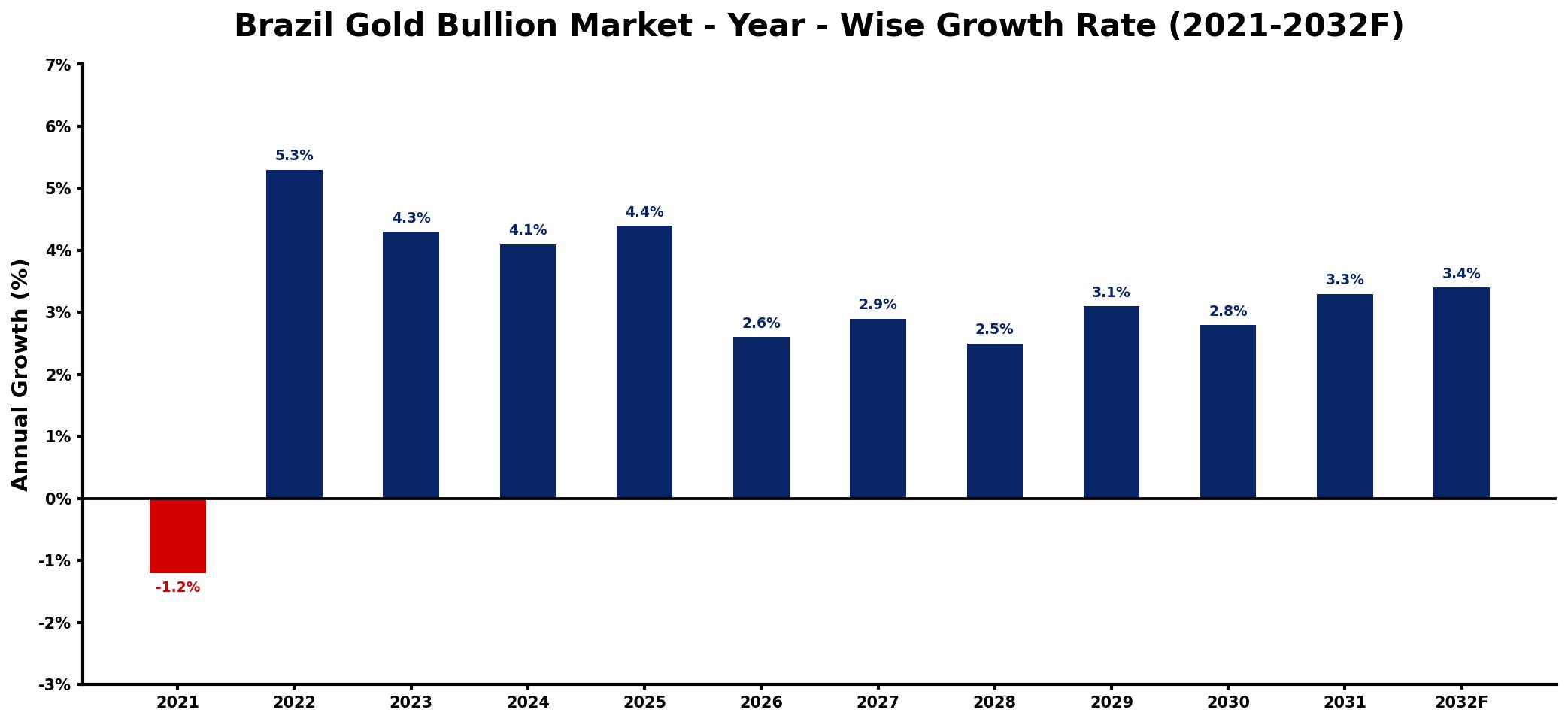
The table below presents the year‑wise growth rates along with the key drivers influencing the market
| Year | Growth Rate | Major Drivers |
| 2021 | -1.2% | Investment sentiment shifts downward |
| 2022 | 5.3% | Increased demand from investors |
| 2023 | 4.3% | Growing interest in safe-haven assets |
| 2024 | 4.1% | Rising manufacturing sector activities |
| 2025 | 4.4% | Higher retail sector purchases |
| 2026 | 2.6% | Strengthened international trade relations |
| 2027 | 2.9% | Emerging market investments expand |
| 2028 | 2.5% | Increased wealth management strategies |
| 2029 | 3.1% | Surge in luxury market consumption |
| 2030 | 2.8% | Enhanced digital asset integration |
| 2031 | 3.3% | Growing global economic stability |
| 2032 | 3.4% | Strengthened regulatory investment frameworks |
Note: Market size estimations and growth projections presented in this report are based on 6Wresearch's proprietary forecasting methodology, utilizing the latest available industry data, government publications, and primary research inputs.
Brazil Gold Bullion Market Synopsis
In Brazil, gold bullion remains a preferred choice for many investors, particularly during economic downturns. Its enduring reputation as a hedge against inflation and currency devaluation drives demand among individuals looking for financial security.
The Brazilian market benefits not only from domestic demand but also from a rich history of gold production. As a country with significant gold reserves, Brazil is well-positioned to enhance its bullion offerings, promoting both supply stability and investment confidence.
Brazil Gold Bullion Market Key Takeaways
- The Brazil Gold Bullion market is poised for steady growth, influenced by cultural preferences and economic factors.
- Gold bullion serves as a popular safe-haven asset, especially during periods of economic instability.
- Effective risk management strategies will be essential for market participants to navigate price volatility.
- Government policies surrounding mining practices significantly affect market dynamics.
- Investors are increasingly looking towards ethically sourced gold, emphasizing responsible mining and trade practices.
Evaluation of Restraints in Brazil Gold Bullion Market
Despite the promising outlook, the Brazil Gold Bullion market is not without its constraints. The volatility of gold prices remains a significant challenge, creating uncertainty for both investors and traders. Economic conditions heavily influence precious metal prices, and unexpected shifts can lead to rapid fluctuations. Additionally, stringent regulatory requirements surrounding mining and trade pose complexities that can hinder market participants. Companies must proactively adapt to these dynamics, employing robust risk management strategies and maintaining an awareness of global economic trends to safeguard their positions.
Brazil Gold Bullion Market Trends
The Brazil Gold Bullion market is experiencing notable trends that shape its landscape. One emerging trend is the increasing preference for sustainable and ethically sourced gold, as investors become more socially conscious. This shift is prompting market players to adopt transparent practices in sourcing and production. Furthermore, theres a rising digitalization trend within the market, with advancements in technology facilitating easier access to gold investment options through online platforms and applications, making it more appealing to a younger demographic of investors.
Brazil Gold Bullion Market Opportunities
Opportunities for growth in the Brazil Gold Bullion market are abundant, particularly through education and awareness initiatives aimed at potential investors. By informing the public on the benefits of gold as a stable asset, market players can cultivate a more informed investor base. Additionally, tapping into Brazils rich cultural affinity for gold and promoting local bullion production can enhance market participation. The potential for developing specialized investment products and services tailored to the needs of Brazilian investors presents a significant avenue for growth.
Government Initiatives in the Brazil Gold Bullion Market
The Brazilian government plays a critical role in shaping the gold bullion market through policies that promote responsible mining and fair trade practices. By enforcing regulations that ensure ethical sourcing and adherence to international standards, authorities help maintain market integrity. Moreover, public spending on mining infrastructure and technology can enhance production capabilities, providing a boost to local economies and supporting the overall growth of the bullion sector.
Future Insights of the Brazil Gold Bullion Market
Looking ahead to the period between 2026 and 2032, the Brazil Gold Bullion market is expected to continue evolving amid changing economic landscapes and investor behaviors. With ongoing inflation concerns and geopolitical instability, gold's appeal as a haven asset is likely to strengthen. As more investors prioritize sustainability, market participants who commit to responsible practices will be better positioned for success. Overall, the combination of cultural attachment to gold and emerging trends toward ethical investments will drive the markets trajectory in the coming years.
Brazil Gold Bullion Market Latest Developments (2025 - 2026)
Recent developments within the Brazil Gold Bullion market reflect a growing emphasis on sustainability and ethical sourcing. Industry players are increasingly adopting technologies that enhance transparency throughout the supply chain. Furthermore, initiatives focusing on public awareness about gold investments are gaining traction, aiming to cultivate a more informed investor base. The government continues to implement policies that promote responsible mining practices, which are expected to enhance market stability and attract long-term investment.
Brazil Gold Bullion Market - Key Attractiveness of the Report
- 10 Years of Market Numbers
- Historical Data Starting from 2022 to 2025
- Base Year: 2025
- Forecast Data until 2032
- Key Performance Indicators Impacting the Market
- Major Upcoming Developments and Projects
Key Highlights of the Report:
- Brazil Gold Bullion Market Outlook
- Market Size of Brazil Gold Bullion Market, 2025
- Forecast of Brazil Gold Bullion Market, 2032
- Historical Data and Forecast of Brazil Gold Bullion Revenues & Volume for the Period 2022-2032F
- Brazil Gold Bullion Market Trend Evolution
- Brazil Gold Bullion Market Drivers and Challenges
- Brazil Gold Bullion Price Trends
- Brazil Gold Bullion Porter's Five Forces
- Brazil Gold Bullion Industry Life Cycle
- Historical Data and Forecast of Brazil Gold Bullion Market Revenues & Volume By Type for the Period 2022-2032F
- Historical Data and Forecast of Brazil Gold Bullion Market Revenues & Volume By Gold Bar for the Period 2022-2032F
- Historical Data and Forecast of Brazil Gold Bullion Market Revenues & Volume By Gold Coin for the Period 2022-2032F
- Historical Data and Forecast of Brazil Gold Bullion Market Revenues & Volume By Distribution Channel for the Period 2022-2032F
- Historical Data and Forecast of Brazil Gold Bullion Market Revenues & Volume By Online for the Period 2022-2032F
- Historical Data and Forecast of Brazil Gold Bullion Market Revenues & Volume By Offline for the Period 2022-2032F
- Brazil Gold Bullion Import Export Trade Statistics
- Market Opportunity Assessment By Type
- Market Opportunity Assessment By Distribution Channel
- Brazil Gold Bullion Top Companies Market Share
- Brazil Gold Bullion Competitive Benchmarking By Technical and Operational Parameters
- Brazil Gold Bullion Company Profiles
- Brazil Gold Bullion Key Strategic Recommendations






































