Brazil Hollow Section Steel Market Size, Share & Growth Rate
The Brazil Hollow Section Steel Market was estimated at USD 116 Million in 2025 and is projected to reach USD 138 Million by 2032, growing at a CAGR of 2.5% from 2026 to 2032. This growth is primarily driven by ongoing urbanization and significant infrastructure development projects across the country. As Brazil invests in residential and commercial construction, the demand for hollow section steel—known for its structural integrity and versatility—is likely to increase, further solidifying its position in the market.
Brazil Hollow Section Steel Market Year-wise Growth Rate and Key Drivers
This graph highlights how the Brazil Hollow Section Steel Market has steadily grown over the years, supported by major growth factors.
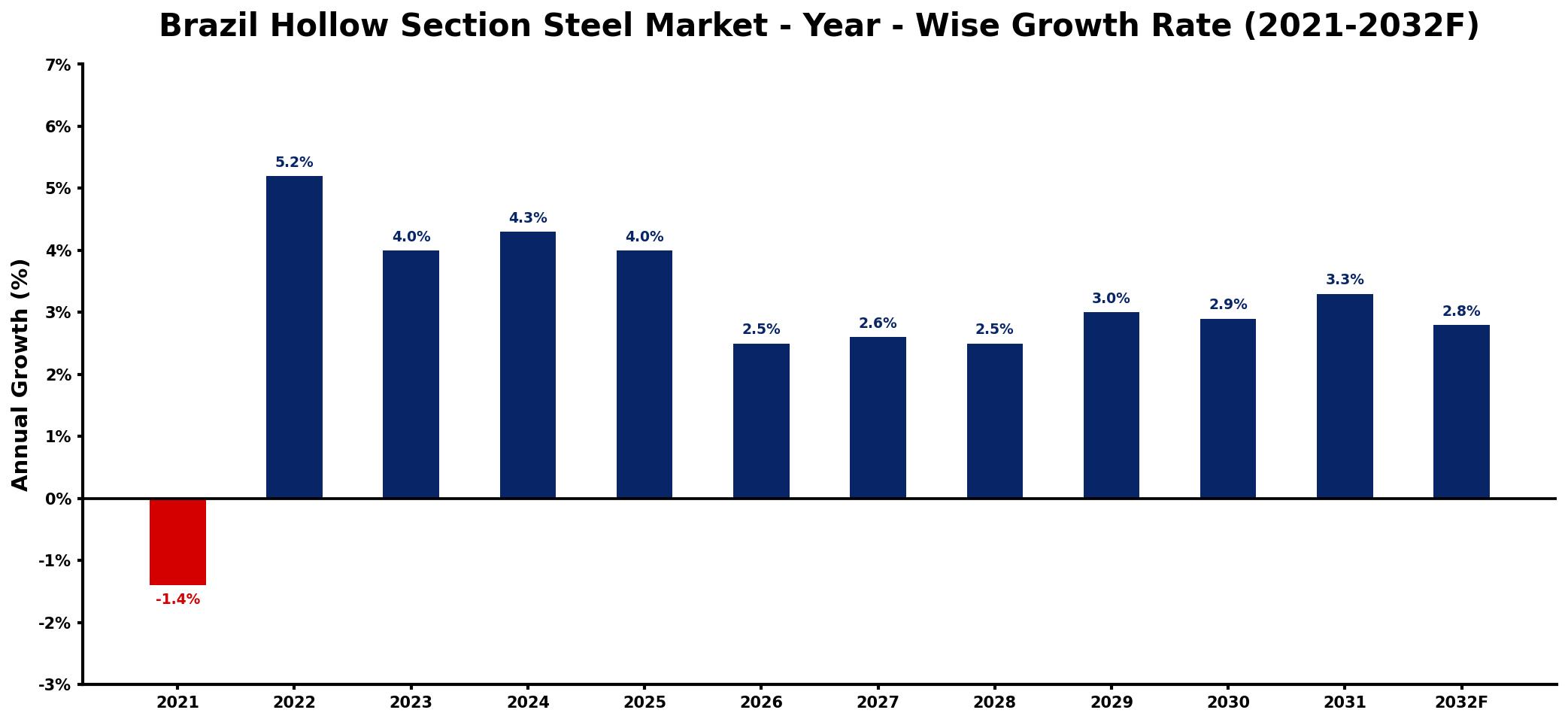
The table below presents the year‑wise growth rates along with the key drivers influencing the market
| Year | Growth Rate | Major Drivers |
| 2021 | -1.4% | Construction activity experienced slowdown |
| 2022 | 5.2% | Infrastructure projects received funding |
| 2023 | 4.0% | Manufacturing sector showed resilience |
| 2024 | 4.3% | Renewable energy projects advanced significantly |
| 2025 | 4.0% | Real estate market gained momentum |
| 2026 | 2.5% | Transportation network upgrades initiated |
| 2027 | 2.6% | Urban development initiatives expanded rapidly |
| 2028 | 2.5% | Export demand from neighboring countries |
| 2029 | 3.0% | Technological innovations enhanced production |
| 2030 | 2.9% | Increased investments in industrial sectors |
| 2031 | 3.3% | Government incentives for infrastructure growth |
| 2032 | 2.8% | Sustainable construction trends emerged strongly |
Note: Market size estimations and growth projections presented in this report are based on 6Wresearch's proprietary forecasting methodology, utilizing the latest available industry data, government publications, and primary research inputs.
Brazil Hollow Section Steel Market Synopsis
The most compelling factor shaping the Brazil Hollow Section Steel Market today is the surge in construction activities. With rapid urbanization and growing populations, the need for robust and efficient building materials has never been greater. This trend is amplified by government initiatives aimed at improving infrastructure, which inherently boost the demand for hollow section steel.
Additionally, the automotive sector is becoming an increasingly significant consumer of hollow section steel, owing to the materials lightweight properties and strength. As Brazil's automotive industry evolves, the adaptation of hollow section steel in vehicle production underscores its versatility and potential for growth within this market.
Brazil Hollow Section Steel Market Key Takeaways
- The market is poised for steady growth, driven by urbanization and infrastructure investment.
- Hollow section steel is favored for its strength and adaptability across various applications.
- Government policies are in place to regulate product quality and ensure structural integrity.
- Challenges such as fluctuating construction activity are monitored but do not overshadow growth opportunities.
- The automotive sector is emerging as a key player in driving demand for hollow section steel.
Evaluation of Restraints in Brazil Hollow Section Steel Market
While the Brazil Hollow Section Steel Market shows promising growth, it is not without its challenges. Fluctuations in construction activity can significantly impact demand, leading to periods of volatility in market performance. Additionally, changes in building regulations can necessitate adaptations in production processes, which may strain manufacturers. These external factors require continuous monitoring, as they play a crucial role in shaping market dynamics.
Brazil Hollow Section Steel Market Trends
Current trends indicate a shift towards sustainable building materials, as environmental concerns gain prominence. The hollow section steel market is adapting to these changes through innovations in manufacturing processes aimed at reducing carbon footprints. Moreover, the integration of smart technologies in construction is prompting the development of high-performance hollow section steel products.
Brazil Hollow Section Steel Market Opportunities
Investment opportunities within the Brazil Hollow Section Steel Market are particularly rich in the public infrastructure sector. As Brazil continues to modernize its transportation networks and urban facilities, demand for high-quality hollow section steel for bridges, railways, and other critical infrastructure is set to rise. Furthermore, as the automotive industry transitions towards lighter materials for improved fuel efficiency, manufacturers have the chance to innovate and diversify their product offerings.
Government Initiatives in the Brazil Hollow Section Steel Market
The Brazilian government has implemented several policies to enhance the quality and reliability of hollow section steel products. Regulatory frameworks focus on standardizing product dimensions and material properties, ensuring that all manufactured steel meets the necessary safety and durability criteria for construction projects. Public spending initiatives are also directed towards significant infrastructure upgrades, supporting market growth and sustainability efforts.
Future Insights of the Brazil Hollow Section Steel Market
Looking forward to the period from 2026 to 2032, the Brazil Hollow Section Steel Market is expected to continue on its growth trajectory. Emerging construction trends, including smart buildings and sustainable practices, will likely shape future demand. Moreover, as Brazil enhances its infrastructure and urban landscapes, the integral role of hollow section steel will become more pronounced, making it a staple in construction projects across various sectors.
Brazil Hollow Section Steel Market Latest Developments (2025 - 2026)
Recent developments in the Brazil Hollow Section Steel Market indicate a focus on improving manufacturing efficiencies and product innovations. Companies are investing in advanced technologies to enhance the performance characteristics of hollow section steel, ensuring compliance with evolving industry standards. Furthermore, there is an uptick in collaboration between manufacturers and construction firms to tailor products specifically for upcoming large-scale infrastructure projects.
Brazil Hollow Section Steel Market - Key Attractiveness of the Report
- 10 Years of Market Numbers
- Historical Data Starting from 2022 to 2025
- Base Year: 2025
- Forecast Data until 2032
- Key Performance Indicators Impacting the Market
- Major Upcoming Developments and Projects
Key Highlights of the Report:
- Brazil Hollow Section Steel Market Outlook
- Market Size of Brazil Hollow Section Steel Market, 2025
- Forecast of Brazil Hollow Section Steel Market, 2032
- Historical Data and Forecast of Brazil Hollow Section Steel Revenues & Volume for the Period 2022-2032F
- Brazil Hollow Section Steel Market Trend Evolution
- Brazil Hollow Section Steel Market Drivers and Challenges
- Brazil Hollow Section Steel Price Trends
- Brazil Hollow Section Steel Porter's Five Forces
- Brazil Hollow Section Steel Industry Life Cycle
- Historical Data and Forecast of Brazil Hollow Section Steel Market Revenues & Volume By Type for the Period 2022-2032F
- Historical Data and Forecast of Brazil Hollow Section Steel Market Revenues & Volume By Rectangular Hollow Section for the Period 2022-2032F
- Historical Data and Forecast of Brazil Hollow Section Steel Market Revenues & Volume By Square Hollow Section for the Period 2022-2032F
- Historical Data and Forecast of Brazil Hollow Section Steel Market Revenues & Volume By Circular Hollow Section for the Period 2022-2032F
- Historical Data and Forecast of Brazil Hollow Section Steel Market Revenues & Volume By Other for the Period 2022-2032F
- Historical Data and Forecast of Brazil Hollow Section Steel Market Revenues & Volume By Application for the Period 2022-2032F
- Historical Data and Forecast of Brazil Hollow Section Steel Market Revenues & Volume By Agricultural for the Period 2022-2032F
- Historical Data and Forecast of Brazil Hollow Section Steel Market Revenues & Volume By Construction for the Period 2022-2032F
- Historical Data and Forecast of Brazil Hollow Section Steel Market Revenues & Volume By General Engineering for the Period 2022-2032F
- Historical Data and Forecast of Brazil Hollow Section Steel Market Revenues & Volume By Mechanical Application for the Period 2022-2032F
- Historical Data and Forecast of Brazil Hollow Section Steel Market Revenues & Volume By Others for the Period 2022-2032F
- Historical Data and Forecast of Brazil Hollow Section Steel Market Revenues & Volume By Global Hollow Section Steel Market dynamics for the Period 2022-2032F
- Historical Data and Forecast of Brazil Hollow Section Steel Market Revenues & Volume By Global Hollow Section Steel Market size for the Period 2022-2032F
- Historical Data and Forecast of Brazil Hollow Section Steel Market Revenues & Volume By Supply & Demand for the Period 2022-2032F
- Brazil Hollow Section Steel Import Export Trade Statistics
- Market Opportunity Assessment By Type
- Market Opportunity Assessment By Application
- Brazil Hollow Section Steel Top Companies Market Share
- Brazil Hollow Section Steel Competitive Benchmarking By Technical and Operational Parameters
- Brazil Hollow Section Steel Company Profiles
- Brazil Hollow Section Steel Key Strategic Recommendations






































