Brazil Identity and Access Management Market Size & Growth Rate (2026-2032)
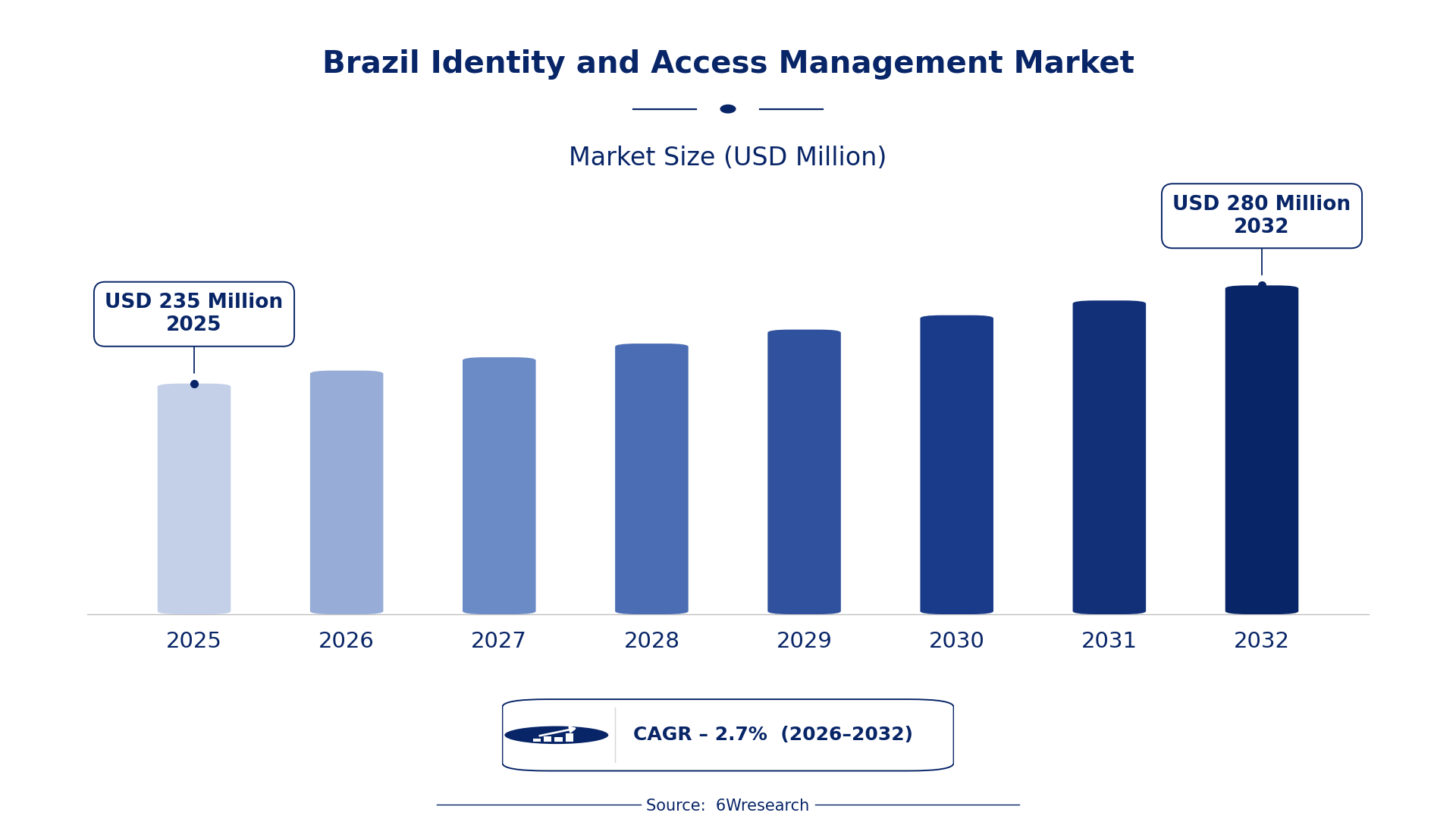
The Brazil Identity and Access Management Market was estimated at USD 235 Million in 2025 and is projected to reach USD 280 Million by 2032, growing at a CAGR of 2.7% from 2026 to 2032.
Brazil Identity and Access Management Market Synopsis
The Brazil Identity and Access Management market has seen a surge in interest as businesses increasingly grapple with digital security challenges. Recent investments reflect a strong commitment to safeguarding digital identities, yet the market is set for a period of significant evolution as companies aim to enhance user experiences while maintaining strict compliance with regulations.
Future trajectories suggest a dual focus on advanced technology integration and user-centric solutions, addressing the growing concerns surrounding identity theft and unauthorized access. As cloud services gain traction, organizations will continue to reassess their identity management strategies, driving sustained market growth.
Brazil Identity and Access Management Market Year-wise Growth Rate and Key Drivers
This graph illustrates the annual growth rates of the Brazil Identity and Access Management Market from 2021 to 2032, highlighting a steady upward trajectory and projected expansion over the forecast period.
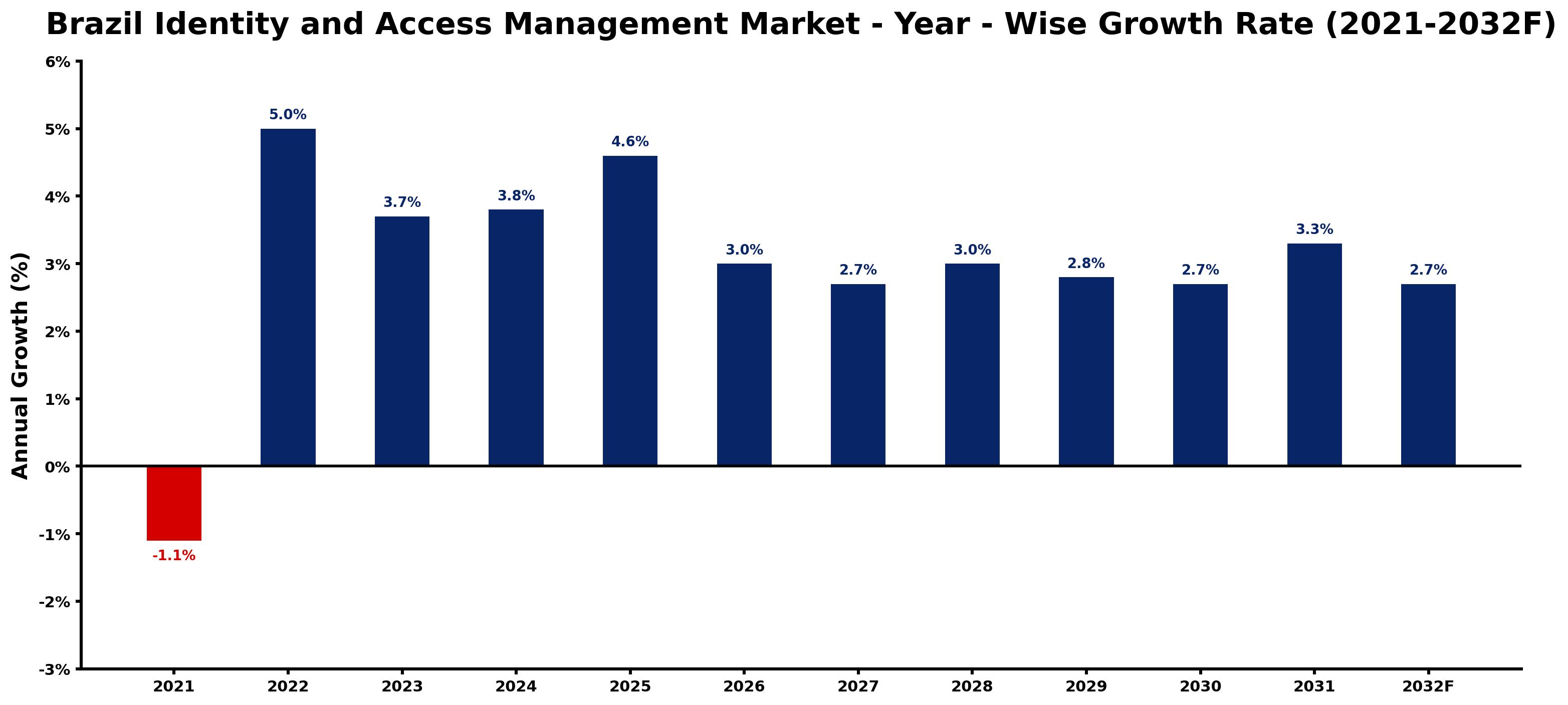
The table below presents the year‑wise growth rates along with the key drivers influencing the market
| Year | Growth Rate | Major Drivers |
| 2021 | -1.1% | Government's LGPD compliance led to slower investments. |
| 2022 | 5.0% | Brazilian government mandates digital identity verification for services. |
| 2023 | 3.7% | Growing biometric adoption in financial services sector. |
| 2024 | 3.8% | Increased focus on cybersecurity due to data breach incidents. |
| 2025 | 4.6% | Corporate compliance with LGPD drives identity management solutions. |
| 2026 | 3.0% | Rise in remote work boosts demand for access management. |
| 2027 | 2.7% | Healthcare sector enhances security with advanced identity solutions. |
| 2028 | 3.0% | E-commerce growth necessitates robust customer identity solutions. |
| 2029 | 2.8% | Investments in government digitalization initiatives enhance IAM needs. |
| 2030 | 2.7% | Increased awareness of identity theft drives consumer demand. |
| 2031 | 3.3% | Smart city projects incorporate innovative identity management technologies. |
| 2032 | 2.7% | Financial institutions boost IAM to comply with regulations. |
Note: Market size estimations and growth projections presented in this report are based on 6Wresearch's proprietary forecasting methodology, utilizing the latest available industry data, government publications, and primary research inputs.
Brazil Identity and Access Management Market Key Takeaways
Below are some of the specific key takeaways from the market, including:
- The increasing implementation of cloud-based IAM solutions is reshaping the market dynamics.
- Regulatory compliance is becoming a critical driver as organizations seek to meet new data protection standards.
- Identity theft concerns are propelling the demand for advanced user authentication methods.
- Integration challenges with legacy systems remain a barrier for many organizations transitioning to IAM solutions.
- User experience enhancements are essential for fostering customer trust and satisfaction.
Evaluation of Restraints in Brazil Identity and Access Management Market
The Brazil Identity and Access Management market is hindered by integration complexities as organizations struggle to adapt existing IT frameworks to modern IAM solutions. Concerns around user authentication methods also persist, with many businesses finding it challenging to balance stringent security measures with user-friendliness. Furthermore, the regulatory environment can be confusing, making compliance a daunting task for organizations looking to protect sensitive data while maintaining operational efficiency. This situation necessitates a critical focus on developing adaptable IAM solutions that can cater to diverse IT ecosystems.
Brazil Identity and Access Management Market Trends
Key trends shaping the Brazil Identity and Access Management market include the rise of biometric authentication technologies and multi-factor authentication processes. These methods are rapidly gaining traction as organizations prioritize enhanced security protocols. Additionally, there is a growing emphasis on integrating artificial intelligence to streamline identity verification processes and monitor user behavior for suspicious activity. As the adoption of remote work accelerates, IAM solutions that facilitate secure access to resources from various locations are increasingly crucial.
Brazil Identity and Access Management Market Opportunities
The demand for identity verification services presents lucrative opportunities for growth. Organizations that can offer innovative solutions tailored to specific industry needs, such as financial services and healthcare, are likely to thrive. The market is ripe for expansion, particularly in developing sophisticated IAM frameworks that comply with evolving regulations while enhancing user experiences. Furthermore, partnerships between tech firms and governmental organizations can facilitate the establishment of standardized identity management protocols, benefiting the entire ecosystem.
Government Initiatives in the Brazil Identity and Access Management Market
Government regulations are significantly influencing the Brazil Identity and Access Management market. By implementing frameworks that prioritize digital identity standards, the government aims to ensure secure access to digital services across various sectors. These initiatives enhance interoperability and aim to establish robust authentication practices, crucial for a secure digital environment.
- A recently completed regulatory framework introduced in 2025 mandates comprehensive data protection measures for IAM solutions.
- Current initiatives are underway to develop a national digital identity program, enhancing citizen access to government services.
- A planned public-private partnership expected to launch by 2027 will focus on establishing a unified digital identity infrastructure.
- Ongoing efforts to create a national certification body for IAM solutions are aimed at standardizing security practices across the market.
Future Insights of the Brazil Identity and Access Management Market
Looking ahead to 2026-2032, the Brazil Identity and Access Management market is set for transformative changes. Organizations will increasingly adopt adaptive IAM frameworks that not only comply with regulations but also offer streamlined user experiences. With ongoing advancements in artificial intelligence and machine learning, solutions will evolve to provide proactive security measures against emerging threats. The convergence of these technologies with evolving regulations promises a future where IAM is integral to business operations across sectors.
Brazil Identity and Access Management Market Latest Developments
The last 12-14 months in the Brazil Identity and Access Management market have been characterized by several key developments, as organizations accelerate their investments in security solutions. The push for compliance and enhanced user experience has driven technological advancements, fostering innovation among IAM providers.
- A major technology vendor announced the rollout of a new cloud-based IAM solution designed to enhance scalability and integration, launched in Q2 2025.
- In early 2025, a significant partnership was established between regional firms to develop a biometric authentication framework aimed at financial institutions.
- A recent initiative focused on increasing public awareness regarding the importance of identity protection started in late 2025 and remains ongoing.
- A planned service upgrade for an existing IAM platform is set to enhance multi-factor authentication capabilities, expected to be completed by mid-2026.
Brazil Identity and Access Management Market - Key Attractiveness of the Report
- 10 Years of Market Numbers
- Historical Data Starting from 2022 to 2025
- Base Year: 2025
- Forecast Data until 2032
- Key Performance Indicators Impacting the Market
- Major Upcoming Developments and Projects
Key Highlights of the Report:
- Brazil Identity and Access Management Market Outlook
- Market Size of Brazil Identity and Access Management Market, 2025
- Forecast of Brazil Identity and Access Management Market, 2032
- Historical Data and Forecast of Brazil Identity and Access Management Revenues & Volume for the Period 2022-2032F
- Brazil Identity and Access Management Market Trend Evolution
- Brazil Identity and Access Management Market Drivers and Challenges
- Brazil Identity and Access Management Price Trends
- Brazil Identity and Access Management Porter's Five Forces
- Brazil Identity and Access Management Industry Life Cycle
- Historical Data and Forecast of Brazil Identity and Access Management Market Revenues & Volume By Component for the Period 2022-2032F
- Historical Data and Forecast of Brazil Identity and Access Management Market Revenues & Volume By Solutions for the Period 2022-2032F
- Historical Data and Forecast of Brazil Identity and Access Management Market Revenues & Volume By Services for the Period 2022-2032F
- Historical Data and Forecast of Brazil Identity and Access Management Market Revenues & Volume By Solution for the Period 2022-2032F
- Historical Data and Forecast of Brazil Identity and Access Management Market Revenues & Volume By Data Directory for the Period 2022-2032F
- Historical Data and Forecast of Brazil Identity and Access Management Market Revenues & Volume By Identity Lifecycle Management for the Period 2022-2032F
- Historical Data and Forecast of Brazil Identity and Access Management Market Revenues & Volume By Deployment Mode for the Period 2022-2032F
- Historical Data and Forecast of Brazil Identity and Access Management Market Revenues & Volume By Cloud for the Period 2022-2032F
- Historical Data and Forecast of Brazil Identity and Access Management Market Revenues & Volume By On-premises for the Period 2022-2032F
- Historical Data and Forecast of Brazil Identity and Access Management Market Revenues & Volume By Organization Size for the Period 2022-2032F
- Historical Data and Forecast of Brazil Identity and Access Management Market Revenues & Volume By SMEs for the Period 2022-2032F
- Historical Data and Forecast of Brazil Identity and Access Management Market Revenues & Volume By Large Enterprises for the Period 2022-2032F
- Historical Data and Forecast of Brazil Identity and Access Management Market Revenues & Volume By Vertical for the Period 2022-2032F
- Historical Data and Forecast of Brazil Identity and Access Management Market Revenues & Volume By BFSI for the Period 2022-2032F
- Historical Data and Forecast of Brazil Identity and Access Management Market Revenues & Volume By Travel and Hospitality for the Period 2022-2032F
- Historical Data and Forecast of Brazil Identity and Access Management Market Revenues & Volume By Healthcare for the Period 2022-2032F
- Historical Data and Forecast of Brazil Identity and Access Management Market Revenues & Volume By Retail and eCommerce for the Period 2022-2032F
- Historical Data and Forecast of Brazil Identity and Access Management Market Revenues & Volume By IT and ITeS for the Period 2022-2032F
- Historical Data and Forecast of Brazil Identity and Access Management Market Revenues & Volume By Education for the Period 2022-2032F
- Historical Data and Forecast of Brazil Identity and Access Management Market Revenues & Volume By Others (Energy and Utilities, Telecommunication, Other Citizen Services) for the Period 2022-2032F
- Brazil Identity and Access Management Import Export Trade Statistics
- Market Opportunity Assessment By Component
- Market Opportunity Assessment By Solution
- Market Opportunity Assessment By Deployment Mode
- Market Opportunity Assessment By Organization Size
- Market Opportunity Assessment By Vertical
- Brazil Identity and Access Management Top Companies Market Share
- Brazil Identity and Access Management Competitive Benchmarking By Technical and Operational Parameters
- Brazil Identity and Access Management Company Profiles
- Brazil Identity and Access Management Key Strategic Recommendations






































