United States (US) Identity and Access Management Market Size & Growth Rate (2026-2032)
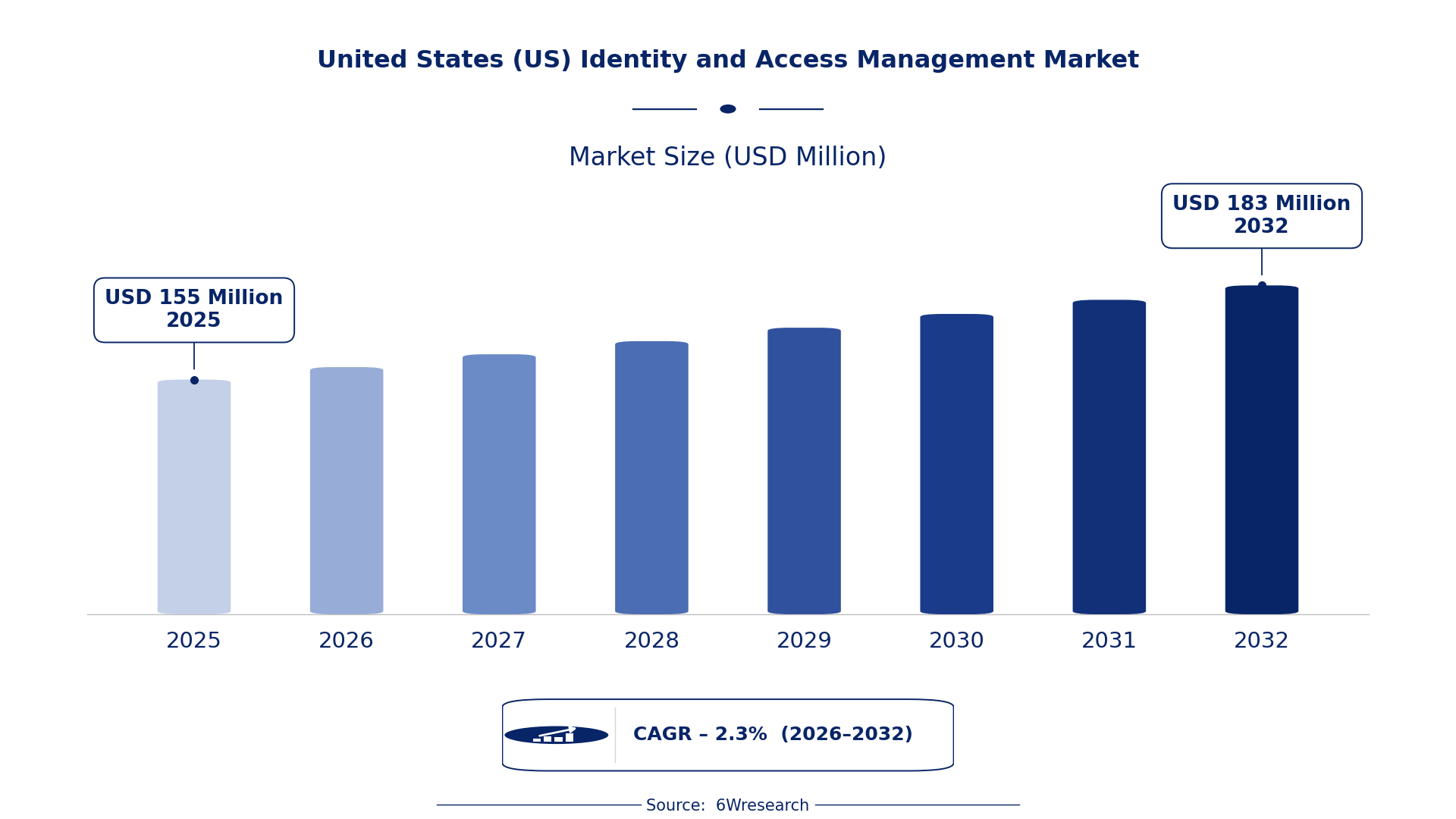
The United States (US) Identity and Access Management Market was estimated at USD 155 Million in 2025 and is projected to reach USD 183 Million by 2032, growing at a CAGR of 2.3% from 2026 to 2032.
United States (US) Identity and Access Management Market Synopsis
The escalating threat of cyberattacks is the primary force influencing the United States Identity and Access Management (IAM) market. Organizations across various sectors are recognizing the need for robust solutions to manage identities and control access to sensitive data effectively.
As businesses increasingly adopt cloud technologies and remote work models, the IAM market is evolving. The integration of advanced security features such as multi-factor authentication and biometrics is becoming essential to ensure that only authorized users gain access to critical systems.
United States (US) Identity and Access Management Market Year-wise Growth Rate and Key Drivers
This graph illustrates the annual growth rates of the United States (US) Identity and Access Management Market from 2021 to 2032, highlighting a steady upward trajectory and projected expansion over the forecast period.
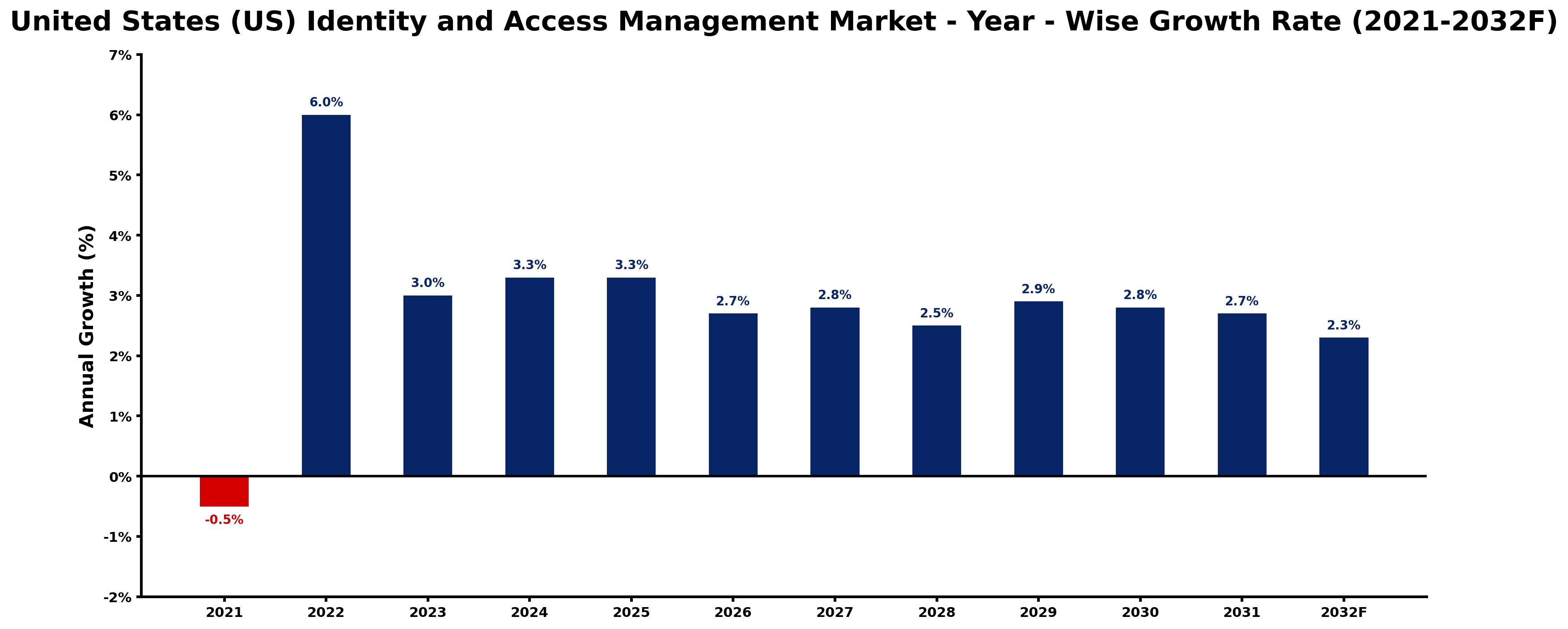
The table below presents the year‑wise growth rates along with the key drivers influencing the market
| Year | Growth Rate | Major Drivers |
| 2021 | -0.5% | Increased focus on zero trust security models adopted. |
| 2022 | 6.0% | Cybersecurity Maturity Model Certification mandates drive IAM investments |
| 2023 | 3.0% | Increase in identity theft cases raises demand for IAM solutions |
| 2024 | 3.3% | Rising biometric authentication use in financial services sector |
| 2025 | 3.3% | Federal agencies prioritize zero-trust security frameworks adoption |
| 2026 | 2.7% | Growth in compliance regulations enhances identity verification needs |
| 2027 | 2.8% | Surge in cloud migration increases IAM solution utilization |
| 2028 | 2.5% | Development of IoT devices amplifies access management requirements |
| 2029 | 2.9% | Enhanced privacy laws drive demand for secure digital identities |
| 2030 | 2.8% | Government initiatives promote secure online identity frameworks |
| 2031 | 2.7% | Healthcare sector's shift to telehealth boosts IAM services |
| 2032 | 2.3% | E-commerce growth necessitates stronger identity management systems |
Note: Market size estimations and growth projections presented in this report are based on 6Wresearch's proprietary forecasting methodology, utilizing the latest available industry data, government publications, and primary research inputs.
United States (US) Identity and Access Management Market Key Takeaways
Below are some of the specific key takeaways from the market, including:
- The growing emphasis on data security drives the demand for advanced IAM solutions.
- Cloud-based IAM solutions are being widely adopted across multiple sectors.
- Multi-factor authentication is increasingly favored for user verification.
- The regulatory environment mandates stricter compliance with data protection laws.
- Integration of AI and machine learning technologies enhances threat detection capabilities.
Evaluation of Restraints in United States (US) Identity and Access Management Market
Several key factors are restraining the growth of the IAM market in the United States. The complexity of IT environments has surged as organizations increasingly implement multi-cloud strategies, making identity management cumbersome. Furthermore, sophisticated cyber threats necessitate constant updates to security measures, which can be resource-intensive. The challenge of balancing security protocols with user experience adds another layer of complexity. Lastly, the human element remains critical; organizations often struggle to maintain effective training and awareness programs around IAM practices.
United States (US) Identity and Access Management Market Trends
The current trajectory of the IAM market is marked by several noteworthy trends. Cloud adoption continues to rise, compelling organizations to invest in scalable IAM solutions that can adapt to dynamic business needs. Multi-factor authentication is no longer optional; it has become a fundamental requirement for securing user access. Additionally, the utilization of biometrics is gaining traction as organizations aim to enhance security. AI and machine learning technologies are now being integrated into IAM solutions, providing advanced analytics for threat detection and continuous monitoring.
United States (US) Identity and Access Management Market Opportunities
Investment opportunities abound in the IAM market, primarily due to heightened awareness surrounding cybersecurity. Organizations are actively seeking IAM solutions to protect digital assets, leading to a surge in demand. Key growth areas include cloud-based IAM, multi-factor authentication technologies, and identity governance tools. The ongoing trend of remote work continues to drive the need for robust IAM solutions that can accommodate a mobile workforce securely. Those investing in innovative IAM technologies and forming strategic partnerships with cybersecurity firms will likely benefit from this expanding market.
Government Initiatives in the United States (US) Identity and Access Management Market
Government policy plays a crucial role in shaping the Identity and Access Management (IAM) market in the United States. The regulatory framework prioritizes cybersecurity, emphasizing the need for stringent IAM practices across both public and private sectors. Various initiatives aim to enhance digital identity verification and protect sensitive information, reflecting a growing commitment to strengthen cybersecurity measures.
- A recently completed initiative, the NIST Special Publication 800-63 series, established guidelines for digital identity verification to enhance security protocols.
- A current program under the Federal Information Security Modernization Act (FISMA) mandates federal agencies to implement IAM controls to secure sensitive data.
- An upcoming plan focuses on expanding the Federal Identity, Credential, and Access Management (FICAM) program to improve access to government resources securely.
- Ongoing efforts are aimed at developing a national cybersecurity strategy that includes robust IAM frameworks for businesses.
Future Insights of the United States (US) Identity and Access Management Market
Looking ahead to 2026-2032, the IAM market in the United States is set for substantial growth. As organizations increasingly prioritize data security, the demand for advanced IAM solutions featuring multi-factor authentication and identity governance will soar. The ongoing transition to remote work and cloud computing will necessitate innovative security measures to manage access effectively. Additionally, further integration of AI and machine learning into IAM solutions is expected to improve threat detection and response capabilities, marking a significant shift in the market's approach to identity management.
United States (US) Identity and Access Management Market Latest Developments
The IAM market in the United States has seen dynamic activity in recent months, reflecting a strong push towards enhanced security solutions. Various organizations are ramping up their investments in IAM technologies to address emerging threats and compliance requirements.
- A leading technology vendor launched a comprehensive IAM platform aimed at streamlining user access controls in early 2025.
- An initiative that began in late 2024 is currently underway, focusing on integrating AI-driven analytics into existing IAM frameworks.
- A major financial institution is implementing an advanced multi-factor authentication system, with completion expected by mid-2026.
- A rollout expected to begin in the second half of 2026 is aimed at enhancing biometric authentication across various sectors.
United States (US) Identity and Access Management Market - Key Attractiveness of the Report
- 10 Years of Market Numbers
- Historical Data Starting from 2022 to 2025
- Base Year: 2025
- Forecast Data until 2032
- Key Performance Indicators Impacting the Market
- Major Upcoming Developments and Projects
Key Highlights of the Report:
- United States (US) Identity and Access Management Market Outlook
- Market Size of United States (US) Identity and Access Management Market, 2025
- Forecast of United States (US) Identity and Access Management Market, 2032
- Historical Data and Forecast of United States (US) Identity and Access Management Revenues & Volume for the Period 2022-2032F
- United States (US) Identity and Access Management Market Trend Evolution
- United States (US) Identity and Access Management Market Drivers and Challenges
- United States (US) Identity and Access Management Price Trends
- United States (US) Identity and Access Management Porter's Five Forces
- United States (US) Identity and Access Management Industry Life Cycle
- Historical Data and Forecast of United States (US) Identity and Access Management Market Revenues & Volume By Component for the Period 2022-2032F
- Historical Data and Forecast of United States (US) Identity and Access Management Market Revenues & Volume By Solutions for the Period 2022-2032F
- Historical Data and Forecast of United States (US) Identity and Access Management Market Revenues & Volume By Services for the Period 2022-2032F
- Historical Data and Forecast of United States (US) Identity and Access Management Market Revenues & Volume By Solution for the Period 2022-2032F
- Historical Data and Forecast of United States (US) Identity and Access Management Market Revenues & Volume By Data Directory for the Period 2022-2032F
- Historical Data and Forecast of United States (US) Identity and Access Management Market Revenues & Volume By Identity Lifecycle Management for the Period 2022-2032F
- Historical Data and Forecast of United States (US) Identity and Access Management Market Revenues & Volume By Deployment Mode for the Period 2022-2032F
- Historical Data and Forecast of United States (US) Identity and Access Management Market Revenues & Volume By Cloud for the Period 2022-2032F
- Historical Data and Forecast of United States (US) Identity and Access Management Market Revenues & Volume By On-premises for the Period 2022-2032F
- Historical Data and Forecast of United States (US) Identity and Access Management Market Revenues & Volume By Organization Size for the Period 2022-2032F
- Historical Data and Forecast of United States (US) Identity and Access Management Market Revenues & Volume By SMEs for the Period 2022-2032F
- Historical Data and Forecast of United States (US) Identity and Access Management Market Revenues & Volume By Large Enterprises for the Period 2022-2032F
- Historical Data and Forecast of United States (US) Identity and Access Management Market Revenues & Volume By Vertical for the Period 2022-2032F
- Historical Data and Forecast of United States (US) Identity and Access Management Market Revenues & Volume By BFSI for the Period 2022-2032F
- Historical Data and Forecast of United States (US) Identity and Access Management Market Revenues & Volume By Travel and Hospitality for the Period 2022-2032F
- Historical Data and Forecast of United States (US) Identity and Access Management Market Revenues & Volume By Healthcare for the Period 2022-2032F
- Historical Data and Forecast of United States (US) Identity and Access Management Market Revenues & Volume By Retail and eCommerce for the Period 2022-2032F
- Historical Data and Forecast of United States (US) Identity and Access Management Market Revenues & Volume By IT and ITeS for the Period 2022-2032F
- Historical Data and Forecast of United States (US) Identity and Access Management Market Revenues & Volume By Education for the Period 2022-2032F
- Historical Data and Forecast of United States (US) Identity and Access Management Market Revenues & Volume By Others (Energy and Utilities, Telecommunication, Other Citizen Services) for the Period 2022-2032F
- United States (US) Identity and Access Management Import Export Trade Statistics
- Market Opportunity Assessment By Component
- Market Opportunity Assessment By Solution
- Market Opportunity Assessment By Deployment Mode
- Market Opportunity Assessment By Organization Size
- Market Opportunity Assessment By Vertical
- United States (US) Identity and Access Management Top Companies Market Share
- United States (US) Identity and Access Management Competitive Benchmarking By Technical and Operational Parameters
- United States (US) Identity and Access Management Company Profiles
- United States (US) Identity and Access Management Key Strategic Recommendations






































