Brazil Integrated Cloud Management Platform Market Size & Growth Rate (2026-2032)
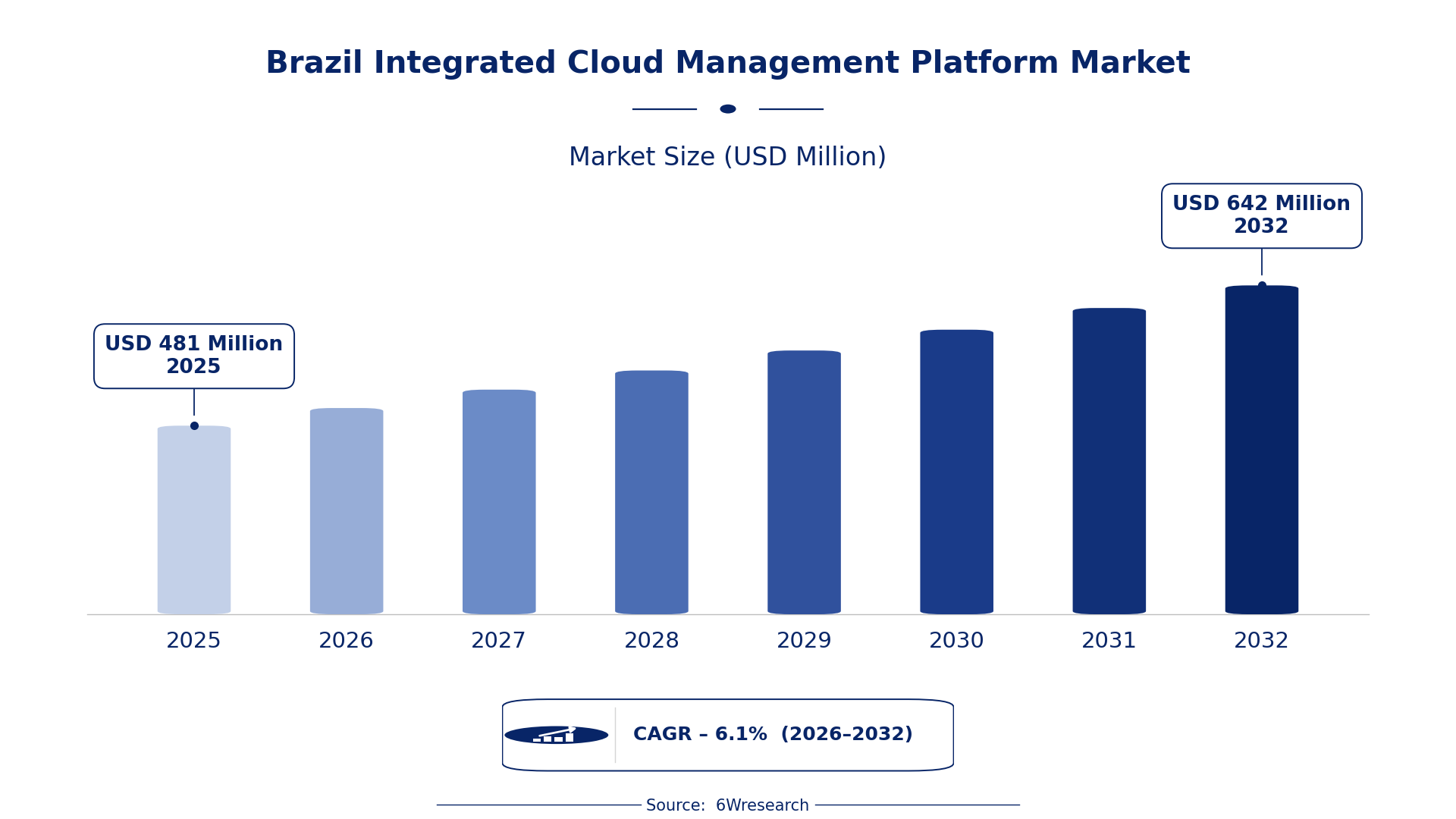
The Brazil Integrated Cloud Management Platform Market was estimated at USD 481 Million in 2025 and is projected to reach USD 642 Million by 2032, growing at a CAGR of 6.1% from 2026 to 2032.
Brazil Integrated Cloud Management Platform Market Synopsis
The most pressing factor currently influencing the Brazil Integrated Cloud Management Platform Market is the complexity associated with managing multi-cloud environments. Organizations are increasingly recognizing that centralized management can help overcome the operational inefficiencies tied to disparate cloud systems.
As businesses strive for enhanced performance and cost control, integrated platforms that provide comprehensive monitoring, provisioning, and optimization capabilities are in demand. This shift is not merely a trend; it reflects a strategic necessity for organizations aiming to thrive in a competitive digital landscape.
Brazil Integrated Cloud Management Platform Market Year-wise Growth Rate and Key Drivers
This graph illustrates the annual growth rates of the Brazil Integrated Cloud Management Platform Market from 2021 to 2032, highlighting a steady upward trajectory and projected expansion over the forecast period.
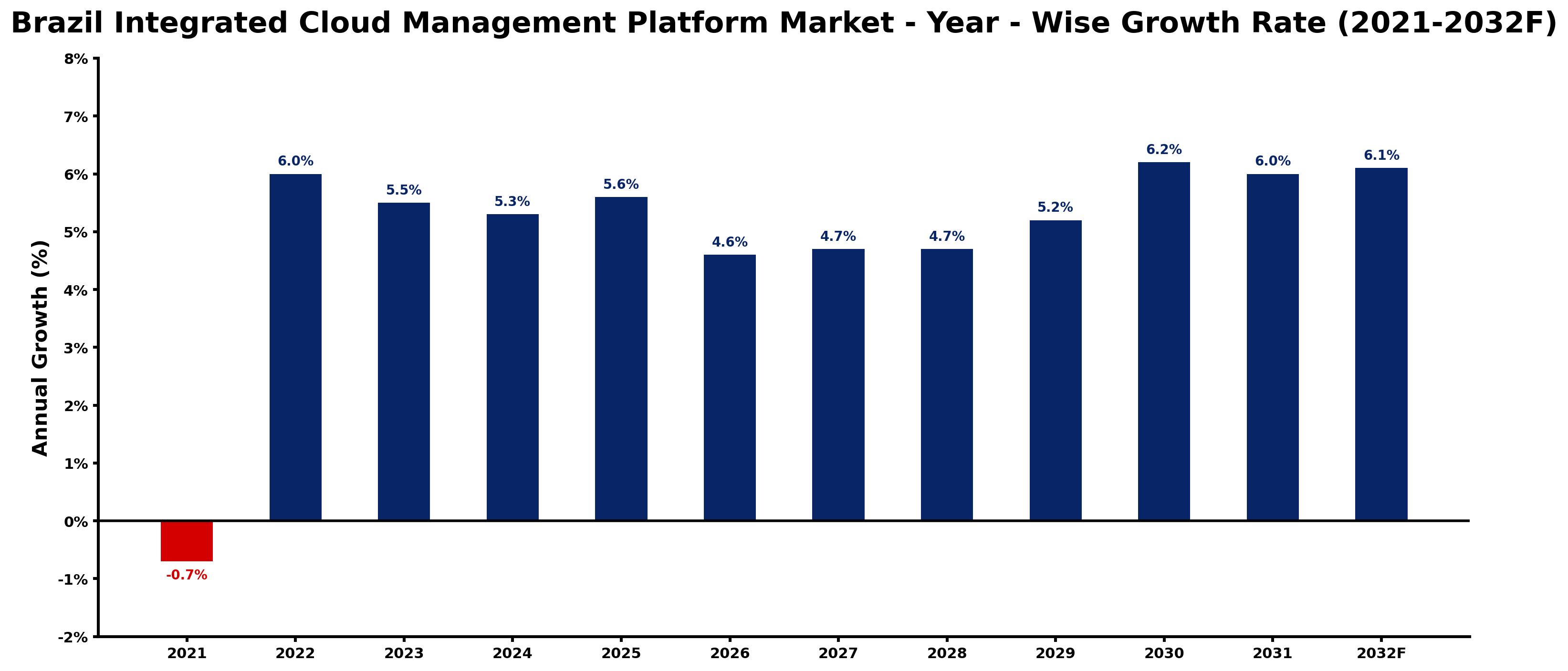
The table below presents the year‑wise growth rates along with the key drivers influencing the market
| Year | Growth Rate | Major Drivers |
| 2021 | -0.7% | Amazon Web Services dominance limits local players' growth. |
| 2022 | 6.0% | Increased demand for digital transformation in Brazilian SMEs. |
| 2023 | 5.5% | Government tax incentives promoting cloud adoption in businesses. |
| 2024 | 5.3% | Rising remote work trends driving cloud service utilization. |
| 2025 | 5.6% | Brazil's National Cybersecurity Strategy enhancing cloud security needs. |
| 2026 | 4.6% | Growth in e-commerce platforms requiring scalable cloud management. |
| 2027 | 4.7% | Rise in data privacy regulations boosting cloud compliance solutions. |
| 2028 | 4.7% | Adoption of IoT devices increasing data storage requirements. |
| 2029 | 5.2% | Local tech hubs fostering innovation in cloud technologies. |
| 2030 | 6.2% | Increased focus on disaster recovery solutions among enterprises. |
| 2031 | 6.0% | Collaborations between telecoms and cloud providers enhancing services. |
| 2032 | 6.1% | Growing enterprise partnerships driving specialized cloud solutions. |
Note: Market size estimations and growth projections presented in this report are based on 6Wresearch's proprietary forecasting methodology, utilizing the latest available industry data, government publications, and primary research inputs.
Brazil Integrated Cloud Management Platform Market Key Takeaways
Below are some of the specific key takeaways from the market, including:
- Organizations are prioritizing integrated cloud management to streamline operations and enhance efficiency.
- Complexity in hybrid and multi-cloud environments is driving the need for sophisticated management solutions.
- Cost optimization remains a critical focus for businesses leveraging cloud technology.
- Government initiatives are fostering an environment conducive to cloud innovation and interoperability.
- Adoption rates of integrated platforms are expected to accelerate as more enterprises recognize their benefits.
Evaluation of Restraints in Brazil Integrated Cloud Management Platform Market
Despite the positive trajectory of the Brazil Integrated Cloud Management Platform Market, organizations face notable restraints. Integration challenges between various cloud platforms and existing legacy systems remain a significant barrier. Many businesses struggle with maintaining consistent performance and managing costs across multiple vendors. This fragmentation can hinder operational efficiency and complicate governance. Additionally, the scarcity of skilled professionals proficient in these integrated solutions further exacerbates the situation, limiting broader adoption.
Brazil Integrated Cloud Management Platform Market Trends
Current trends indicate a growing reliance on automation and AI-driven analytics within integrated cloud management platforms. Businesses are increasingly seeking solutions that not only manage cloud resources but also provide predictive insights for better decision-making. on top of that, the rise of remote work has intensified the demand for secure, scalable, and efficient cloud solutions, making integrated platforms more appealing.
Brazil Integrated Cloud Management Platform Market Opportunities
There are ample opportunities for growth within the Brazil Integrated Cloud Management Platform Market. Companies that focus on enhancing interoperability between different cloud solutions are well-positioned to capture market share. Additionally, as organizations shift towards hybrid models, platforms that can offer seamless integration and management across diverse environments will thrive. The growing emphasis on data security and compliance also presents avenues for specialized management solutions catering to these needs.
Government Initiatives in the Brazil Integrated Cloud Management Platform Market
The Brazilian government's commitment to digital transformation is a driving force behind the growth of the integrated cloud management platform market. Policies aimed at fostering technology adoption and enhancing cloud governance frameworks are critical. Such government initiatives are designed to encourage businesses to invest in integrated solutions that streamline cloud operations and promote innovation.
- A recently completed initiative introduced a regulatory framework mandating interoperability standards for cloud services.
- Current efforts include a national digital infrastructure upgrade programme, which aims to enhance cloud accessibility and performance across public and private sectors.
- A planned public-private partnership is expected to launch in 2026, focusing on developing cloud governance frameworks to promote secure cloud adoption.
- Ongoing workshops and training programs are being implemented to address the skills gap in cloud management, aiming to boost local expertise.
- Upcoming policy changes anticipated in 2027 will mandate clearer billing practices for cloud services, enhancing transparency for users.
Future Insights of the Brazil Integrated Cloud Management Platform Market
Looking ahead, the Brazil Integrated Cloud Management Platform Market is set for continued growth. As enterprises further embrace digital transformation, the demand for integrated platforms that facilitate agile and efficient cloud management will intensify. The shift towards hybrid and multi-cloud environments will remain a dominant theme, compelling providers to innovate and refine their offerings. Enhanced security features and compliance capabilities will also emerge as priorities, steering organizations toward solutions that can effectively manage risks while maximizing operational efficiency.
Brazil Integrated Cloud Management Platform Market Latest Developments
In the past year, the Brazil Integrated Cloud Management Platform Market has seen significant developments as companies adapt to changing demands and technologies. Investment in cloud-based solutions has surged, driven by a focus on efficiency and cost management. As a result, various companies have rolled out new features and services aimed at enhancing user experience and operational performance.
- A major technology vendor launched an updated version of its integrated cloud management platform in Q2 2025, introducing AI-powered analytics for performance monitoring.
- An initiative that began in early 2025 is currently underway, focusing on enhancing interoperability between multiple cloud services for smoother operations.
- By late 2025, a leading regional operator is expected to complete a project that integrates cloud management tools with existing enterprise resource planning systems.
- A new partnership between cloud service providers initiated in mid-2025 aims to develop standardized protocols for data management across platforms.
- Plans are in place for a new training program to be introduced in Q3 2026, targeting cloud management skills to support the growing demand in the market.
Brazil Integrated Cloud Management Platform Market - Key Attractiveness of the Report
- 10 Years of Market Numbers
- Historical Data Starting from 2022 to 2025
- Base Year: 2025
- Forecast Data until 2032
- Key Performance Indicators Impacting the Market
- Major Upcoming Developments and Projects
Key Highlights of the Report:
- Brazil Integrated Cloud Management Platform Market Outlook
- Market Size of Brazil Integrated Cloud Management Platform Market, 2025
- Forecast of Brazil Integrated Cloud Management Platform Market, 2032
- Historical Data and Forecast of Brazil Integrated Cloud Management Platform Revenues & Volume for the Period 2022-2032F
- Brazil Integrated Cloud Management Platform Market Trend Evolution
- Brazil Integrated Cloud Management Platform Market Drivers and Challenges
- Brazil Integrated Cloud Management Platform Price Trends
- Brazil Integrated Cloud Management Platform Porter's Five Forces
- Brazil Integrated Cloud Management Platform Industry Life Cycle
- Historical Data and Forecast of Brazil Integrated Cloud Management Platform Market Revenues & Volume By Component for the Period 2022-2032F
- Historical Data and Forecast of Brazil Integrated Cloud Management Platform Market Revenues & Volume By Solutions for the Period 2022-2032F
- Historical Data and Forecast of Brazil Integrated Cloud Management Platform Market Revenues & Volume By Services for the Period 2022-2032F
- Historical Data and Forecast of Brazil Integrated Cloud Management Platform Market Revenues & Volume By Vertical for the Period 2022-2032F
- Historical Data and Forecast of Brazil Integrated Cloud Management Platform Market Revenues & Volume By BFSI for the Period 2022-2032F
- Historical Data and Forecast of Brazil Integrated Cloud Management Platform Market Revenues & Volume By IT and Telecom for the Period 2022-2032F
- Historical Data and Forecast of Brazil Integrated Cloud Management Platform Market Revenues & Volume By Government and Public Sector for the Period 2022-2032F
- Historical Data and Forecast of Brazil Integrated Cloud Management Platform Market Revenues & Volume By Manufacturing for the Period 2022-2032F
- Historical Data and Forecast of Brazil Integrated Cloud Management Platform Market Revenues & Volume By Retail and Consumer Goods for the Period 2022-2032F
- Historical Data and Forecast of Brazil Integrated Cloud Management Platform Market Revenues & Volume By Healthcare and Lifesciences for the Period 2022-2032F
- Historical Data and Forecast of Brazil Integrated Cloud Management Platform Market Revenues & Volume By Energy and Utilities for the Period 2022-2032F
- Historical Data and Forecast of Brazil Integrated Cloud Management Platform Market Revenues & Volume By Others for the Period 2022-2032F
- Historical Data and Forecast of Brazil Integrated Cloud Management Platform Market Revenues & Volume By Organization Size for the Period 2022-2032F
- Historical Data and Forecast of Brazil Integrated Cloud Management Platform Market Revenues & Volume By SMEs for the Period 2022-2032F
- Historical Data and Forecast of Brazil Integrated Cloud Management Platform Market Revenues & Volume By Large Enterprises for the Period 2022-2032F
- Brazil Integrated Cloud Management Platform Import Export Trade Statistics
- Market Opportunity Assessment By Component
- Market Opportunity Assessment By Vertical
- Market Opportunity Assessment By Organization Size
- Brazil Integrated Cloud Management Platform Top Companies Market Share
- Brazil Integrated Cloud Management Platform Competitive Benchmarking By Technical and Operational Parameters
- Brazil Integrated Cloud Management Platform Company Profiles
- Brazil Integrated Cloud Management Platform Key Strategic Recommendations






































