Brazil IoT Connectivity Market Size & Growth Rate (2026-2032)
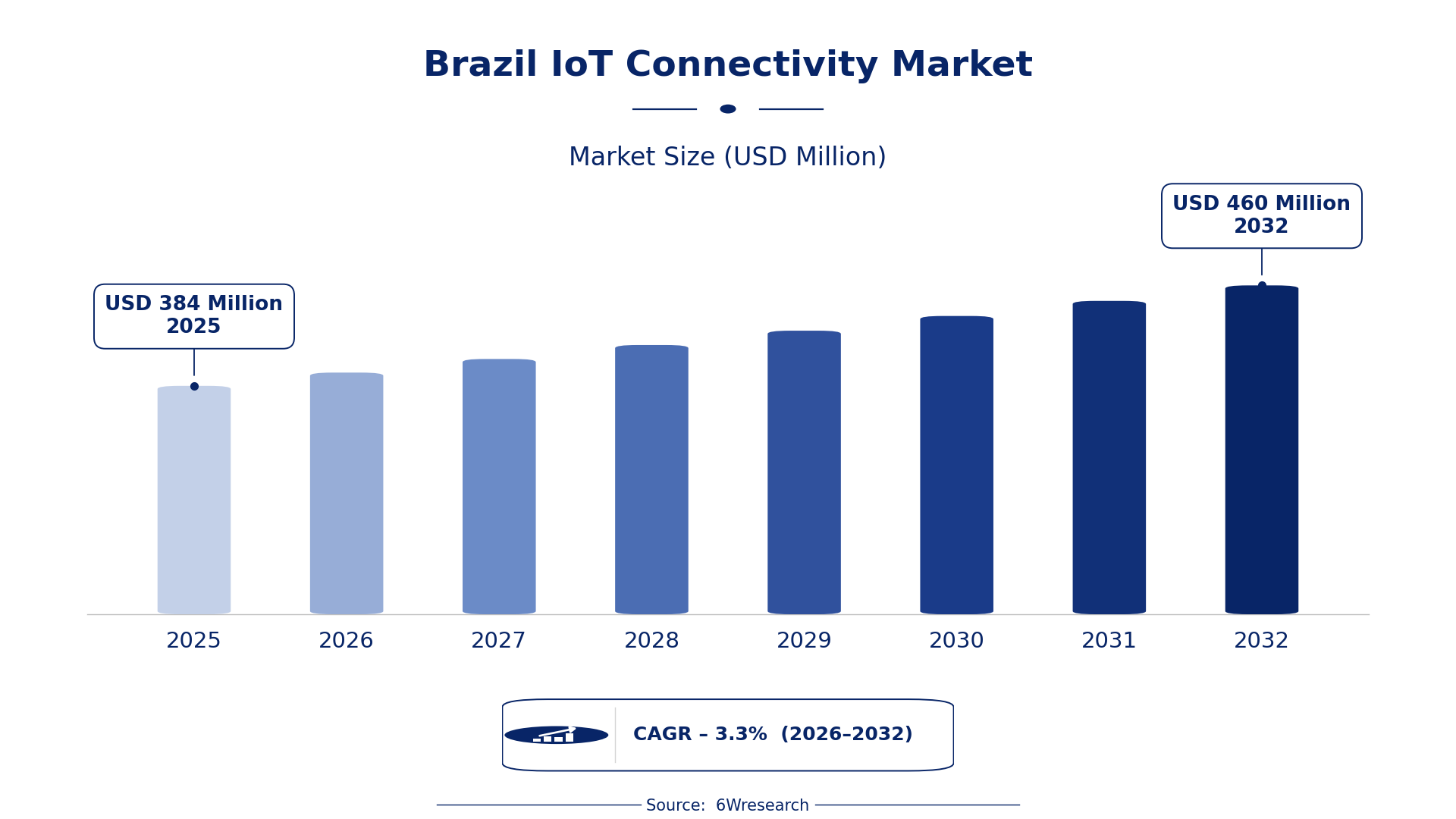
The Brazil IoT Connectivity Market was estimated at USD 384 Million in 2025 and is projected to reach USD 460 Million by 2032, growing at a CAGR of 3.3% from 2026 to 2032.
Brazil IoT Connectivity Market Synopsis
The IoT connectivity market in Brazil is currently on an upward trajectory, reflecting a surge in the adoption of IoT devices across various sectors. As organizations increasingly seek to harness the power of data-driven insights, the need for reliable connectivity solutions has become paramount.
Looking ahead, the market is expected to continue expanding, propelled by advancements in network technologies such as LPWAN, cellular, and satellite. These innovations are crucial for facilitating efficient communication among devices, ultimately driving operational efficiencies and unlocking new avenues for innovation.
Brazil IoT Connectivity Market Year-wise Growth Rate and Key Drivers
This graph illustrates the annual growth rates of the Brazil IoT Connectivity Market from 2021 to 2032, highlighting a steady upward trajectory and projected expansion over the forecast period.
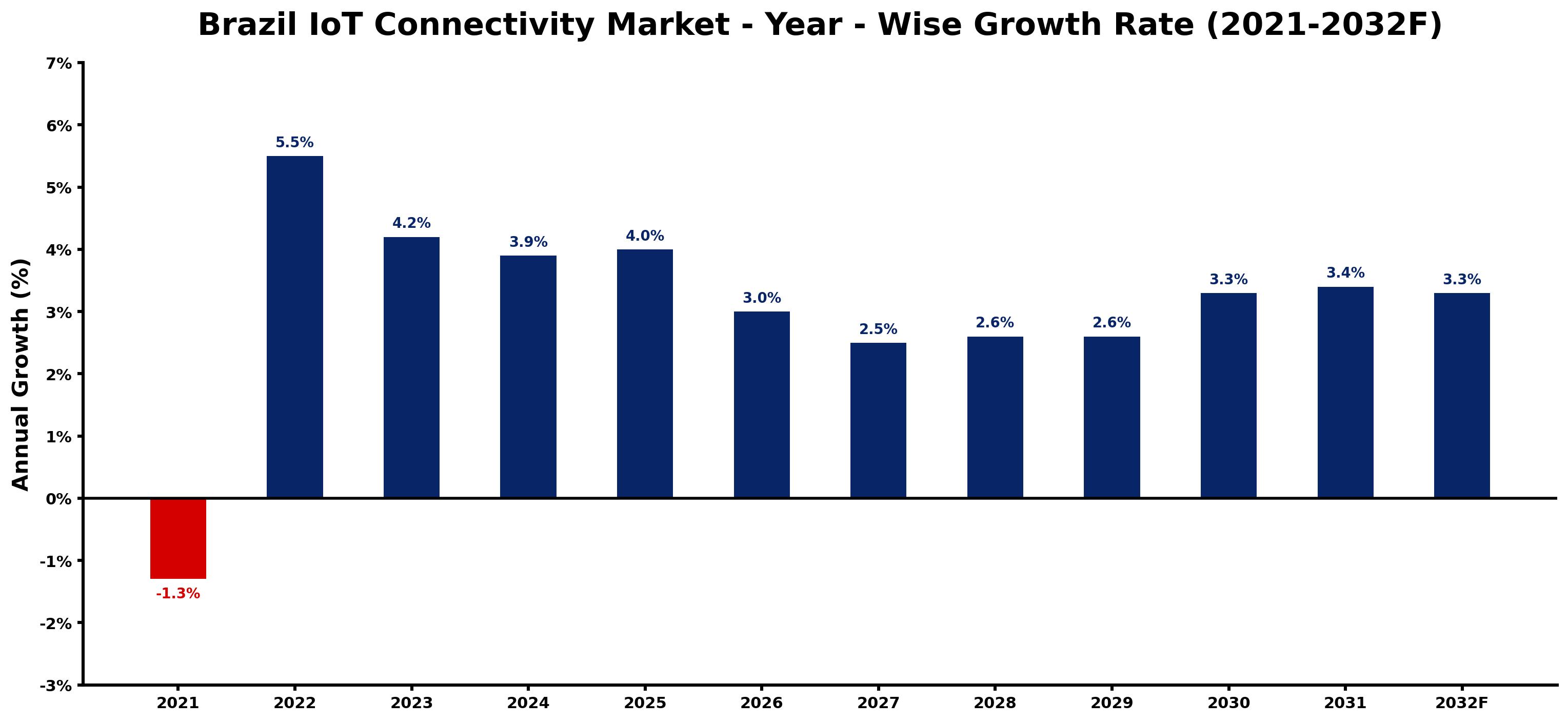
The table below presents the year‑wise growth rates along with the key drivers influencing the market
| Year | Growth Rate | Major Drivers |
| 2021 | -1.3% | Regulatory barriers from Anatel hindering new connections. |
| 2022 | 5.5% | Government initiatives promoting IoT in agriculture sector |
| 2023 | 4.2% | Increasing mobile network coverage enhancing IoT access |
| 2024 | 3.9% | Local businesses adopting IoT for operational efficiency |
| 2025 | 4.0% | Telecom regulations fostering competition in IoT services |
| 2026 | 3.0% | Growth in IoT-enabled healthcare solutions improving access |
| 2027 | 2.5% | Rise in smart city projects integrating IoT technologies |
| 2028 | 2.6% | Emergence of public-private partnerships for IoT innovation |
| 2029 | 2.6% | Sustainability initiatives driving IoT adoption in industry |
| 2030 | 3.3% | Regulatory incentives encouraging IoT investments in Brazil |
| 2031 | 3.4% | Educational programs boosting IoT skills among workforce |
| 2032 | 3.3% | Increased venture capital funding for IoT startups |
Note: Market size estimations and growth projections presented in this report are based on 6Wresearch's proprietary forecasting methodology, utilizing the latest available industry data, government publications, and primary research inputs.
Brazil IoT Connectivity Market Key Takeaways
Below are some of the specific key takeaways from the market, including:
- The demand for IoT connectivity solutions is being driven by the increasing deployment of connected devices across diverse industries.
- Legacy infrastructure and regulatory constraints pose significant challenges to the energy sector's IoT adoption.
- Government policies aimed at enhancing digital infrastructure are creating favorable conditions for market growth.
- Technological advancements in connectivity options are enabling more scalable and cost-effective IoT solutions.
- The energy sector is a key focus area for IoT applications, particularly in smart metering and grid management.
Evaluation of Restraints in Brazil IoT Connectivity Market
Despite the promising growth trajectory, several restraints impede the Brazil IoT Connectivity Market. One of the most pressing issues is the aging infrastructure that many organizations are currently operating on. Upgrading this infrastructure to support modern IoT technologies necessitates substantial investment and technical know-how, which can be daunting for many companies. on top of that, regulatory constraints related to data privacy and cybersecurity add layers of complexity that organizations must navigate. These challenges can stifle innovation and slow the pace of IoT adoption in critical sectors.
Brazil IoT Connectivity Market Trends
Emerging trends in the Brazil IoT Connectivity Market reflect a shift towards more integrated and efficient solutions. The increasing focus on sustainability is driving the adoption of IoT in energy management, with companies implementing smart grid technologies to optimize resource use. Additionally, the rollout of 5G networks is set to revolutionize connectivity options, offering higher speeds and lower latency. This technological leap will empower businesses to deploy more advanced IoT applications, enhancing operational efficiencies across sectors.
Brazil IoT Connectivity Market Opportunities
There are substantial opportunities for growth in the Brazil IoT Connectivity Market, particularly in sectors like agriculture, healthcare, and transportation. The agricultural sector, in particular, stands to benefit from IoT applications aimed at precision farming and resource management. Additionally, the healthcare industry is increasingly adopting IoT solutions for remote patient monitoring and asset tracking, creating a robust demand for reliable connectivity. As businesses seek to innovate and improve their processes, the need for advanced connectivity solutions will continue to rise.
Government Initiatives in the Brazil IoT Connectivity Market
Government initiatives play a crucial role in shaping the Brazil IoT Connectivity Market. With a focus on enhancing digital infrastructure, recent policy measures are designed to improve connectivity and support the deployment of IoT technologies. The regulatory environment is increasingly favorable, encouraging investment from both public and private sectors.
- A national digital infrastructure upgrade program launched in early 2025 aims to enhance broadband access across urban and rural areas.
- A regulatory framework introduced in 2025 mandates improved data privacy and cybersecurity standards for IoT applications.
- Current efforts are focused on expanding 5G network deployment, which is critical for next-generation IoT applications.
- A planned public-private initiative expected to begin in late 2026 will address connectivity challenges in remote regions.
- Ongoing partnerships between telecom operators and IoT service providers are fostering innovation in connectivity solutions.
Future Insights of the Brazil IoT Connectivity Market
The Brazil IoT Connectivity Market is set for continued growth through 2032, driven by technological advancements and increasing demand across various sectors. As businesses prioritize digital transformation, the integration of IoT solutions will become more prevalent. The expansion of 5G networks will facilitate more sophisticated applications, enabling real-time data analytics and improved decision-making. In this evolving environment, organizations that embrace IoT connectivity will gain a competitive edge, positioning themselves for success in the digital economy.
Brazil IoT Connectivity Market Latest Developments
In the past year, Brazil's IoT Connectivity Market has witnessed a flurry of activity, reflecting the growing interest in digital transformation. Companies are investing in new technologies and partnerships to enhance their IoT capabilities. This dynamic environment is fostering innovation and competitiveness among stakeholders.
- A major technology vendor announced an ongoing initiative in early 2025 to enhance connectivity solutions tailored for smart city applications.
- In Q2 2025, a leading regional operator launched a new LPWAN service aimed at supporting agricultural IoT applications.
- A public-private partnership aimed at improving rural connectivity was initiated in late 2025 and remains underway.
- Upcoming in mid-2026, a new regulatory program is expected to streamline IoT device certification processes.
- A recent collaboration between telecommunications firms is focused on developing next-generation IoT security solutions, with plans for rollout in early 2026.
Brazil IoT Connectivity Market - Key Attractiveness of the Report
- 10 Years of Market Numbers
- Historical Data Starting from 2022 to 2025
- Base Year: 2025
- Forecast Data until 2032
- Key Performance Indicators Impacting the Market
- Major Upcoming Developments and Projects
Key Highlights of the Report:
- Brazil IoT Connectivity Market Outlook
- Market Size of Brazil IoT Connectivity Market, 2025
- Forecast of Brazil IoT Connectivity Market, 2032
- Historical Data and Forecast of Brazil IoT Connectivity Revenues & Volume for the Period 2022-2032F
- Brazil IoT Connectivity Market Trend Evolution
- Brazil IoT Connectivity Market Drivers and Challenges
- Brazil IoT Connectivity Price Trends
- Brazil IoT Connectivity Porter's Five Forces
- Brazil IoT Connectivity Industry Life Cycle
- Historical Data and Forecast of Brazil IoT Connectivity Market Revenues & Volume By Component for the Period 2022-2032F
- Historical Data and Forecast of Brazil IoT Connectivity Market Revenues & Volume By Platform for the Period 2022-2032F
- Historical Data and Forecast of Brazil IoT Connectivity Market Revenues & Volume By Services for the Period 2022-2032F
- Historical Data and Forecast of Brazil IoT Connectivity Market Revenues & Volume By Application Areas for the Period 2022-2032F
- Historical Data and Forecast of Brazil IoT Connectivity Market Revenues & Volume By Building & Home Automation for the Period 2022-2032F
- Historical Data and Forecast of Brazil IoT Connectivity Market Revenues & Volume By Smart Energy & Utility for the Period 2022-2032F
- Historical Data and Forecast of Brazil IoT Connectivity Market Revenues & Volume By Smart Manufacturing for the Period 2022-2032F
- Historical Data and Forecast of Brazil IoT Connectivity Market Revenues & Volume By Connected Health for the Period 2022-2032F
- Historical Data and Forecast of Brazil IoT Connectivity Market Revenues & Volume By Smart Retail for the Period 2022-2032F
- Historical Data and Forecast of Brazil IoT Connectivity Market Revenues & Volume By Smart Transportation for the Period 2022-2032F
- Historical Data and Forecast of Brazil IoT Connectivity Market Revenues & Volume By Others (Education and Agriculture) for the Period 2022-2032F
- Historical Data and Forecast of Brazil IoT Connectivity Market Revenues & Volume By Organization Size for the Period 2022-2032F
- Historical Data and Forecast of Brazil IoT Connectivity Market Revenues & Volume By Large Enterprises for the Period 2022-2032F
- Historical Data and Forecast of Brazil IoT Connectivity Market Revenues & Volume By SMEs for the Period 2022-2032F
- Brazil IoT Connectivity Import Export Trade Statistics
- Market Opportunity Assessment By Component
- Market Opportunity Assessment By Application Areas
- Market Opportunity Assessment By Organization Size
- Brazil IoT Connectivity Top Companies Market Share
- Brazil IoT Connectivity Competitive Benchmarking By Technical and Operational Parameters
- Brazil IoT Connectivity Company Profiles
- Brazil IoT Connectivity Key Strategic Recommendations






































