Iraq IoT Connectivity Market Size & Growth Rate (2026-2032)
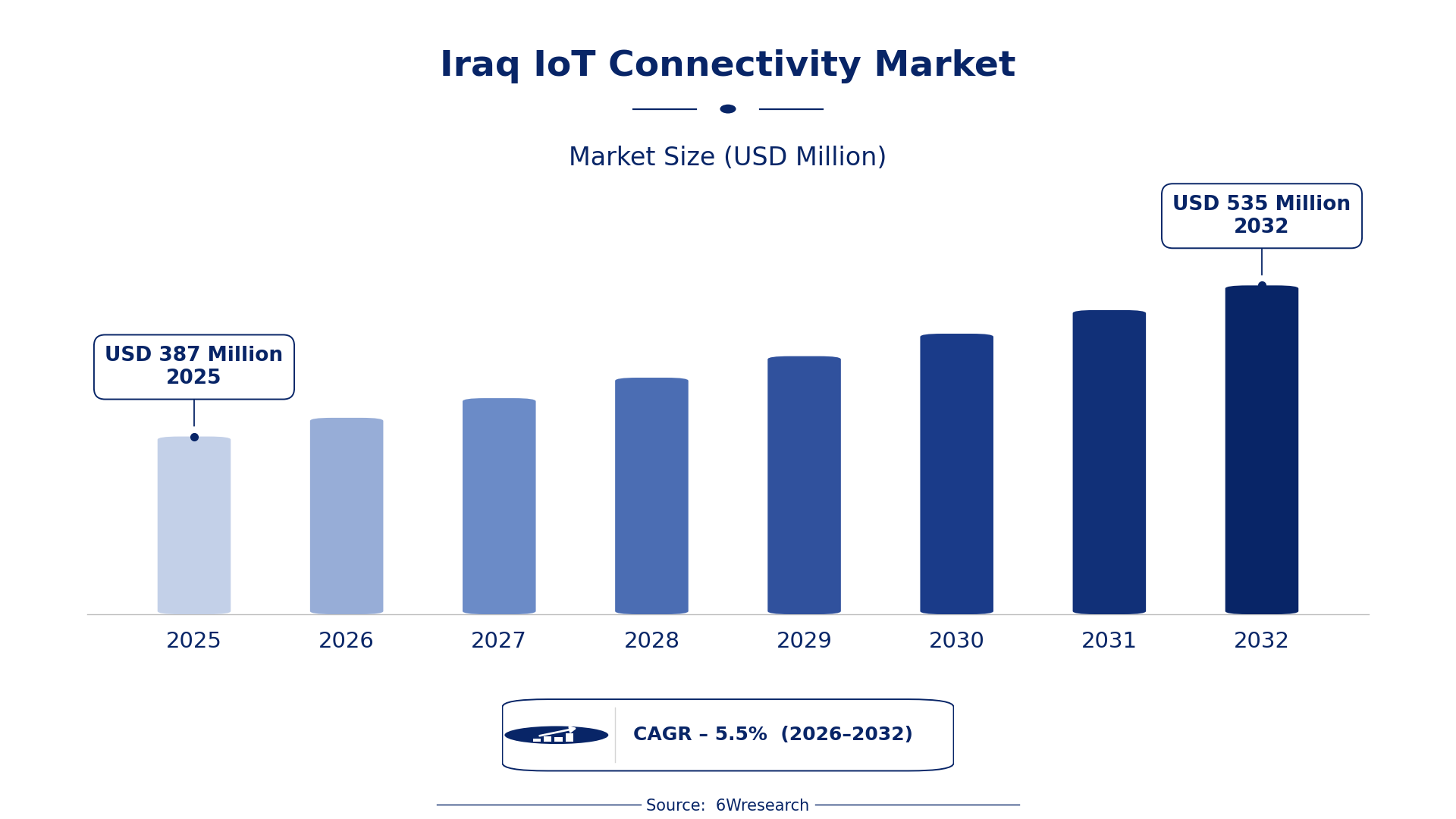
The Iraq IoT Connectivity Market was estimated at USD 387 Million in 2025 and is projected to reach USD 535 Million by 2032, growing at a CAGR of 5.5% from 2026 to 2032.
Iraq IoT Connectivity Market Synopsis
The Iraq IoT Connectivity Market is currently witnessing substantial momentum as industries increasingly embrace connected technologies. This growth stems from a pressing need for reliable connectivity solutions across various sectors, including smart cities and industrial automation. The future, however, signals an even more pronounced expansion as infrastructure investments and digital transformation initiatives gain traction.
In the coming years, the market is set to evolve significantly, driven by heightened demand for IoT applications. The integration of advanced connectivity technologies will not only support existing use cases but also unlock new opportunities for innovation. As stakeholders recognize the importance of efficient communication channels, the market's trajectory remains optimistic.
Iraq IoT Connectivity Market Year-wise Growth Rate and Key Drivers
This graph illustrates the annual growth rates of the Iraq IoT Connectivity Market from 2021 to 2032, highlighting a steady upward trajectory and projected expansion over the forecast period.
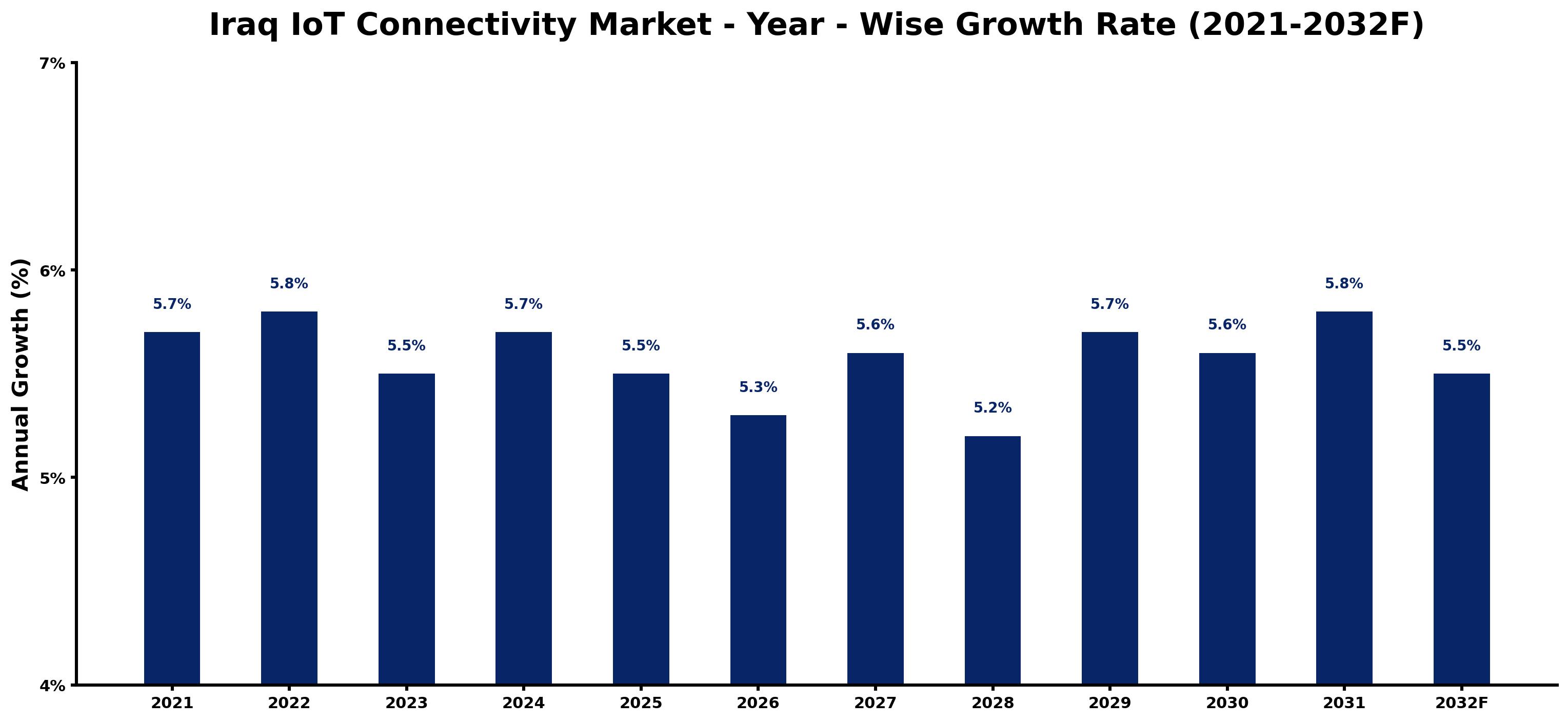
The table below presents the year‑wise growth rates along with the key drivers influencing the market
| Year | Growth Rate | Major Drivers |
| 2021 | 5.7% | Increased investment in smart city solutions by Baghdad government. |
| 2022 | 5.8% | Adoption of IoT in oil and gas sector operations. |
| 2023 | 5.5% | Rising smartphone penetration driving IoT connectivity needs. |
| 2024 | 5.7% | Partnerships between local telcos and tech firms for IoT. |
| 2025 | 5.5% | Regulatory support for IoT security standards and compliance. |
| 2026 | 5.3% | Growing interest in IoT for healthcare monitoring systems. |
| 2027 | 5.6% | Local startups innovating IoT solutions for various industries. |
| 2028 | 5.2% | Government focus on disaster management through IoT technologies. |
| 2029 | 5.7% | Increased consumer demand for smart home devices and services. |
| 2030 | 5.6% | Educational programs promoting IoT skills in universities. |
| 2031 | 5.8% | Emergence of localized IoT platforms tailored for Iraq's needs. |
| 2032 | 5.5% | Rising e-commerce demand enhancing logistics IoT applications. |
Note: Market size estimations and growth projections presented in this report are based on 6Wresearch's proprietary forecasting methodology, utilizing the latest available industry data, government publications, and primary research inputs.
Iraq IoT Connectivity Market Key Takeaways
Below are some of the specific key takeaways from the market, including:
- Growing investment in IoT infrastructure is crucial for market expansion.
- Cellular, LPWAN, Wi-Fi, and Bluetooth technologies drive seamless device communication.
- Applications in asset tracking and smart infrastructure are rapidly gaining traction.
- Interoperability and data security remain key challenges to address for broader adoption.
- Government initiatives are enhancing telecommunications infrastructure and network coverage.
Evaluation of Restraints in Iraq IoT Connectivity Market
Despite the promising growth of the Iraq IoT Connectivity Market, several constraints are hindering its full potential. Infrastructure limitations, particularly in remote areas, pose a significant barrier. High costs associated with deploying advanced connectivity solutions also restrict broader accessibility. on top of that, ensuring interoperability between different connectivity technologies remains a challenge, complicating integration efforts for enterprises. Data security and privacy concerns are paramount as well, as stakeholders seek to protect sensitive information in an increasingly connected world.
Iraq IoT Connectivity Market Trends
A few key trends are shaping the Iraq IoT Connectivity Market. The move towards 5G technology is becoming more pronounced, offering greater bandwidth and lower latency for IoT applications. Smart city initiatives are driving demand for reliable connectivity, as urban areas look to enhance infrastructure and improve public services. Additionally, there is a growing emphasis on LPWAN technologies, which provide cost-effective solutions for IoT deployments that require long-range communication with low power consumption. Finally, partnerships between public and private sectors are fostering innovation, enabling new service offerings tailored to local needs.
Iraq IoT Connectivity Market Opportunities
Investment opportunities abound in the Iraq IoT Connectivity Market. The expansion of smart infrastructure projects provides a fertile ground for connectivity solutions, particularly in urban centers. As industries pivot towards automation, there is a growing demand for IoT applications that streamline operations and enhance efficiency. on top of that, the potential for public-private partnerships presents avenues for collaboration that can lead to innovative service delivery models. Connectivity providers that can navigate the challenges and capitalize on these opportunities will find a market ripe for growth.
Government Initiatives in the Iraq IoT Connectivity Market
The Iraqi government is actively shaping the IoT Connectivity Market through strategic policy initiatives aimed at enhancing telecommunications infrastructure. These efforts are critical in expanding network coverage and ensuring reliable communication for IoT applications. Public-sector priorities focus on fostering digital transformation and attracting investment in high-speed internet capabilities.
- A national digital infrastructure upgrade programme now in its rollout phase aims to improve connectivity across urban and rural areas.
- Current initiatives include the expansion of 4G networks, with plans to introduce 5G technology by 2026.
- A public-private partnership framework launched in early 2025 encourages collaboration to enhance IoT infrastructure.
- The government is working on a regulatory framework that mandates data privacy and security for IoT solutions, expected to be finalized in late 2026.
- Investment incentives for technology companies are currently underway, aimed at boosting local manufacturing of IoT devices.
Future Insights of the Iraq IoT Connectivity Market
Looking ahead to 2026-2032, the Iraq IoT Connectivity Market is set for transformative growth. As the country continues to invest in its telecommunications infrastructure, the proliferation of IoT applications across various sectors will likely accelerate. The anticipated rollout of 5G technology will enhance the capabilities of connected devices, facilitating innovative applications in smart cities and industrial automation. As interoperability improves and costs decrease, adoption rates are expected to surge, positioning Iraq as a competitive player in the regional IoT landscape.
Iraq IoT Connectivity Market Latest Developments
Recent industry activity within the Iraq IoT Connectivity Market reflects a strong focus on enhancing connectivity solutions across various sectors. Stakeholders are increasingly recognizing the potential of IoT to drive efficiency and innovation. As investments flow into infrastructure, developments are emerging that promise to reshape the market in the near future.
- A major technology vendor initiated the deployment of a new LPWAN network in early 2025, designed to support smart agriculture applications.
- A leading regional operator launched an enhanced IoT service platform in Q1 2026, aimed at optimizing industrial processes through data analytics.
- Plans for a nationwide 5G network rollout are expected to begin in mid-2026, enhancing connectivity for urban centers.
- A pilot project for smart waste management systems started in late 2025, focusing on urban areas to improve efficiency.
- Research collaborations between universities and tech firms are currently underway, focusing on developing IoT solutions tailored to local challenges.
Iraq IoT Connectivity Market - Key Attractiveness of the Report
- 10 Years of Market Numbers
- Historical Data Starting from 2022 to 2025
- Base Year: 2025
- Forecast Data until 2032
- Key Performance Indicators Impacting the Market
- Major Upcoming Developments and Projects
Key Highlights of the Report:
- Iraq IoT Connectivity Market Outlook
- Market Size of Iraq IoT Connectivity Market, 2025
- Forecast of Iraq IoT Connectivity Market, 2032
- Historical Data and Forecast of Iraq IoT Connectivity Revenues & Volume for the Period 2022-2032F
- Iraq IoT Connectivity Market Trend Evolution
- Iraq IoT Connectivity Market Drivers and Challenges
- Iraq IoT Connectivity Price Trends
- Iraq IoT Connectivity Porter's Five Forces
- Iraq IoT Connectivity Industry Life Cycle
- Historical Data and Forecast of Iraq IoT Connectivity Market Revenues & Volume By Component for the Period 2022-2032F
- Historical Data and Forecast of Iraq IoT Connectivity Market Revenues & Volume By Platform for the Period 2022-2032F
- Historical Data and Forecast of Iraq IoT Connectivity Market Revenues & Volume By Services for the Period 2022-2032F
- Historical Data and Forecast of Iraq IoT Connectivity Market Revenues & Volume By Application Areas for the Period 2022-2032F
- Historical Data and Forecast of Iraq IoT Connectivity Market Revenues & Volume By Building & Home Automation for the Period 2022-2032F
- Historical Data and Forecast of Iraq IoT Connectivity Market Revenues & Volume By Smart Energy & Utility for the Period 2022-2032F
- Historical Data and Forecast of Iraq IoT Connectivity Market Revenues & Volume By Smart Manufacturing for the Period 2022-2032F
- Historical Data and Forecast of Iraq IoT Connectivity Market Revenues & Volume By Connected Health for the Period 2022-2032F
- Historical Data and Forecast of Iraq IoT Connectivity Market Revenues & Volume By Smart Retail for the Period 2022-2032F
- Historical Data and Forecast of Iraq IoT Connectivity Market Revenues & Volume By Smart Transportation for the Period 2022-2032F
- Historical Data and Forecast of Iraq IoT Connectivity Market Revenues & Volume By Others (Education and Agriculture) for the Period 2022-2032F
- Historical Data and Forecast of Iraq IoT Connectivity Market Revenues & Volume By Organization Size for the Period 2022-2032F
- Historical Data and Forecast of Iraq IoT Connectivity Market Revenues & Volume By Large Enterprises for the Period 2022-2032F
- Historical Data and Forecast of Iraq IoT Connectivity Market Revenues & Volume By SMEs for the Period 2022-2032F
- Iraq IoT Connectivity Import Export Trade Statistics
- Market Opportunity Assessment By Component
- Market Opportunity Assessment By Application Areas
- Market Opportunity Assessment By Organization Size
- Iraq IoT Connectivity Top Companies Market Share
- Iraq IoT Connectivity Competitive Benchmarking By Technical and Operational Parameters
- Iraq IoT Connectivity Company Profiles
- Iraq IoT Connectivity Key Strategic Recommendations






































