Brazil Lavender Oil Market Top 5 Importing Countries and Market Competition (HHI) Analysis
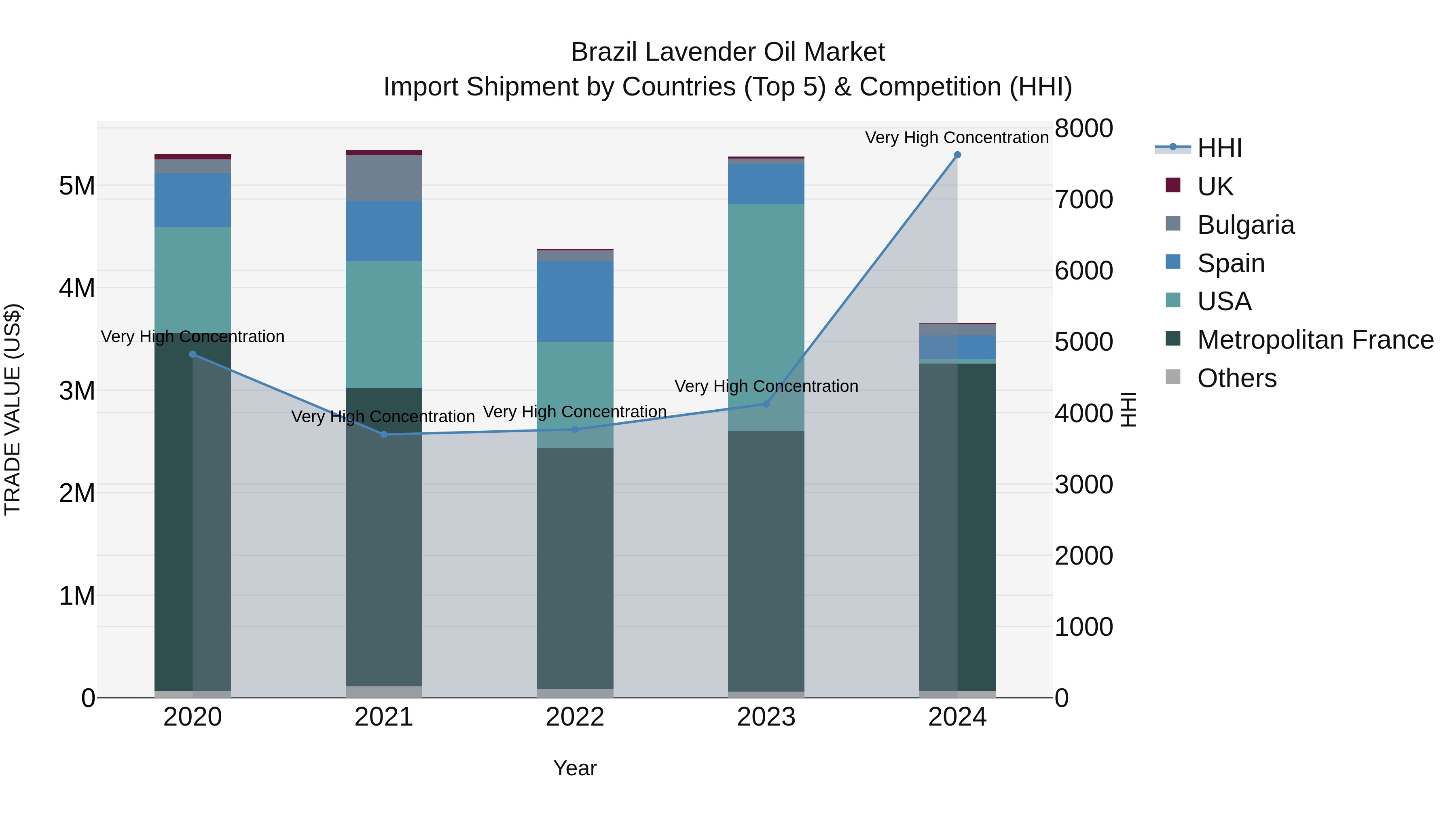
Brazil`s lavender oil import market in 2024 saw significant contributions from top exporting countries including Metropolitan France, Spain, Bulgaria, USA, and China. Despite a high Herfindahl-Hirschman Index indicating market concentration, the industry experienced a negative compound annual growth rate of -8.86% from 2020 to 2024. The growth rate in 2024 plummeted by -30.67%, reflecting a challenging year for lavender oil imports. The dynamics of the market suggest the need for strategic adjustments and market diversification to navigate these fluctuations effectively.
Brazil Lavender oil Market Overview
The Brazil Lavender Oil Market encompasses the production, extraction, and distribution of lavender essential oil, derived from lavender plants. Lavender oil is renowned for its calming and therapeutic properties, used in aromatherapy, personal care products, and natural remedies for stress relief, relaxation, and sleep enhancement. Market dynamics are driven by factors such as lavender cultivation, essential oil extraction methods, consumer demand for natural wellness products, and trends in aromatherapy and holistic health practices.
Drivers of the market
The lavender oil market in Brazil experiences growth driven by its applications in aromatherapy and personal care products. Lavender oil, extracted from Lavandula angustifolia flowers, is valued for its calming fragrance and potential health benefits, including stress relief and relaxation. With increasing interest in aromatherapy practices and natural wellness solutions, the demand for lavender oil has risen in Brazil. Factors such as spa culture, beauty trends, and holistic healthcare contribute to the demand for lavender oil in the country.
Challenges of the market
Challenges in Brazil lavender oil market include weather conditions, crop yield variations, and competition from international lavender oil producers. Market players may face challenges related to lavender cultivation, oil extraction techniques, and product quality standardization. Additionally, there are challenges associated with market saturation, pricing pressures, and consumer preferences for natural and organic lavender oil products in aromatherapy, cosmetics, and pharmaceutical applications.
Government Policy of the market
Government policies in Brazil influence the lavender oil market through regulations on agriculture, essential oil production, and consumer products. These policies aim to regulate the cultivation, harvesting, and processing of lavender plants to ensure product quality, safety, and sustainability. Additionally, there are initiatives to promote research and development in lavender cultivation techniques and to regulate the labeling and marketing of lavender oil products. Moreover, regulatory frameworks may govern the importation and distribution of lavender oil to comply with Brazil regulations and standards.
Key Highlights of the Report:
- Brazil Lavender oil Market Outlook
- Market Size of Brazil Lavender oil Market, 2024
- Forecast of Brazil Lavender oil Market, 2031
- Historical Data and Forecast of Brazil Lavender oil Revenues & Volume for the Period 2021-2031
- Brazil Lavender oil Market Trend Evolution
- Brazil Lavender oil Market Drivers and Challenges
- Brazil Lavender oil Price Trends
- Brazil Lavender oil Porter's Five Forces
- Brazil Lavender oil Industry Life Cycle
- Historical Data and Forecast of Brazil Lavender oil Market Revenues & Volume By Application for the Period 2021-2031
- Historical Data and Forecast of Brazil Lavender oil Market Revenues & Volume By Food and Beverage for the Period 2021-2031
- Historical Data and Forecast of Brazil Lavender oil Market Revenues & Volume By Cosmetic for the Period 2021-2031
- Historical Data and Forecast of Brazil Lavender oil Market Revenues & Volume By Pharmaceutical for the Period 2021-2031
- Historical Data and Forecast of Brazil Lavender oil Market Revenues & Volume By Distribution Channel for the Period 2021-2031
- Historical Data and Forecast of Brazil Lavender oil Market Revenues & Volume By Pharmacy and Drug Stores for the Period 2021-2031
- Historical Data and Forecast of Brazil Lavender oil Market Revenues & Volume By Health and Beauty Stores for the Period 2021-2031
- Historical Data and Forecast of Brazil Lavender oil Market Revenues & Volume By Online Retailing for the Period 2021-2031
- Historical Data and Forecast of Brazil Lavender oil Market Revenues & Volume By Others for the Period 2021-2031
- Brazil Lavender oil Import Export Trade Statistics
- Market Opportunity Assessment By Application
- Market Opportunity Assessment By Distribution Channel
- Brazil Lavender oil Top Companies Market Share
- Brazil Lavender oil Competitive Benchmarking By Technical and Operational Parameters
- Brazil Lavender oil Company Profiles
- Brazil Lavender oil Key Strategic Recommendations






































